Prof. Sorin Pop is a Professor in the Department of Mathematics and Computer Science at Eindhoven University of Technology (TU/e). His research focuses on numerical analysis and computational methods for multiphase flow in porous media, with emphasis on two-phase flow dynamics, dynamic capillarity, and hysteresis effects. He has published extensively in journals like Computer Methods in Applied Mechanics and Engineering and Studies in Applied Mathematics . His work involves developing and analyzing numerical schemes for complex flow models, including domain decomposition methods and iterative solvers for nonlinear systems. Pop collaborates internationally on projects involving porous media applications in environmental and industrial contexts. He has supervised 21 academic works and contributed to over 117 research outputs since 2000.
Borello Domenico is a Full Professor in the Department of Industrial and Environmental Engineering at Sapienza University of Rome. His research focuses on renewable energy systems, fluid dynamics, combustion engineering, and environmental sustainability. He has contributed to advancements in hydrogen production, ammonia combustion, and sustainable waste-to-energy technologies through experimental and numerical methodologies. His work integrates computational fluid dynamics (CFD) and machine learning to optimize energy systems and reduce emissions. Key research areas include green hydrogen production via floating photovoltaic systems, cavitation prediction in hydrodynamic systems, and techno-economic analysis of energy transport. He has developed novel approaches for turbine design, compressor erosion assessment, and biofuel gasification processes. His studies address both technical challenges and policy implications of decarbonizing transportation and industrial sectors. Borello has collaborated on projects involving microbial fuel cells for environmental remediation, chemical looping cycles for carbon capture, and hybrid powertrain efficiency testing. His research emphasizes real-world applications, such as railway energy consumption modeling and microgrid integration of renewables.
Andreas Boudouvis is a Professor at the National Technical University of Athens (NTUA), School of Chemical Engineering, in the Department of Analysis, Design and Development of Processes and Systems. He served as Rector of NTUA from October 2019 until November 2023 and previously as Dean of the Chemical Engineering School from March 2013. His research focuses on computational transport phenomena and fluid mechanics with applications in chemical vapor deposition, multiscale modeling, and reduced-order modeling techniques. His research aims at investigating causes and illuminating mechanisms of engineering systems based on first principles. His work emphasizes computational analysis of transport phenomena, particularly examining viscous, gravitational, interfacial, and electromagnetic forces in flow and transport systems. Boudouvis employs advanced computational methods including Galerkin/finite element methods and numerical linear algebra techniques for large-scale scientific computing. His recent publications demonstrate a strong focus on hybrid equation-based and data-driven computational workflows for industrial deposition processes, population balance modeling for pharmaceutical applications, and multiscale analysis of chemical vapor deposition systems. His research group has produced numerous PhD and graduate theses spanning computational mechanics, fluid dynamics, and materials processing. Scientific Awards: 2024 Award for Excellence in Academic Teaching from the Foundation for Research and Technology-Hellas Professor honoris causa of the University of West Attica (2023) Boudouvis has supervised over 40 doctoral and graduate students whose work has received numerous awards including the Léopold Escande Prize for best PhD theses. His research group maintains strong international collaborations with institutions including Johns Hopkins University, University of Luxembourg, and Institut National Polytechnique de Toulouse. His work bridges fundamental computational methods with practical industrial applications, particularly in materials processing and chemical engineering systems.
Pavel Kudinov is an Associate Professor at the Department of Nuclear Science & Engineering, KTH Royal Institute of Technology. He specializes in nuclear thermal-hydraulics, severe accident analysis, and computational fluid dynamics (CFD). His research focuses on phenomena such as steam explosions, containment venting, thermal stratification in suppression pools, and debris coolability during severe accidents. He actively contributes to experimental validation efforts using facilities like PPOOLEX and PANDA. His work integrates advanced modeling techniques with experimental data to improve safety assessments for boiling water reactors (BWRs) and lead-cooled reactors. He has collaborated on projects like SAFEST and SESAME, addressing core degradation, melt relocation, and ex-vessel accident management strategies. Key areas of expertise include: CFD modeling of multiphase flows, uncertainty quantification in severe accident codes (e.g., MELCOR), and risk-oriented accident analysis methodologies (ROAAM+). He teaches courses on nuclear reactor technology and applied modern physics at KTH.
Dr. Maria Barrufet is a Professor of Petroleum Engineering at Texas A&M University, holding roles as Assistant Department Head for Staff Administration and Director of Online Learning in Petroleum Engineering. She also serves as the Baker Hughes Endowed Chair and Affiliated Faculty in Chemical Engineering. Her research focuses on reservoir engineering, enhanced oil recovery (EOR), and CO2 capture/storage technologies, with expertise in multiphase flow and shale reservoir simulation. Education: Ph.D. in Chemical Engineering, Texas A&M University (1987) M.S. in Chemical Engineering, Universidad Nacional de Salta, Argentina (1983) B.S. in Chemical Engineering, Universidad Nacional de Salta, Argentina (1979) Research Interests: Integration of capillary pressure and thermodynamics for reservoir fluid analysis Simulation of near-critical fluids and compositional reservoirs Equations of state (EOS) modeling for multiphase equilibria CO2 storage and EOR mechanisms in unconventional reservoirs Flow assurance and leak detection in multiphase systems Publications Trends: Her recent work emphasizes CO2 sequestration in shale reservoirs, molecular sieving phenomena in nanoporous media, and advanced EOR techniques for unconventional resources. Key themes include phase behavior modeling, reservoir simulation of complex fluid systems, and energy-efficient production strategies. Awards: Charles Crawford Distinguished Service Award (2006, 2012-2013) Faculty Fellow, Texas A&M Engineering Experiment Station (2004-2005) Assessing Technology in Teaching Award (2004) Advising & Teaching: As a leader in online education, Dr. Barrufet has pioneered distance learning initiatives in petroleum engineering. Her academic leadership includes staff administration roles and curriculum development for international programs.
Rebecca Allen is an Associate Professor at the Department of Built Environment, Faculty of Technology, Art and Design at OsloMet – Oslo Metropolitan University. Her work focuses on sustainable built environments and CO2 storage solutions, emphasizing computational modeling for geoscientific challenges. She is affiliated with the Sustainable Built Environment (SustainaBuilt) research group. Her research integrates advanced simulation tools like MATLAB and Python to address critical issues in porous media analysis, heat pump thermodynamics, and CO2 storage optimization. Notable contributions include developing algorithms for quantifying effective void space in porous pavements and modeling vapor compression cycles for residential heating systems. Allen’s publications span topics such as parameter uncertainty in CO2 storage capacity estimates, formation categorization for carbon sequestration, and innovative stormwater management strategies using porous asphalt. She actively participates in international conferences like the International Conference on Net-Zero Built Environment and Scandinavian Simulation Society events. Her interdisciplinary approach bridges environmental engineering, geology, and computational methods to advance climate resilience and sustainable infrastructure. Collaborations include projects on the Norwegian Continental Shelf and public education initiatives about carbon storage technologies.
Dr. Ed Long is a Senior Lecturer in Fluids Engineering, focusing on interdisciplinary research at the intersection of fluid dynamics, combustion systems, and environmental applications. His work spans experimental and analytical studies in laser cutting gas dynamics, aerosol technology, and sustainable energy solutions. He has contributed to advancements in engine emissions reduction, battery thermal management, and soil erosion modeling. His research often involves cutting-edge diagnostic techniques such as particle imaging velocimetry and electrochemical analysis. Key research areas include combustion optimization in compression ignition engines, mitigation of hazardous fumes in industrial processes, and improving drug delivery systems through aerosol dynamics. His studies also address environmental challenges like pollution control and sustainable manufacturing. Dr. Long's experimental work frequently employs advanced imaging and sensor technologies to analyze fluid flow, particle behavior, and thermal interactions in complex systems. Though no specific awards are noted, his prolific publication record (over 30 articles from 2006–2024) demonstrates sustained contributions to mechanical, biomedical, and environmental engineering. His research bridges theoretical models with practical applications, such as low-cost turbidity sensors and novel designs for exhaust cleaning modules. Collaborations likely span academic and industrial partners, though specific affiliations are not detailed here.
Dr. Yi Li is a Lecturer in Applied Mathematics at the School of Mathematical and Physical Sciences, University of Sheffield. His research focuses on fluid mechanics, particularly turbulence, with emphases on flow optimization, simulation, and stochastic modeling. He explores topics such as downscaling in multi-scale systems, data assimilation for turbulence modeling, and chaos synchronization in turbulent flows. Research Themes: Downscaling: Explores self-similarity properties in turbulent flows to improve subgrid-scale modeling. Flow Optimization: Combines machine learning and data assimilation to enhance turbulence predictions, addressing challenges like pollution control and weather forecasting. Stochastic Modelling: Investigates particle and bubble dynamics in turbulent flows to understand mixing and dispersion processes. Teaching: Dr. Li teaches advanced modules including Operations Research, Magnetohydrodynamics, and Topics in Advanced Fluid Mechanics. Publications: His work spans fluid dynamics, computational methods, and signal processing, with notable contributions to turbulence modeling, ultrasonic applications, and data-driven approaches. Recent publications focus on machine learning applications in bubbly flows and 4DVAR data assimilation techniques. PhD Supervision: Offers supervision in fluid mechanics, turbulence, and interdisciplinary projects combining data science with fluid dynamics. Prospective students can contact him via email .
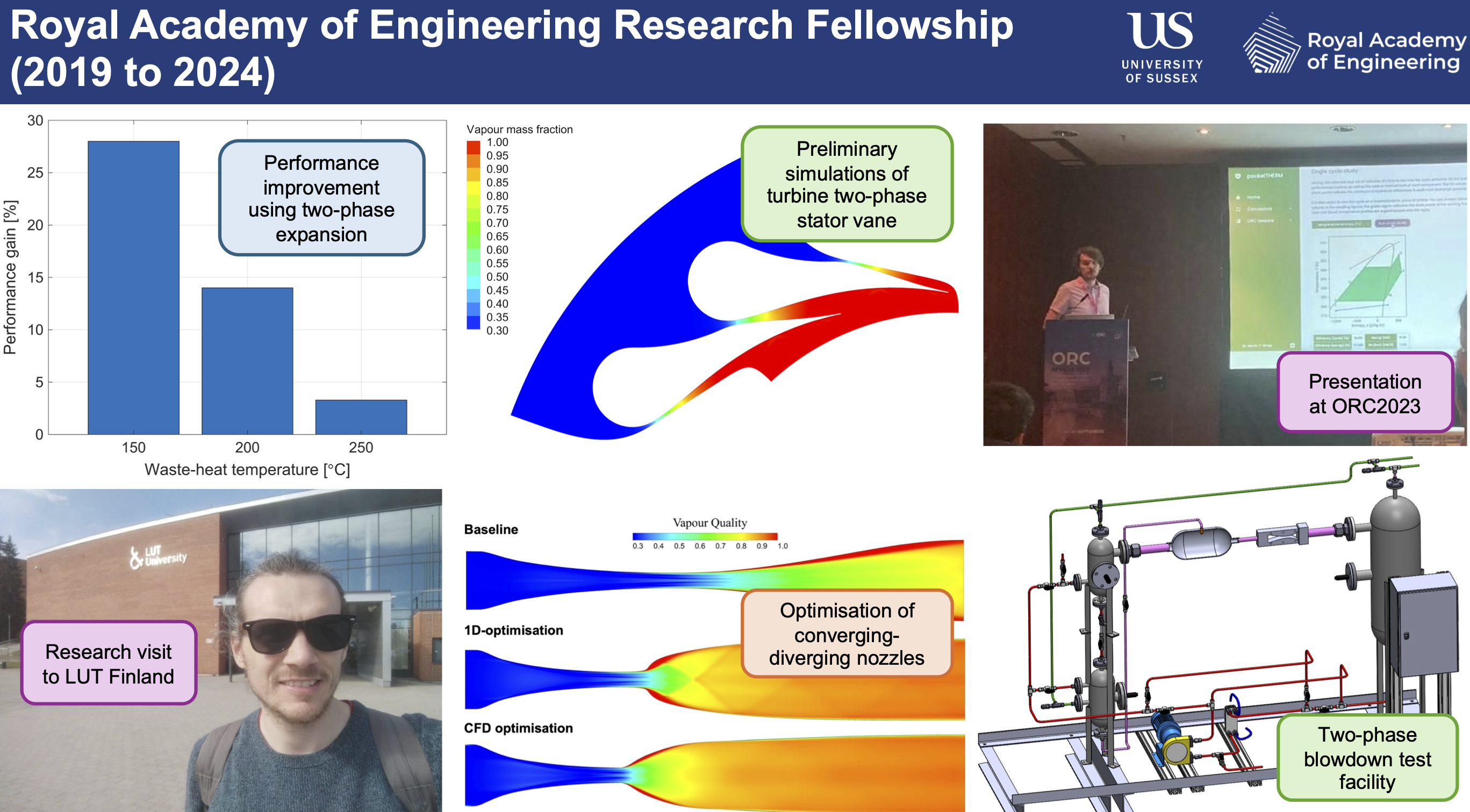
Dr. Martin T. White is an Associate Professor in Mechanical Engineering at the University of Sussex, part of the School of Engineering and Informatics and the Energy and Materials Engineering Research Centre (EMERC). He holds a PhD from City, University of London (2015) and an MEng in Mechanical Engineering from the University of Southampton (2011). Prior to his current role, he served as Senior Lecturer (2022–2024) and Lecturer in Thermal Power (2019–2022) at City, University of London, and held postdoctoral roles at Imperial College London and City. He is a Fellow of the Higher Education Academy and a member of the Institution of Mechanical Engineers. His research focuses on novel thermal power systems, particularly organic Rankine cycles (ORC), supercritical carbon dioxide (sCO₂) turbines, and waste-heat recovery. He leads the development of experimental test rigs and computational tools like pocketTHERM and pocketORC , which enhance education and design in thermodynamics. Key projects include the EU-funded SCARABEUS initiative, designing axial turbines for concentrated solar power, and optimizing turbine blades for CO₂ blends. Recent work includes advancing wet-to-dry expansion in ORC systems using non-equilibrium CFD simulations and experimental rigs. He has supervised PhD students (e.g., Charlie Westpfel, Pawel Ogrodniczak) and co-supervised Salma Salah, who successfully completed her viva in 2023. His research spans turbine aerodynamics, fluid dynamics, and educational technology, addressing global energy challenges through innovative thermal systems. Key achievements include the Royal Academy of Engineering Research Fellowship (2019–2024), which supported studies on two-phase expansion in ORC turbines. His work integrates academic and industrial collaboration, exemplified by the SCARABEUS turbine design with industrial partners. Future directions include experimental validation of two-phase expansion and exploring CO₂-blend applications in heat pumps and refrigeration systems. Awards and recognition include the IMechE awards for student projects supervised and the University of Sussex’s Brian Roberts Prize for academic excellence. His interdisciplinary approach bridges fundamental research, engineering design, and educational innovation in sustainable energy systems.
Paul Stanwix is Associate Professor in the School of Engineering at the University of Western Australia, with joint appointments in Mechanical and Chemical Engineering. His research develops novel sensing technologies for fluid mixtures in energy applications, particularly hydrogen, natural gas, and cryogenic systems. Research focuses on: Hydrogen liquefaction and ortho-para conversion Microwave and NMR sensing technologies Thermophysical property measurement Gas hydrate formation and flow assurance Cryogenic fluid behavior Recent publications feature advanced sensor designs for industrial applications, including hydrogen purity monitoring and multiphase flow measurement. Research integrates experimental techniques with thermodynamic modeling. Significant recognition includes: WA Innovator of the Year Finalist (2019) ARC Discovery Early Career Award (2014) National Measurement Institute Prize (2008) Stanwix co-founded Jovian Tech commercializing hydrogen sensors and holds multiple patents. Current projects include developing hand-held skin cancer probes and optimizing hydrogen liquefaction processes.
Prof. Dr. Udo Kragl is a full Professor and Chair of Technical Chemistry at the University of Rostock, affiliated with the Department of Technical and Analytical Chemistry within the Interdisciplinary Faculty. He has held leadership roles including Vice Rector for Research and Research Training (2015–2023) and Head of Department at the Leibniz Institute for Catalysis since 2003. Diploma, University of Bonn, 1989 Doctorate (Dr. rer. nat.), University of Bonn, 1992 Habilitation in Technical Chemistry, University of Bonn, 1998 His research focuses on chemo- and biocatalysis in multiphase systems , ionic liquids (ILs) , polymerized ionic liquids (PILs) , membrane processes , and chemical reaction engineering . His group explores the stabilization of enzymes in ILs, thermomorphic solvent systems for biocatalysis, and the use of nanofiltration for IL recovery. Recent work includes developing PIL-based hydrogels for controlled and stimulus-responsive drug delivery and investigating ILs as quenching media in metallurgy . The publication trends reflect a strong emphasis on sustainable chemistry, green solvents, and process intensification. Key themes include enzyme stabilization in non-conventional media, recyclable catalytic systems, advanced separation techniques, and multifunctional materials for biomedical and industrial applications. Scientific Awards and Leadership: Chairman of the Board, German Society for Catalysis (GeCatS), since 2020 Prof. Kragl has led major research initiatives and secured funding such as from the European Regional Development Fund (ERDF) for advanced equipment (GCMS, ion trap mass spectrometer). He has supervised numerous students and researchers, with recent lab news welcoming new colleagues, indicating active mentorship. His work is conducted through collaborative projects like REMEDIS and Response, involving institutions such as the IBMT at the University of Rostock. The working group maintains a strong experimental focus, with recent installations of high-end analytical and processing equipment, supporting ongoing research in catalysis, materials, and process engineering.
Qi Shu is a Professor in the Compound Semiconductor Technology department at RWTH Aachen University . His research focuses on thermal engineering, fluid dynamics, and computational physics, particularly in advanced semiconductor technology applications. Current research interests include ferrofluid-based cooling systems, particle suspension mechanics, and heat transfer optimization in complex flows. His work combines experimental studies and numerical simulations to analyze thermal convection in particle-laden systems, non-spherical particle behavior, and shear flow effects on conductivity. Recent publications highlight trends in multiphysics modeling (LBM-DEM-FEM coupling), electromagnetic cooling systems using ferrofluids, and detailed investigations of particle rotation dynamics in nanofluids. These studies span disciplines including materials science, computational fluid dynamics, and applied thermal engineering. Based at the Central Laboratory for Micro- and Nanotechnology (ZMNT), his lab investigates semiconductor technology with a focus on thermal management solutions for high-performance electronic systems and nanoscale fluid dynamics.
Richard Goldfarb is a Research Professor specializing in Geology and Geological Engineering, focusing on advanced studies of gold deposits within metamorphic terranes, tectonic metallogeny, and regional ore genesis. His work emphasizes understanding the formation mechanisms of orogenic gold deposits and their spatial-temporal distribution across major ore provinces like those in China, Alaska, and Asia. Key research interests include exploring the tectonic controls on ore deposits, the secular variation of gold endowment, and the interplay between metamorphic processes and mineralization. He has conducted extensive studies on major gold provinces such as the Jiaodong Peninsula in China, the West Qinling Orogen, and the Canadian Cordillera. Goldfarb's contributions include groundbreaking analyses of structural controls in orogenic gold systems, the role of fault architectures, and the application of geochronology to constrain mineralization timing. His work bridges field observations, geochemical analyses, and tectonic interpretations to advance global understanding of precious metal systems. Recent studies emphasize the integration of advanced techniques like thermochronology and fluid inclusion analysis to unravel complex ore-forming processes. His publications highlight the significance of plate tectonic settings in shaping gold metallogeny, particularly in post-collisional environments and subduction-related systems.
Dr. Donatella Cirrone is a Researcher in Safety Engineering at the Belfast School of Architecture & the Built Environment , Ulster University. Her work focuses on hydrogen safety, computational fluid dynamics (CFD), and hazard modeling for energy systems. Role: Research Associate in Safety Engineering Email: d.cirrone@ulster.ac.uk Research Outputs: 15+ publications (2016-2025) Her research explores hydrogen storage risks , BLEVE dynamics , and cryogenic temperature hazards . Key methodologies include CFD simulations and multiphase flow analysis. Recent work trends highlight liquid hydrogen transfer safety , blast wave modeling , and multi-peak pressure structures in storage tank failures. These align with UN Sustainable Development Goals for clean energy and sustainable infrastructure. Scientific awards include: Young Scientist Award 2022 Best Paper Award (2025) Early Career Conference Grant (2019) Best Presentation Award (2017)
George S. Constantinescu is a Professor in the Department of Civil and Environmental Engineering at the University of Iowa's College of Engineering, serving as Faculty Research Engineer at IIHR—Hydroscience and Engineering and affiliated with the Iowa Flood Center since joining the institution in 2004. His work integrates advanced computational methods with practical environmental and hydraulic engineering challenges. Education: PhD in Civil and Environmental Engineering, University of Iowa, 1997 MS in Civil and Environmental Engineering, Civil Engineering Institute, Bucharest, Romania, 1992 BS in Civil and Environmental Engineering, Civil Engineering Institute, Bucharest, Romania, 1991 Professor Constantinescu's research focuses on computational fluid dynamics for environmental systems, specializing in turbulence modeling, large-eddy and detached-eddy simulation techniques for multiphase flows, and applications in coastal engineering and water resources management. He leverages parallel computing to advance predictive capabilities in hydraulic and environmental fluid mechanics, addressing critical challenges in flood modeling and sustainable water infrastructure. Scientific Awards: No scientific awards were specified in the source text. Advising and Grants: Information regarding graduate students, research grants, or sponsored projects was not provided in the available documentation. Labs and Teams: He leads the Constantinescu Research Group and contributes to interdisciplinary initiatives at IIHR—Hydroscience and Engineering and the Iowa Flood Center, where his team develops high-fidelity simulation frameworks for environmental fluid dynamics and flood prediction systems.