Annelie Ekelin is a researcher at Linnaeus University , affiliated with the Faculty of Technology and the Department of Physics and Electrical Engineering . She supervises and examines bachelor's and master's theses in media and communication studies and journalism, with a background as a journalist and prior work at Blekinge University of Technology . Active in ICT and e-governance research Key projects: Augment (EU Best Practice), Regpress 2 , and norm-critical communication models Her research spans interaction design , digital storytelling , transmedia communication , and method development for participatory design , with international collaborations including the TeNet group at IIT Madras and EU-funded initiatives. Notable trends in her work include trust-building in digital media , asymmetric communication , and inclusive multimodal strategies , particularly for non-native speakers. She contributes to interdisciplinary groups like the Linnaeus University Centre for Intermedial and Multimodal Studies (IMS) and focuses on vocational education research, addressing professional identity and organizational governance.
Dr. Ismail Sengor Altingovde serves as an Associate Professor in the Department of Computer Engineering within the College of Engineering at Middle East Technical University (METU) in Ankara, Turkey. Previously, he completed his B.S. and M.S. degrees at Bilkent University, followed by a Ph.D. in Computer Engineering from Bilkent in 2009. His academic journey includes post-doctoral research at Bilkent University (2009-2011) and L3S Research Center in Hannover, Germany (2011-2012) before joining METU. His educational background includes: B.S. in Computer Engineering, Bilkent University (1999) M.S. in Computer Engineering, Bilkent University (2001) Ph.D. in Computer Engineering, Bilkent University (2009) - Thesis: "Improving The Efficiency of Search Engines: Strategies for Focused Crawling, Searching, and Index Pruning" Dr. Altingovde's research focuses on Information Retrieval , particularly Web Search and Mining, Big Data analysis, and Database Management Systems. His work addresses critical challenges in search result diversification, query performance prediction, and scalable indexing techniques. He has pioneered approaches in handling zero-result queries, integrating social signals into search, and developing neural information retrieval models. His research bridges theoretical algorithm design with practical implementations for real-world search engines. His publication record demonstrates a strong trajectory in search technologies, with recent work emphasizing neural information retrieval, social media integration in search, and cross-lingual search systems. The research shows consistent focus on improving search relevance while addressing scalability challenges in modern web-scale systems. His work spans both theoretical contributions and practical implementations with industry relevance. Among his notable recognitions: Distinguished Young Scientist 2016 award (GEBIP) from Turkish Academy of Sciences (TUBA) 2013 Yahoo! Faculty Research and Engagement Program (FREP) award (selected from 27 researchers across 24 countries) Dr. Altingovde actively contributes to the research community through professional service including co-chairing ECIR 2017 short paper track and serving on program committees for CIKM, SIGIR, and Web Science conferences. He has secured multiple research grants from TÜBITAK (Scientific and Technological Research Council of Turkey) including projects on query result caching, semantic relationships for search scalability, and domain-specific search engines. His work connects academic research with practical applications through collaborations with industry partners like Yahoo! Research. He leads research within METU's Computer Engineering Department, contributing to projects like LivingKnowledge (focusing on fact, opinions and bias in time) and previously participating in European projects like MUSCLE (Multimedia Understanding through Semantics, Computation, and Learning). His laboratory work emphasizes experimental validation of search algorithms with real-world datasets and practical implementations.
Lauren Aimonette Liang is an Associate Professor in the Department of Educational Psychology at the University of Utah, where she has served since 2011. She directs the LEAP-Quest Academic Learning Communities and co-directs the READ-U Program (Reading with Empathy, Awareness, and Depth with U). Her work focuses on children's and adolescent literature integration in education, emphasizing diversity, comprehension strategies, and social-emotional growth. PhD in Curriculum and Instruction - Literacy Education (University of Minnesota) MA in Cognition and Development (University of California, Berkeley) BA in English and American Studies (University of Notre Dame) Dr. Liang's research explores: Selection and pedagogical use of global/culturally diverse literature Text characteristics influencing student comprehension Multimodal literacy through book trailers and makerspaces Teacher education curriculum development Impact of digital storybook features on learning Social-emotional learning through literature Her publications span top journals like Reading Research Quarterly and Reading Psychology , with a 2025 book Courageous Conversations in the Classroom addressing mental health through literature. Current grants include the READ-U Program (Beverley Taylor Sorenson Foundation) and past US Department of Education funding. Professional recognition includes: University Professorship (2016-2018) Outstanding Undergraduate Research Mentor Award (2024) College of Education Teaching Award (2009) Dina Feitelson Research Award (2022) She has organized numerous community-engaged author visits and developed frameworks like "PURPOSEful Text Selection" for educators, while serving on prestigious award committees such as the Caldecott Medal and Batchelder Award panels.
Constanza Catalina Fierro Mella is a PhD Fellow and Postdoc in the Natural Language Processing section at the Department of Computer Science, University of Copenhagen's Faculty of Science. Her research bridges computational linguistics with philosophical inquiry into knowledge representation in language models. Her primary research interests include Multilingual Language Models , Knowledge Representation , Mechanistic Interpretability , and Cross-cultural NLP . Fierro's work examines how language models remember and represent facts across languages, with particular attention to the epistemological foundations of artificial intelligence. Her publication record shows a strong focus on understanding the inner workings of language models, with recent papers exploring how multilingual models remember facts, the intersection of philosophy and mechanistic interpretability, and knowledge representation in large language models. Her research often involves collaboration with Anders Søgaard and other members of Copenhagen's NLP group. Fierro has received significant attention for her work, with papers like 'Challenges and Strategies in Cross-Cultural NLP' garnering over 100 citations. Her research spans both theoretical foundations and practical applications of natural language processing. She has contributed to diverse areas including multimodal learning (investigating connections between vision and language models), healthcare applications (predicting hospital readmissions), and historical document analysis (date recognition in parish records).
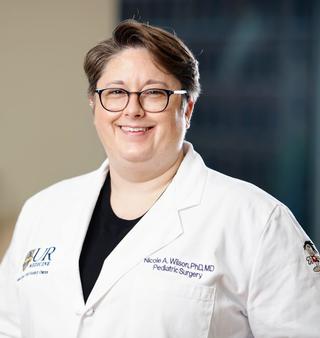
Nicole A. Wilson, Ph.D., M.D. serves as a faculty member at the University of Rochester Medical Center within the departments of General Surgery, Pediatrics, and Surgery. She practices at Golisano Children's Hospital in Rochester, NY, specializing in pediatric surgical care with clinical expertise in pediatric general/thoracic surgery, minimally invasive techniques, and congenital neonatal diseases. Her research program focuses on computational imaging, 3D modeling, biomechanics, and medical device development through the Pediatric Surgery Structure-Function Laboratory. Current research examines the intersection of social determinants of health with pediatric surgical outcomes, machine learning applications in trauma activation systems, and novel imaging technologies for procedural guidance. Dr. Wilson's publication portfolio demonstrates strong emphasis on healthcare disparities, with recent work analyzing neighborhood deprivation impacts on child abuse severity, gastrostomy utilization patterns, and kidney transplant outcomes. Her engineering background informs translational projects including photoacoustic imaging for gastric tube placement and adhesion prevention pharmacotherapies. Jay Grosfeld, MD Scholar Grant (2023) Keith D. Amos, MD Memorial Award (2018) Eugene M. Bricker, MD Teaching Award (2018) Alpha Omega Alpha Medical Honors Society (2018) As an educator, she actively mentors medical students, graduate students, and surgical residents. Her leadership extends to quality improvement initiatives that have successfully reduced healthcare disparities in gastrostomy tube management and ovarian torsion care. Current projects include developing AI-assisted trauma activation systems and investigating impostor syndrome within pediatric surgical professionals.
Stefan Balke is a Researcher at the AudioLabs Erlangen, Friedrich-Alexander-Universität Erlangen-Nürnberg (FAU), focusing on wind music research and Music Information Retrieval (MIR). Previously, he held a PostDoc position at the Institute of Computational Perception, JKU Linz (2018–2019) and later worked as a Data Scientist and Team Lead in industry. He temporarily served as a professor at Hochschule Weserbergland in 2023/24. Education: PhD (Dr.-Ing.) in MIR from FAU (2018), Electrical Engineering studies at Leibniz Universität Hannover (2008–2013). Research Interests: Music Information Retrieval, Deep Learning, Jazz and Wind Music Analysis, Dataset Development. His work includes creating datasets like ChoraleBricks (wind music) and JSD (jazz structure analysis), and tools like trackswitch.js for audio visualization. Grants & Projects: Secured 35k€ funding for his orchestra through the 'Engagiertes Land' program (2024). Collaborated on exhibits such as 'The Listening Machine' (Ars Electronica) and 'Con Espressione!' (mathematics of music exhibition). Contributions: Active on GitHub with repositories for datasets (choralebricks, jsd) and tools. Co-developed web-based audio tools and contributed to open-source projects like Sonic Visualiser and librosa.
Jalila Filali is a Researcher at Université Laval, affiliated with the Computer Vision and Systems Laboratory. Her work focuses on advancing computer vision techniques through ontology integration and deep learning models, with applications in environmental monitoring and wildlife tracking. She holds a post-doctoral position and specializes in image classification, object detection, and semantic annotation systems. Her research interests include developing ontology-driven systems for image annotation, comparing machine learning models like HMAX and Bag-of-Visual-Words for large-scale classification, and applying YOLOv5 frameworks to analyze wildlife behavior via camera-collar videos. She has contributed to projects involving environmental information extraction in northern Quebec ecosystems. Key technical trends in her publications include hybrid ontology-machine learning architectures, classifier fusion techniques, and the integration of visual features with semantic knowledge bases. She has explored both theoretical advancements in computer vision algorithms and practical implementations in ecological monitoring contexts. Jalila Filali's work is supported by the Computer Vision and Systems Laboratory at Université Laval, where she contributes to interdisciplinary projects merging artificial intelligence with ecological research.
Kwanghee Jung is an Associate Professor in the Department of Educational Psychology, Leadership, & Counseling at Texas Tech University's College of Education. He holds a Ph.D. from McGill University and serves as a Research Associate at TTU. His expertise centers on advanced statistical methodologies, including structural equation modeling, multilevel analysis, and latent growth curve modeling, applied across human development, mental health, and brain imaging research. Jung has pioneered applications of generalized structured component analysis (GSCA) and constrained principal component analysis (CPCA) in diverse fields. His research integrates quantitative rigor with technological innovation, such as developing BlocklyXR for extended reality storytelling and investigating biometric authentication via smartphone sensors. He actively addresses educational challenges through projects like competency-based curriculum implementation studies in Kenya and flipped learning approaches for entrepreneurship education. Jung’s work emphasizes methodological precision, having authored studies on bootstrap confidence interval methods for GSCA and cross-validation indices. His contributions span academic publications, software tools (e.g., WEB GESCA), and practical applications in VR/AR development for education and healthcare training (e.g., VRescuer for disaster response).
PD Dr. Anne Schüler is a Researcher and Deputy Head of the Multiple Representations Lab at the Leibniz Institute for Knowledge Media (IWM) in Tübingen, Germany. She holds a PhD (summa cum laude) and habilitation in Psychology from Eberhard Karls University of Tübingen, with a focus on cognitive foundations of multimedia learning. Her work explores how multimedia principles enhance learning, particularly addressing validation processes, cross-modal integration, and the correction of misconceptions through instructional strategies like refutation videos. She has been an Equal Opportunities Officer at IWM since 2018. Her research spans cognitive psychology, educational technology, and instructional design, with a strong emphasis on empirical studies using eye-tracking and EEG. Key projects include investigating reactivation mechanisms during multimedia processing, the impact of digital distractions, and the design of adaptive multimedia systems. Her findings contribute to improving multimedia learning environments in education and professional contexts. Publications highlight themes such as text-picture integration dynamics, boundary conditions of multimedia effects, and the role of visual cues in comprehension. She has collaborated extensively with institutions like the University of Tübingen and international researchers, advancing theoretical frameworks for multimedia learning through experimental studies and data-driven insights.
Schloss Dagstuhl - Leibniz Center for InformaticsGermany
Yue Zhang is a Professor at Westlake University's School of Engineering with an exceptionally active research program spanning multiple disciplines. With dozens of publications in high-impact venues during 2025-2026 alone, Dr. Zhang demonstrates leadership in interdisciplinary research connecting computer science with practical applications in healthcare, environmental science, and education. Affiliation: Westlake University, School of Engineering Research Areas: Machine Learning, Biomedical Engineering, Computer Vision, Environmental Monitoring Publication Output: 90+ papers indexed in dblp (1996-2026), with remarkable productivity in recent years Dr. Zhang's research interests center on applying advanced machine learning techniques to solve real-world problems across multiple domains. The work demonstrates particular strength in biomedical signal processing (EEG, ECG, HRV analysis), environmental monitoring (mangrove forests, crop yield estimation, nitrogen content), and educational technology (AI integration in classrooms). The research approach typically combines deep learning architectures with domain-specific knowledge to create interpretable and effective solutions. The publication record reveals a strong trend toward multimodal and interdisciplinary approaches, with increasing focus on practical applications of AI in healthcare diagnostics, environmental conservation, and educational transformation. Recent work shows particular innovation in attention mechanisms, tensor-based optimization, and knowledge distillation techniques adapted for specialized domains. Dr. Zhang's collaborative network spans multiple institutions and disciplines, with frequent co-authorship patterns suggesting established research groups in both computer science and application domains. The work appears well-funded given the range of sophisticated applications and high publication output across top venues.
Rhonda McEwen is a Professor at the University of Toronto Mississauga, holding roles as Vice-Principal Academic and Dean, and Director of the Institute of Communication, Culture, Information and Technology (ICCIT). She also serves as President and Vice-Chancellor of Victoria University. Her academic journey includes degrees from the University of Toronto (PhD, Information), University of Colorado (MSc, Telecommunications), and City University London (MBA, Information Technology Management). Her research focuses on Human-Machine Communication, cognitive effects of technology, and tactile interfaces. Notable projects include studies on eye-gaze technology for children with communication disorders, VR's impact on learning, and trust dynamics in human-robot interactions. Her work has been featured on CBS's 60 Minutes and in journals like Information, Communication & Society and New Media and Society . McEwen leads initiatives such as the Schwartz Reisman Institute and has secured grants totaling over $1.5 million. She advises students like Yaxi Zhao and Ethan Rong. Her awards include the Canada Research Chair Tier 2 and a Prime Minister’s Award for Excellence in Teaching (via the Touch Technologies project). Her research explores technology’s societal implications, bridging communication studies, behavioral sciences, and applied technology. She emphasizes ethical AI, inclusive design, and technology’s role in education and healthcare.
University of Illinois Urbana-ChampaignUnited States
Lav R Varshney is an Associate Professor with joint appointments in Electrical and Computer Engineering, the Siebel School of Computing and Data Science, Industrial Engineering, Neuroscience, and Digital Agriculture at the University of Illinois. His research spans artificial intelligence, information theory, computational creativity, and quantum computing. He leads projects in neuroengineering and digital agriculture through affiliations with the Beckman Institute and NCSA. With 271+ publications, his recent work includes quantum channel communication (2025), AI evaluation benchmarks (2025), and multimodal language models (2025). His research has examined societal aspects including technology adoption dynamics and privacy-enhancing technologies for public service.
International University of SarajevoBosnia & Herzegovina
Dr. Almasa Mulalić Dr. Almasa Mulalić serves as the Dean of the Faculty of Education and holds the academic rank of Associate Professor at the International University of Sarajevo, the top private university in Bosnia and Herzegovina. She specializes in Applied Linguistics, focusing on English Language Teaching (ELT), Peace Education, and Gender Studies. Currently overseeing the ELT Program, she actively contributes to academic governance through roles in conference committees, scholarship exams, and postgraduate study programs. Her research emphasizes student perceptions in educational settings, including AI integration in language learning, peacebuilding roles of female academics, and critical thinking pedagogy. She has authored books, journal articles, and participated in scientific projects addressing language acquisition, personality-learning strategy correlations, and cross-cultural communication dynamics. Dr. Mulalić’s work bridges theoretical research with practical educational challenges, particularly in post-conflict societies. Her contributions span both local and international collaborations, reflecting her commitment to advancing pedagogical practices and institutional development in higher education.
Thomas Leitch is the Unidel Andrew B. Kirkpatrick, Jr. Chair in Writing at the University of Delaware, affiliated with the Department of English within the College of Arts & Sciences. A graduate of Columbia and Yale, his academic journey bridges literary scholarship and cinema studies, with a focus on narrative theory, genre cinema, and adaptation studies. His work examines how textual adaptations—particularly of literary classics into film—shape cultural understanding and pedagogical approaches to English studies. Leitch’s research portfolio includes ten books and over a hundred essays, with notable works like Film Adaptation and Its Discontents (2007) and The History of American Literature on Film . He co-edited Hitchcock Annual and authored two monographs on Alfred Hitchcock, exploring directorial authorship and cinematic storytelling. His recent scholarship extends into transnational adaptation, censorship impacts, and interdisciplinary public humanities. Academically, Leitch serves on editorial boards for Adaptation , Journal of Adaptation in Film and Performance , and Hitchcock Annual , while also reviewing mystery fiction for Kirkus Reviews . His Fulbright Lecturer role at Hebrew University of Jerusalem highlights his global academic contributions. Awards include an Edgar Allan Poe Award nomination for Perry Mason and Crime Films (2003). Leitch advocates for inclusive pedagogical strategies, blending cinephilia with critical analysis in teaching film and literature. His work frequently interrogates adaptation’s role in preserving or reimagining cultural heritage, with recent explorations into digital media’s impact on literary education.
Jerry Spanakis is an Assistant Professor at Maastricht University with dual affiliations: the Department of Advanced Computing Sciences (Faculty of Science and Engineering) and the Maastricht Law+Tech Lab (Faculty of Law). His roles include leading the EU Horizon project VOXReality, researching for NSMD/HumanAds/RegTech4AI initiatives, and serving as a technical expert for the European Commission’s e-enforcement academy. He coordinates MaastrichtNLP (NLP research group) and participates in the Open Science Community Maastricht. Education: PhD in Computational Intelligence (2007–2012) from the National Technical University of Athens, School of Electrical & Computer Engineering. Research Focus: Social Machine Learning: Developing responsible AI systems for societal challenges, including interpretable models for consumer protection and regulatory compliance. Computational Social Media: Analyzing social media data to detect online harms (e.g., misleading ads, content moderation failures) and model user behavior. Structuring Unstructured Data: Semantic organization of legal texts, social media, and multimodal data for applications in law, aviation, and public health. Publication Trends: Jerry's recent work (2023–2025) emphasizes NLP innovations for legal and regulatory domains, multilingual information retrieval, and ethical AI frameworks. Key themes include Large Language Model applications in law, influencer marketing compliance, and cross-lingual neural machine translation. Scientific Awards: None reported. Advising & Grants: Jerry supervises 7 PhD candidates and 100+ Master’s/Bachelor’s students in NLP, machine learning, and social computing. He leads the €2.8M EU project VOXReality (voice-driven XR interactions) and contributes to NWO/Philips grants on mental health analytics. Current grants focus on: AI-driven legal process automation (RegTech4AI) Dark pattern detection in e-commerce (NSMD) Influencer marketing transparency (HumanAds) Labs & Teams: Jerry founded MaastrichtNLP, a university-wide NLP research group, and co-leads the Law+Tech Lab, which develops computational tools for legal compliance. His teams collaborate with Deloitte, the European Commission, and healthcare institutions on applied AI projects.