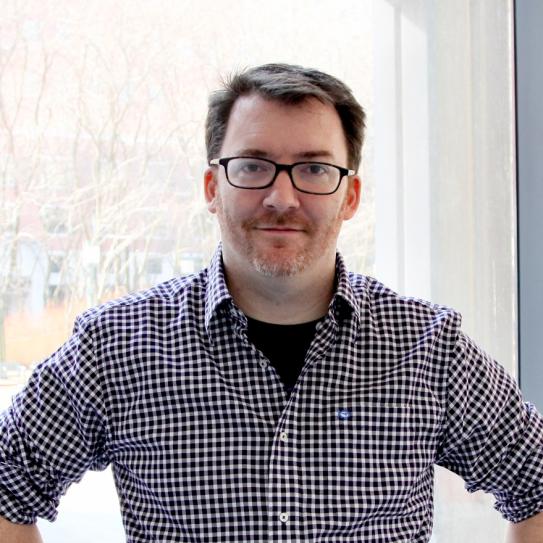
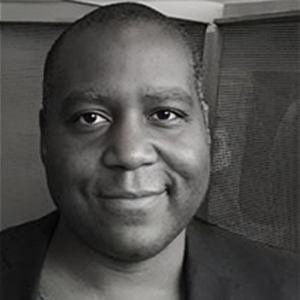
Craig Buckley is an Associate Professor in the Department of the History of Art and affiliated with the Yale School of Architecture. His research bridges modern architecture with visual arts and media, focusing on techniques like montage, collage, and screen-based practices. Education: BA (Trent University), MA (University of Western Ontario), PhD (Princeton University) His work examines how media such as print, film, and digital screens shape architectural culture. Key themes include cinema architecture, media theory, and the intersection of design with socio-political movements like 1968 protests. His recent articles analyze topics such as colonial-era cinema architecture, media façades, and pneumatic structures. He teaches courses on architecture’s relationship with media and print culture, often utilizing Yale’s special collections.
John Hatfield is a Professor in the Art History department at Temple University's Tyler School of Art. With over 30 years of experience in arts management, he has held leadership roles at Socrates Sculpture Park (Executive Director for 10 years), New Museum (Deputy Director for 17 years), and the Lower Manhattan Development Corporation. His career bridges academic practice with real-world civic engagement, focusing on art as a catalyst for social change. M.F.A., Tyler School of Art (1989) B.F.A., Illinois Wesleyan University (1986) Research interests span arts management , community engagement , and public art , with publications analyzing contemporary artists' roles in urban development and societal transformation. His recent works explore memorial art , conceptual environmental art , and social practice methodologies . Publications include exhibition monographs on artists like Jeffrey Gibson and Nari Ward, demonstrating interdisciplinary engagement with sculpture installation art urban cultural planning artistic activism curatorial innovation community-based projects . As a practicing artist and educator, Hatfield has taught graduate Museum Studies at New York University, served on art juries, and contributed to international discourse on contemporary art through lectures and exhibition monographs.
Yigal S. Nizri is an Associate Professor, Teaching Stream at the University of Toronto, cross-appointed between the Department for the Study of Religion and the Anne Tanenbaum Centre for Jewish Studies (ATCJS), where he serves as Undergraduate Director. His research focuses on Jewish-Moroccan history, diaspora studies, and Mizrahi cultural identity in Israel. Nizri holds a PhD from New York University and specializes in the emergence of Jewish Moroccan scribal culture within trans-Mediterranean diasporic networks. His work examines Maghribi halakhic traditions, Jewish-Muslim cultural intersections, and Mizrahi identity formation. His publications demonstrate consistent focus on Jewish textual traditions in North Africa, cultural memory in diaspora communities, and the representation of Mizrahi identity in Israeli society. Recent works explore themes of return migration, disaster narratives in Jewish book culture, and the evolution of Moroccan rabbinic print traditions. Nizri teaches courses including History of the Jewish People The Arab Jew: A History of a Concept Mizrahim in Israel: History, Politics, and Culture focusing on Jewish historiography and identity formation across diverse cultural contexts.
Martha Stiegman is an Associate Professor at the Faculty of Environmental and Urban Change, York University. Her research integrates Indigenous knowledge, food sovereignty, and arts-based methodologies to address issues of social, environmental, and disability justice. She is actively engaged in community-based research and public scholarship in Toronto and Mi’kma’ki (Nova Scotia). Her educational background includes a PhD from Concordia University’s Special Individualized Program and a BA in English Literature & Political Science from McGill University. This interdisciplinary foundation supports her work at the intersection of activism, research, and art. Stiegman’s research focuses on three interconnected domains: Indigenous/settler treaty relations, food sovereignty and justice movements, and participatory video and arts-based research. She emphasizes decolonizing methodologies and community-led knowledge production. Her work explores how arts-based approaches can deepen dialogues across communities and strengthen collective action for justice. Her recent publications and multimedia projects demonstrate a strong trend toward interdisciplinary, community-engaged scholarship that bridges Indigenous epistemologies, environmental justice, and disability justice. She frequently uses film, digital storytelling, and public art to mobilize knowledge and challenge colonial narratives. Co-creator of A Treaty Guide for Torontonians (2022) Lead on the Polishing the Chain project exploring Toronto’s treaty relationships Editor of the forthcoming Anti Colonial Food Systems (Routledge) Active collaborator with Indigenous scholars and artists including Dr. Sherry Pictou, Ange Loft, and Elder Kerry Prosper Stiegman has been involved in significant research grants such as the Atlantic Aboriginal Health Research Program. While specific advisees are not listed, her collaborative projects suggest active mentorship and supervision. She does not appear to lead a formal lab but works within research collectives and community partnerships.
Catherine Guastavino is a Professor at McGill University's School of Information Studies (within the Faculty of Arts) and an Associate Member at the Schulich School of Music. She also contributes to the Centre for Interdisciplinary Research in Music Media and Technology (CIRMMT). Her roles include leading research projects and supervising graduate students in music technology and related fields. She holds a PhD in Psychoacoustics from Université Pierre et Marie Curie (Paris VI), an MSc from IRCAM (France), and a BSc in Mathematics from McGill University. Her research focuses on auditory perception, soundscape analysis, human-computer interaction, and urban acoustics. Notable projects include the 'Sounds in the City' partnership addressing urban noise policy and the development of immersive soundscape simulation tools. She leads or co-leads grants from SSHRC, NSERC, and MITACS, emphasizing interdisciplinary approaches to sound in urban environments. Guastavino's work bridges academic research with practical applications, such as designing sound installations for public spaces and improving acoustic environments in transportation and performance venues. She collaborates with city planners, musicians, and engineers, reflecting her commitment to making cities sound better through evidence-based strategies. Key Projects: SSHRC Partnership Grant for urban soundscape management (2018-2023) NSERC Discovery Grant on auditory localization (2019-2024) MITACS projects on Montreal festival soundscapes and noise policy Labs & Partnerships: Multimodal Interaction Laboratory (MIL) Collaborations with Ville de Montréal and Quartier des Spectacles Education: PhD: Psychoacoustics (Paris VI) MSc: Computer Science & Music Technology (IRCAM) BSc: Mathematics (McGill) Her teaching includes courses like Music Information Retrieval, integrating computational methods with artistic and scientific applications.
Dr. Jules Rawlinson is a Senior Lecturer in Digital Design at the Reid School of Music , University of Edinburgh. He serves as Programme Director for the MSc Sound Design and contributes to MSc Design and Digital Media, ESALA undergraduate courses, and the Reid School's MSc Digital Composition and Performance. PhD in Composition (University of Edinburgh, 2011) MSc Sound Design (University of Edinburgh, 2006) BA Combined Arts (Sunderland University) Jules investigates audiovisual composition , live electronics , and interactive performance systems , blending machine learning , virtual environments , and corpus-based sound synthesis . His work explores non-linear narrative structures , graphical scores , and political sound-art through collaborations like Raw Green Rust and projects such as Lie Still My Sleepy Fortunes and w[i]nd . His 15 most recent outputs span audiovisual installations , generative sound systems , and collaborative performances , focusing on virtual reality , spectral transformation , and digital improvisation . Jules co-founded the LLEAPP network and has secured grants from EPSRC and New Media Scotland's Alt-w Fund . He supervises PhD students Tim Bentley, Hal Xu, Benjamin Cantil, and Liam Peacock, with works showcased at festivals including Sonorities , Edinburgh International Film Festival , and Edinburgh Festival Fringe . His Requiem for Edward Snowden was featured in BBC Radio 3's Hear and Now and selected for Creative Scotland's Made In Scotland Showcase.
Professor Annie Mahtani is a Professor of Electroacoustic Composition and Practice at the University of Birmingham's Department of Music. She holds a BMus (Hons), MA, MPhil, and PhD from the University of Birmingham and Birmingham City University. Her work focuses on electroacoustic music, acousmatic composition, multichannel audio, spatialisation, and field recordings, with significant contributions to site-specific installations and cross-disciplinary collaborations. She co-directs the SOUNDkitchen collective and serves on key boards such as the British ElectroAcoustic Network (BEAN) and the British Section of ISCM. Her research explores the sonic identity of environmental sounds, large-scale multichannel composition, and ambisonic audio techniques. As a performer with BEAST (Birmingham Electroacoustic Sound Theatre), she develops live acousmatic performances and soundwalks. Recent projects include Becoming Tree (an immersive audio retelling of a literary work) and Minimum Monument , performed at Birmingham Hippodrome. She actively collaborates with dance and theatre companies like Rosie Kay Dance Company. Professor Mahtani teaches undergraduate and postgraduate modules in electroacoustic composition and is involved in admissions and curriculum leadership. Her works have been performed globally in festivals like Klang! Électroacoustique and Sound + Environment, showcasing her innovative contributions to contemporary music and sound art.
Claudia Lehmann is a University Professor of Film Art & Visual Communication at the Institute for Open Arts, Department of Scenography at Mozarteum University Salzburg. She has been a professor at Mozarteum University since 2019 and previously served as a visiting professor at the Berlin Weissensee Art Academy. As a faculty member, she contributes to the Institute management, teaches as a Teacher, and serves on the Curricular Commission. Dr. Lehmann holds a doctorate in physics (Dr. rer. nat.) with her dissertation "GAUGE COVARIANT MULTISCALE ANALYSIS OF COMPLEX SYSTEMS" published through DESY-Publications in 2004. Her academic journey reflects a unique interdisciplinary trajectory from scientific research to artistic practice. Claudia Lehmann's research interests center around the intersection of art and science, with particular focus on perception, reality, and systemic phenomena. Her work spans documentaries, feature films, music videos, art videos, installations, and performances, constantly searching for new forms and formats. She develops visual concepts, video stage sets, and unique live video performances, often in collaboration with Nicolas Stemann. Through her work, she explores diverse possibilities for new structures, especially in the form of artistic collaboration. Her recent artistic output shows a consistent trend toward interdisciplinary work that blends theater, film, and digital media. Lehmann frequently collaborates with Nicolas Stemann and Konrad Hempel, creating innovative performances that integrate video technology with traditional stagecraft. Her work often addresses social and political themes while experimenting with form and presentation. The Institute for Experimental Affairs (IXA), which she co-founded with Konrad Hempel, serves as a platform for exploring the interfaces between science and art through various projects and research initiatives. Dr. Lehmann has received several prestigious awards for her work: Samsung Smartfilm Award 2013 Shocking Shorts Award 2007 Nomination for German Documentary Film Music Prize 2013 Nomination for Studio Hamburg Young Talent Prize for Best Screenplay As an educator and researcher, Lehmann has developed numerous collaborative projects and performances that have been featured at major international festivals including the Berlin International Film Festival, Leipzig Documentary Film Festival, and various theater festivals. Her work with IXA represents a significant research initiative at the intersection of science and art. Lehmann co-founded the Institute for Experimental Affairs (IXA) with visual artist and composer Konrad Hempel. Through IXA, she conducts research and realizes projects at the interfaces between science and art. Her collaborative work spans theater productions, film projects, and interactive installations that have been presented at venues including the Schauspielhaus Zürich, Münchner Kammerspiele, Opéra Comique Paris, and various international festivals.
Paul D. Miller, known professionally as DJ Spooky, That Subliminal Kid, is a Professor of Music and Mediated Art at The European Graduate School (EGS). Based in New York City, he is an experimental electronic and hip-hop musician, conceptual artist, and writer whose work spans music production, film, multimedia installations, and critical theory. He has released over a dozen albums pioneering 'illbient' and trip hop genres, authored influential books including Rhythm Science and Sound Unbound , and exhibited internationally at venues like the Venice Biennale and Andy Warhol Museum. Education: Bowdoin College: Studied philosophy and French literature; thesis on Richard Wagner's Gesamtkunstwerk as precursor to new media. Research Interests: Miller's work centers on remix culture as a postmodern methodology, exploring intersections of sound, image, and technology. His theoretical framework positions the DJ as a 'post-subjective auteur' who creates meaning through layered connections across time, culture, and media. Key projects include Rebirth of a Nation (reworking D.W. Griffith's film to address racial history) and Terra Nova (Antarctica sound recordings addressing climate change), demonstrating his focus on historical reinterpretation and environmental crisis through digital media. Publications: His 14 scholarly articles (2001-2009) analyze remix as cultural practice across domains from album art history ( The Inner Sleeve ) to Baudrillard's philosophy ( Baudrillard: A Remembrance ). The corpus reveals consistent investigation into how sampling, digital layering, and media archaeology reshape narrative, memory, and cultural identity in the information age. Awards: No scientific awards or fellowships were documented in the source text. Advising and Grants: The source text provides no information regarding students supervised, academic advising, or research grants administered by Miller. Labs and Teams: Miller operates through project-based collaborations rather than fixed labs, forming temporary collectives with institutions like the American Museum of Natural History (for Terra Nova ) and artists including Yoko Ono, Ryuichi Sakamoto, and choreographer Francesca Harper. His 'Unfinished Stories' project with Pulitzer-winning critic Margo Jefferson exemplifies his interdisciplinary approach bridging dance, music, and social commentary.
Arie E. Kaufman is a Distinguished Professor in the Department of Computer Science at Stony Brook University, serving as Chief Scientist of the Center of Excellence in Wireless and Information Technology (CEWIT) and Director of the Center of Visual Computing (CVC). He additionally holds a Distinguished Professorship in Radiology, with a 40+ year career at Stony Brook since joining in 1985 and chairing the CS department from 1999-2009. His seminal research spans computer graphics, visualization, and virtual reality with biomedical applications, pioneering breakthroughs including 3D Virtual Colonoscopy (FDA-approved colon cancer screening), Cube hardware architectures (commercialized as VolumePro), the Reality Deck (1.5 billion-pixel immersive display), and foundational work in volume visualization. His interests focus on real-time rendering, medical imaging, and immersive analytics, with recent work integrating machine learning for healthcare and environmental risk visualization. Recent publications demonstrate continued leadership in high-resolution immersive displays (Silo), XR analytics with LLMs, storm surge visualization, and neural reconstruction techniques. His work bridges theoretical innovation with practical applications, particularly in pancreatic cancer prognosis and disaster preparedness. Major honors include: IEEE Visualization Career Award (2005) Fellow of the National Academy of Inventors (2017) ACM Fellow (2009) IEEE Fellow (1998) Long Island Technology Hall of Fame (2013) European Academy of Sciences membership (2002) As PI on 100+ research grants, Kaufman's work has generated 300+ refereed papers, 40+ patents, and extensive media coverage (New York Times, Science, Wall Street Journal). He leads the Center of Visual Computing with focus on translational research, including VolVis software (5,000+ installations) and Reality Deck deployments for big data analytics. His lab develops cutting-edge visualization infrastructure for medical diagnostics and environmental modeling, with current projects advancing immersive storm surge analytics, neural structure extraction, and VR-based risk communication systems. Future work emphasizes AI-enhanced visualization for precision medicine and climate resilience planning.
Andrea Wollensak is Professor of Art at Connecticut College, where she has taught since 1993. She is an interdisciplinary artist and designer whose work explores the convergence of place, identity, and history through site-based artworks that combine new media technology with traditional design and fabrication. Her educational background includes a B.F.A. from the University of Michigan and an M.F.A. from Yale University. She has held visiting faculty positions at numerous institutions including the University of Gothenburg, Nova Scotia College of Art and Design, Concordia University, Rhode Island School of Design, and the Estonian Academy of Arts. Wollensak's research focuses on social design and place-based storytelling, employing collaboration with community partners, computer scientists, musicians, poets, and scientists. Her work addresses themes of place-based narratives, environment, and memory through forms including audio/video, interactive installations, data visualization, artist books, and digitally fabricated works. She examines how design can be used as a tool for social impact and civic participation. Her most recent projects include Mapping Your Journey to School (2023), which engages Estonian and Ukrainian refugee students in creative writing workshops; Water Stories: Visual Poetics and Collective Voices (2022), a year-long artist residency at the Anchorage Museum; and Open Waters (2019-2020), an interactive installation examining Arctic environmental change. U.S. Fulbright Scholar in Estonia (2023) Artistic Excellence Award in Digital Art from Connecticut Office of the Arts Artist residency at Hafnarborg Contemporary Art Museum in Iceland (2011) Connecticut Commission on Culture and Tourism Grants in New Media (2010, 2006) IASPIS International Artist Studio Program in Sweden (2007) Rockefeller Study and Conference Center residency (2000) Wollensak has advised numerous students in design and new media projects, often collaborating with community partners. She served as Director of the Ammerman Center for Arts and Technology at Connecticut College from 2014-2020 and currently serves on the Advisory Council of the Winterhouse Institute and the Advisory Board for Digital Media Connecticut. Her teaching emphasizes design as an interdisciplinary practice that prepares students to be creative problem solvers who can use design to create positive social impact. Her work has been exhibited internationally at venues including the Göteborg International Contemporary Art Biennial, Nova Scotia Art Gallery, Brno Design Biennial Moravian Gallery, Center for Visual Art in Denver, Brown University's Granoff Center Gallery, and the Burchfield Penney Arts Center in Buffalo.
Serge CARDINAL is a Full Professor at the Department of Art History, Cinema, and Audiovisual Media at Université de Montréal. His research focuses on the intersections of sound, music, and cinema, blending philosophical inquiry with creative practice. He leads projects exploring musicality in film, interdisciplinary analysis methods, and the legacy of cinema through installations and exhibitions. Education: The text does not explicitly detail his formal education, but his extensive academic output and professorial role suggest advanced degrees in cinema studies and related fields. Research Interests : Musicality in film, research-creation, Deleuzean philosophy applied to cinema, actor studies, and interdisciplinary audiovisual practices. His work bridges theory and practice, using soundscapes, installations, and performances to analyze cinematic material. Recent Projects : Includes installations like Tombeau de Gilles Groulx (2019) and The Political Glenn Gould (2024), as well as collaborative research networks like the OICRM. He has explored digital tools for cinematic analysis (Numalyse, 2025) and sound transcription in intermedia contexts (Studio Glenn Gould, 2021). Grants & Funding : Recipient of grants from FRQSC and SSHRC for projects on sound in Quebec cinema, research-creation methodologies, and interdisciplinary music-cinema studies. Leads teams in strategic research programs and individual creation grants. Labs/Teams : Member of the Observatoire interdisciplinaire de création et de recherche en musique (OICRM) and the research-creation lab La création sonore: cinéma, arts médiatiques, arts du son .
Henrik von Coler is an Assistant Professor at Georgia Institute of Technology's School of Music within the College of Design. His work bridges engineering, electronic music, and empirical research, focusing on spatial audio systems, live electronics, and human-computer interaction in musical contexts. He joined Georgia Tech in 2023 after serving as director of the TU Studio for Electronic Music at Technische Universität Berlin from 2015 to 2023, where he founded the Electronic Orchestra Charlottenburg (EOC) to explore live electronic ensembles in multichannel environments. His research emphasizes the integration of sound, space, and HCI to enhance compositional and performative expressiveness. Notable projects include immersive audio installations, virtual instrument design, and AI-assisted composition. Coler has performed globally on immersive audio systems and curated international concerts. His technical contributions span spatial sound synthesis algorithms, networked music systems, and real-time signal processing tools. Key areas of exploration include volumetric music performances in metaverse environments, hybrid spatial interaction via ARCube, and statistical models for spectral synthesis. He has developed open-source systems like Orchestra (for metaverse performances) and SPRAWL (for ensemble interaction). Coler’s work often combines empirical research with artistic practice, aiming to redefine the boundaries of live electronic music through technological innovation. His academic output spans over 30 peer-reviewed articles since 2011, with recent focus on metaverse applications, AI-human collaboration, and immersive audio design. While no formal awards are listed, his leadership roles and project outcomes highlight significant contributions to music technology and spatial audio engineering.
R. Luke DuBois is an Associate Professor and Co-Chair of the Technology, Culture and Society Department at the NYU Tandon School of Engineering, where he also directs the Integrated Design & Media program and the Brooklyn Experimental Media Center. He holds a DMA in music composition from Columbia University and is a renowned artist, composer, and performer whose work explores intersections between technology, sound, and visual media. His research focuses on digital media, human-computer interaction, and emerging technologies applied to artistic expression and accessibility. Key roles include directing the SONYC initiative (addressing urban noise pollution via AI) and leading the NYU Ability Project (advancing disability studies through technology). He has collaborated with institutions like the Smithsonian and artists such as Maya Lin, and his work has been exhibited globally, including at the Sundance Film Festival and the Aspen Institute. DuBois co-developed the Jitter software suite for real-time data manipulation and performs in avant-garde groups like Bioluminescence and Fair Use. His artistic practice combines time-lapse phonography, interactive installations, and interdisciplinary projects that critique cultural ephemera while advancing accessibility in STEM and the arts. Recent contributions include browser-based tools for accessible music notation (SoundCells) and sonification techniques for calculus education. He serves on the Board of the ISSUE Project Room and has been featured in major publications like the New York Times and TED Conference talks.
Keith Obadike is a Professor in the Department of Art at Cornell University's College of Architecture, Art, and Planning (AAP), where he also serves as Director of Undergraduate Studies. He is an acclaimed interdisciplinary artist and composer, known for his collaborative work with Mendi Obadike, which spans sound art, digital media, public installations, performance, and internet-based projects. His artistic and academic work critically engages with technology, race, history, and identity. Obadike earned a B.A. in Visual Art from North Carolina Central University and an M.F.A. in Sound Design from Yale University. Prior to joining Cornell, he taught at William Paterson University and held visiting positions at Princeton University, Columbia University, Northwestern University, and the Art Institute of Chicago. His research and creative practice focus on sound art, digital media, public art, performance, and collaborative practice , with strong interdisciplinary connections to Afrofuturism, data sonification, and social justice. He explores how sound and technology mediate racial identity, memory, and liberation, notably through the concept of acousmatic blackness , which he and Mendi developed to describe the racial perception of sound when its source is unseen. Obadike’s selected works include large-scale public sound installations such as Blues Speaker (for James Baldwin) , Free/Phase , Compass Song (Times Square Arts), and GuideStar (Space Needle, Seattle). His projects often use data sonification, archival research, and mythic storytelling, blending historical inquiry with futuristic vision. Notable series include the Opera-Masquerades , Americana Suites , and Numbers Station works, which transform databases of violence into sonic experiences. His honors include: Rockefeller New Media Arts Fellowship (2004) Louis Comfort Tiffany Biennial Award (2015) New York Foundation for the Arts Fellowship in Fiction New Music USA Creator Development Fund (2022) Obadike has received commissions and support from institutions such as the Vera List Center, Harlem Stage, Times Square Arts, the American Composers Orchestra, and the Cornell Mui Ho Center for Cities. He has exhibited and performed at The New Museum, The Whitney Museum of American Art, MoMA, and The Studio Museum in Harlem. His writings and publications include contributions to Studies into Darkness (2022), and artist books such as Four Electric Ghosts and Big House / Disclosure (both 2014). He has also released albums like Crosstalk (2008) and created internet artworks such as Blackness for Sale (2001) and The Interaction of Coloreds (2002), which are foundational in new media and critical race art. While specific advisees are not listed, his role as Director of Undergraduate Studies and Professor indicates active mentorship. His work is deeply collaborative, often co-created with Mendi Obadike, and supported by interdisciplinary teams and institutions.