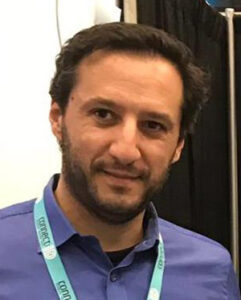
Nikos Pappas is a Researcher affiliated with the School of Electrical and Computer Engineering (ECE) at the Technical University of Crete. He is part of the TUC/MUSIC Laboratory (Laboratory of Distributed Multimedia Information Systems and Applications), focusing on interdisciplinary research in e-learning platforms, multimedia systems, and service-oriented architectures. His work emphasizes innovative educational technologies, digital ecosystems, and knowledge management infrastructure. His academic contributions span over two decades, with notable projects such as Coursevo (a gamified online learning platform) and Py4hs (a Python teacher training program). He actively contributes to advancing educational technologies through frameworks like PerFECt and TeC, which integrate computational principles into interdisciplinary learning environments. Key areas of expertise include distributed multimedia systems, metadata management, and platform development for collaborative learning communities. His research bridges theoretical computer science with practical applications, particularly in vocational training, robotics education, and digital business ecosystems. Though no awards are explicitly listed, his extensive publications reflect impactful contributions to e-learning systems and multimedia infrastructure. He advises on educational technology initiatives and maintains an active role in the development of open learning environments like MOLE (Multimedia Open Learning Environment).
Constantine Kotropoulos is a Professor at the Department of Informatics, School of Informatics, Aristotle University of Thessaloniki. He holds a PhD (1993) and a Diploma in Electrical Engineering (1988), both from Aristotle University. His professional journey includes roles from Lecturer (1997) to current Professor (2015–present), with extensive postdoctoral and research experience in electrical and computer engineering fields. His research focuses on Digital Signal Processing , Audio/Music/Speech Processing , Pattern Recognition , and Human-Centered Multimodal Interaction . Recent work emphasizes forensic applications (e.g., source device identification), medical diagnostics (speech pathology classification), and explainable AI (face aging, camera model identification). Key research themes include electric network frequency analysis for audio authentication, multimodal fusion for media forensics, and optimization techniques for non-negative machine learning problems. His publications span signal processing, multimedia, and healthcare technology, with a focus on practical applications of advanced algorithms. He maintains active collaborations in interdisciplinary areas such as agricultural disease detection via hyperspectral imaging and route recommendation systems leveraging image-driven data. His work often bridges theoretical computer science with real-world challenges in security, healthcare, and environmental monitoring.
Varouchakis Emmanouil is an Assistant Professor at the Technical University of Crete (TUC), affiliated with the School of Mineral Resources Engineering (MRE). His research focuses on geostatistical modeling, hydrogeology, and sustainable resource management. He actively contributes to projects like the IMMERSE initiative, which develops virtual excursions for critical raw materials education in the clean energy transition. His work integrates advanced statistical methods with environmental systems analysis. Key areas of expertise include groundwater dynamics, stochastic simulations for mining emissions reduction, and renewable energy potential assessment in the Mediterranean. He has developed decision support frameworks for water allocation optimization and circular economy strategies in mining waste management. His research often combines geostatistics with machine learning and remote sensing data to enhance environmental monitoring and predictive modeling. Emmanouil collaborates on EU-funded initiatives such as the OurMED project for sustainable water storage and the InTheMED project analyzing groundwater dynamics. He has authored numerous papers on topics like space-time correlations in mineral dissolution, spatial variability of precipitation, and probabilistic forecasting of extreme climate events. His academic contributions span both theoretical advancements (e.g., covariance models in multivariate geostatistics) and applied solutions (e.g., wave energy assessments in the Aegean Sea). He maintains an active role in advancing methodologies for climate resilience in energy infrastructure and groundwater resource management systems.
Vasileios Chasanis is a researcher at the Department of Computer Science & Engineering, University of Ioannina, specializing in machine learning applications for video analysis, summarization, and surveillance systems. His work bridges theoretical algorithms with practical implementations in multimedia processing. Educational background: Diploma in Electrical and Computer Engineering, Aristotle University of Thessaloniki (2004) PhD in Computer Science, University of Ioannina (2009) His research focuses on Machine Learning and Computer Vision with emphasis on video structure analysis and real-time processing . Core methodologies include support vector machines , spectral clustering , and multi-view feature extraction for tasks like shot boundary detection, key-frame extraction, and scene segmentation. Recent work extends to clinical data mining and tourism technology applications. Publication trends show consistent innovation in video summarization algorithms and efficient feature extraction , with increasing interdisciplinary applications in healthcare and tourism. His 2023 work demonstrates expansion into web-based augmented reality systems for tourism destinations. Scientific recognition: Best Scientific Paper Award at ICPR 2014 for key-frame extraction research Research funding includes EU-cofunded projects: PENED 2003 (machine learning for video analysis), ARTreat FP7 (clinical decision support), and ongoing VIDEOSUM (video storage/summarization platform). Collaborates extensively with the IP AN Group at University of Ioannina. He co-developed the VideoSum platform—a comprehensive system for video storage, processing, and summarization—integrating spectral clustering and temporal analysis techniques for industrial applications in media management.
George Xylomenos is a Professor in the Department of Informatics at Athens University of Economics and Business (AUEB), where he has been a faculty member since 2002, progressing from Lecturer to Professor. He serves as Scientific Coordinator of the Information Systems Management Center and previously held roles including Deputy Chair of the Department of Informatics and Deputy Rector for Financial Planning and Development. He is affiliated with the Mobile Multimedia Laboratory (MMlab) at AUEB and has made significant contributions to computer networking research. Professor (System Software) at AUEB, Department of Informatics (2020-present) Associate Professor at AUEB, Department of Informatics (2015-2020) Assistant Professor at AUEB, Department of Informatics (2007-2015) Lecturer at AUEB, Department of Informatics (2002-2007) Research Associate at University College London (2016-2017) Education Ph.D. in Computer Science, University of California, San Diego (1999) M.S. in Computer Science, University of California, San Diego (1996) Diploma in Applied Informatics, Athens University of Economics and Business (1993) Professor Xylomenos' research focuses on computer network and operating system design and implementation. His primary interests include Future Internet architecture, Information-Centric Networking, Quality of Service provisioning, communication protocols for wireless and mobile networks, and Network Music Performance systems. His work bridges theoretical networking concepts with practical implementations, particularly in the areas of content-centric networking and multimedia communications. He has pioneered research in multi-service link layers for wireless networks and has made significant contributions to the understanding of TCP performance over wireless links. His recent publications demonstrate a strong focus on Named Data Networking, decentralized identity systems, and Network Music Performance. The research trends show a progression from traditional IP networking toward information-centric architectures, with increasing emphasis on security, privacy, and multimedia applications in distributed environments. Scientific Awards Best demo award at ACM ICN Conference (2017) Future Internet Award from FP7 PURSUIT project (2013) Runner up for best local student paper at IEEE Symposium on Computers and Communications (2011) Best non-student paper award at European Wireless Conference (2007) National Semiconductor Corporation Graduate Fellowship (1996) Professor Xylomenos has supervised numerous research projects, including multiple EU-funded initiatives such as PURSUIT, PSIRP, and EIFFEL in the Future Internet domain, and MUSINET for Network Music Performance. He has served on the editorial board of IEEE Transactions on Mobile Computing (2016-2024) and has been active in numerous Technical Program Committees for major networking conferences. His research has attracted significant funding from European Union programs including FP7, H2020, and Horizon 2020. He is a core member of the Mobile Multimedia Laboratory (MMlab) at AUEB, which focuses on advanced networking technologies, multimedia systems, and future Internet architectures. The lab has been instrumental in Greece's participation in major European research initiatives related to Information-Centric Networking and Network Music Performance. The laboratory maintains strong collaborations with international research groups, particularly in Europe and the United States.
Stavros J. Perantonis serves as Research Director at the Institute of Informatics and Telecommunications, National Center for Scientific Research "Demokritos" in Athens, Greece. He is currently Head of the Computational Intelligence Laboratory and Chairman of the Scientific Consulting Board of the Institute. Additionally, he teaches graduate courses in Pattern Recognition at the Department of Informatics & Telecommunications, University of Athens. His educational background includes: Athens College Graduate (1979) Bachelor's degree in Physics, University of Athens (1984) M.Sc. in Computer Science, University of Liverpool, UK (1991) D. Phil. in Computational Physics, University of Oxford, UK (1987) Perantonis specializes in computational intelligence with research focusing on artificial neural networks, image and multimedia processing, pattern classification, and document analysis. His work bridges theoretical foundations with practical applications in document analysis, 3D object retrieval, and medical imaging systems. His research methodology often combines neural network approaches with traditional image processing techniques to solve complex pattern recognition problems. His recent publications demonstrate a strong focus on document analysis systems, 3D shape retrieval, and human behavior analysis. The trends in his work show consistent development in computational intelligence methods applied to practical problems, with increasing emphasis on real-world applications in historical document processing, medical imaging, and surveillance systems. His research has evolved from foundational neural network theory to sophisticated applications in multiple domains. His notable scientific recognitions include: First prize of Panhellenic mathematical contest (1979) Scholarship by National Scholarship Foundation (1979-82) Scholarship by Alexander S. Onassis Public Benefit Foundation for graduate research (1985-1986) Grant by Science and Engineering Research Council (SERC), UK, for postdoctoral research (1987-1990) Perantonis has supervised numerous PhD students in areas including optimization, neural networks, document analysis, and 3D modeling. His laboratory has secured significant research funding through multiple national and EU projects including D-SCRIBE (digitization of Greek manuscripts), EMEDI (virtual medical school), and SEMVEILLANCE (semantic analysis for surveillance applications). His Computational Intelligence Laboratory serves as a hub for interdisciplinary research connecting computer science with practical applications in cultural heritage, healthcare, and security domains.
Dr. George Xylomenos is a Professor at the Department of Informatics of Athens University of Economics and Business (AUEB), affiliated with the Mobile Multimedia Laboratory (MMLab). He obtained his Diploma in Informatics from AUEB (1993), followed by M.S. and Ph.D. degrees in Computer Science from UC San Diego (1996, 1999). His research focuses on Future Internet design, Quality of Service, wireless networks, and multimedia communication protocols. He has led numerous national and European projects, including roles as Deputy Rector for Financial Planning (2017–2020) and Deputy Chair of the Department of Informatics (2021–2024). He has published over 100 articles with >4000 citations and received awards such as the Future Internet Award (2013) and Best Demo Award (ACM ICN 2017). Education: B.S., Informatics, AUEB (1993) M.S. & Ph.D., Computer Science, UC San Diego (1996–1999) Research Interests: Future Internet architectures, network performance optimization, wireless protocols, QoS, and multimedia systems. His work explores latency-critical applications like Network Music Performance and secure data management in distributed systems. Key Projects: Leader of projects AViD-NMP, SeEDS, and TENeMP (2020–present) Co-investigator in FP7 PURSUIT and H2020 SOFIE Grants & Awards: Over 4000 citations across 100+ publications Editorial roles: IEEE Transactions on Mobile Computing Best Paper Awards: ACM ICN 2017, IEEE EWS 2007 Labs & Teams: Mobile Multimedia Lab (MMLab) at AUEB, collaborating on ICN, IoT, and network music performance systems.
Michael Paterakis is a Professor in the Department of Electronic and Computer Engineering at the Technical University of Crete, where he has served since 1995. His leadership roles include Vice-Rector for Academic Affairs & Personnel (2005-2010), Director of the University Research Institute of Telecommunications Systems (2000-2005), and Department Chair (1999-2001). His education includes a Diploma in Electrical Engineering from NTUA (1984), M.Sc. from University of Connecticut (1986), and Ph.D. from University of Virginia (1988). Prior to TUC, he was Assistant/Associate Professor at University of Delaware (1988-1995). Professor Paterakis's research centers on Computer Communication Networks with emphasis on protocol design , performance modeling of broadband wireless networks, and applied queuing theory . His work spans Wireless Communications , Multimedia Systems , and Network Optimization , addressing challenges in next-generation telecommunications infrastructure through rigorous mathematical analysis. Analysis of his 2006-2016 publications reveals persistent focus on wireless/powerline MAC protocols , multimedia call admission control , and video caching mechanisms . His research evolved from fundamental queuing theory toward practical implementations in heterogeneous networks, consistently prioritizing performance efficiency in resource-constrained environments. He has supervised 5 Ph.D. and 17 M.Sc. students while managing significant projects including the Information Society Operational Programme (2005-2009), which deployed Crete's metropolitan fiber optic networks across six municipalities. His service includes editing ACM journals, co-organizing IEEE workshops, and reviewing for major telecommunications conferences. Based in the Information and Networks Laboratory , his team develops protocols for unified services wireless networks with applications in mobile multimedia delivery and distributed information systems.
Prof. Nikolaos Mitrou is a Full Professor in the Department of Communications, Electronics and Information Systems at the School of Electrical and Computer Engineering, National Technical University of Athens (NTUA). He holds a Diploma in Electrical Engineering from NTUA (1980), an MSc in Systems and Control from UMIST (1982), and a PhD in Electrical Engineering from NTUA (1986). His research focuses on broadband and mobile communications, multimedia systems, sensor networks, and semantic web technologies. He has led major EU-funded projects like RACE, ESPRIT, and IST, coordinating initiatives totaling over €13M in digital library services (SEAB, KALLIPOS). Education: PhD in Electrical Engineering, NTUA (1986) MSc in Systems and Control, UMIST (1982) Electrical Engineering Diploma, NTUA (1980) Research interests span digital communication systems , network architecture optimization , sensor network applications , and knowledge representation systems . His work bridges theoretical advancements with practical implementations in fields like geographic information systems and multimedia content management. Prof. Mitrou has supervised 21 completed PhD students and currently guides 6 more across topics including sensor networks and distributed knowledge systems. He contributed over 45 journal papers and served as a reviewer for major journals, while holding IEEE and IFIP WG memberships. He led the Networking 2004 conference and managed critical projects like AC235-WATT for ATM network monitoring and OPENISE for interactive services platforms. His technical coordination of national and EU projects underscores his leadership in bridging academic research with industrial applications.
Evangelos Sakkopoulos is an Associate Professor at the Department of Informatics, University of Piraeus. He holds a PhD from the Department of Mechanical Engineering and Informatics at the University of Patras. His research interests include personalized software technology, mobile programming, web systems, and their applications in education, healthcare, maritime safety, and legal informatics. He has over 60 international publications and actively participates in EU technical committees for internal affairs regulations. His teaching portfolio includes postgraduate courses on Software Technology and undergraduate programming subjects like Java. Education PhD in Mechanical Engineering and Informatics from the Patras University of Technology (University of Patras Polytechnic). Research Interests Evangelos focuses on interdisciplinary research in: AI-driven cultural e-learning (e.g., LYRICEL system for song lyrics analysis). Privacy-preserving data mining techniques, including frequent itemset hiding and database anonymization. Mobile and web-based systems for healthcare monitoring (Care@HOME), maritime surveillance (Mobile Data Fusion), and government services (Olympus architecture). Natural Language Processing for legislative documents and low-resource languages. Personalized identity management solutions and secure digital service frameworks. Articles Trends Recent publications emphasize AI in education, privacy-protecting data algorithms, and mobile/web systems for critical sectors like healthcare and maritime safety. His work addresses challenges in legal informatics, cultural preservation, and EU digital standardization. Awards No scientific awards explicitly mentioned in the provided texts. Advising & Grants Evangelos has collaborated in European and national research programs, including projects on: Ethnicity/naturalization process digitalization (Greek Citizenship Test). Healthcare personnel rostering solutions. Cultural artifact damage assessment systems (Data Engineering for Materials Identification). Labs & Teams He contributes to the MODIP Quality Assurance Unit and participates in research teams developing systems like HappyCruise for maritime safety and OLYMPUS for secure digital identity management.
Eirini Liotou is an Assistant Professor at the Department of Informatics and Telematics, Harokopio University, within the School of Digital Technology. She holds a PhD from the National and Kapodistrian University of Athens (2017), with postdoctoral research funded by the State Scholarship Foundation (ΙΚΥ) from 2019–2021. Her academic career includes adjunct teaching roles at the National and Kapodistrian University of Athens, Hellenic Open University, and Business College of Athens. She has extensive industry experience as a Senior Software Engineer at Siemens and as a Project Manager/Researcher in EU projects like 5G-IANA and XGain. Education: PhD: Quality of Experience in Mobile Networks (NTUA, 2017) MSc: Communications & Signal Processing (Imperial College London, 2012) MSc: Informatics & Telecommunications (NTUA, 2011) Diploma: Electrical & Computer Engineering (National Technical University of Athens, 2006) Research Interests: Focuses on 5G/6G networks, Software-Defined Networking (SDN), Quality of Experience (QoE), and automotive networking. Her work addresses challenges in network virtualization, edge computing, federated learning, and vehicular communications. She has contributed to projects like CASPER and SMART-NRG, emphasizing user-centric service provisioning and network orchestration. Publications: Over 25 peer-reviewed papers spanning SDN applications, QoE management, and vehicular networks. Recent trends include federated learning for cellular networks, edge computing in automotive systems, and QoE-driven network optimization. Awards: Post-doctoral Research Scholarship (ΙΚΥ, 2019–2021) Grants & Projects: Deputy Coordinator: 5G-IANA (EU 5G PPP Phase 3.VI) Deputy Coordinator: XGain (Horizon 2021) Senior Researcher: Marie Curie projects CASPER and CROSSFIRE Labs/Teams: Active in the Communication Networks Laboratory (NTUA) and the I-SENSE group at ICCS. Leads research in intelligent automotive networking and edge-cloud continuum applications.
Alexandra Gasparinatou is a Teaching Professor at the Department of Informatics & Telematics, Harokopio University. She holds a PhD in Educational Technology from the National and Kapodistrian University of Athens, focusing on adaptive learning environments for distance education. Her academic background includes a BSc in Physics (University of Patras), MSc degrees in Medical Physics and Computational Mathematics & Informatics, and an MEd in Educational Sciences (Hellenic Open University). Her research interests center on educational technology, particularly adaptive online learning systems, informatics text comprehension, and learning styles in distance education. She has supervised multiple undergraduate and postgraduate theses and contributed to over 30 publications in peer-reviewed journals and conferences. Dr. Gasparinatou has collaborated with the Hellenic Open University since 2013 as teaching staff and has participated in educational training programs as a trainer. Her work emphasizes the integration of media and adaptive technologies to enhance learning outcomes in computer science education.
Konstantinos Chorianopoulos is an Associate Professor at Ionian University's Department of Informatics, specializing in Human-Computer Interaction and Multimedia Software Technology. PhD in Administrative Science and Technology, Athens University of Economics and Business MSc in Marketing and Communication Diploma in Electronic and Computer Engineering, Technical University of Crete His research bridges computer science and communication, focusing on: Interactive systems for health informatics Video processing algorithms Educational game mechanics Ubiquitous computing interfaces Social media analytics Mobile communication platforms Recent publications demonstrate expertise in interdisciplinary applications combining data science with user experience design , particularly in epidemiological tracking , serious games , and video interaction systems . He teaches advanced courses in: Human-Computer Communication (THE-400) Information Visualization (HY-645) Mobile and Social Media (HY-665)
Sapountzaki Galini is an Assistant Professor at the Department of Special Education, University of Thessaly, specializing in Greek Sign Language (GSL). She has held this position since January 2012 and teaches courses on GSL linguistics and methodology. Her work focuses on language acquisition in deaf communities, educational accessibility, and technology-enhanced learning platforms for sign languages. Education: PhD in Linguistics (2005) from the University of Bristol Diploma in GSL Interpreting (1997) Bachelor’s in Philology (1994) from the Athens School of Philosophy Research Interests: Dr. Sapountzaki’s work bridges theoretical linguistics and applied education. She explores grammar structures in GSL, particularly tense/aspect markers, and advocates for bilingual education for deaf students. Her projects include developing e-learning platforms like SL-ReDu for GSL recognition and assessment, emphasizing 3D modeling and multimodal data fusion. She also examines the impact of language deprivation on deaf children and strategies for remote GSL instruction during crises like the pandemic. Grants & Advising: No specific grants listed, but her work is supported by projects like SYNENNOISI and DIANOIMA. She has advised on curricula for deaf education programs and collaborates with institutions like the Neuropsychology Laboratory and Pedagogical Institute. Her teaching spans special education teacher training and interpreter education. Labs/Teams: Collaborates with the Institute of Speech Processing (ISL) and the University of Thessaly’s Special Education Committee. Active in designing GSL video texts and accessibility tools for public schools.
Pino Alexandros is a Lecturer in the Department of Informatics and Telecommunications at National and Kapodistrian University of Athens (NKUA), affiliated with the School of Sciences. He has held roles including Laboratory Teaching Staff (EDIP) since 2014 and researcher in the Voice and Accessibility Lab since 1997. His expertise spans Human-Computer Interaction, Assistive Technologies, and Web Accessibility. Educations: PhD (2012): NKUA, Topic: Open Source Software for AAC Applications. MSc (2003): NKUA, Major: Communications and Networks. BEng (1995): Democritus University of Thrace, Field: Energy Engineering. Research Interests: Development of assistive technologies for motor and sensory impairments. Accessibility of digital content (web, eTextbooks, cultural heritage). Human-Computer Interaction design for inclusive systems. Gesture-based interfaces and real-time signal processing. Grants & Projects: EU-funded projects (e.g., InSIDE, HERMOPHILOS) focusing on inclusive education and accessible technologies. National initiatives on assistive tech inventory systems and web accessibility frameworks. Labs/Teams: Active contributor to the Voice and Accessibility Lab, leading work on AAC systems and assistive tech evaluation.