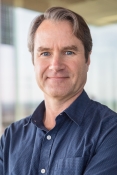
Shawn Newsam is a Professor in the Computer Science & Engineering (CSE) Department at the School of Engineering, University of California, Merced . His work focuses on developing advanced computational methods to extract meaningful insights from complex datasets. Ph.D. (2004) from UC Santa Barbara M.S. (1996) from UC Davis B.S. (1991) from UC Berkeley Newsam's research in computer vision and machine learning specifically targets: Location-based image analysis for geospatial understanding Texture and pattern recognition in remote sensing data Development of techniques for content-based information retrieval Applications to spatio-temporal, multimedia, and scientific datasets He leads the Computer Vision Lab at UC Merced and has been actively involved in: Graduate education as a member of the EECS (Electrical Engineering and Computer Science) graduate group Research presentations at institutions like Lawrence Livermore National Laboratory and UC campuses Technical advising for projects involving automated annotation of aerial imagery
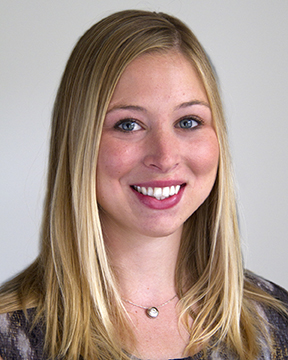
Christa Kiersch is a Professor in the Department of Management at the University of Wisconsin-La Crosse's College of Business Administration. Her teaching portfolio includes courses such as Employee Training & Development, Leadership & Team Development, and Global Consulting Program (study abroad in Bratislava, Slovakia). Ph.D. in Business Administration from Colorado State University (2012) M.S. in Business Administration from Colorado State University (2010) B.S. in Business Administration from University of Iowa (2007) Kiersch's research spans leadership frameworks (authentic/servant leadership), organizational justice, employee engagement, and innovative pedagogical approaches. Recent work explores critical thinking development through classroom exercises, multimedia learning applications, and pandemic-era workplace adaptations. Her publications address topics including: Cognitive Load Theory in course design Virtual teamwork competencies Disability inclusion in post-pandemic workplaces Character-based leadership development These works appear in journals like Management Teaching Review and Journal of Leadership Education . Active in academic service, she collaborates with researchers across disciplines and institutions, with recent presentations at conferences including The Joys of Teaching and Learning (UW System) and Western Academy of Management. She maintains affiliations with professional organizations such as the Society for Industrial/Organizational Psychology and Academy of Management.
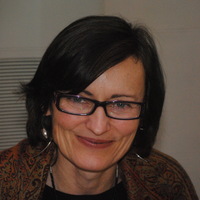
Dr. Norbert Tschakert is a Professor in the Department of Accounting and Finance at Salem State University. He holds the Gassett-Schiller '83 Endowed Chair and teaches courses in forensic accounting, auditing, and advanced accounting. Dr. Tschakert has previously taught at Helmut Schmidt University, San Diego State University, and the University of the Virgin Islands. Certified Public Accountant (CPA) Certified Management Accountant (CMA) Certified Internal Auditor (CIA) Certified Fraud Examiner (CFE) Certified in Financial Forensics (CFF) and Information Technology Professional (CITP) His research focuses on forensic accounting, data analytics integration in auditing, and ethical violations. He has pioneered the use of digital video technology in accounting education and developed case studies on FCPA violations and corporate ethics. Dr. Tschakert has received numerous awards, including the 2024-2025 Fulbright Research Scholar award, multiple AICPA/FSA Innovation in Graduate Teaching Awards, and the Salem State Accounting Association Professor of the Year Award. He serves as Past President of the Northeast Region Section of the American Accounting Association and is an Associate Editor for Accounting Education .
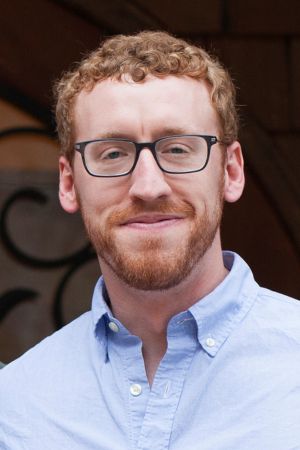
Maria Victoria Aguilar Sebastian is a Professor of Arabic Language at the Department of Arabic and Islamic Studies, Universidad de Murcia since 1992. She coordinates the EALE research group focused on Teaching-Learning of Foreign Languages (Arabic and Spanish) and has led multiple projects on Arabic language education in multicultural contexts. Doctorate from Universidad Complutense de Madrid (1991) Specializes in Arabic as a Foreign Language (TAFL), Diglossia, and Moroccan Dialect Developed comprehensive Arabic teaching methodologies including Nishan, Alatul, and Letters and Meanings series Her research explores the integration of Arabic varieties in Spain's educational system, challenging traditional dissociation between Modern Standard Arabic and Darija. She has contributed to the European Reference Framework adaptation for Arabic instruction. Key publication trends show focus on: Communicative approaches for Arabic learning Technology-enhanced language instruction Dialectal and standard Arabic co-teaching Arabic language policy in Europe Historical sociolinguistics in al-Andalus
Scott Hotaling is an Assistant Professor at Utah State University's Watershed Sciences department, specializing in climate resiliency. His work bridges global change biology , natural resource management , and genomic adaptation in alpine ecosystems. Climate adaptation strategies Mountain biodiversity conservation Water security research Genomic insights into aquatic insects Research Focus Hotaling investigates climate change impacts on glacial ecosystems , evolutionary genomics of cold-adapted species , and policy-driven solutions for environmental resilience . His studies span topics like snow algae dynamics , stonefly genetics , and rock glacier hydrology . Scientific Recognition Innovator of the Year, 2024 – USU Office of Sustainability He leads the Climate Adaptation Intern Program (2023–ongoing) and Mountain Futures (2023–ongoing), while contributing to Utah’s climate outreach (2022–ongoing). His lab also produces multimedia content on glacier ecology and mountain stream systems.
Juan-Manuel Torres Moreno is an Associate Professor (Maître de Conférences HDR HC) at the University of Avignon (UAPV), where he conducts research in Natural Language Processing at the Laboratoire Informatique d'Avignon (LIA). His academic position includes the HDR (Habilitation à Diriger des Recherches), a post-doctoral qualification in France that enables supervision of PhD students. His primary research interests focus on Natural Language Processing, with particular emphasis on automatic text summarization, sentence generation, and phrase compression algorithms. His work spans both theoretical and applied aspects of NLP, incorporating machine learning techniques and artificial intelligence approaches. His research has significant applications in multilingual processing, text mining, and information extraction systems. Torres Moreno's publication record demonstrates a consistent trajectory in advancing text summarization techniques, with recent work exploring cross-lingual approaches, multimedia content processing, and deep learning applications. His research often bridges the gap between theoretical linguistic concepts and practical implementation, with publications spanning from fundamental NLP algorithms to applied systems for video summarization, speech processing, and multilingual document analysis. He actively collaborates with researchers across multiple institutions including École Polytechnique de Montréal (with 50 joint publications), Laboratoire Informatique d'Avignon (83 publications), and Universidad Nacional Autónoma de México. His work appears in reputable journals such as Computer Speech and Language, Data and Knowledge Engineering, and Pattern Recognition Letters. Within the Laboratoire Informatique d'Avignon, Torres Moreno contributes to the Language Processing research theme, working with colleagues on projects related to multilingual information access, opinion mining, and text analysis. His research group has participated in several evaluation campaigns including DEFT (Défi Fouille de Textes) challenges, focusing on information retrieval and sentiment analysis tasks.
Patrick Blumschein serves as Academic Director and Head of ZELF (Center for Teacher Training) at the Freiburg University of Teacher Education, where he also leads the Department of Educational Research and School Pedagogy within Faculty 1 (Institute of Educational Science). He holds a doctorate from the University of Freiburg (2003) and has been with the PH Freiburg since 2011, serving as Head of ZELF since 2015. His research focuses on educational science, instructional design, blended learning, and teacher training. Blumschein designs continuing education courses for teachers in Baden-Württemberg, making new research findings accessible through ZELF's quality framework-based courses that offer ECTS credits and can contribute to Master of Arts degrees through the MAPLE concept. His recent publications demonstrate a strong focus on hybrid learning environments, model-based instructional approaches, and the integration of technology in education. His work spans theoretical foundations of instructional design to practical applications in teacher training and corporate education settings. Blumschein actively collaborates with external partners, including Daimler AG since 2016, conducting educational needs analyses and developing prototype learning environments, particularly exploring virtual reality applications for continuing education. Since 2015: Head of Centre for Teacher Training at PH Freiburg Since 2011: Institute of Educational Science at PH Freiburg 1998-2011: Research Associate at University of Freiburg 2003: Doctorate at University of Freiburg 1997: Master's degree in Sociology, History and Educational Science His work on projects like MUSE (Master for Teaching and School Development) and MAPLE demonstrates his commitment to flexible, research-based teacher education that accommodates working professionals while maintaining academic rigor.
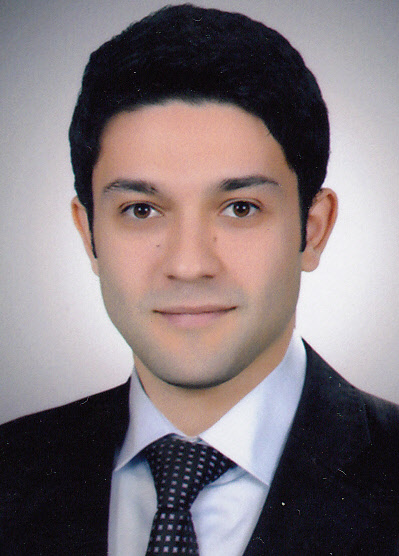
Octavian Mihai Machidon is an Assistant Professor at the Faculty of Computer and Information Science (FRI), specializing in mobile computing, IoT systems, and approximate computing. His research bridges technological innovation with diverse applications in agriculture, cultural heritage, and smart governance. Current research focuses on energy-efficient mobile systems, UAV-based agricultural monitoring, and smart governance frameworks Previously led H2020 Smart4All AgriAdapt project Recipient of multiple awards for research excellence and innovation His work demonstrates cross-disciplinary impact through projects like Mobiprox (IEEE IoT Journal) and SqueezeSlimU-Net (IEEE Journal of Selected Topics in Applied Earth Observations). Key trends include adaptive algorithms, real-time processing, and sustainable technology integration. 2024 - FRI Special Award for Exceptional Research Achievement 2023 - Agrobiznis 'Best Idea' award for AgriAdapt project As member of the Computer Communications Laboratory , he contributes to digital transformation initiatives and teaches courses in process automation and mobile sensing platform development.
Dr. Christian Hartmann serves as an Academic Councillor and Research Assistant at the Chair of Teaching and Learning with Digital Media within the TUM School of Education since 2020. With a PhD in Educational Science from Ruhr University Bochum (2020) and prior research assistant experience at Ruhr University's Educational Psychology Chair (2015-2020), he brings extensive expertise in digital learning environments. Bachelor's & Master's in Education and History from Ruhr University Bochum Visiting scholar at Carnegie Mellon University's HCI Institute (2016) His research focuses on immersive learning technologies , including: Vicarious failure mechanisms in education Computer-supported cooperative learning (CSCL) Adaptive learning systems with VR/AR Coherence formation in multimedia environments Key publication trends show significant contributions to: Productive failure analysis (2018-2025) Social VR collaboration tools (2023) Immersive technology's impact on special education (2023) AI integration in science education (2025) As a program committee member for DELFI 2022 VR/AR Learning workshop and reviewer for journals like Learning & Instruction , he actively shapes educational technology research. His work has been presented at major conferences including EARLI (Austria 2025, Germany 2024), DGPs Congress (Austria 2025), and AERA Annual Meeting (USA 2025). Current affiliations include the European Association for Research on Learning and Instruction (EARLI) , International Society of the Learning Sciences (ISLS) , and German Society for Psychology (DGPs) . The Immersive Virtual Reality Lab at TUM School of Education serves as his primary research environment.
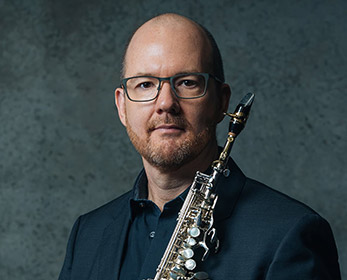
Matthew Styles is a Senior Lecturer in Saxophone Studies at the Western Australian Academy of Performing Arts (WAAPA), Edith Cowan University. He serves as Coordinator of Honours (Music) and is a postgraduate supervisor with extensive experience in musician injury research through collaboration with sports science specialists. As a faculty member, he teaches research preparation courses, creative projects, and woodwind workshops across undergraduate and postgraduate levels. Matthew holds a Doctor of Musical Arts from the University of Western Australia (2008), a Bachelor of Music with Second Class Honours from the same institution, and two Certificate IV qualifications in Training and Assessment (2013 and 2023). His academic journey includes studies at the Royal College of Music, London, and mentorship under renowned saxophonists including Bob Berg, Martin Robertson, Dr. Kyle Horch, Dr. Otis Murphy, and Dr. Eugene Rousseau. His research interests center on cross-genre pedagogy and performance, specifically bridging classical and jazz traditions for classical musicians, and developing injury mitigation strategies for saxophonists through multi-disciplinary approaches with sports science. With over 30 years of professional experience as a saxophonist across jazz, classical, funk, and avant-garde genres, Styles brings practical insight to his academic work. His research outputs demonstrate consistent productivity with publications spanning from 2009 to 2025, showing particular focus on saxophone health, performance techniques, and cross-genre exploration. The publications reveal a trajectory from performance-focused outputs toward increasingly research-intensive work examining health, pedagogy, and interdisciplinary approaches. 2004 Churchill Fellowship HenriSelmerParis Artist D'Addario Artist JLV Sound Ambassador Dr. Styles actively supervises doctoral and master's students, currently serving as Principal Supervisor for three PhD candidates and Associate Supervisor for one PhD candidate. His completed supervision portfolio includes four PhD students as Principal Supervisor and five as Associate Supervisor across diverse musical topics. He has secured research funding including an ECU Early Career Researcher Grant ($23,560) for his project 'Saxology: recasting third stream music for the saxophone' (2014-2015). As director of 'The Phone Co.', he leads performance initiatives that integrate his research interests with practical application. His professional activities extend to membership in the Australian Society for Performing Arts Healthcare (since 2012), Performing Arts Medical Association (since 2015), and Western Australian Music (since 2022), where he serves as a conference reviewer, demonstrating his commitment to advancing knowledge in performing arts healthcare and music education.
Soroush Sabbaghan is an Associate Professor at the Werklund School of Education at the University of Calgary and serves as the inaugural Generative AI Educational Leader in Residence at the Taylor Institute for Teaching and Learning. He also holds the position of Area Chair for Language and Literacy Specialization at the Werklund School of Education. With dual PhDs in Curriculum and Learning from the University of Calgary (2015) and English Language Teaching from Tehran Azad University (2011), his academic journey spans both Canadian and international educational contexts. Dr. Sabbaghan's research focuses on the critical intersection of educational technology, teacher development, and equity, with a particular emphasis on the ethical integration of generative AI in educational settings. His work explores how AI-powered tools can support inclusive and evidence-informed teaching practices across K-12 and higher education environments. He has developed multiple AI applications including REVIA, AI4Equity, CaseCraft, SMARTIE, COERI, and PEARL to enhance teaching and learning experiences while maintaining academic integrity. His scholarly output reveals a clear trajectory toward increasingly sophisticated applications of AI in education, with his most recent publications (2023-2025) centering on ethical frameworks, human-centered AI design, and practical implementations of generative technologies in academic settings. These works collectively address critical tensions between technological innovation and educational values, particularly regarding academic integrity, equity, and professional development. Teaching Award for Experiential Learning (2025) Teaching Award for Teaching in Online Environments (2021) Dr. Sabbaghan has secured significant research funding, including SSHRC grants and multiple University of Calgary Teaching and Learning Grants, to explore AI's impact on education. He actively collaborates with educators across Canada and internationally, serving as Principal Investigator on studies examining co-designed AI tools in teacher education. His leadership extends to directing the Generative AI Resource Development Working Group and co-chairing the Academic Generative AI Working Group at the institutional level. He has also developed numerous AI-powered educational applications through projects like the Math Minds initiative and various teaching innovation grants. As an active member of the AI Community of Practice at the University of Calgary and host of the AI Speaker Series, Dr. Sabbaghan fosters interdisciplinary dialogue about AI's role in education. His work with the International Foundations Program and as Liaison to the Haskayne School of Business demonstrates his commitment to cross-institutional collaboration. His recent development of tools like SMARTIE (an AI-powered course design tool featured in CityNews Calgary) exemplifies his practical approach to translating research into classroom applications.
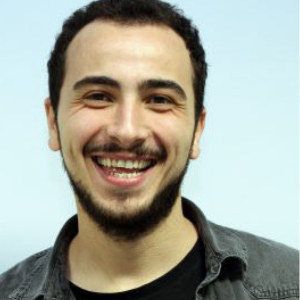
ÖNDER ÇANGAL is an Associate Professor at Gaziantep University Faculty of Education Department of Turkish and Social Sciences Education since 2024. He previously served as Associate Professor (2022-2024) and Lecturer (2015-2022) at Gaziantep University Turkish Language Teaching Center. His international experience includes teaching Turkish at Yunus Emre Institutes in Belgrade (2021), Algeria (2019-2020), and Bosnia (2012-2015), as well as Turkic studies at Emir Abdulkadir Islamic Sciences University (2019-2020). PhD in Teaching Turkish as a Foreign Language (Hacettepe University, 2016-2020) MSc in Turkish Language Education (Gazi University, 2011-2013) BSc in Turkish Language Teaching (Gazi University, 2007-2011) His research focuses on Turkish as a Foreign Language (TFL) pedagogy, digital language tools, cultural context in language learning, and technology integration in education. With over 27 articles and 20 book chapters, his work examines social media applications, grammar acquisition challenges, and specialized Turkish curricula for migrants and professionals. Scientific recognition includes the 2024 Ziya Gökalp Başarı Ödülü and 2022 Kurtuluş Bilim Ödülü . He designed online Turkish learning portals under national projects and developed cultural immersion programs for Serbian students. His publications analyze Turkish language teaching methods across 18 countries and address writing skill challenges for Syrian and Bosnian learners.
Alessandro Ragano is a Postdoctoral Researcher at the Insight Centre for Data Analytics , where he has been investigating Quality of Experience (QoE) aspects of audio archives and developing data-driven approaches for QoE estimation and audio restoration using deep learning since 2018. Education: MSc in Computer Science and Engineering from Politecnico di Milano (Italy) BSc in Computer Engineering from Università Degli Studi di Salerno (Italy) His research integrates machine learning , audio signal processing , and multimedia quality assessment to improve speech enhancement, audio restoration, and perceptual modeling. Recent trends in his publications focus on self-supervised learning , objective quality metrics , and audio dataset generation with applications in speech separation, music representation, and audio inpainting. He actively contributes to open-source tools like Binamix and AQP for audio research and quality evaluation.
Thomas C Henderson is a tenured Professor at the School of Computing within the College of Engineering at the University of Utah. His research focuses on autonomous systems , computational models , and intelligent machine systems , with specific interests in biosystem simulation, distributed systems, and adaptive algorithms. He has contributed to Bayesian sensor networks , UAS traffic management , and probabilistic logic frameworks for intelligent agents. Current academic appointments since 1989 Adjunct roles in Biomedical Engineering Active in IEEE committees (2024-2025) Research trends in recent publications emphasize autonomous aircraft coordination , probabilistic reasoning , and multi-sensor integration . Key subfields include lane-based airspace modeling, reinforcement learning for UAS, and pseudogradient navigation techniques. His work has received recognition through a Best Paper Award (IEEE 2008) and the US Air Force Summer Faculty Fellowship . Strategic deconfliction protocols Dynamic data-driven applications Structural health monitoring systems He actively mentors undergraduate research through courses like Deep Learning Capstone and Senior Capstone Design . Current grants include "Deep Learning in AI and Robotics" (2024-2029) and "Robust Reasoning using Geometric SAT/PSAT" (2022-2023).
Angelica Duran is a Professor of English, Comparative Literature, and Religious Studies at Purdue University, with a courtesy appointment in Critical Disability Studies. She holds a Ph.D. from Stanford University (2000), an M.A. (1988) and B.A. (1987) from the University of California, Berkeley. Her research spans 16th–21st century comparative literature, focusing on English and Spanish traditions, religious studies, disability studies, and translation theory. She has published extensively on Milton, including monographs and edited volumes exploring his global reception, visual adaptations, and pedagogical applications. Her recent publications examine Milton’s transnational influence, the role of prosthetic sign systems in literary interpretation, and intersections of disability, movement, and theological discourse. She bridges early modern and contemporary analyses, addressing issues of translation, cultural adaptation, and digital humanities. Duran has received two Irene Samuel Memorial Awards for her edited volumes Milton in Translation (2017) and Milton Across Borders and Media (2023). She serves on editorial boards and academic committees, including the Renaissance Society of America's Conference Chair (2022–27). As a comparative literature scholar, she connects European, American, and global traditions, emphasizing religious, diasporic, and pedagogical dimensions. Her work explores how texts traverse ideological, physical, and disciplinary boundaries.