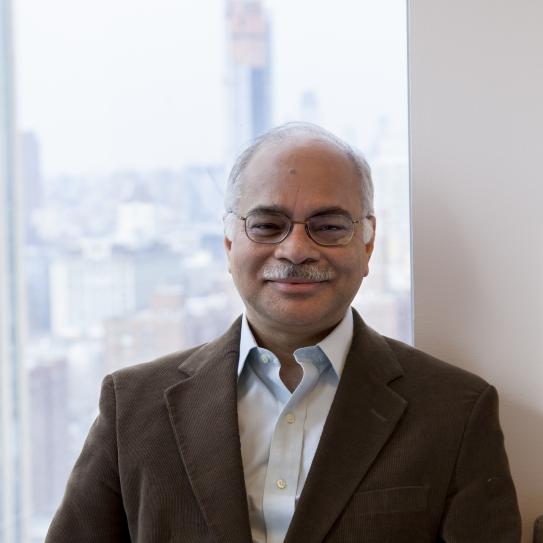
Shivendra Panwar is a Professor in the Electrical and Computer Engineering Department at the NYU Tandon School of Engineering and Director of the New York State Center for Advanced Technology in Telecommunications (CATT). He holds IEEE Fellow and NAI Fellow distinctions. His research focuses on wireless networks (5G/6G, mmWave, terahertz), video distribution over wireless, AR/VR/XR applications, and R&D policy. Education: B.Tech from IIT Kanpur (1981), M.S. and Ph.D. from University of Massachusetts Amherst (1983, 1986). He co-founded the NY City Media Lab and is a member of NYU Wireless. Notable awards include the IEEE Leonard G. Abraham Prize (2004), 2011 Multimedia Best Paper Award, and Sony Research Awards (2016-2017). Recent work addresses challenges in millimeter wave systems, full-duplex cellular networks, and latency-sensitive applications. His contributions span protocol design, network architecture innovation, and economic analysis of telecom systems. He has authored/co-authored influential books on TCP/IP and network management.
Whitney Lew James is an Assistant Professor at the University of Notre Dame, affiliated with the Department of Writing and Rhetoric and the Initiative on Race and Resilience. She teaches a sustainability-themed Multimedia Writing and Rhetoric course and has been active in academic roles since 2013. Ph.D., Rhetoric and Composition, Texas Christian University M.A., Writing and Publishing, Emerson College B.A., Comparative Literature, University of California, Santa Barbara Her research focuses on digital cultural rhetorics , translingual pedagogy , antiracist writing assessment , and disability rhetorics . She examines how digital technologies and pedagogical practices intersect with social justice, equity, and accessibility. Her work engages themes like predictive algorithms and data surveillance in education, digital embodiment , and activist approaches to writing . Articles explore methodologies for digital rhetoric, social media activism, and inclusive assessment frameworks. Outstanding Dissertation Award, Texas Christian University She co-authored works on global writing initiatives and ethical research methodologies, with conference presentations at RSA, CCCC, and Watson Conference. Her teaching emphasizes equitable classroom practices and empowering student voices.
Associate Professor Joel Windle is a prominent academic in cultural and linguistic diversity at the University of South Australia (UniSA), affiliated with UniSA Education Futures. His research focuses on inclusive curricula, multilingualism, and transnational education, with projects spanning Brazil, North America, and Australia. He leads international collaborations like the CAPES-funded 'Multilingualism, linguistic rights and social inequality' and CNPq’s 'Transnational contacts in the periphery.' Windle has received prestigious awards including CNPq Fellowship and FAPERJ State Science Fellowship. His work bridges education and sociology, addressing issues like refugee integration, anti-racist pedagogy, and global literacy practices. He supervises research degrees and contributes to policy discussions on educational equity. His publications include Making Sense of School Choice (awarded multiple sociology prizes) and co-edited volumes on Vietnamese language dynamics and transperipheral research frameworks. Windle’s advocacy for marginalized communities and critical citizenship education underscores his commitment to social justice in education.
Eva Brumberger is a Professor in the School of Applied Professional Studies at Arizona State University (ASU). Her research focuses on visual communication, technical communication, and pedagogical strategies for integrating visual literacy into academic and professional settings. She explores topics such as AI-generated imagery bias, generational differences in visual literacy, and the role of visual rhetoric in education. Her work bridges academia and industry, emphasizing the importance of aligning curricula with workplace needs. Key themes include the evolution of technical communication in Web 2.0 environments, intercultural visual communication, and the application of eye-tracking technology to study expertise and perception. Brumberger’s publications highlight innovative research methods and interdisciplinary approaches, such as combining qualitative and data-driven analysis. Her contributions span curriculum design, workplace communication practices, and the ethical implications of emerging technologies like AI in visual content creation. While no formal awards or grants are listed, her extensive publication record reflects sustained engagement with visual communication challenges across diverse contexts. She advocates for integrating technological fluency into communication education to prepare students for evolving professional landscapes.
Associate Professor at Nanyang Technological University's College of Computing and Data Science, serving as Deputy Director of the Cyber Security Research Centre @ NTU (CYSREN) and Associate Director of the NTU Centre Computational Technologies for Finance (CCTF). His research focuses on building trustworthy, efficient, and intelligent systems with emphasis on security and privacy across AI, robotics, and cloud infrastructures. Educational background: Bachelor of Physics, Peking University, 2011 Ph.D. in Electrical Engineering, Princeton University, 2017 Research spans five core domains: Generative AI Safety (vulnerability identification, safety testing, misuse detection), Deep learning security (adversarial examples, backdoor attacks, privacy protection), Robotics security (perception system attacks, safety testing), Machine learning optimization (workload scheduling, acceleration), and Computer architecture security (side-channel defenses, cloud security). His work bridges theoretical security with practical system implementations across diverse applications. Recent publications (2024-2026) reveal intense focus on securing generative AI systems, particularly text-to-image models and large language models, with significant contributions to red teaming methodologies, backdoor attack mitigation, and multimodal security. Emerging trends show expanding research into autonomous vehicle security and privacy-preserving machine learning with cryptographic techniques. Key awards include: Distinguished Artifact Award (CCS 2024) Stamatis Vassiliadis Best Paper Award Nominee (FPL 2024) Outstanding Paper Award (ACL 2024) Distinguished Artifact Award (Usenix Security 2024) Actively supervises PhD students and research staff while leading multiple high-impact grants: Ongoing: NRF CREATE Quantum Security (2025-2029), Continental NTU Corp Lab Automotive HPC (2025-2028), CRPO EV Charging Security (2025-2027) Completed: MoE AcRF Tier2 IP Protection (2022-2025), NTU S-Lab Efficient GPU Scheduler (2020-2025) Leads research within CYSREN and TAICeN (Trustworthy AI Centre NTU), directing interdisciplinary teams that investigate security threats across AI deployment stacks while developing practical defenses for real-world systems.
Rebecca Morris is a Teaching Professor at the University of Pittsburgh’s School of Computing and Information. She holds a PhD and MLIS from the University of Pittsburgh and a BS in Elementary Education from Penn State University. Her career spans roles as an elementary teacher, middle school librarian, and academic faculty member. Morris has served as an Assistant Professor at the University of North Carolina at Greensboro (2013–2016) and Simmons University (2011–2013). During parental leave, she worked part-time as adjunct faculty at McDaniel College and UNCG. Her research focuses on school librarianship, digital storytelling, and educational methodologies. Key areas include resilience in librarians during crises, leadership development programs for school librarians, and the intersection of AI with education. She has published widely on topics like Common Core integration, STEM collaboration, and library website usability. Morris’s work emphasizes practical applications of theory in K-12 settings. Her recent scholarship highlights narrative approaches to professional development and ethical considerations in emerging technologies. She actively contributes to professional organizations like ALISE through SIG sessions and leadership roles.
Patrizio Campisi is a Full Professor in the Section of Applied Electronics at the Department of Engineering, Roma TRE University, Rome, Italy. He leads cutting-edge research in digital signal and image processing with applications to secure multimedia communications and biometrics. He has held visiting positions at the University of Toronto, Beckman Institute (UIUC), and École Polytechnique de Nantes, and has been a Marie Curie Fellow (2010–2014). His educational background includes a Laurea (summa cum laude) in Electronic Engineering from Sapienza University of Rome and a Ph.D. in Electrical Engineering from Roma TRE University. His research focuses on secure biometric recognition (signature, keystroke, EEG, vein), digital watermarking, blind image deconvolution, HDR imaging, and privacy-preserving technologies. He has contributed significantly to template protection, multimodal biometrics, and forensic image analysis. His work bridges engineering, computer science, and security, with strong applications in mobile authentication, border control, and social media safety. The recent publications reflect a strong trend in biometrics, image forensics, and privacy-enhancing technologies, with a focus on real-world applications in mobile systems, healthcare, and law enforcement. Key themes include secure authentication, de-identification, and computational imaging. IEEE Second International Conference on Biometric Systems 2008 Best Student Paper Award IEEE Biometric Symposium 2007 Best Paper Award IEEE International Conference on Image Processing 2006 Best Student Paper Award Marie Curie Fellow (2010–2014) NATO-CNR Advanced Fellowship (2003) IEEE Senior Member Prof. Campisi has supervised numerous students and leads the BioMedia4n6 lab. He has secured major EU grants including H2020 projects AMBER, COSMOS, and ENCASE. His editorial leadership includes serving as Editor-in-Chief of IEEE Transactions on Information Forensics and Security (2018–2020) and Chair of the IEEE Information Forensics and Security Technical Committee (2017–2018). He is actively involved in research networks such as COST Actions on de-identification and biometrics-forensics integration, and has contributed to EU policy via the BEST Thematic Network on biometrics and fundamental rights. His lab, BioMedia4n6, focuses on biometrics, multimedia forensics, and privacy-aware systems.
Dr. Mohamed E. ElAraby is a faculty member at Beni-Suef University's Faculty of Computer and Information, Egypt, with prior affiliation at Mansoura University. His academic work centers on cutting-edge technologies in computer science, particularly machine learning, cloud computing, and IoT, applied to healthcare and information systems. His research focuses on developing intelligent systems for real-world challenges, especially in pandemic prediction and data retrieval. Using advanced machine learning models and cloud-based architectures, he has pioneered innovative solutions such as IoT-driven COVID-19 prediction frameworks and elastic web crawlers for multimedia and facial data retrieval. The recent publications demonstrate a strong trend in leveraging internet-sourced data and cloud infrastructure to build robust, scalable health informatics and intelligent systems. His work bridges theoretical AI advancements with practical applications in public health and information access. Scientific Sponsorships: GlaxoSmithKline M.J. Murdock Charitable Trust Dr. ElAraby has secured research funding from prominent organizations, indicating strong industry-academia collaboration. While no formal students are listed, his publication record suggests active mentorship and research leadership. He contributes significantly to journals like Biomedical Signal Processing and Control and Multimedia Tools and Applications , reflecting high academic engagement. His work is supported by advanced computing labs focused on AI, IoT, and cloud systems, though specific lab names are not mentioned. These teams likely focus on developing next-generation intelligent systems for healthcare and data science applications.
Wojciech Samek is a Professor in the Department of Electrical Engineering and Computer Science at the Technical University of Berlin and Head of the AI Department at Fraunhofer Heinrich Hertz Institute (HHI), Germany. He holds a joint appointment, bridging academic research and industrial application in artificial intelligence. He is a Fellow at BIFOLD and ELLIS Unit Berlin, and a Principal Investigator in several DFG projects including DeSBi and BIOQIC. PhD (Dr. rer. nat.) with distinction, Technical University of Berlin, 2014 Studies in Computer Science, Humboldt University, Heriot-Watt University, University of Edinburgh His research centers on Explainable AI (XAI) , Trustworthy Deep Learning , and Efficient AI . He pioneered Layer-wise Relevance Propagation (LRP), a foundational method for interpreting deep neural networks. His work spans model interpretation, robustness against adversarial attacks, neural network compression, federated learning, and applications in healthcare, communications, and multimedia. The recent articles highlight a strong trend toward extending explainability beyond deep models , with research on concept-level explanations, unsupervised learning interpretability, and XAI-driven model improvement. There is a consistent focus on robustness, privacy, and efficiency in distributed learning settings, particularly for federated and edge AI. Applications in medical AI and neuroscience are prominent, emphasizing safety and interpretability in high-stakes domains. Best Paper Award, Pattern Recognition (2020) Digital Signal Processing Best Paper Prize (2022) Fellow, BIFOLD - Berlin Institute for the Foundation of Learning and Data Member, Germany's Platform for Artificial Intelligence Senior Editor, IEEE TNNLS; Associate Editor, Pattern Recognition, Digital Signal Processing, PLoS ONE Area Chair, NeurIPS, ICML, NAACL Program Chair, IEEE MLSP 2023 Contributor to ISO/IEC MPEG-17 NNC standard Prof. Samek advises a large group of PhD students and leads a vibrant research team at Fraunhofer HHI and TU Berlin. His group has secured significant funding through DFG, BIFOLD, and industrial collaborations. He has co-authored over 200 peer-reviewed papers, many of which are ESI Hot or Highly Cited. He is deeply involved in organizing workshops and tutorials on XAI, federated learning, and neural compression at top venues like NeurIPS, ICML, CVPR, and IEEE conferences. His lab develops open-source tools such as the LRP Toolbox , Keras Explanation Toolbox , DeepCABAC , and Quantus , promoting reproducibility and adoption of interpretable and efficient AI methods. The team is actively working on next-generation AI that is not only accurate but also transparent, robust, and trustworthy.
Nino Auricchio is a Senior Lecturer in Sound Engineering at the University of West London, School of Computing and Engineering. He leads the BSc (Hons) Sound Engineering and BSc (Hons) Audio Software Engineering programs, and teaches on the MSc Digital Audio Engineering and other acoustics-related degrees. His research lies at the intersection of audio engineering, music technology, and cognitive perception. Key interests include timbre and emotional responses in electronic dance music, modular synthesizer performance, and intelligent systems for audio mixing. He applies case-based reasoning to model and recommend audio engineering workflows, bridging AI and practical sound design. His recent publications and creative works reflect a strong trend in both technical innovation and artistic expression. He has published on similarity modeling in audio engineering and the emotional impact of timbre, while also releasing electronic music and performing internationally with modular synthesizers. His work spans academic research, music production, and live performance. Member, Audio Engineering Society Nino Auricchio has been involved in music production as a co-producer and engineer for the funk and soul band Funkshone, releasing albums in the UK and Japan. He has also performed electronic music at festivals and academic venues across Europe. While no formal grants are mentioned, his interdisciplinary work suggests ongoing engagement with music technology research and creative practice. He is associated with performance projects such as 'Cold waves' and 'Télégraphe', and has released on DiN Records. His lab or research group is not explicitly named, but his collaborative work with researchers like Sauer, Roth-Berghofer, and Proctor indicates active participation in a research team focused on intelligent audio systems.
Pari Delir Haghighi is a Senior Lecturer in the Department of Human Centred Computing at Monash University's Faculty of Information Technology. She holds a PhD in Computing (2010) and a Bachelor of Computer Science (Honours) from Monash University (2004). Her research focuses on ubiquitous computing, context-aware systems, mobile health, and AI-driven decision support. She has pioneered solutions for chronic disease management, emergency response systems, and healthcare data integration. Notable projects include developing the DO4MG ontology for emergency management, AI-powered construction safety systems, and mobile interventions for eating disorders. She has led 13 research projects, including collaborations on digital health, safety engineering, and body image interventions. Her work aligns with UN Sustainable Development Goals related to health and education. Teaching contributions include awards for Honours supervision (2014) and student learning excellence (2020). She teaches courses such as Mobile and Distributed Computing Systems and Systems Analysis and Design. Pari actively organizes conferences like the International Conference on Advances in Mobile Computing and Multimedia. Her lab, the Data Visualisation and Immersive Analytics Research Lab, explores innovative visualisation techniques. Current research emphasizes culturally inclusive digital health interventions, LLM auditing for harmful content detection, and IoT middleware benchmarking. She advises on interdisciplinary projects, fostering collaboration between IT and healthcare sectors.
Professional Overview Katrina Tour is a Senior Lecturer in the Faculty of Education at Monash University, specializing in digital literacies and their application in English as an Additional Language (EAL) contexts. She leads research on how digital technologies empower refugee and migrant communities, focusing on education, employment, and policy. Her roles include Course Leader for MTESOL and expertise in generative AI, multimodal composing, and strengths-based practices. Educational Background Began career as a school teacher in Belarus. Taught English and Spanish across primary to tertiary levels before moving to Australia. Completed postgraduate studies at Monash University, including an Australian Postgraduate Award (2010). Research Interests Dr. Tour's work centers on digital literacies in EAL/TESOL, with projects exploring: Technology use in refugee/migrant education. Generative AI applications for language learning. Strengths-based pedagogies and policy development. Visual methodologies and sociocultural theories. Recent Projects & Media Recent initiatives include the AMEP Digital Literacies Framework (2021–2022) and contributions to media discussions on AI in language learning. Her work aligns with UN SDGs related to quality education and reducing inequalities. Awards & Recognition Recipient of Best Paper Award (2021). Dean's Award for Teaching and Learning (2023). ACTA Conference Scholarship (2018). Professional Engagement Leads the Digital Literacies in EAL Special Interest Group and chairs the Digital Technologies Advocacy Group (Australian Council of TESOL Associations). Active in international conferences, delivering keynote speeches on refugee empowerment and AI integration.
Prof. Toktam Mahmoodi is a Professor of Communications Engineering at King's College London, affiliated with the Department of Engineering under the Faculty of Natural, Mathematical & Engineering Sciences. She leads the Centre for Telecommunications Research, focusing on advanced networking, edge computing, and 5G/6G technologies. Her academic journey includes a BSc from Sharif University of Technology and a PhD from King's College London. Education: BSc in Electrical Engineering, Sharif University of Technology PhD in Telecommunications, King's College London Research Interests: Her work spans ultra-low latency networking, network virtualization, edge intelligence, and sustainable communication systems. She explores integration of cloud and mobile networks, autonomous networks, and energy-efficient solutions. Key areas include federated learning, tactile internet, and telemedicine applications. Grants & Projects: Principal Investigator for the Native Sensing in 6G Networks - Capgemini project (2023-2027). Co-Investigator in the VERGE project for AI-driven edge architectures (2023-2025). Lead in the ANIARA initiative for connected car communications (2020-2022). Pioneered projects like SoftEdge Networking and Primo-5G for immersive telepresence. Labs & Teams: Director of the Centre for Telecommunications Research, a global leader in telecommunications and cybersecurity research.
Dr Sandra Gaudenzi is a globally recognized academic and practitioner in interactive narratives, particularly in interactive documentaries (i-docs). She holds a Visiting Professor role at the University of Westminster, where she co-leads the Digital and Interactive Storytelling LAB MA program. She also serves as a Visiting Fellow at the Digital Cultures Research Centre (UWE, UK), co-directing the i-Docs conference and co-editing the foundational text i-docs: The Evolving Practices of Interactive Documentary . Her professional background spans factual television production and over two decades of research, teaching, and consulting in digital storytelling. Gaudenzi's research focuses on interaction design in digital narratives, storytelling ideation processes, and co-creative methodologies. Notable projects include the Corona Haikus collaborative pandemic response project and her role as Creative Director of the BBC Taster's DigitalMe interactive experience. Her PhD, The Living Documentary , explores participatory reality co-creation in digital documentaries. She has presented at over 30 international conferences since 2013, including talks on AR in crisis communication, immersive trends, and ethical AI in storytelling. Gaudenzi pioneered the !F Lab training initiative (2015–2018), developing the WHAT IF IT ideation process for interactive narratives, documented in her !F Lab Field Guide . Her work bridges academic research with industry practice through workshops, symposia, and collaborative productions across Europe and South America.
Qingzhao Zhang is an incoming Assistant Professor in the Department of Electrical and Computer Engineering at the University of Arizona, starting in Fall 2025. Previously, he completed his Ph.D. at the University of Michigan under the supervision of Professor Z. Morley Mao. His academic journey bridges computer science, electrical engineering, and cybersecurity disciplines with a focus on practical security applications. Dr. Zhang's research spans computer security at the intersection of system security, artificial intelligence, and cyber-physical systems. His work addresses critical security challenges in safety-critical applications, particularly connected and autonomous vehicles. His research methodology combines formal verification, system building, and security analysis to develop practical solutions for real-world security problems. His expertise extends to blockchain security, industrial control systems, and AI security, demonstrating a broad yet cohesive research vision. Analysis of Zhang's recent publications reveals a consistent focus on security challenges in emerging technologies, with a particular emphasis on autonomous systems. His work demonstrates strong technical depth across multiple domains, from low-level network protocols to high-level AI systems. The trajectory of his research shows increasing sophistication in addressing complex security problems in cyber-physical systems, with recent work expanding into large language model security. Reviewer for ICLR 2025, ICRA 2025, ACM Multimedia 2024 Artifact Evaluation Reviewer for Usenix Security 2022 Pre-Review Task Force for NSDI 2025 Teaching experience in Multidisciplinary Design Program at University of Michigan (2022-2023) Dr. Zhang is actively recruiting PhD students for Fall 2026 and research interns. His research group focuses on developing security solutions for next-generation AI and cyber-physical systems, with particular emphasis on autonomous vehicles and critical infrastructure security. He maintains strong industry connections through his applied research in automotive security and blockchain technologies.