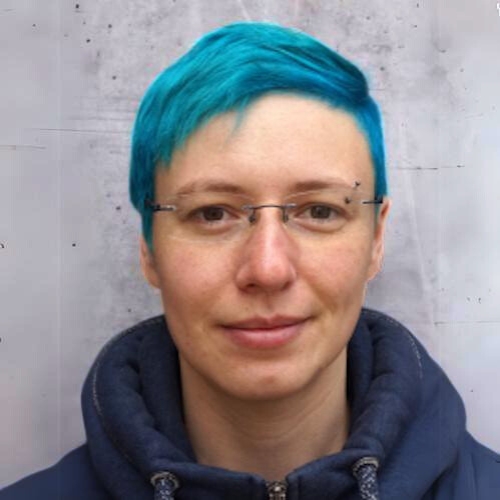
Carsten Levisen is an Associate Professor at the Department of Communication and Humanities, Roskilde University. His research spans sociocultural linguistics, linguistic anthropology, and interdisciplinary studies in semantics, pragmatics, and discourse analysis. Key research areas include: Cultural Semantics Intercultural Pragmatics Postcolonial & Decolonial Linguistics Construction Grammar Green Semantics & Environmental Linguistics Visual & Color Semantics His recent publications focus on blue pragmatics, danger discourse, and postcolonial metalanguage. He collaborates internationally through the Natural Semantic Metalanguage research community and holds editorial roles in journals like Journal of Postcolonial Linguistics and Scandinavian Studies in Language . He has received fellowships such as the ANU Hansen Friendship Scholar (2025) and Senior Research Fellow at Hanse-Wissenschaftskolleg (2019-2020).
Israfel Salazar is a Research Fellow at the Department of Computer Science , University of Copenhagen, affiliated with the Natural Language Processing research group . His work focuses on multimodal understanding and representation, bridging natural language processing, machine translation, computer vision, genomics, and historical data analysis. Email : israfel.salazar@di.ku.dk Phone : +4535337068 Research interests include: Culturally aware multimodal machine translation Massively multilingual vision evaluation Genomic offset statistics Temporal data extraction from historical documents His recent publications highlight interdisciplinary approaches combining language and vision systems, statistical modeling for biological data, and historical record analysis. He contributes to benchmarking frameworks and evaluation methodologies for modern AI applications. Israfel's work spans both foundational and applied research domains, with a focus on cross-modal learning, computational methods in bioinformatics, and automated analysis of historical archives. His projects often require hybrid techniques integrating linguistic and visual modalities. He operates within the Natural Language Processing section at DIKU, which also hosts research into probabilistic programming applications in bioinformatics, computer vision integration with NLP, and energy-efficient computational frameworks. Collaborations with other DIKU groups (e.g., FUTHARK for GPU acceleration, quantum programming) may inform his technical implementations.
Vésteinn Snæbjarnarson is a Research Fellow at the Department of Computer Science , University of Copenhagen , affiliated with the Pioneer AI (P1AI) research group. His work spans Natural Language Processing and Machine Learning , focusing on language model interpretability, sentiment analysis, and efficient model architectures. Research Interests: His research examines the intersection of language model steering , emotional response analysis , and resource-constrained AI . Key areas include adversarial robustness, open-set recognition, and sentiment detection in Icelandic text. Recent Trends: 2024 publications highlight advancements in quantized model optimization , multilingual sentiment datasets , and neural network security , with applications to both technical AI (computer vision, language modeling) and human-centric AI (emotional impact of geohazards).
Lucas Alexander Kock is an Instructor at the Department of Computer Science , University of Copenhagen . His research spans Machine Learning and its applications in diverse domains including medical data analysis, quantum computing, and sustainable AI. Role: Lecturer in Machine Learning Affiliation: SCIENCE AI Centre, University of Copenhagen Research interests focus on: Quantum machine learning Neuroscience applications Cross-cultural AI systems Environmental sustainability in computing Medical informatics Deep learning explainability Recent publications demonstrate expertise in quantum computing applications , neural signal interpretation , and ethical AI frameworks . No formal awards or advisees are listed in available public data.
Daniel Nicholas Mølhave is an Instructor at the Department of Computer Science (DIKU) , University of Copenhagen, located at Universitetsparken 1, 2100 København Ø. His work is associated with the Natural Language Processing (NLP) section, which focuses on methods for automated text processing, understanding, and generation using statistical models and machine learning. University affiliation: University of Copenhagen Department: Department of Computer Science (DIKU) Email: damo@di.ku.dk The NLP section at DIKU engages in cutting-edge research spanning core areas such as: Natural language understanding Multi-modal machine learning Explainable AI Visually-grounded language learning Cross-lingual NLP Language technologies Research applications include machine translation, misinformation detection, image captioning, and multilingual multimodal representation learning. The section contributes to the SCIENCE AI centre and offers courses in the Bachelor's and Master's programs in Computer Science, Machine Learning, and Data Science.
Tobias Nordholm-Højskov is an Instructor at the Department of Computer Science , University of Copenhagen (DIKU). His research intersects machine learning with healthcare, sustainability, and quantum computing, focusing on theoretical foundations and applications in medical data analysis, climate-aware AI, and quantum systems. He is affiliated with the SCIENCE AI Centre and contributes to projects like QDarts (quantum dot array simulation) and TreeSense (remote sensing for environmental monitoring). His work spans diverse subfields, including Explainable AI for healthcare records Federated Learning in rare disease research Quantum-inspired neural networks Retrieval-Augmented Generation frameworks Environmental impact mitigation in AI
Rob van der Goot is an Associate Professor in Data Science at the IT University of Copenhagen. His affiliations include the NLPnorth group and the Pattern Recognition Revisited lab . His research focuses on Natural Language Processing (NLP), with emphasis on language modeling, lexical normalization, and computational job market analysis. Key contributions include the development of the EEVEE annotation tool, studies on language model biases, and cross-lingual parsing techniques. He has received prestigious awards such as the Best Paper Award at W-NUT 2022 and the Outstanding Paper Award at EACL 2021 . His work spans projects like the Pioneer Centre for Artificial Intelligence (funded by the Danish National Research Foundation) and Multi-Task Sequence Labeling Under Adverse Conditions (funded by Amazon). His research also intersects with societal impacts, addressing bias in AI systems and improving NLP tools for under-resourced languages. Media engagements include discussions on AI adoption in Danish municipalities and business applications. His publications (48+) span topics from domain adaptation to large language model evaluation, emphasizing practical NLP solutions and reproducible research practices.
Michele Coscia is an Associate Professor in the Department of Data Science at the IT University of Copenhagen. He also serves as the Head of Programme for the BSc in Data Science. His research focuses on network analysis, social networks, data mining, and their applications in understanding human mobility, complex systems, economic development, and memetics. He has contributed to projects such as the Pioneer Centre for Artificial Intelligence and leads initiatives like ROMNET (Past social network reconstruction from material culture data) and Work2Vec (exploring deep learning in healthcare and work hours analysis). His research interests encompass interdisciplinary network science, including misinformation dynamics, ideological polarization, and the impact of social media systems. He has developed methodologies like the generalized Euclidean measure for multilayer networks and explored cultural data analytics through case studies like Italian music history. His work also addresses real-world challenges, such as quantifying the effects of violence on migration patterns and optimizing network sampling strategies for cost efficiency. Michele Coscia has received the Årets Forskningsmiljø 2022 award, recognizing his contributions to fostering outstanding research environments. He actively engages with media, discussing topics like misinformation and data visualization. As a principal investigator, he oversees projects funded by institutions such as the Villum Foundation and Danish National Research Foundation. His research spans academic collaborations across countries, reflecting his global network and commitment to advancing network theory and its applications.
Kristoffer Laigaard Nielbo is a Professor at Aarhus University’s School of Culture and Society - Center for Humanities Computing , specializing in computational methods for humanities research. He contributes to AI-driven cultural heritage projects, literary analysis, and mental health diagnostics using electronic health records. His work bridges machine learning with literary theory, social media analysis, and historical data processing. Current Projects : Golden Imprints of Danish Cultural Heritage (2023–2026), CLAI: Center for Language Generation and AI (2023–), SOCIAL MEDIA INFLUENCE (2023–2028). Previous Awards : Best Paper Award (2020), Videnskabsministerens EliteForsk-rejsestipendier (2010). Research Interests : Nielbo focuses on Computational Humanities , Quantitative Text Analysis , and Artificial Intelligence . His work includes modeling literary complexity, analyzing sentiment arcs, and developing multimodal frameworks for cultural data. He also explores AI ethics, fairness in literary criticism, and digital diplomacy. Article Trends : Recent publications emphasize machine learning applications in literary studies (e.g., canonicity, genre asymmetries) and mental health prediction models . He contributes to meme analysis in international relations , multimodal AI for art, and Scandinavian language benchmarks , reflecting interdisciplinary expertise. Scientific Awards : Best Paper Award at ACL (2020) EliteForsk Rejsestipendier (2010) Collaborations : Nielbo co-leads projects like TEXT: Center for Contemporary Cultures of Text (2025–2031) and collaborates with institutions including Carlsberg Foundation and PSYCOP cohort. He actively participates in conferences and AI ethics discussions.
Hanne Bruun Søndergaard Knudsen is an Associate Professor at Aalborg University's Department of Communication and Psychology, affiliated with The Faculty of Social Sciences and Humanities. She leads the Reading Cognition research group and supervises at Børnesprogklinikken (Child Language Clinic) under the Clinic for Rehabilitation. Her roles include teaching developmental psychology, psychological testing, and interventions for children with DLD, ADHD, autism, and reading difficulties. Research focuses on DLD, reading comprehension, executive functions, and interventions for psychosocial consequences of language disorders. Active in European networks like COST Action CA21131 and collaborates on projects such as MeRID (Cross-linguistic Sentence Processing) and MultiplEYE (Multilingual Eye-tracking). Research highlights include eye-tracking studies on reading cognition, multilingualism effects, and pilot interventions for writing strategies (SRSD) in Danish classrooms. She has contributed to over 40 publications, including work on DLD screening critiques and the psychosocial well-being of adolescents with DLD. Grants include funding from the Swiss National Science Foundation and Croatian Science Foundation for cross-linguistic reading research. She supervises psychology students and participates in national and international conferences.
Jana Lasser is Professor for Data Analysis at the University of Graz and leads the Complex Social & Computational Systems research group at the interdisciplinary IDea_Lab. She is also Associate Faculty at the Complexity Science Hub Vienna (CSH), reflecting her deep engagement with complex systems research across institutions. Her educational background includes a PhD in Physics from Georg-August-University of Göttingen, based on research at the Max Planck Institute for Dynamics and Self-Organization. She held postdoctoral and visiting positions at the Medical University of Vienna, Graz University of Technology (as a Marie Curie Fellow), and RWTH Aachen (as interim professor) before joining the University of Graz in 2024. Her research centers on emergent phenomena in complex social systems, using machine learning, data science, NLP, and computational modeling. Key interests include misinformation, counterspeech, social media algorithms, mental health in academia, and pattern formation in geophysical systems. She is a leading voice in open science, data literacy, and reforming academic culture. Her recent publications (2023–2025) reveal a strong interdisciplinary trend, bridging computational social science, public health, political communication, and geophysics. Many papers focus on misinformation, political discourse, and algorithmic governance, often using large-scale social media data. Others explore mental health, academic labor, and foundational geophysical processes, demonstrating her wide-ranging analytical expertise. ERC Starting Grant 101160928 (DeSiRe) FWF standalone project P 37280-N netidee SCIENCE prize Open Knowledge Fellow of the Wikimedia Foundation (2019/2020) Marie Curie Fellow Jana Lasser actively mentors and advises through her leadership of major research projects and initiatives. She leads the Survey Special Interest Group in the COST Action on Researcher Mental Health and co-founded the Network Against Abuse of Power in Science. Her research has been supported by prestigious grants including an ERC Starting Grant and FWF funding. She has developed and taught numerous open-access courses in computational social science, Python, and data literacy, emphasizing reproducibility and educational outreach. She leads the Complex Social & Computational Systems research group at IDea_Lab and is a key figure in the Complexity Science Hub Vienna. Her work on the Schwurbelarchiv and agent-based models for healthcare resilience demonstrates her leadership in building and utilizing large-scale data infrastructures for societal benefit.
Ernests Lavrinovics is a PhD fellow at the Department of Computer Science , Aalborg University , affiliated with the Technical Faculty of IT and Design and Data, Knowledge and Web Engineering research group. His work focuses on Natural Language Processing (NLP) , Large Language Models (LLMs) , and addressing challenges in machine translation and knowledge graph integration for resource-poor languages. His research explores critical NLP themes including hallucination detection in LLMs , adapter-based regularization techniques for multilingual transfer, and multitask benchmark development for creole languages. He contributes to datasets like MultiHal and CreoleVal , emphasizing semantic grounding and cross-lingual evaluation. Recent publications analyze adapter architectures as regularizers in low-resource settings (ACL 2025) He co-developed MultiHal (2025), a multilingual dataset for LLM hallucination evaluation His work spans knowledge graph applications , transfer learning , and multilingual representation challenges As an active academic, he has organized events like the Copenhagen NLP Symposium (2025) and AAU NLP Symposium (2024). He participates in technical programs at venues such as ACL and MRL Workshops , with citations in Scopus and Mendeley readership.
Susana S. Fernández is a Professor at the Department of German and Romance Languages, School of Communication and Culture, Aarhus University, Denmark. She holds leadership roles as head of the Study Board for Theoretical Pedagogical Education for Upper Secondary School Teachers, co-head of the research program Language and Communication , and head of the research unit Language Acquisition and Pedagogy . Her research is centered on foreign and second language pedagogy, with a strong emphasis on intercultural semantics and pragmatics, grammar teaching, teacher cognition, and Spanish linguistics. Her research interests include: Foreign and second language pedagogy Intercultural semantics and pragmatics Grammar instruction and teacher cognition Spanish language acquisition Corpus linguistics and Spanish linguistics Pragmatic competence in adult learners The recent publications (2020–2025) reflect a consistent focus on communicative language teaching, intercultural competence, and the cognitive aspects of grammar instruction. Her work bridges theoretical linguistics with practical classroom applications, particularly in Danish as a second language for adult migrants and teacher training contexts. She frequently engages in national discourse on language education policy. Her scientific awards include: To-årigt post-doc stipendium (2007) for research on cognitive-based grammar teaching Velux Foundation stipendium (2022) Susana S. Fernández actively supervises and mentors through her leadership in research programs and projects. She has led or participated in numerous research projects, including the Velux-funded Danish in the Making , and contributes to academic service through peer review, editorial work, and organizing workshops and conferences. Her work is supported by external grants and institutional collaboration. She is actively involved in research networks and collaborative projects such as Emancipatory Ethnopragmatics and Ethnopragmatics for Intercultural Competence (EPIC) , which aim to integrate cultural values and communicative styles into language education. Her current projects extend into 2027, indicating sustained research activity.
Luca Maria Aiello is a Professor and Data Science Research Group Leader at the IT University of Copenhagen 's Department of Digital Design. He heads the education program for the Master of Data Science degree while co-leading the Networks, Data, and Society research group. His research spans computational social science , social media analysis , and network science , with recent focus on: Urban social connectivity patterns Sleep quality and social dimensions Financial collective action on Reddit COVID-19 pandemic's impact on dreaming Climate change discourse on TikTok Current research projects include COCOONS (Collective Coordination through Online Social Media) funded by the Carlsberg Foundation (2023-2025), and multiple grants for the International Conference on Computational Social Science (IC2S2) from Danish Data Science Academy and Otto Mønsteds Fond. Dr. Aiello has received significant recognition including the 2022 Research Environment of the Year award, with his work being covered by 16 news outlets , 47 X (Twitter) users , and 3 Facebook pages .
Zi Wang serves as an Instructor in the Department of Computer Science at the University of Copenhagen, located at Universitetsparken 1, 2100 København Ø, with contact via ziwa@di.ku.dk and institutional website https://diku.dk/. Her research concentrates on Natural Language Processing and Computational Linguistics, specializing in multilingual compositional generalization and cross-lingual model evaluation. Key interests include machine translation robustness, language model generalization across linguistic structures, and dataset translation methodologies for NLP benchmarking. Her 2023 ACL publication demonstrates expertise in analyzing how language models handle compositional structures across languages using translated datasets, contributing to advancements in multilingual AI evaluation frameworks. No scientific awards were documented in the source material. No advising relationships or grant funding details were provided. No affiliated research labs or collaborative teams were mentioned.