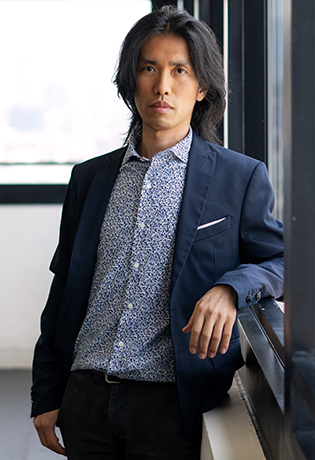
Ryo Ikeshiro is an Assistant Professor at the School of Creative Media, City University of Hong Kong, and co-director of the spatial audio art/research unit SoundLab. His work bridges sound art, computational creativity, and cultural studies through immersive installations, algorithmic audio-visual systems, and sonification techniques. PhD in Creative Practice (Goldsmiths, University of London) MPhil in Music (University of Cambridge) BMus (King's College London) Ikeshiro's research interrogates the materiality of sound through: Multichannel Ambisonics and directional audio Neural network-driven temporal dislocation Sonification of climate data and historical soundscapes Machine learning for artistic interpretation Interplay of identity and technology East Asian ideophonic traditions His 2010-2024 publications and installations reveal cross-disciplinary engagement with: Fractal mathematics in audiovisual art Algorithmic composition systems Interactive installation technologies Sonic cartography Historical memory in sound Collaborative research frameworks SoundLab, which he co-directs, develops spatial audio research at the intersection of: Technical innovation Cultural representation Experimental pedagogy Public engagement International artistic exchange Practice-based research
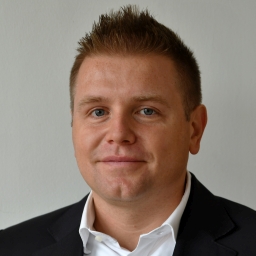
Herbert Buchner is a researcher affiliated with the University of Cambridge in the Information Engineering Division , focusing on Machine Learning for Signal Processing and Human-Machine Interfaces . Research Interests : Acoustic scene analysis, biomedical interfaces, haptic systems, wave-domain adaptive filtering, and sensor networks. Applications : Speech recognition, wavefield synthesis, active noise control, and full-duplex communication systems. His work explores TRINICON (a framework for broadband adaptive MIMO filtering), blind source separation, and wave-domain filtering, emphasizing theoretical rigor and real-time implementation. Key Awards : Best Paper Award at ITG Conference on Speech Communication (2008) Best Student Paper Award at IEEE Intl. Workshop on Acoustic Echo and Noise Control (2001) Publications highlight 15 recent articles in areas like: Wave-Domain Adaptive Filtering Blind Source Separation for Convolutive Mixtures Robust Extended Multidelay Filters Multichannel Acoustic Echo Cancellation Active Room Compensation Biomedical Signal Processing
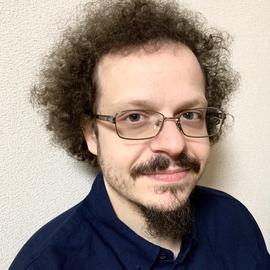
Konrad Kowalczyk is an Associate Professor at AGH University of Science and Technology in Krakow, Poland, where he heads the Signal Processing Group within the Faculty of Computer Science, Electronics and Telecommunications. With extensive international experience from institutions including Queen's University Belfast, Stanford University, and Fraunhofer Institute, he has established himself as a leading researcher in audio and speech signal processing. His academic journey includes B.Eng. and M.Sc. degrees from AGH University (2005), a Ph.D. from Queen's University Belfast (2009), and a Habilitation in ICT from AGH University (2020). B.Eng. and M.Sc. in Electronics and Telecommunications, AGH University of Krakow (2005) Ph.D. in Electronics, Queen's University Belfast, UK (2009) Habilitation (D.Sc.) in Information and Communication Technology, AGH University of Krakow (2020) Kowalczyk's research spans multiple cutting-edge areas in audio processing, with particular focus on speech and audio signal processing enhanced by machine learning techniques. His work integrates deep neural networks with traditional signal processing methods to address challenges in array signal processing , speech enhancement , and speaker recognition . The research group he leads explores innovative applications in distributed signal processing for IoT , acoustic event detection , and spatial audio rendering , bridging theoretical advances with practical implementations. His recent publications demonstrate a clear trend toward integrating deep learning with traditional signal processing techniques, particularly in speaker diarization, source separation, and robust speech recognition. The research increasingly focuses on real-world applications requiring reverberation-robust processing , distributed microphone array systems , and end-to-end neural architectures that can operate in challenging acoustic environments. There's a noticeable shift toward more complex, integrated systems that combine multiple signal processing tasks. Stanislaw Staszic Medal for best graduate of AGH (2005) IEEE Best Student Paper Contest finalist (2007) AES Student Technical Paper Award winner (2008) Best Student Paper Award at IWAENC conference (2014) Best Paper Awards at IEEE SPA conferences (2016, 2019) Polish Ministry of Science Scholarship for Distinguished Young Scientists (2016-2019) Prime Minister Award for outstanding scientific achievements (2020) As Principal Investigator, Kowalczyk leads multiple significant research projects including "Acoustic Intelligence" (2024-2028) funded by National Science Center, and "Deep extraction for robust speech recognition" (2023-2028). He has successfully secured funding from prestigious programs including First TEAM from the Foundation for Polish Science, and EU FP7 projects. His research group actively supervises Ph.D., M.Sc., and B.Eng. students, with strong connections to international institutions including Aalto University and IEEE Signal Processing Society. The research output includes numerous journal publications, conference papers, patents, and software implementations that have advanced the field of audio signal processing. Kowalczyk leads the Signal Processing Group at AGH University, which focuses on developing innovative solutions for speech and audio processing challenges. The group maintains strong collaborations with international institutions including Aalto University (Finland), and participates in European research initiatives. Their work spans theoretical development through practical implementation, with applications ranging from medical voice assistants to distributed acoustic sensor networks.
Mathieu Fontaine is an Associate Professor in Machine Listening at Télécom Paris , affiliated with the LTCI Lab within the IDS Department (Information, Data, Signal). His research focuses on machine listening for speech and audio signal processing. PhD in Informatics (2019), Lorraine University Master in Applied and Fundamental Mathematics (2015), Poitiers University BSc in Fundamental Mathematics (2013), Rennes University Fontaine's research spans speech enhancement , speaker separation , source localization , and music source separation using heavy-tailed probabilistic models and deep Bayesian networks , with applications in augmented reality . He has expertise in Python , signal processing , and machine learning (80% proficiency). His recent publications (2024) include work on diffusion models for speech synthesis , room acoustics estimation from 3D meshes , robust audio scene analysis , and direction-aware speech processing . Earlier publications (2022-2023) explore flow-based NMF , alpha-stable representations , and adaptive beamforming in multiparty environments. Fontaine collaborates with the S2A team and ADASP group at LTCI Lab. His work integrates probabilistic modeling with deep learning to address challenges in real-world audio processing, including reverberation, noise, and complex acoustic environments.
Luis Antonio Azpicueta Ruiz is an Associate Professor in the Department of Signal Theory and Communications at Carlos III University of Madrid. He leads research in the Signal Processing and Learning Group (GTSA) and Machine Learning for Data Science (ML4DS) group, focusing on interdisciplinary applications spanning acoustics, telecommunications, and machine learning. Research Interests: His work bridges signal processing theory with practical applications in environmental acoustics, adaptive filtering systems, and machine learning. Key research themes include: Advanced adaptive filtering architectures for nonlinear systems Distributed estimation in sensor networks Acoustic echo cancellation and room equalization Psychoacoustic evaluation methods Machine learning applications in noise monitoring and sound analysis Research Projects: Principal investigator for multiple funded projects including: Diagnóstico del ruido de chorro en aeronaves (AEI, 2022-2025) LearnINg FLow and Noise Dynamics via AI (COMUNIDAD DE MADRID, 2024-2026) BODYinTRANSIT - Sensory-driven Body Transformation (EUROPEAN COMMISSION, 2022-2026) Aprendizaje Automático para análisis Big Data (MINISTERIO DE ECONOMÍA, 2018-2021)
Paul Théberge is a Professor at Carleton University, cross-appointed to the Institute for Comparative Studies in Literature, Art and Culture and the School for Studies in Art and Culture (Music). He teaches graduate courses in Cultural Mediations (technologies of culture), Film Studies (sound in visual media), and Music (sound studies), reflecting his interdisciplinary academic home within Ottawa's major research institution. His research interrogates the material and cultural dimensions of sound technologies, with core expertise in music-technology-culture intersections, internet-mediated musical practices, and sonic applications in film/television. Théberge's scholarship bridges musicology, media studies, and science and technology studies, examining how recording technologies reshape creative practice and auditory experience across historical periods from analog tape to digital streaming platforms. Analysis of his 15 most recent publications reveals persistent engagement with sound's materiality—from multichannel audio histories to the embodied nature of listening—and consistent exploration of technological transitions, particularly the internet's disruption of traditional music production/distribution models. His work demonstrates deep methodological versatility spanning archival research, ethnographic observation, and creative composition. Scientific recognition includes: International Association for the Study of Popular Music (US branch, 1998) Society for Ethnomusicology (2000) While the source text doesn't specify current advising activities, his extensive editorial work (e.g., co-editing Living Stereo ) and composition output suggest significant mentorship through collaborative projects. His research has been supported through Canada Research Chair funding and industry partnerships like Sony Classical International.
Bruce Wiggins is an Associate Professor in Audio Engineering at the College of Science and Engineering. His research focuses on spatial audio technologies, including Ambisonics, binaural auralization, and 3D audio systems. Notable projects include the GASP guitar system and WHAM webcam-based head-tracked audio solutions. He has contributed to advancements in microphone array calibration, speaker array modeling, and virtual reality audio integration. His work bridges theory with practical applications in music technology and acoustic engineering. Education: PhD in Audio Engineering (2004). Research Interests: Ambisonics, spatial audio capture and reproduction, 3D audio for virtual reality, binaural rendering, and innovative musical instrument design. His work emphasizes practical implementations such as the GASP guitar system and calibration tools for low-cost microphone arrays. Article Trends: Recent publications address virtual stereo microphone techniques (2024), dynamic electrical systems (2024), and browser-based 3D audio (2023). Earlier work explores head-tracking algorithms (2016–2020) and acoustic modeling for domestic environments (2017). Grants/Advising: No explicit grants listed. Advising details unavailable but has collaborated with numerous researchers on projects like WHAM and GASP. Labs/Teams: Active in interdisciplinary teams developing spatial audio tools and instruments, including collaborations on virtual reality auralization and ambisonic guitar systems.
Prof. Dr.-Ing. André Jakob is a faculty member at Berlin University of Technology , affiliated with the Department VII - Electrical Engineering - Mechatronics - Optometry. His academic role spans teaching and research in digital signal processing, audio technology, and acoustics. Digital Signal Processing Audio Technology Acoustics Active Noise Control His research focuses on active noise control , simulation of moving sound sources , and audio signal processing , with applications in robotics, building acoustics, and medical devices. Publications include advancements in anti-noise window systems , sound source localization , and acoustic measurement techniques . His recent work explores real-time auralization for educational robotics and nonlinear acoustic modeling with neural networks. The 15 most recent articles demonstrate a consistent focus on acoustic simulation , active control systems , and sound propagation modeling , with conference contributions at DAGA, NAG-DAGA, and international acoustics events. Topics range from dental drill noise reduction to active sound design in musical instruments , reflecting interdisciplinary applications. He supervises numerous Master's and Bachelor's theses in areas like real-time signal processing, deep learning for sound recognition, and virtual acoustics. His lab at TU Berlin explores multi-loudspeaker systems , acoustic beamforming , and active noise cancellation for both industrial and consumer applications.
Dr Ambrose Seddon is a Principal Academic in Music and Audio Technology at Bournemouth University, specializing in electroacoustic and electronic music. He holds a BMus (Hons) from Goldsmiths College, University of London, an MA in Electroacoustic Composition, and a PhD in Music (electroacoustic composition), both from City, University of London. His research focuses on electroacoustic composition, multichannel and ambisonic techniques, form in electroacoustic music, and music analysis. Notable awards include the 1st Prize at the Klang! and Visiones Sonoras competitions, and the European Region Composition Prize at ICMC 2007. He has residences at Elektronmusikstudion (EMS) and Visby International Centre for Composers (VICC). Dr Seddon teaches composition, studio recording, and creative music technology, supervising PhD students in related fields. His work spans sound installations, live electronics with the ensemble NonRecursive, and performances at venues worldwide. Academic roles include external examiner for BSc Music and Sound Technology at the University of Portsmouth and leadership in the Creative Sonic Practice Research Group.
Shoji Makino is a Professor at Waseda University's Graduate School of Information, Production and Systems. He has held academic and research positions at institutions such as the University of Tsukuba and NTT Communication Science Laboratories. His work spans acoustic signal processing, blind source separation, and adaptive filtering. Education: Ph.D., Tohoku University (1993.03) Mechanical Engineering, Tohoku University Graduate School of Engineering (1979.04–1981.03) Engineering, Tohoku University Faculty of Engineering (1975.04–1979.03) Research Interests: His research focuses on acoustic signal processing for speech and audio, including blind source separation (BSS) , beamforming , and adaptive filtering . He pioneered methods for solving permutation alignment in frequency-domain BSS and developed geometrically constrained ICA techniques. Scientific Awards: Hoko Award (2018.10, Hattori Hokokai Foundation) Outstanding Contribution Award of the Institute of Electronics, Information, and Communication Engineers (2018.06) IEEE Signal Processing Society Best Paper Award (2014.01) IEEE Fellow (2004.01) IEICE Achievement Award (1997.05) Committee Memberships: He has served as Chair of the IEEE CAS Society's Blind Signal Processing TC, General Chair of IEEE WASPAA2007, and Associate Editor of IEEE Trans. SAP. He is actively involved in EURASIP, APSIPA, and the Acoustical Society of Japan.
Cheng Zhi Huang is the Robert N. Noyce Career Development Professor and Assistant Professor at MIT, holding a shared appointment between the departments of Music and Theater Arts and Electrical Engineering and Computer Science (EECS). His work bridges artificial intelligence, music technology, and computer science to advance human-AI collaboration in musical creativity. Huang leads research in generative models for music composition, real-time interactive systems, and expressive performance synthesis. His contributions include tools like ReaLJam for AI-assisted jamming and the MAESTRO dataset for piano performance modeling. His research interests span AI-driven music generation, human-AI interaction frameworks, and culturally-aware music technologies. Notable projects include The Bach Doodle—an accessible web-based composition tool—and MIDI-DDSP for detailed performance control. Huang’s work emphasizes ethical and creative applications of AI in arts, fostering collaborations between musicians, engineers, and computer scientists. His publications highlight advancements in hierarchical generative modeling, source separation techniques, and co-creation interfaces for novices. Huang’s research has been showcased in venues like TISMIR and IEEE conferences, reflecting his interdisciplinary impact on music technology and machine learning.
Lisa Birke is an interdisciplinary artist and faculty member at the University of Saskatchewan’s College of Arts and Science , where she founded the Digital and Integrated Practice (DIP) area in the Department of Art & Art History in 2019. Her work intersects performance, video art, augmented reality, and installation to critique cultural norms and explore subjective realities through Canadian landscape narratives. Education: BFA (1999) in Visual Art (Painting) from Emily Carr Institute of Art and Design MFA (2013) in Fine Arts (Studio Art) with distinction from the University of Waterloo Birke’s research investigates the collision of art history, pop culture, and everyday life in multi-channel digital works. She blurs the line between theatrics and documentation, focusing on themes like postfeminist critique, relational aesthetics, and technological mediation. Recent projects include TrippingTime (2024) and Natures of Reality (2021), both utilizing augmented reality for public engagement. Key scientific trends: Immerse audiences in layered realities, challenge normative representations, and employ collaborative digital tools (360 video, AR) to address themes of community, tolerance, and the deconstruction of perfection. Scientific awards: Provost’s New Teacher Award (2022) USSU Teaching Excellence Award (2022) Canada Council for the Arts Grow Grant (2023-2024) Arizona International Film Festival Jury Award (2024) Teaching & advising: Birke advocates for competence, autonomy, and relatedness in pedagogy, emphasizing foundational skills alongside experimental risk-taking. She served as graduate chair (2019-2022) and mentors students in digital media, installation, and performance art. Labs & teams: Principal Investigator for the Shared Spaces augmented reality outreach project (University of Saskatchewan), collaborating with international institutions and grade 8 students in Germany.
Stephan Preihs is a postdoctoral researcher and group leader at the Institute of Communications Technology of the Leibniz University Hannover , with a focus on acoustics, digital signal processing, and immersive audio systems. He received his Dipl.-Ing. in electrical engineering (communications engineering) from the same university in 2010 and his Dr.-Ing. in 2016. Education: Dipl.-Ing., Electrical Engineering (Communications Engineering), Leibniz University Hannover (2010) Dr.-Ing., Leibniz University Hannover (2016) Research Interests: Acoustics for immersive audio reproduction Digital signal processing and audio coding Signal detection/classification Psychoacoustic models Audio transmission for PMSE Recent Article Trends: Deep learning in sound source localization Wind turbine noise analysis via immersive audio Advancements in headphone technology Immersion prediction in spatial audio Low-latency communication protocols Scientific Awards: Best Paper Award at IEEE International Workshop on Networked Immersive Audio (2024) AES Show 2024 Best Technical Paper Award AES Spring 2021 Student Paper Award AES Poster Award 2019 AES Convention Student Paper Award 2019 Teaching: Lecturer for '3D Audio - Fundamentals of Spatial Reproduction Systems' Lecturer for 'Applications of Digital Audio Signal Processing' Coordinator of student laboratories in 'Audio Communication and Acoustics' and 'Transmission Technology'
Andrew McPherson is a Professor of Musical Interaction at Queen Mary University of London, affiliated with the School of Electronic Engineering and Computer Science and the Centre for Multimodal AI. He leads the Augmented Instruments Laboratory, a research team focused on music technology and interdisciplinary collaboration. His work bridges electrical engineering, composition, and human-computer interaction, emphasizing the creation of new tools for musicians through hardware/software interfaces and expressive performance modeling. McPherson's research interests include augmented instruments, digital signal processing, and the design of intuitive musical interfaces. He has pioneered projects like the Bela embedded platform and the Magnetic Resonator Piano, emphasizing practical applications in traditional and experimental music venues. Collaborations with artists and industry inform his approach, ensuring research outputs are artistically relevant and accessible. Education & Expertise: Trained in electrical engineering and composition, McPherson combines technical proficiency with artistic sensibility. His lab’s projects, such as the TouchKeys and hackable instruments, highlight his focus on democratizing music technology. Grants & Awards: He holds a Royal Academy of Engineering Senior Research Fellowship (2021–2026) and an ERC Consolidator Grant (2023–2027). He co-leads the UKRI Centre for Doctoral Training in Artificial Intelligence and Music, fostering future researchers in AI-driven music innovation. Labs/Teams: The Augmented Instruments Lab collaborates across disciplines, with dual affiliation at Queen Mary and Imperial College London’s Dyson School of Design Engineering. The lab’s work spans from foundational research to industry partnerships, including spinout company Augmented Instruments Ltd, which supports maker communities and industry consultancy.
Josh Reiss is a Professor of Audio Engineering at Queen Mary University of London (QMUL), part of the School of Electronic Engineering and Computer Science . He holds additional roles including President-Elect and Fellow of the Audio Engineering Society (AES), and Visiting Professor at Birmingham City University. His research focuses on audio signal processing, procedural audio, and intelligent music production. He earned degrees including BSc in Physics, BSc in Mathematics, and a PhD. Research & Awards : Reiss has published over 200 papers, authored books like Intelligent Music Production , and received awards such as the AES Board of Governors Award (2009, 2010) and Best JAES Paper 2016. His work spans sound synthesis, dynamic range compression, and live audio systems. Teaching & Industry : Teaches modules like Artificial Intelligence and Sound Design. Co-founded startups LandR (AI mixing), Tonz, and Nemisindo. Leads the Centre for Digital Music at QMUL, advancing research in audio technology. Labs & Teams : Active in the Centre for Digital Music, collaborating on projects like the Open Multitrack Testbed and semantic audio evaluation tools.