Jiatao Gu is an Assistant Professor in the Department of Computer and Information Science (CIS) at the University of Pennsylvania, with a planned start in Fall 2025. He also works as a part-time Staff Research Scientist at Apple (MLR) and previously served as a full-time Research Scientist at Meta AI (FAIR Labs). His academic journey includes a Ph.D. in Electrical and Electronic Engineering (2018) from the University of Hong Kong under Prof. Victor O.K. Li, and a B.Eng. in Electronic Engineering (2014) from Tsinghua University.
Yaoyao Liu is an Assistant Professor at the University of Illinois Urbana-Champaign, holding joint appointments in the School of Information Sciences and Coordinated Science Laboratory. He is affiliated with the Siebel School of Computing and Data Science, National Center for Supercomputing Applications (NCSA), and Illinois Informatics. His research focuses on computer vision and machine learning, particularly in areas like continual learning, few-shot learning, and 3D geometry modeling. He completed his PhD at the Max Planck Institute for Informatics and a BS at Tianjin University. Research Interests: Continual learning and class-incremental learning Generative models and diffusion models 3D geometry and medical imaging applications Awards: ECVA PhD Award (2024). Professional Activities: Area Chair for CVPR, NeurIPS, ICLR, and other top conferences. Served as Senior Program Committee member for AAAI and IJCAI. Labs/Teams: Active in interdisciplinary projects at NCSA and Illinois Informatics, collaborating on medical imaging and 3D vision challenges.
Zhu Li is a full professor at the Department of Computer Science & Electrical Engineering (CSEE) at the University of Missouri, Kansas City (UMKC), and director of the NSF Center for Big Learning (CBL). He holds a PhD in Electrical & Computer Engineering from Northwestern University (2004). Previously, he served as an AFRL summer visiting professor at the US Air Force Academy (2016-18, 2020-24), Senior Staff Researcher at Samsung Research America and FutureWei Technology, and Assistant Professor at The Hong Kong Polytechnic University. His research focuses on point cloud and light field compression, deep learning for visual compression, remote sensing, and multimedia systems. Key achievements include 50+ patents and 200+ publications. He is an IEEE Senior Member and serves as Associate Editor-in-Chief for IEEE Trans on Circuits & System for Video Technology, and Associate Editor for IEEE Trans on Image Processing and others. Notable awards include the Best Paper Runner-up at PBVS 2023, Best Poster at ICME 2006, and Best Paper at ICIP 2007. His lab has secured grants from NSF, AFRL, and industry partners, advancing research in neural compaction, SAR image processing, and immersive media communication. Education: PhD in Electrical & Computer Engineering, Northwestern University (2004) Affiliations: NSF I/UCRC Center for Big Learning (Director), IEEE (Senior Member) Grants: NSF Trustee's N.T. Veatch Award (2025), AFRL Phase 2 STTR ($1.2M), NSF 5G/6G Networks Grant (2022) Labs/Teams: Multimedia Computing & Communication Lab, MCC Lab collaborating with global institutions
Pieter Peers is an Associate Professor in the Department of Computer Science at the College of William & Mary. Prior to this, he was a senior researcher at the Graphics Laboratory at the University of Southern California's Institute for Creative Technologies and a Research Assistant Professor at USC's Viterbi School of Engineering. His educational background includes a Ph.D. in Computer Science from K.U.Leuven (Belgium) in 2006 and a BS/MS in the same field from the same institution in 2000. Peers' research focuses on relighting, appearance modeling, and neural rendering—central topics in computer graphics and vision. His work bridges traditional rendering techniques with modern deep learning, particularly in inverse rendering, material modeling, and image-based relighting. He has made significant contributions to subsurface scattering, photometric stereo, and neural rendering systems. His recent publications, including work in SIGGRAPH, CVPR, and ICCV, demonstrate a strong trend toward integrating diffusion models and transformer architectures into appearance modeling and relighting tasks. These works often address real-world challenges such as single-image relighting, material estimation, and lighting control with minimal user input. RenderFormer (SIGGRAPH 2025): Transformer-based neural rendering with global illumination. ScribbleLight (CVPR 2025): Scribble-driven indoor relighting using diffusion models. MatFusion (SIGGRAPH Asia 2023): Diffusion-based SVBRDF capture. He has mentored and collaborated with numerous students and researchers, including Chong Zeng, Jun Myeong Choi, and James Bieron, indicating active involvement in advising and research supervision. While no formal grants or awards are listed, his consistent publication record in top venues suggests sustained research funding and recognition in the graphics community. Peers has led research in advanced rendering systems, including work on compressive light transport sensing, wavelet environment matting, and compact representations of heterogeneous subsurface scattering. His early work at USC and K.U.Leuven laid the foundation for his current research in neural appearance modeling and inverse rendering.
Giorgos Bouritsas is a machine learning scientist serving as a postdoctoral fellow at the Archimedes AI unit and the University of Athens, while also holding an adjunct lecturer position at NCSR Demokritos. He received his PhD in computer science from Imperial College London and his MEng in electrical and computer engineering from the National Technical University of Athens. His academic journey includes research stints at Google DeepMind, École Polytechnique Fédérale de Lausanne, KU Leuven, NCSR Demokritos, and Universitat Politècnica de Catalunya. Dr. Bouritsas specializes in geometric and graph deep learning, with research focusing on neural network architectures for geometric data, weight space learning, and applications in biology and chemistry. His work bridges theoretical analysis with practical implementations, particularly in developing methodologies for complex networks, physical systems, 3D objects, and neural network weight spaces. He has made significant contributions to graph neural networks, including novel approaches to improving expressivity through subgraph isomorphism counting and developing spiral convolutional networks for 3D shape representation. His recent publications demonstrate a strong trajectory in geometric deep learning, with papers accepted at top conferences including NeurIPS (with an oral presentation in 2024), ICML, CVPR, and ICCV. His 2024 workshop proposal on Neural Network Weights as a New Data Modality was accepted for ICLR 2025. He regularly serves as a reviewer for major machine learning conferences, earning outstanding reviewer distinctions at NeurIPS, ICML, and LoG. Outstanding Reviewer at NeurIPS 2021, 2024 Outstanding Reviewer at ICML 2022, 2024 Outstanding Reviewer at LoG 2022, 2023 Dr. Bouritsas teaches Deep Learning in the MSc in AI program at NCSR Demokritos, demonstrating his commitment to academic service and education. His research has practical applications spanning cryo-EM image analysis, 3D facial recognition for medical diagnostics, and theoretical foundations of contrastive learning frameworks.
Prof. Rüdiger Westermann is a full Professor leading the Chair of Computer Graphics and Visualization at the Technische Universität München (TUM). His academic career includes roles at RWTH Aachen University (2001–2003) and research stays at Caltech and the University of Utah. He holds a doctorate from the University of Dortmund (1996) and has conducted foundational work in practical computer science, focusing on computer graphics, scientific visualization, and real-time numerical simulation. His research emphasizes algorithm development for interactive data exploration and physical simulation, particularly leveraging many-core architectures. Key research areas include volume visualization, multi-scale finite element simulation, and hierarchical data representation. Recent contributions involve stress-guided 3D design optimization, Bayesian imaging techniques, and GPU-accelerated visualization tools. His work bridges theoretical advancements with practical applications in meteorology, materials science, and medical visualization. Prof. Westermann’s academic journey includes a postdoctoral position under Prof. T. Ertl at Erlangen-Nuremberg (1998–2001) and prior research at GMD St. Augustin (1992–1997). He is actively involved in developing visualization tools for ensemble weather forecasts (e.g., Met. 3D) and structural design optimization for additive manufacturing. His publications span high-impact venues like IEEE Transactions on Visualization and Computer Graphics, emphasizing real-world applicability of visualization and simulation techniques. His research group at TUM collaborates on projects such as the Alpine benchmark for PDE emulators and GPU-based algorithms for large-scale data processing. Current efforts focus on neural fields for ensemble visualization, adaptive sampling techniques, and Bayesian methods for radio interferometry imaging.
Lawrence Carin is a Professor of Electrical and Computer Engineering and Computer Science at Duke University, holding the James L. Meriam Distinguished Professorship. He previously served as Provost at King Abdullah University of Science and Technology (2020-2023) and Department Chair of ECE at Duke (2011-2014). His research focuses on machine learning (ML), artificial intelligence (AI), and their applications in medicine, security, and imaging. Carin earned his Ph.D., M.S., and B.S. in Electrical Engineering from the University of Maryland, College Park (1985-1989). Education: B.S.E., M.Sc.Eng., Ph.D. in Electrical Engineering, University of Maryland, College Park (1985-1989) His work spans ML foundations, medical diagnostics (e.g., thyroid cancer prediction via deep learning), and computer vision. He co-founded Signal Innovations Group (acquired by BAE Systems) and Infinia ML (acquired by Aspirion). Notable contributions include Bayesian methods for bias detection in LLMs, interpretable AI for medical imaging, and federated learning frameworks. Carin is an IEEE Fellow (2001) and has authored over 500 publications in top venues like IEEE Transactions, NeurIPS, and CVPR. Key research trends in recent articles include medical image analysis (e.g., OCT for glaucoma, CT for lung abnormalities), NLP (bias mitigation, commonsense QA), and efficient ML models (sparse convolutions, contrastive learning). His labs collaborate across Duke’s engineering and medical schools, focusing on translational AI solutions. Current projects explore explainable AI for clinical decision-making and robust ML under limited data.
Alec Jacobson is an Associate Professor in the Department of Computer Science at the University of Toronto, with a courtesy appointment in Mathematics. He holds the Canada Research Chair in Geometry Processing and serves as a Senior Research Scientist at Adobe Research Toronto. Located at the Bahen Centre, he leads research in computer graphics and geometry processing as part of the Dynamic Graphics Project lab. His research focuses on Geometry Processing , Discrete Differential Geometry , and Computer Graphics , with applications in 3D reconstruction, computational fabrication, and neural representations. Key areas include mesh processing algorithms, physics-based simulation, and differentiable rendering techniques that bridge theoretical foundations with practical implementations. Recent publications demonstrate strong trends in neural field optimizations, robust 3D reconstruction, and physics simulation. His team frequently combines machine learning with geometric methods to solve challenging inverse problems in computer vision and graphics, with consistent innovation in computational efficiency and mathematical foundations. Scientific Awards: Canada Research Chair in Geometry Processing AXL Faculty Fellow Best Paper Honourable Mention (SGP 2024) Best Paper Award (SIGGRAPH 2022) Test of Time Award (SIGGRAPH 2024) He leads the Third Space research group advising numerous graduate students and postdocs. Current research infrastructure includes collaborations with the Vector Institute and Adobe Research, supported by grants focused on geometric algorithms and neural representations.
Georgios Giannakis is a Professor in the Department of Electrical and Computer Engineering at the University of Minnesota. His research spans communications, networking, signal processing, and machine learning with applications to wireless systems and networks. Professor Giannakis' research interests include: Signal Processing and Analysis Wireless Communications and Networking Machine Learning for Signal Processing Graph Signal Processing Bayesian Optimization and Inference Federated and Distributed Learning His current research focuses on complex-field and network coding, cooperative wireless communications, cognitive radios, cross-layer designs, mobile ad hoc networks, and wireless sensor networks. Recent work has expanded into graph learning, Bayesian optimization, and federated learning approaches for communication systems with applications to 5G/6G networks, Internet of Things, and wireless sensor networks. Professor Giannakis has received significant research funding, including multiple NSF grants such as "Resonant-Beam based Optical-Wireless Communication," "Robust Learning over Graphs," "Learning-driven Models for 5G Internet Measurements," and "Online Learning for IoT Monitoring and Management." His fingerprint analysis reveals key research areas including fading channels (81%), sparsity (71%), multiuser systems (66%), wireless sensor networks (56%), and transmitter technologies. His scientific contributions include over 1,188 research outputs with consistent productivity across decades, demonstrating his sustained impact in the field. His recent publications show a clear trend toward integrating machine learning techniques with traditional signal processing for next-generation communication systems that require robustness, efficiency, and adaptability in dynamic environments.
Professor Wanqing Li is a leading academic in machine learning and 3D computer vision at the University of Wollongong, where he serves as Director of the Advanced Multimedia Research Lab (AMRL). He holds a B.Sc. and M.Sc. from Zhejiang University and a Ph.D. from The University of Western Australia. His career includes roles at Motorola Labs (Senior/Principal Researcher) and visiting stints at Microsoft Research. His research focuses on 3D multimedia signal processing, human activity understanding, and medical image processing, with applications in aged care and health monitoring. He has published over 250 papers in top venues like TIP, CVPR, and AAAI, and his work has been recognized with awards including the Motorola CTO’s Award (2003). He currently leads the Centre for Artificial Intelligence (CAI) at UOW and is a co-founder of the Centre for Multimedia Signal Processing and Content Management. Education: B.Sc. (Zhejiang University), M.Sc. (Zhejiang University), Ph.D. (University of Western Australia). Research Interests: Machine Learning (statistical/deep learning), 3D computer vision (human motion analysis, 3D reconstruction), medical imaging, free-viewpoint video systems, and applications in healthcare. He pioneered 3D data-driven human activity understanding, now a cornerstone of modern computer vision. Awards & Recognition: Motorola CTO’s Award (2003), Australia’s top multimedia researcher (2021–2023), elected Associate Editor of IEEE Transactions on Image Processing (2022). Labs/Teams: Director of Advanced Multimedia Research Lab (AMRL), co-founder of CAI and Multimedia Signal Processing Centre.
Amitabh Varshney is the Dean of the College of Computer, Mathematical, and Natural Sciences and Professor of Computer Science at the University of Maryland, College Park. He previously directed the UMD Institute for Advanced Computer Studies (2010–2018) and served as interim Vice President for Research (2016–2017 and 2021). His research focuses on virtual/augmented reality (VR/AR), scientific visualization, molecular graphics, and high-performance computing. Collaborations include NVIDIA, Honda, IBM, and the University of Maryland, Baltimore (UMB). Education: B.Tech. (IIT Delhi, 1989), M.S. and Ph.D. (UNC Chapel Hill, 1991 and 1994). Research highlights include molecular surface algorithms, GPU computing, and immersive technologies for healthcare and education. Awards include the NSF CAREER Award (1995), IEEE Visualization Technical Achievement Award (2004), and IEEE Fellow (2010). He leads the NVIDIA CUDA Center of Excellence and co-founded the Maryland Blended Reality Center. Recent work explores nanophotonics for AR/VR displays, VR medical training, and bias detection in AI systems. His interdisciplinary projects address challenges in personalized medicine, pain management, and implicit bias training through extended reality (XR). Key Projects: Augmentarium (immersive infrastructure), CHIB (healthcare bioinformatics), Immersive Media Design Program. Grants: NSF, NIH, industry partnerships. Awards: NSF CAREER, IEEE Technical Achievement Award, IEEE Fellow.
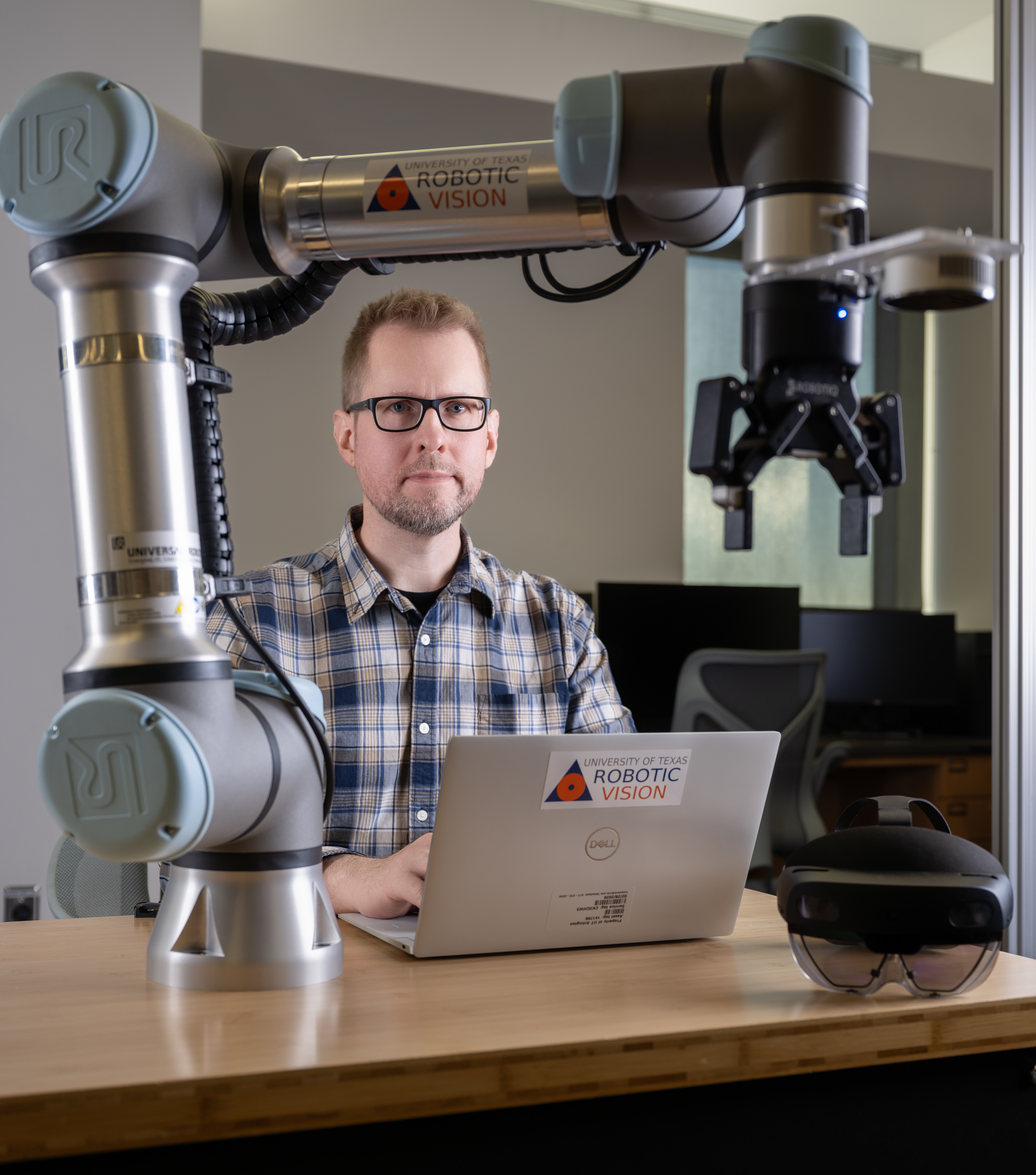
William J. Beksi is an Assistant Professor at The University of Texas at Arlington's Department of Computer Science and Engineering, and director of the Robotic Vision Laboratory. His research focuses on robotics, computer vision, and machine learning, with applications in autonomous systems, agricultural robotics, and event-based vision. PhD, MS in Computer Science (University of Minnesota) BS in Mathematics and Computer Science (Stevens Institute of Technology) Dr. Beksi develops algorithms for robot perception and autonomy, emphasizing topological data analysis, control barrier functions, and 3D reconstruction. His work has been sponsored by NSF, USDA, DoD, and industry partners. Recent publications (2023-2025) span event-based vision, agricultural robotics, 3D vision, and safety-critical systems. Key trends include polynomial path planning for deception, edge-informed contrast maximization, and semi-supervised active learning frameworks. ONR Summer Faculty Fellow (2022-2024) NSF CRII Award (2020) IEEE Senior Member UTA CSE Rising Star Research Award (2024) Dr. Beksi advises PhD students in robotics and computer vision, including recipients of UTA Dissertation Fellowships and DoD SMART scholarships. His lab collaborates with institutions like krtkl, AFRL, and NSWCDD on projects ranging from UAV collision avoidance to lunar robotics.
Chris Joslin is a Professor at the School of Computer Science, Carleton University. His office is located in 4302 Canal Building, and he can be reached at Chris.Joslin@carleton.ca. He specializes in interdisciplinary research areas including computer graphics, medical imaging, virtual reality, computer vision, and human-computer interaction. His work bridges theoretical advancements with practical applications in animation, 3D modeling, and medical visualization. Research interests include developing novel techniques for 3D editing, medical image processing, and immersive virtual environments. Notable contributions include advancements in 3D Gaussian splatting, AI-driven MRI analysis, and robust sensor fusion for autonomous systems. His publications span from foundational studies on motion retargeting to applied work in procedural audio generation for soft-body simulations. Recent trends in his articles emphasize integration of deep learning with traditional computer vision tasks, optimization of medical imaging workflows, and enhancing accessibility in virtual reality systems. Despite prolific output, no scientific awards are explicitly mentioned in the provided texts. Advising and grant details remain unspecified, though his involvement in collaborative projects like VPARK and ISIS suggests engagement with interdisciplinary teams. His work is anchored at Carleton’s Herzberg Laboratories, a hub for advanced computational research.
Hadi Ali Akbarpour is an Assistant Professor in the Department of Computer Science at Saint Louis University's School of Science and Engineering . He earned a Ph.D. in Electrical and Computer Engineering from the University of Coimbra, Portugal (2012). Research focuses on Artificial Intelligence and Computer Vision at the intersection of Autonomous Systems , Remote Sensing , and Robotics Key topics: Deep Learning , 3D Reconstruction , Homography Modeling , and Sensor Fusion Recent publications highlight advancements in: Structure-from-Motion for aerial imagery Deep Learning for novel view generation Georegistration accuracy in wide-area contexts 3D Point Cloud integration Agricultural Monitoring via aerial mosaicking Professional accolades include: Best Paper , Presentation , and Challenge Awards Co-chaired the 51st IEEE Applied Imagery Pattern Recognition Workshop Guest Editor for Sensors Journal special edition (2021) His funded projects include roles as Principal Investigator ( $1.1M ), co-PI ( $8M ), and task leader in $6M SBIR projects .
Dr. Junpeng Wang is a Postdoctoral Researcher (since June 2023) in the Chair of Computer Graphics and Visualization at the Technical University of Munich, working under Prof. Rüdiger Westermann. Previously, he completed his PhD at the same institution from November 2018 to June 2023. His research focuses on lightweight structural design and optimization with geometry-based approaches, as well as scientific visualization of tensor and mesh data. Wang's research interests span lightweight structural design , structural optimization , and scientific visualization . His work integrates computational mechanics with computer graphics to develop novel methods for stress analysis, lattice structure optimization, and 3D data visualization. His research has practical applications in mechanical engineering, additive manufacturing, and scientific data analysis. His publication portfolio shows a strong trend toward integrating machine learning with traditional computational mechanics methods, particularly in the areas of 3D Gaussian Splatting and neural data structures. Wang has developed the 3D-TSV (3D Trajectory-based Stress Visualizer), a significant tool for exploring principal stress directions in 3D solids under load, which has been published in Advances in Engineering Software (2022). Wang serves as a reviewer for prestigious journals including IEEE Transactions on Visualization and Computer Graphics (TVCG), Computer Methods in Applied Mechanics and Engineering (CMAME), Journal of Mechanical Design (JMD), Optics Express (OPTE), Computer-Aided Geometric Design (CAG), and Shape Modeling International Conference (SPM[C]). His collaborative work primarily involves Prof. Rüdiger Westermann at TUM and Jun Wu at other institutions, demonstrating strong interdisciplinary connections between computer graphics and mechanical engineering research groups.