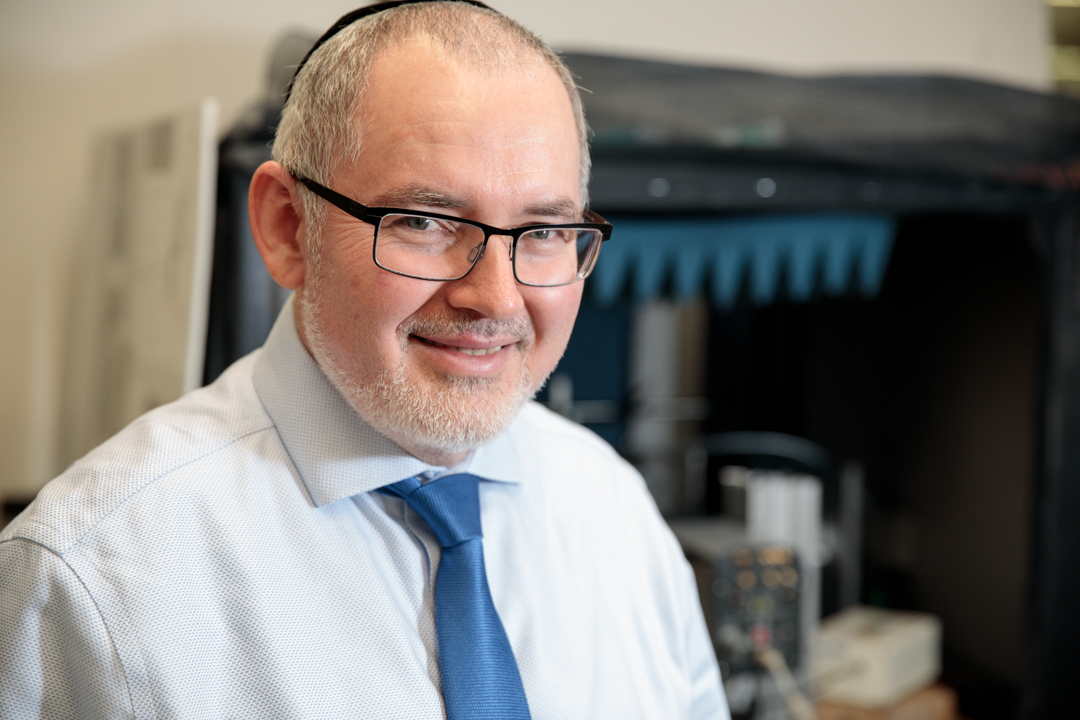
Dr. Prasanth Venugopal is an Associate Professor specializing in Power Electronics with a focus on advanced energy transfer systems and battery technology. His research spans wireless power transfer, electric vehicle charging, and electrochemical impedance spectroscopy for battery diagnostics. Primary research areas: Wireless Power Transfer (100%), Harmonics (88%), Inductive Power Transfer (87%), Battery Engineering (48%) Recent publications demonstrate expertise in transformerless converter designs, multi-level architectures, and AI-driven battery capacity estimation. He has pioneered meander coil topologies for harmonic mitigation and developed computation-light models for battery aging analysis. His work includes collaborations on Li-ion battery degradation, onboard chargers for electric vehicles, and hybrid power systems for electric aircraft. Despite significant output in IEEE Transactions, no explicit awards or student mentoring data appears in the provided texts.
Richard Nickl is a Professor of Mathematical Statistics at the University of Cambridge, affiliated with the Department of Pure Mathematics and Mathematical Statistics (DPMMS) and the Statistical Laboratory. His research focuses on high-dimensional inference, Bayesian nonparametrics, statistics for partial differential equations, and inverse problems. He has held significant grants, including an ERC Advanced Grant (2024–2029) and an EPSRC Programme Grant (2022–2027). His work bridges statistics, probability, and analysis, with contributions to theoretical foundations and computational methods in non-linear inverse problems. Key research interests include Bayesian posterior consistency, statistical inference for diffusions, and polynomial-time algorithms for high-dimensional posteriors. Notable publications include foundational monographs such as Mathematical foundations of infinite-dimensional statistical models (2016), which earned a PROSE Award, and recent advancements in Bayesian nonparametric inference for McKean-Vlasov models (2025). His group organizes workshops, such as the 2024 Statistical Aspects of Non-Linear Inverse Problems conference. Awards: 2017 PROSE Award in Mathematics. Grants: ERC Advanced Grant, EPSRC Programme Grant. Lab/Team: Research Group in Mathematical Statistics at DPMMS, focusing on inverse problems and Bayesian methodology.
Xiaolei Fang is Associate Professor in the Edward P. Fitts Department of Industrial and Systems Engineering at North Carolina State University. His research develops advanced statistical learning, deep learning, and optimization methods for industrial applications involving high-dimensional data, with particular focus on condition monitoring, failure prognostics, and system performance optimization. He holds a PhD in Industrial Engineering and MS in Statistics from Georgia Tech. Professor Fang's research integrates machine learning with industrial engineering to solve complex problems in predictive maintenance, quality control, and energy systems. His methodological innovations include federated learning approaches for privacy-preserving prognostics, distributionally robust machine learning models, and tensor-based statistical methods for manufacturing quality diagnostics. He has received multiple prestigious awards including the ISE Outstanding Research Award (2024), Sigma Xi Best PhD Thesis Award (2019), and SAS Data Mining Best Paper Award (2016). His research has been funded by NSF, Cisco Systems, and the US Department of Energy. Professor Fang teaches courses in Quality Design & Control, Statistical Models for Systems Analytics, High-Dimensional Data Analytics, and Optimization Models. He has supervised 9 PhD students to completion and currently advises 7 graduate students working on projects spanning federated learning for prognostics, tensor-based quality control, and machine learning applications in manufacturing and energy systems.
Ion Stoica is a Professor in the Electrical Engineering and Computer Sciences Department at the University of California, Berkeley, where he holds the Xu Bao Chancellor Chair. He serves as Director of the Sky Computing Lab and is Executive Chairman of both Databricks and Anyscale. His research spans distributed systems, cloud computing, and AI systems, with significant contributions to large-scale data processing frameworks. Stoica's research interests focus on the intersection of AI and systems, with emphasis on developing practical implementations that bridge theoretical foundations with real-world deployability. His work addresses fundamental challenges in distributed computing, resource management, and large-scale machine learning systems. Current projects include Ray (a distributed execution framework), vLLM (a high-throughput inference engine for LLMs), Chatbot Arena (an open platform for human preference evaluations), and SkyPilot (a framework for running AI workloads across clouds). His research output demonstrates a consistent trajectory toward more efficient, scalable systems for modern AI workloads, particularly focusing on optimizing inference performance, resource utilization, and cross-cloud deployment. Recent publications reflect growing interest in large language model serving, video generation optimization, and agent-based systems. ACM Fellow SIGOPS Hall of Fame Award (2015) SIGCOMM Test of Time Award (2011) ACM Doctoral Dissertation Award (2001) Member of National Academy of Engineering Honorary Member of the Romanian Academy Stoica has advised an extensive number of doctoral students who have gone on to prominent positions in academia and industry, including assistant professorships at Stanford, MIT, Carnegie Mellon, and other top institutions. He has received significant research funding through his lab activities and startup ventures. His research group has been particularly successful in translating academic research into widely adopted open-source technologies and commercial products. Stoica leads the Sky Computing Lab at UC Berkeley, which focuses on developing systems for AI workloads across multiple clouds. His research group has produced numerous influential open-source projects including Apache Spark, Apache Mesos, and Alluxio, which have become industry standards for large-scale data processing. The lab maintains strong industry partnerships while pursuing fundamental research in distributed systems and AI infrastructure.
Thiago Batista Soeiro serves as a Full Professor with exceptional scholarly impact, evidenced by over 200 research publications and an h-index of 27. His work fundamentally advances power electronics applications in transportation and energy systems, particularly through innovations in electric vehicle infrastructure and sustainable power conversion technologies. Despite the absence of explicit institutional affiliation in source materials, his research permeates critical IEEE journals and conferences. Professor Soeiro's research portfolio centers on: Power converter design for electric vehicle charging systems AI-driven battery health estimation using electrochemical impedance spectroscopy Wireless power transfer optimization for automotive applications High-efficiency topologies for more electric aircraft Hydrogen energy system integration Advanced semiconductor utilization in grid-connected systems Analysis of his 2023-2025 publications reveals accelerating innovation in wide-voltage-range converters, predictive battery management, and fault-tolerant power systems. His work increasingly bridges machine learning with power electronics, notably through computation-light AI models for battery diagnostics, while maintaining strong focus on practical implementation challenges in EV charging and aircraft electrification. No scientific awards or honors were documented in the available materials. Similarly, information regarding student supervision, research grants, laboratory facilities, or collaborative teams was not provided in the source texts.
Sergey Gorbunov is an Associate Professor in the Department of Computer Science at the University of Waterloo . He holds a Ph.D. from MIT (2015), an M.Sc. and H.B.Sc. from the University of Toronto (2012 and 2011, respectively). His research focuses on Cryptography, Network Security, Blockchain Technology, Secure Protocols, and Privacy-Preserving Systems . He explores advanced cryptographic techniques for decentralized systems, privacy-enhancing technologies, and secure communication protocols. His work includes pioneering contributions to blockchain security (e.g., mitigating front-running attacks, enhancing transaction privacy) and foundational cryptographic tools like homomorphic encryption and multi-signature schemes. Recent publications emphasize resilient consensus mechanisms, anonymous payment channels, and efficient cryptographic primitives for distributed systems. Notable projects include Astrape (anonymous payment channels), Algorand Agreement (fast Byzantine consensus), and StealthDB (encrypted SQL databases). His research bridges theoretical cryptography with practical applications in secure computing and decentralized technologies.
Alaa Alameldeen is an Associate Professor in the School of Computing Science at Simon Fraser University (SFU), part of the Faculty of Applied Sciences. Previously, he worked as a Research Scientist at Intel Labs (2006–2020) and held an Adjunct Faculty position at Portland State University (2008–2018). He earned a PhD in Computer Sciences from the University of Wisconsin-Madison (2006), and earlier degrees from Alexandria University, Egypt. His research focuses on computer architecture, including memory systems (processing-in-memory, cache/memory compression, security), energy-efficient architectures, and hardware-software co-design for machine learning. He advises PhD and MSc students in these areas and teaches advanced computing science courses. Key contributions include innovations in memory hierarchies, cache compression techniques, and mitigating hardware vulnerabilities. His work has been published in top conferences (e.g., ISCA, MICRO, HPCA) and patented in areas like near-memory processing and error correction. Alameldeen currently leads a research group exploring secure and high-performance memory architectures. He has supervised multiple graduate students, with many progressing to roles at leading tech companies and academic institutions.
Banu Lokman is a Professor of Operational Research (OR) at the University of Portsmouth, serving as Associate Head (Research and Innovation) in the School of Organisations, Systems and People within the Faculty of Business & Law. She leads the Centre for Innovative and Sustainable Finance and contributes to the Centre for Operational Research & Logistics. Her expertise spans multi-criteria decision-making, optimization, and their applications in healthcare and sustainability. She holds editorial roles at OMEGA and the IMA Journal of Management Mathematics and organizes the NATCOR MCDM courses. Previously, she served as Deputy Director of CORL (2011–2024), Secretary of the International MCDM Society, and Board Member of INFORMS MCDM Section. She currently chairs the INFORMS MCDM Section as President-elect/Vice-President. Education: BSc, MSc, and PhD in Industrial Engineering from Middle East Technical University (METU, Turkey), followed by postdoctoral research at Aalto University (Finland). She taught at METU (2014–2019) and held visiting roles at Aalto University. Research Interests: Focuses on developing optimization methods for multi-criteria decision problems, particularly in healthcare (e.g., optimizing prostate biopsy decisions with Portsmouth NHS Trust) and sustainability. Her work emphasizes algorithms for nondominated set representation, robust efficiency analysis, and cluster ensemble methods. Key Awards: Bernard Roy Award (2022) for outstanding contributions to Multiple Criteria Decision Aiding, and Young Researcher Award (2015). Advising & Grants: Leads a healthcare-related PhD project and contributes to projects like the Social Investment Fund collaboration with Waltham Forest Council. She actively supervises students and participates in research initiatives on supply networks and data control systems. Labs & Teams: Engaged with interdisciplinary teams in operational research and logistics, particularly in applying OR to real-world challenges such as energy market optimization and MRO supply networks.
Sadaf Salehkalaibar is an Assistant Professor in the Department of Computer Science at the University of Manitoba, Winnipeg, Canada. She holds an office in the EITC building (E2-416) and has previously held academic positions at the University of Tehran, University of Toronto as a research associate, and visiting roles at McMaster University, Telecom Paristech, and National University of Singapore. Her research focuses on explainable artificial intelligence, generative models, and information theory with an emphasis on rate-distortion-perception tradeoffs in video and image processing. Her educational background includes teaching courses such as Signals and Systems, Digital Signal Processing, and Network Security at the University of Tehran. She currently teaches COMP4190 (Artificial Intelligence) at the University of Manitoba. Research interests revolve around developing efficient algorithms for AI systems, with key contributions in learned video compression, federated learning, and privacy-preserving techniques. Notable work includes the M22 algorithm for communication-efficient federated learning and the NSERC Discovery Grant-funded project on data-driven learning efficiency. Recent publications highlight advancements in perception loss functions, Gaussian vector source analysis, and secure distributed hypothesis testing. She actively serves on editorial boards (e.g., IEEE Transactions on Communications) and conferences (ISIT, ITW). Awards include the prestigious NSERC Discovery Grant (2025). Supervision highlights 13 MSc students at the University of Tehran, focusing on topics like privacy-preserving systems and distributed learning. Labs/teams: Leads research group at University of Manitoba focusing on AI and information theory applications in multimedia systems.
Christian Igel is a Professor at the Department of Computer Science, University of Copenhagen, and serves as director of the SCIENCE AI Centre . He is also a co-lead of the Pioneer Centre for Artificial Intelligence in Denmark. His academic journey includes a Doctoral degree from Bielefeld University (2002) and a Habilitation degree from Ruhr-University Bochum (2010). Igel is a Juniorprofessor (2002–2010) and has held editorial roles at journals like KI - Künstliche Intelligenz and Artificial Intelligence Journal . Doctoral degree: Faculty of Technology, Bielefeld University, Germany (2002) Habilitation degree: Department of Electrical Engineering and Information Sciences, Ruhr-University Bochum, Germany (2010) His research spans Machine Learning , focusing on Support Vector Machines , Evolution Strategies , Reinforcement Learning , Deep Neural Networks , and PAC-Bayesian Analysis . He applies these methods to Environmental Monitoring , Medical Diagnostics , and Climate Research . Recent publications highlight work on adversarial machine learning , environmentally sustainable AI , and tree resource mapping using deep learning. His scientific awards include being a ELLIS Fellow . Igel’s software tools like Shark , woody , and Multi-Planar UNet are widely used in research and industry. Notable grants and collaborations involve projects with European Lab for Learning and Intelligent Systems (ELLIS) , SCIENCE AI Centre , and international teams in Denmark , Germany , and France . His lab leadership emphasizes open-source frameworks and reproducible research. Editorial Roles: German Journal on Artificial Intelligence , Evolutionary Computation Journal , Artificial Intelligence Journal Software Projects: Shark , woody , Multi-Planar UNet , U-Time Collaborations: SCIENCE AI Centre , Pioneer Centre for Artificial Intelligence , European Lab for Learning and Intelligent Systems
Q. Jane Gu is a Professor at the School of Electrical and Computer Engineering at Georgia Tech since September 2024, holding the Ed and Pat Joy Professorship. Previously, she was at the University of California, Davis (2012–2024) and the University of Florida (2010–2012). She earned her Ph.D. in Electrical Engineering from UCLA in 2007. Her research focuses on high-efficiency, low-power interconnects, millimeter-wave, sub-mm-wave, and terahertz integrated circuits and systems for applications in communication, radar, and imaging. Notable contributions include sub-THz resonator-based sensors, dielectric waveguide interconnect channels, and energy-efficient transmitters. Recipient of NSF CAREER Award (2013) 2015 UC Davis Outstanding Junior Faculty Award 2017 and 2018 Qualcomm Faculty Awards 2019 UC Davis Chancellor’s Fellow 2022–2023 IEEE SSCS Distinguished Lecturer Her group has garnered nine best paper awards, including top honors at the 2016, 2017, and 2020 IEEE MTT-S International Microwave Symposia. Research interests span terahertz interconnects, millimeter-wave radar systems, and integrated circuits for high-speed communication. Publications reflect advancements in sensor design, high-frequency transceivers, and phased-array systems, emphasizing energy efficiency and signal integrity.
Jarno Vanne is a Professor at the Department of Computing Sciences, Faculty of Information Technology and Communication Sciences at Tampere University. His research focuses on video coding standards, real-time systems, and hardware acceleration, particularly in the context of FPGA implementations and open-source tools. He leads projects involving VVC (Versatile Video Coding), V-PCC (Volumetric Video Coding), and HEVC (High Efficiency Video Coding), with an emphasis on efficiency, low latency, and machine learning integration. Key research interests include point cloud compression, saliency-guided encoding, parallelization schemes, and real-time video communication protocols. His work often addresses challenges in multi-party video streaming, embedded systems, and encryption mechanisms for privacy protection. He has contributed to open-source projects like the UVG dataset, Kvazaar encoder, and CiThruS simulation frameworks. Recent publications highlight advancements in VVC intra encoding optimizations, machine learning-driven partitioning schemes, and FPGA-accelerated solutions for edge computing. His research bridges theoretical video coding algorithms with practical implementations, aiming to improve compression efficiency while maintaining real-time performance.
Professor Michael Keidar holds the A. James Clark Professorship at the George Washington University (GW) , School of Engineering and Applied Science, within the Mechanical and Aerospace Engineering department. He leads the Micropropulsion and Nanotechnology Lab , pioneering research in plasma medicine, micropropulsion systems, and plasma nanoscience. His lab collaborates with industry partners like Vector (licensed plasma thruster technology) and US Patent Innovations, LLC (a $5.3M grant for cold plasma cancer therapy). Key research areas include: Cold plasma applications in biomedical treatment Microthrusters for nanosatellites Synthesis of graphene and carbon nanotubes Multi-scale plasma simulations Scientific accolades include the 2017 Ronald C. Davidson Award and AIAA Engineer of the Year (2016-2017), alongside leadership in interdisciplinary projects with GW’s Global Food Institute .
Dr. Huadong Mo is a Senior Lecturer at the School of Systems and Computing, University of New South Wales (UNSW) Canberra, Australia. He holds a B.E. degree in automation from the University of Science and Technology of China (2012) and a Ph.D. in systems engineering and engineering management from the City University of Hong Kong (2016). Prior to his current position, he was a research associate at ETH Zurich's Reliability and Risk Engineering Lab (2016-2019) and a Lecturer at UNSW Canberra (2019-2021). Dr. Mo's educational background includes a strong foundation in systems engineering with international experience across China, Switzerland, and Australia. His career trajectory demonstrates a progression from academic research to faculty positions with increasing responsibilities in teaching and research leadership. His research focuses on enhancing the resilience, performance, and security of complex systems using learning-based algorithms, primarily in power and energy systems, cyber-physical systems, and manufacturing systems. He applies data analytics to understand system evolution under uncertainties, with particular emphasis on prognostics and health management, sustainable transportation, robust operation of power systems under extreme events, and reinforcement learning-based asset management. His work bridges theoretical advances with practical applications in critical infrastructure. Analysis of Dr. Mo's recent publications reveals a strong focus on energy systems, particularly in the integration of machine learning with power grid management, battery storage systems, and resilience against cyber threats. His research shows a clear trajectory toward increasingly complex system integration, with growing emphasis on multi-vector energy communities, cross-domain prediction, and uncertainty-aware energy management. The interdisciplinary nature of his work spans electrical engineering, computer science, and operations research. 2024 IEEE SMC Early Career Award 2023 Visiting Research Fellowship (Jean d'Alembert Pour Fellowship) Gold Medal in 2024 China International College Student Innovation Competition (as supervisor) Arc PGC Supervisor Award (2021) IEEE SMC Outstanding Chapter Award (2021) Alumni Achievement Award from City University of Hong Kong (2019) Dr. Mo actively supervises numerous HDR students working on cutting-edge research topics including battery health monitoring, quantum control, reinforcement learning for power systems, and explainable AI for energy management. He leads multiple significant research grants totaling over 3 million AUD, including projects funded by ARC, Energy Innovation Fund, and international collaborations with institutions like ETH Zurich, Cambridge, and Tsinghua University. His research group maintains strong international connections, facilitating student exchanges and collaborative research. As Postgraduate Course Coordinator of Systems Engineering and Chair of IEEE SMC ACT Chapter, Dr. Mo plays a significant role in academic leadership and professional community building. His research team collaborates with industry partners on practical implementations of their theoretical work, particularly in the energy sector.
Dr. John G. Hayes is a Senior Lecturer at University College Cork (UCC) in the Department of Electrical & Electronic Engineering . He holds a Ph.D. from UCC (1998), an M.S.E.E. from the University of Minnesota (1989), an M.B.A. from California Lutheran University (1993), and a B.E. from UCC (1986). His academic career began at UCC in 2000, and he directs the Power Electronics Research Laboratory (PERL) , focusing on industrial collaborations with companies like Analog Devices and General Motors. Research Interests : Power electronics, magnetic components, electric vehicles, renewable energy systems, smart grids, and energy storage. Notable Work : Joint author of Electric Powertrain: Energy Systems, Power Electronics and Drives for Electric, Hybrid and Fuel Cell Vehicles (Wiley, 2018) and its Chinese edition (2021). Scientific Awards : 2011 IEEE William M. Portnoy Award for Best Paper/Presentation at IEEE ECCE. Advising : Supervised 10+ Ph.D. students across powertrain modeling, magnetic materials, and converter control. Current advisee: Conor Healy (Doctoral Degree). Labs : Leads PERL, which develops high-power converters for automotive and renewable energy applications, partnering with industry leaders like SMA Magnetics and United Technologies.