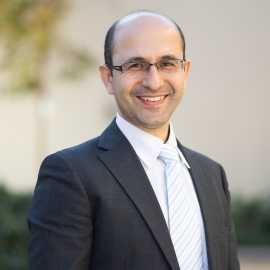
Abu Sebastian is a Distinguished Research Scientist at IBM Research - Zurich and a Visiting Professor in Materials at the University of Oxford . With over 200 publications and 100 patents, he pioneered in-memory computing , neuromorphic systems , and phase-change memory technologies . His work has been recognized by the IEEE Control Systems Technology Award , ERC Grants , and Ovshinsky Lectureship . Education: B.E. (Hons.) in Electrical and Electronics Engineering from BITS Pilani, India M.S. and Ph.D. in Electrical Engineering with minor in Mathematics from Iowa State University Research Interests focus on AI hardware , analog computing , and emerging memory technologies . His groundbreaking work includes phase-change memory-based neural networks , neuro-vector symbolic architectures , and hybrid CMOS/memristive neuromorphic systems . Scientific Awards: IEEE Fellow ERC Advanced Grant (2025) Ovshinsky Lectureship (2019)
Carolin Fink is an Associate Professor in the Department of Materials Science and Engineering at The Ohio State University (OSU), affiliated with the Edison Joining Technology Center. She serves as principal investigator and thrust area lead for the NSF/IUCRC Manufacturing and Materials Joining Innovation Center (Ma 2 JIC) and participates in the Materials and Manufacturing for Sustainability (M&MS) Discovery Theme program. Her research is funded by the National Science Foundation (NSF), Institute for Materials Research (IMR), and Electric Power Research Institute (EPRI). Her research focuses on: Defect formation in welds Weldability evaluation Alloy development for welding and additive manufacturing (AM) Metallurgical process understanding through experimental testing, advanced characterization, and materials modeling Recent research trends include: Microstructural heterogeneities in AM materials Hot cracking mechanisms in superalloys Corrosion resistance of stainless steel welds Intermetallic compound formation in dissimilar joining Cryogenic cooling effects on deposition processes Thermodynamic modeling for weld applications Scientific awards: 2021 Warren F. Savage Memorial Award (AWS) 2021 Charles Ellison MacQuigg Award for Outstanding Teaching (OSU CoE) 2016 Henry Granjon Prize (IIW) Additional roles: Chair of Admissions for Welding Engineering Graduate Committee Editorial Board Member, Welding in the World Journal Technical Paper Committee Member, American Welding Society Reviewer for multiple scientific journals Active participant in International Institute of Welding technical commissions STEM outreach coordinator for female high school students
LTC Phillip M. Lacasse serves as an Assistant Professor of Operations Research in the Department of Operational Sciences at the Air Force Institute of Technology (AFIT), assigned under a formal Memorandum of Agreement between AFIT and the U.S. Army Functional Area 49 Proponent Office. As an active-duty U.S. Army Lieutenant Colonel, his military career includes tank and scout platoon leadership, company command during Operation Iraqi Freedom, and staff roles at USMEPCOM and West Point. His academic credentials include: B.S. in Mathematics from United States Military Academy M.S. in Industrial Engineering from University of Wisconsin-Madison Ph.D. in Engineering from University of Wisconsin-Milwaukee Dr. Lacasse's research integrates Operations Research , Machine Learning , and Natural Language Processing to solve defense and industrial challenges. His work demonstrates expertise in autonomous swarm behavior for anti-access environments, emotion classification in multilingual social media, and workforce optimization for military applications. Recent publications reveal a strong focus on simulation modeling for military processing systems and defect prediction in smart manufacturing. His scholarly output shows consistent application of advanced analytics to real-world problems, particularly in military logistics (e.g., applicant scheduling simulations) and industrial systems (e.g., PCB defect prediction). Key trends include leveraging large language models for linguistic tasks and developing optimization frameworks for Army force structure analysis.
Dr. Tong Liu is a Lecturer in Pervasive Data Science at the Department of Computer Science, School of Computer Science, University of Sheffield, UK. Previously, he served as a Research Associate at the Sargent Centre for Process Systems Engineering at both Imperial College London (2022-2023) and the University of Sheffield (2021-2022), and as a visiting researcher at the University of Southampton (2018-2019). His academic journey reflects a strong foundation in control theory and data science with applications across multiple domains. Dr. Liu obtained his B.S. degree in Automation and Ph.D. degree in Control Theory and Engineering in 2016 and 2021, respectively, from Chongqing University, China. During his doctoral studies, he also conducted research at the School of Electronics and Computer Science, University of Southampton (2018-2019). Dr. Liu's research focuses at the intersection of machine learning, data science, and decision-making. His primary expertise lies in advancing sustainable and lifelong AI methodologies for pervasive data analytics to support intelligent decision-making. His work spans multiple application domains including industrial automation, precision agriculture, and healthcare informatics. Specific research areas include lifelong learning, online learning, transfer learning, time series and streaming data analytics, adaptive modeling of dynamic processes, and safe learning and optimization. His research has practical implications for developing more efficient, sustainable, and intelligent systems across various industries. Dr. Liu's recent publications demonstrate a strong focus on lifelong learning frameworks, adaptive modeling for industrial processes, and applications in precision agriculture and healthcare. His work shows a progression from foundational algorithm development to practical implementations in real-world systems. A notable trend is the integration of domain knowledge with machine learning techniques to create more efficient and reliable systems. His research increasingly emphasizes sustainability and safety considerations in AI applications, reflecting broader trends in responsible AI development. Dr. Liu serves as Course Director for MSc Advanced Computer Science at the University of Sheffield. He is actively involved in research funding, including as Co-PI on the KG-PPN project: 'Knowledge Guided Multimodal AI for Automatic Quantification and Infestation Estimate of Plant-Parasitic Nematodes,' funded by Innovate UK (06/2025 - 02/2026, £54,388). His research group, the Pervasive Computing Group, focuses on developing AI solutions for real-world challenges across multiple domains. Dr. Liu is affiliated with the Pervasive Computing Group at the University of Sheffield's School of Computer Science. His research collaborations span multiple institutions including Imperial College London, University of Southampton, and various industry partners including Shell. His work often involves interdisciplinary teams bringing together expertise in machine learning, control systems, and domain-specific knowledge from agriculture, healthcare, and industrial engineering.
Dr. Kristian Groom is a Senior Lecturer at the School of Electrical and Electronic Engineering (University of Sheffield), specializing in semiconductor optoelectronics and additive manufacturing. His research spans quantum dot lasers, photonic integration, and mid-infrared photonics for biomedical and industrial applications. Education: MPhys and PhD in Physics (University of Sheffield, 1999-2003) Awards: Royal Academy of Engineering Research Fellowship (2005) His research focuses on optoelectronic device engineering using advanced fabrication techniques like epitaxial regrowth. Key areas include: Quantum dot and quantum cascade lasers Superluminescent diodes for OCT Photonic integrated circuits Laser arrays for additive manufacturing Heterogeneous integration on non-native substrates Recent publications (2025-2015) highlight his work on: 450 nm diode area melting for metal alloys MIR photonics with Ge-on-Si waveguides Multi-beam laser systems in 3D printing Quantum dot dynamics in GaAs systems Photonic crystals with regrowth technology He leads projects in the EPSRC Heteroprint consortium and Future Photonics Hub , with a patent for semiconductor light sources. His teaching includes Electronic Devices & Circuits and Microsystems Packaging .
Thomas Whittles is a postdoctoral researcher in the Department of Solid State Quantum Electronics at the Max Planck Institute for Solid State Research, Stuttgart, Germany (since 2018). He completed his PhD in Physics at the University of Liverpool (2013-2017), specializing in electronic characterization of earth-abundant sulphides for solar photovoltaics. Education MPhys in Physics (University of Durham, 2009-2013) PhD in Physics (University of Liverpool, 2017) Research Interests focus on photovoltaic materials , particularly condensed matter physics of earth-abundant sulphides like CuSbS₂, Cu₃BiS₃, SnS, and CZTS. His work investigates electronic structures, band alignments, and material properties via XPS and inverse photoemission, aiming to improve solar cell efficiency through thin film characterization and surface electronic property optimization . Scientific Contributions include Springer Theses publication (2018), Best Thesis Prize (2017), and Woodruff Thesis Prize (2017). His publications span materials science , solid state physics , and photovoltaic device engineering , with key studies on work function tailoring, sapphire surface morphology, and transparent conducting oxides. Awards & Memberships Best Thesis Prize (University of Liverpool, 2017) Woodruff Thesis Prize (Institute of Physics, 2017) Thesis Publication in Springer Theses (2018) Member of the Institute of Physics (MInstP, since 2018) Publications show a focus on photovoltaic materials (CuSbS₂, Cu₃BiS₃, SnS) and thin film characterization , with recent work on heterostructure work functions and sapphire surface processing . His research bridges experimental material science and theoretical band structure modeling .
Dr. Seyed Ali Ghorashi is a Reader (equivalent to Associate Professor) in the Department of Engineering & Computing at the University of East London's School of Architecture Computing and Engineering. With over 20 years of experience in both industry and academia, he holds significant professional recognition including Fellow of the Higher Education Academy, Senior Member of IEEE, and professional membership in the British Computer Society. His educational background includes BSc and MSc in Electrical and Computer Engineering from the University of Tehran, and a PhD in Telecommunications and Networks from King's College London where he also worked as a postdoctoral researcher. He has held academic positions in the UK and Middle East and worked as a Senior Researcher at Samsung Electronics (UK) Ltd. Dr. Ghorashi's research spans multiple cutting-edge domains with particular emphasis on practical AI applications. His work integrates telecommunications, signal processing, and machine learning to address real-world challenges in digital health, 5G/6G networks, IoT, smart cities, and robotics. Recent research directions include Digital Health, AI for Sustainability, Digital Twin technologies, Internet of Behavior, and applications of Generative Adversarial Networks. His publication record shows consistent output in high-impact venues with a focus on human activity recognition using wireless signals, indoor positioning systems, radar technology, and structural damage assessment. The research demonstrates strong interdisciplinary connections between telecommunications engineering, computer vision, and practical AI applications across multiple sectors. Fellow of the Higher Education Academy (FHEA) Senior Member of IEEE Professional member of the British Computer Society (BCS) Four US patents Google Scholar: H-index 32, i10-index 84 Dr. Ghorashi has supervised over 200 MSc students, 16 PhD candidates, and 2 post-doctoral researchers. His research has been supported by significant projects including UK Mobile VCE (Core 2 & 4), the European Dreams4Cars project, 3GPP technical meetings, and an EPSRC project at King's College London. He serves as a technical reviewer for prestigious journals including IEEE Transactions on Cybernetics, IEEE IoT Journal, and IEEE Transactions on Wireless Communications, and has guest-edited special issues on Machine Learning in IoT. He leads research within the AI Centre for Public Sector and Smart Cities Research Group, focusing on applying advanced computational techniques to urban infrastructure and public service challenges. His current work bridges theoretical advances in machine learning with practical implementations in telecommunications infrastructure and healthcare applications.
Ilyass Abouelaziz is a Research Fellow at CESI Reims Campus, where he is affiliated with the LINEACT research team. His academic affiliation is with CESI, an engineering institution in France, where he focuses on computer science and engineering disciplines. Dr. Abouelaziz completed his PhD at the Faculty of Sciences of Rabat (2014-2020) with research on reference-free evaluation of 3D mesh quality using deep learning and visual saliency. He also earned a Research Master's Degree in Computer Science and Telecommunications from the same institution (2012-2014), with focus on Computer Vision and Visual Saliency, and a Fundamental License in Computer Science, Electronics, and Automation (2009-2012). His research interests span multiple areas at the intersection of computer vision and artificial intelligence, with particular expertise in 3D mesh quality assessment, point cloud processing, deep learning applications, and computer vision. His work combines theoretical foundations with practical applications in digital modeling and visual quality evaluation. His publication record demonstrates consistent output in top-tier journals and conferences, with a clear research trajectory focused on blind and no-reference quality assessment methods for 3D meshes. His work increasingly incorporates deep learning approaches, particularly convolutional neural networks, while maintaining connections to traditional computer vision techniques and geometric features. Dr. Abouelaziz serves as a reviewer for prestigious publications including Optics Express and IEEE International Conference on Image Processing, and has participated in various scientific committees for international conferences in signal processing and telecommunications. He currently supervises doctoral student Hafsa Benallal on research related to point cloud segmentation and cleaning for digital model creation. His teaching activities encompass algorithms, web development, programming (C, JAVA, Python), Artificial Intelligence, and Image processing for engineering students at levels ranging from 2nd to 5th year.
Olivier Bethoux is a Researcher at the Laboratory of Electrical and Electronic Engineering of Paris (LE2I), affiliated with Sorbonne University. His work focuses on power electronics, energy conversion systems, and control strategies for various power applications. He is actively involved in research on fuel cell systems, electric drives, and renewable energy integration, with numerous publications spanning from 2023 to 2025. His primary research interests include: Power electronics and converter design Fuel cell technology and hybrid power systems Control strategies for power converters and electric drives Energy management in hybrid systems Photovoltaic systems and renewable energy integration Power quality and harmonics analysis Bethoux's recent publications demonstrate a strong focus on energy routing, fuel cell systems, and power converter optimization. His work spans theoretical analysis, experimental validation, and practical applications in transportation and renewable energy systems. The research shows particular expertise in multi-source power systems, control strategies, and reliability considerations for hybrid power sources. Many of his publications involve collaborations with researchers such as Toufik Azib, Mickaël Hilairet, and Yiyu Lai, indicating active participation in research teams. His scientific contributions include numerous conference papers and journal articles on power electronics, with a focus on practical implementations and experimental validations. The work often addresses challenges in power distribution, converter coordination, and efficiency optimization for various energy systems including wind power generation, electric vehicles, and fuel cell applications.
Nekane Ione Sainz Bedoya is a lecturer and researcher at the University of Deusto , College of Engineering , in the Computing, Electronics and Communication Technologies department. She received her M.S. in Telecommunications Engineering from the University of Deusto in 2001 and PhD in Engineering from the University of Navarra in 2005. Dr. Sainz's research focuses on Industrial Internet of Things (IIoT) Blockchain applications in industry and education Wireless sensor networks Intelligent transport systems Smart cities Renewable energy systems Her work spans over 20 years with significant contributions in vehicular communication systems and recent innovations in blockchain integration for Academic credential verification Food supply chain traceability Green hydrogen certification She has co-authored 10+ journal articles and 22+ conference papers, developing energy-efficient protocols for wireless networks and practical IoT-blockchain platforms. Dr. Sainz collaborates with industry leaders like Telefónica and Accenture on projects including Smart energy systems Industrial 4.0 Circular food systems Public lighting management She supervises research projects such as ACM2024_21 (AI Models for Early Dropout Prediction) Urban Adaptation Solutions (2024-2028) Green Hydrogen Blockchain Management (2024) European Circular Food Systems (2020-2024)
Dr. Paola Domínguez Fernández is a Future Faculty Leaders (FFL) Fellow at the Institute for Theory and Computation (ITC) within the Center for Astrophysics | Harvard & Smithsonian. She specializes in large-scale magnetic fields, cosmic rays, and non-thermal phenomena in galaxy clusters using cosmological magneto-hydrodynamics (MHD) simulations. Education: Ph.D. in Astrophysics (Universität Hamburg, 2021), M.Sc. in Astrophysics (University of Bonn, 2017), B.Sc. in Physics (UNAM, 2015) Her research focuses on magnetic field evolution, shock dynamics, and synchrotron emission in galaxy clusters, employing tools like ENZO, PLUTO, and FLASH codes. Recent publications analyze AGN jet interactions, radio relic substructures, and turbulence effects in the intracluster medium (ICM). She is a committed mentor, co-directing the Science and Research Mentoring Program (SRMP) and serving as Deputy Co-Chair of the Postdoc Council at CfA. Her awards include the Future Faculty Leaders Fellowship and HmbNFG doctoral funding.
Dr. Farshid Pahlevani is a Researcher at the University of New South Wales (UNSW), Faculty of Engineering, School of Materials Science and Engineering, and a key member of the Centre for Sustainable Materials Research and Technology (SMaRT). With an international research career spanning prestigious institutes in Japan, Singapore, and Australia, Dr. Pahlevani specializes in innovative waste management solutions and sustainable metallurgical processes. His work focuses on transforming industrial waste into valuable resources, contributing significantly to environmental sustainability and cost efficiency in manufacturing. Dr. Pahlevani's primary research interests encompass Waste Management , Metallurgical Processes , Sustainable Materials , High Temperature Processing , Resource Recovery , Green Manufacturing , and Steel Production . His groundbreaking work has led to the development of novel methods for incorporating waste materials into metals manufacturing and transforming non-metallic wastes into green materials. He has published over 100 articles in leading journals, secured 6 international patents (with 4 licensed to companies across Japan, South Korea, Thailand, and Singapore), and attracted millions of dollars in research funding. Analysis of Dr. Pahlevani's recent publications reveals a strong focus on waste-to-resource conversion technologies. His research spans multiple disciplines including materials science, metallurgy, environmental engineering, and sustainable manufacturing. Key themes include thermal transformation of carbon-rich wastes, development of novel composites from recycled materials, surface engineering for corrosion resistance, and advanced recycling techniques for plastics and textiles. His work consistently demonstrates practical applications for industrial waste streams, contributing to the circular economy and sustainable manufacturing practices. Dr. Pahlevani's scientific achievements have been recognized with numerous awards: Most innovative engineer of the year (2020) Licensing award for liquid forging technology (2013) Nominated for Sawamura and Guimaraes awards (2012) Best industrial oriented research at SIMTech, Singapore (2011) Best research at Iron and Steel Institute of Japan (2010) Hata-no award for young researcher, Tohoku University (2009) Best National project for Al casting method in Japan (2007) As a process metallurgist at UNSW's SMaRT Centre since April 2015, Dr. Pahlevani has established strong industry partnerships and secured significant research funding. His work bridges fundamental science with industrial applications, focusing on practical solutions for waste management challenges. He has successfully adapted metallurgy knowledge to achieve the transformation of various waste streams into valuable materials, demonstrating the commercial viability of sustainable manufacturing approaches. The Centre for Sustainable Materials Research and Technology (SMaRT) provides the primary research environment for Dr. Pahlevani's work. This innovative center focuses on developing new technologies for utilizing waste as a resource in the production of next-generation green materials and products. Through this platform, Dr. Pahlevani collaborates with interdisciplinary teams to advance sustainable manufacturing practices and waste transformation technologies.
Prof. Adrian Evans serves as Deputy Head of Department in the Department of Electronic & Electrical Engineering at the University of Bath, where he leads research within the Electronics Materials, Circuits & Systems Research Unit (EMaCS) and The Foundry: Centre for Digital, Manufacturing & Design. His academic profile demonstrates active engagement in doctoral supervision and cutting-edge research across multiple domains of image processing and biometrics. His primary research focuses on biometrics—particularly 3D face recognition techniques resilient to facial expressions—and advanced colour/multispectral image processing. He has pioneered methods for colour edge detection, nonlinear filtering, and scale-space sieve-based segmentation. His motion estimation work specializes in analyzing non-rigid bodies like clouds and glaciers, while his nonlinear image processing research centers on mathematical morphological sieves and granulometric texture analysis. Recent publication trends (2021-2025) reveal a strategic shift toward computer vision applications in transportation (multi-camera vehicle tracking systems) and healthcare (non-contact cardiorespiratory monitoring). His work increasingly integrates radar technology with computer vision for vital sign detection while maintaining foundational contributions to mathematical morphology and image enhancement techniques. No major scientific awards are documented in the provided materials. His supervisory record includes 11 doctoral students, with current openness to new PhD candidates. Research funding spans UK government and industry collaborations including EPSRC projects like High Speed 4K Video Transmission (2016-2018) and multiple KTP partnerships with Seiche Measurements Limited and Navtech Radar Limited. He operates within Bath's EMaCS research unit and The Foundry center, leveraging these interdisciplinary environments for digital manufacturing and design innovation. His work directly supports UN Sustainable Development Goals through applications in smart transportation systems and healthcare technology development.
Professor Willie Hamilton is Professor of Primary Care Diagnostics at the University of Exeter's Health and Community Sciences school. A third-generation Belfast doctor, he specializes in primary care cancer diagnostics with transformative impact on UK cancer diagnosis pathways. As clinical lead for NICE's 'Referral for Suspected Cancer' guideline (NG12, 2015), his work underpins 100 of 210 recommendations governing £1 billion in annual NHS spending, contributing to reduced avoidable cancer deaths and improved survival rates through earlier diagnosis. His educational background includes: BSc in Medical Microbiology (Bristol, 1979) MB, ChB (Bristol, 1982) MRCP (UK, 1986) MRCGP (1989) FRCGP (2002) FRCP (2003) MD thesis: 'Earlier diagnosis of colorectal, lung and prostate cancer' (Bristol, 2005) Hamilton's research centers on developing and validating cancer risk assessment tools for primary care, generating electronic clinical decision support systems used in UK GP surgeries to estimate cancer risk from patient symptoms. His DISCOVERY unit (DIagnosing Symptomatic Cancer Optimally) focuses on optimizing diagnostic pathways across multiple cancers, with recent work expanding into dementia diagnostics (DECODE Project) and musculoskeletal disorders while maintaining cancer diagnosis as the core theme. His profoundly deaf status has not impeded his career, guided by the mantra 'Deaf people can do anything except hear' alongside professional mottos 'Quaerere Verum' and 'Cum Scientia Caritas'. Analysis of his recent publications reveals concentrated efforts on optimizing colorectal cancer diagnosis through faecal immunochemical testing (FIT), with growing emphasis on health equity, patient/practitioner perspectives, and cost-effectiveness. His work spans ovarian, lung, and multi-cancer detection, increasingly incorporating AI techniques and electronic decision support while addressing socioeconomic disparities in diagnostic access and outcomes. His notable recognition includes: CBE for services in improving early cancer diagnosis (2019 New Year Honours) RCGP Overall Paper of the Year (awarded twice) Hamilton leads fifteen research staff and PhD students while securing over £30 million in competitive funding, including: NIHR programme grants (2010-2016, 2020) Department of Health Policy Research Unit (£5 million, 2010-2018, renewed 2019) Cancer Research UK Catalyst award (£4.83 million, 2015-2020) Dennis and Mireille Gillings Foundation donation (£2 million for ERICA trial) These support major initiatives like the ERICA trial implementing electronic cancer risk assessment in GP software and the CanTest collaboration shifting diagnostic testing into primary care. He directs the DISCOVERY unit at Exeter Medical School and co-leads the international CanTest collaboration, focusing on optimizing cancer diagnosis through integrated risk tools, clinical trials, and policy implementation while mentoring the next generation of diagnostic researchers.
Christopher Ritchie serves as a Lecturer in the Art and Design Department within the College of Arts and Sciences at the University of New Haven, bringing over 20 years of professional design experience to the classroom. His industry background spans major clients including Coca-Cola, The Wall Street Journal, Moby, and The New York Times, with expertise in multi-disciplinary design and art direction. His educational foundation includes: B.S. in Graphic Design Communication from Jefferson University (formerly Philadelphia College of Textiles & Science) M.F.A. in Design from the School of Visual Arts (2005) Ritchie's creative practice centers on research-based conceptual design, specializing in brand identity systems, packaging solutions, and integrated campaign development. He excels in translating complex narratives into strategic visual systems, with particular focus on social impact design as evidenced by projects for non-profits like Barrier Free Living and Unlocking Employment. His approach bridges commercial viability with conceptual depth across physical and digital mediums. Recent creative output (2023-2024) demonstrates sustained leadership in high-profile branding initiatives, particularly for The Wall Street Journal's Future of Everything Festival and Science of Success campaigns. His portfolio reveals consistent evolution across environmental graphics, publication design, and identity systems, reflecting adaptability to emerging industry demands while maintaining conceptual rigor. As an educator in the Graphic and Digital Design program, Ritchie leverages his extensive agency and in-house experience to mentor students. His career trajectory—from MTV and Chase during the internet startup era through founding his Coa Design practice—provides authentic case studies in professional development, client management, and creative problem-solving within contemporary design landscapes.