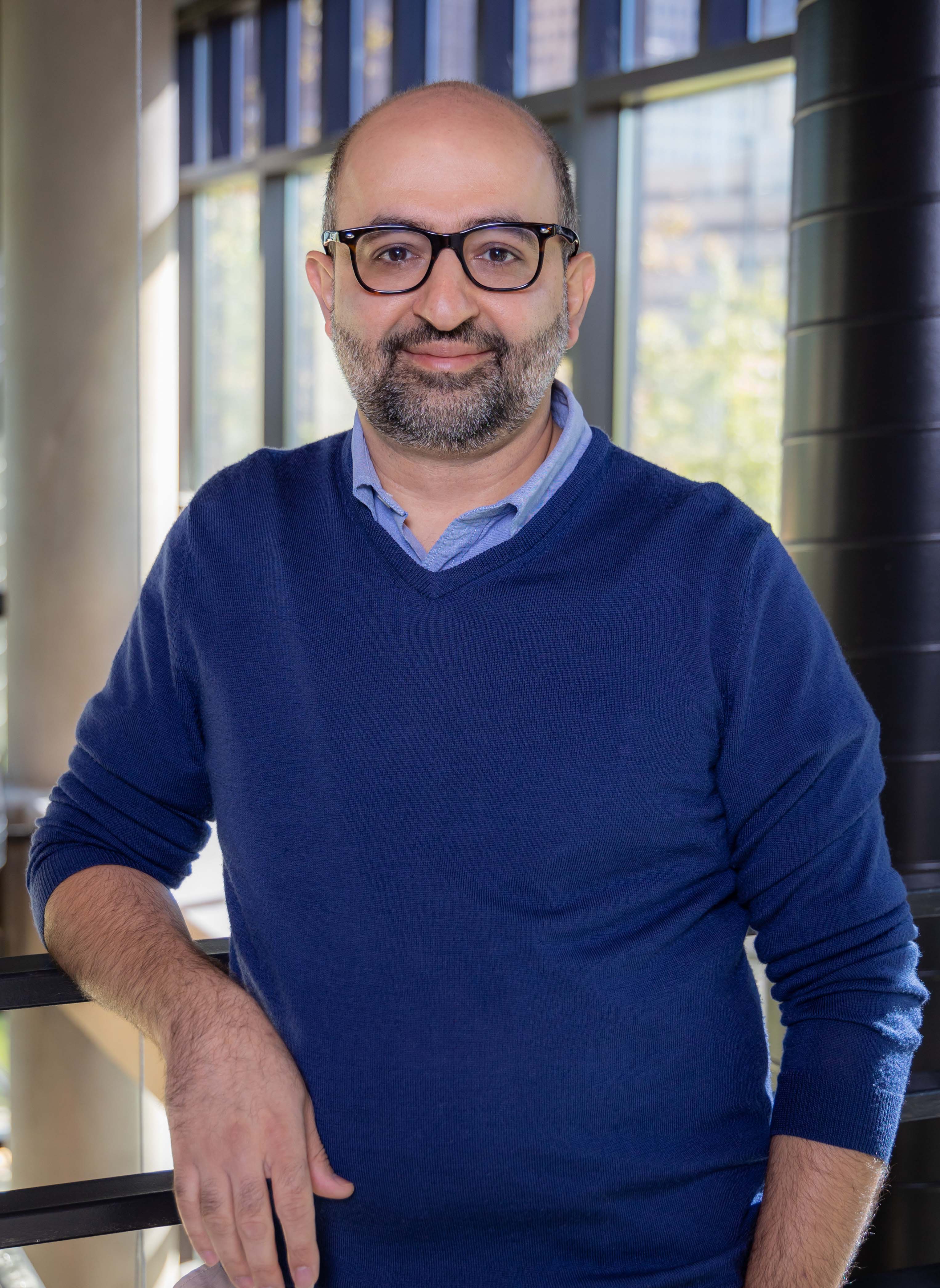
Dr. Scarlett Raine is a Lecturer in the School of Electrical Engineering and Robotics at Queensland University of Technology (QUT), where she serves as a Chief Investigator at the QUT Centre for Robotics and an Associate Investigator at the QUT Centre for Data Science and QUT Centre for Environment and Society. Her work focuses on applying Artificial Intelligence to automate underwater image analysis for marine ecosystem monitoring.
Kimon Fountoulakis is an Associate Professor at the University of Waterloo. His research focuses on Machine Learning on Graphs and Numerical Optimization, with a strong emphasis on algorithmic methods for graph-structured data. He holds a Ph.D. from The University of Edinburgh (2015), an M.Sc. from The University of Edinburgh (2010), and a B.Sc. from Athens University of Economics and Business (2009). His work spans theoretical foundations and practical applications in graph algorithms, optimization, and machine learning. Research interests include graph neural networks, local graph clustering algorithms, and algorithmic reasoning. His contributions address challenges in graph representation learning, message-passing architectures, and scalable optimization methods. Notable themes in his publications include improving counting abilities of vision-language models, analyzing graph convolutions, and developing flow-based clustering techniques with statistical guarantees. His work often bridges theory and practice, with applications in network analysis, pandemic containment strategies, and high-performance computing. While no specific grants or awards are listed, his research demonstrates significant contributions to graph-based machine learning and optimization. He maintains a research group at the University of Waterloo, with a focus on developing open-source tools and frameworks for graph algorithms. His lab’s work emphasizes local graph clustering methods and their scalability in real-world networks.
Andreas Geiger is a Professor and Head of the Department of Computer Science at the University of Tübingen, Germany. He leads the Autonomous Vision Group (AVG) within CyberValley and is a core faculty member of the Tübingen AI Center. His roles also include PI in the ML in Science Excellence Cluster and the CRC Robust Vision, as well as ELLIS Fellow and coordinator of the ELLIS PhD program. He specializes in machine learning models for computer vision, robotics, and autonomous systems, with applications in self-driving cars, VR/AR, and scientific document analysis. Educational background: While not explicitly detailed, his positions imply a Ph.D. in Computer Science or related field. His work spans interdisciplinary collaborations with institutions like ETH Zürich, Microsoft, and the University of Bonn. Research focuses on 3D scene understanding, Gaussian splatting, generative models, and reliable autonomous systems. Notable contributions include the KITTI dataset and foundational work in neural radiance fields. Awards include the Sage 10-Year Impact Award (2024), ERC Starting Grant (2019), and IEEE PAMI Young Researcher Award (2018). Key projects include the Scholar Inbox paper recommender platform, ReSim (reliable world simulation), and advancements in 3D scene generation (e.g., UrbanCAD, PrITTI). His lab maintains a strong focus on open-source tools and datasets, such as the CARLA Route Generator. Grants and funding include support from Vector Stiftung (MINT innovation program) and EU initiatives like the ML in Science Cluster. His team collaborates internationally, with recent work presented at CVPR, SIGGRAPH, and NeurIPS.
Cyrill Stachniss is a Full Professor at the University of Bonn , where he heads the Lab for Photogrammetry and Robotics and is affiliated with the Lamarr Institute for Machine Learning and Artificial Intelligence . He was previously a Visiting Professor in Engineering at the University of Oxford until 2025. His academic journey includes positions at the University of Freiburg, University of Zaragoza, and the Swiss Federal Institute of Technology. University: University of Bonn School: Faculty of Engineering Department: Department of Photogrammetry Academic Rank: Professor His research spans robotics, photogrammetry, SLAM, autonomous navigation, perception systems, agricultural robotics, and unmanned aerial vehicles . He emphasizes probabilistic techniques for mobile robots and has made significant contributions to visual and LiDAR-based localization, scene understanding, and 3D reconstruction. The recent publications highlight a strong trend toward neural implicit representations, agricultural phenotyping, radar-based perception, and active learning . His team develops robust systems for real-world deployment in dynamic and unstructured environments, particularly in precision farming and autonomous vehicles. Scientific Awards: IEEE RAS Early Career Award (2013) Microsoft Research Faculty Fellow (2010) 7th EURON Georges Giralt Award (2008) Multiple Best Paper Awards at ICRA, IROS, RSS, and RAL Faculty Teaching Award, University of Freiburg He has advised numerous students and leads the DFG Cluster of Excellence PhenoRob and Research Unit FOR 1505 Mapping on Demand . His lab has co-founded three startups, reflecting strong industry and societal impact. He also runs the educational video series 5 Minutes with Cyrill , explaining key robotics concepts.
Baharan Mirzasoleiman is an Assistant Professor in the Department of Computer Science at the University of California, Los Angeles (UCLA), where she leads the BigML research group. Prior to joining UCLA, she was a postdoctoral research fellow in Computer Science at Stanford University working with Jure Leskovec. She received her Ph.D. in Computer Science from ETH Zurich advised by Andreas Krause. Her research focuses on addressing sustainability, reliability, and efficiency of machine learning, with particular emphasis on improving big data quality by developing theoretically rigorous methods to select the most beneficial data for efficient and robust learning. Her work spans several critical areas including data efficiency, robustness against label noise and data poisoning, and addressing spurious correlations in machine learning models. She has made significant contributions to understanding how neural networks exploit spurious features that correlate with certain categories during training but fail to generalize to minority groups. Professor Mirzasoleiman's research demonstrates how theoretically grounded approaches can lead to practical improvements in model robustness and efficiency across various applications including medical diagnosis and environmental sensing. Her work has resulted in the development of the SpuCo package, a Python library that provides modular implementations of state-of-the-art methods to address spurious correlations, along with controllable synthetic datasets like SpuCoMNIST and large-scale vision datasets like SpuCoAnimals. She has received numerous prestigious awards including the ETH medal for Outstanding Doctoral Thesis, being selected as a Rising Star in EECS by MIT, an NSF Career Award, a UCLA Hellman Fellows Award, and an Okawa Research Award. Her students have also received multiple fellowships and awards including Amazon Doctoral Student Fellowships and an OpenAI Superalignment Fast Grant. Professor Mirzasoleiman actively contributes to the academic community through invited talks at major conferences including ICML, ICLR, NeurIPS, and KDD, as well as co-organizing workshops on new frontiers in adversarial machine learning and sparsity in neural networks. She has developed educational resources including tutorials on Foundations of Data-efficient Learning presented at ICML 2024.
Peter A. Flach is Professor of Artificial Intelligence at the Intelligent Systems Laboratory, School of Computer Science, University of Bristol, where he has been faculty since 1997 and was promoted to Professor in 2003. He currently directs the UKRI AI Centre for Doctoral Training in Practice-Oriented Artificial Intelligence and serves as Vice-President of the European Association for Data Science (EuADS), having previously served as its President. His research centers on rigorous evaluation and improvement of machine learning systems, with seminal contributions to classifier calibration (including Beta Calibration and Precision-Recall-Gain curves), explainable AI frameworks, and data science methodology. He pioneered the extension of CRISP-DM to data science trajectories and developed Explainability Fact Sheets for systematic assessment of XAI approaches. His work bridges theoretical foundations with practical deployment in real-world systems. Analysis of his recent publications reveals a dominant focus on interpretable and reliable machine learning, with strong emphasis on performance evaluation metrics, model calibration techniques, and human-centered explainability. His research increasingly addresses healthcare applications through projects like SPHERE and clinical decision support systems, while maintaining core contributions to fundamental ML theory. His scientific recognition includes prestigious fellowships: Fellow of the European Lab for Learning and Intelligent Systems (ELLIS) Fellow of the European Association for Artificial Intelligence (EurAI) Professor Flach has secured major research funding including UKRI Centre for Doctoral Training grants and EU network funding (TAILOR). He leads extensive collaborations across Engineering, Population Health Science, and international institutions (Monash University, Polytechnic University of Valencia), plus over 20 industry partners in the Practice-Oriented AI CDT including LV= and QinetiQ. His work with the SPHERE project demonstrates successful translation of AI research into residential healthcare settings. He leads the Intelligent Systems Laboratory at Bristol, which develops influential open-source tools including the FAT Forensics Python toolbox for algorithmic fairness and the Explainability Fact Sheets framework. His lab maintains strong connections with the European AI community through ELLIS and EurAI, positioning Bristol as a hub for human-centered and methodologically rigorous AI research.
Sanjay Purushotham is an Assistant Professor in the Department of Information Systems at the University of Maryland Baltimore County (UMBC), with a PhD in Electrical Engineering from the University of Southern California (USC) and a postdoctoral background in Computer Science at USC's Integrated Media Systems Center (IMSC). His research focuses on machine learning, data mining, and their applications in biomedical informatics, social network analysis, and multimedia data mining. Key contributions include survival analysis models using pseudo values and federated learning frameworks for healthcare data. He has received awards including the Best Paper Award at SIGSPATIAL 2014 and a Best Poster Runnerup at SCMLS 2016. Education: PhD in Electrical Engineering (USC), Postdoc in Computer Science (USC) His work spans interdisciplinary areas such as domain adaptation for remote sensing, thermal face translation, and interpretable neural networks for medical applications. Recent projects include federated survival analysis models and climate-informatics frameworks for cloud property retrieval. He teaches courses in artificial intelligence, healthcare informatics, and statistical learning at UMBC. Research highlights include developing MedFuseNet for multimodal medical question answering and VDAM for multi-sensor cloud data analysis. His work on fair survival analysis models addresses algorithmic bias in healthcare predictions. Current grants include a NSF CAREER award for trustworthy federated learning in computational healthcare.
Prof. Hayden Kwok Hay SO is an Associate Professor at the University of Hong Kong (HKU), affiliated with the Department of Electrical and Electronic Engineering. He currently serves as Acting Director of the School of Innovation and previously co-directed the Computer Engineering Program. His research focuses on reconfigurable computing systems, FPGA-based architectures, and their applications in AIoT, medical imaging, and high-performance computing. He holds a B.S., M.S., and Ph.D. in Electrical Engineering and Computer Sciences from UC Berkeley (1998–2007). Prof. So has been recognized with awards such as the IEEE-HKN Teaching Award (2021), Croucher Innovation Award (2013), and multiple teaching excellence awards. He leads the Computer Architecture & System Research Lab (CASR) and co-founded the Joint Lab on Future Cities (JLFC). His work spans FPGA overlay architectures, graph processing systems, and hardware-software co-design for efficient computing. Key research contributions include advancements in FPGA-based reconfigurable systems, sparse dataflow architectures, and medical imaging accelerators. He has secured grants for projects like 'Advanced machine vision guided aquatic surface vehicles' and 'Efficient and Productive Parallel Data Processing in Hybrid FPGA-CPU Clusters.' Prof. So has advised numerous students and researchers, contributing to over 150 peer-reviewed publications. His current projects explore AI hardware acceleration, neuromorphic computing, and FPGA-driven solutions for big data challenges.
Huamin Qu is a Chair Professor in the Department of Computer Science and Engineering at the Hong Kong University of Science and Technology (HKUST). He serves as the Founding Dean of the Academy of Interdisciplinary Studies (AIS), Founding Head of the Division of Emerging Interdisciplinary Areas (EMIA), and was the Founding Acting Head of Computational Media and Arts (CMA) at HKUST(GZ). Qu directs the VisLab and coordinates the Human-Computer Interaction (HCI) group. He obtained his BS in Mathematics from Xi'an Jiaotong University and MS/PhD in Computer Science from Stony Brook University. Qu's research integrates Data Visualization , Human-Computer Interaction , and Human-Centered AI , with applications in urban informatics, social networks, and explainable AI. His work focuses on developing interactive systems for big data analytics, visual storytelling, and AI-driven decision support. Research extends to multimodal communication, fintech, and augmented reality applications. His publications emphasize visual analytics for complex datasets (mobility, social media, financial), interaction techniques for immersive environments, and AI-enhanced visualization tools. Recent works explore explainable AI interfaces and large-scale data communication frameworks. IEEE Visualization Academy (2020) IEEE VGTC Technical Achievement Award AI 2000 Most Influential Scholar (2019, 2023, 2024) 21 Best Paper/Honorable Mention awards IBM Faculty Award (2009) APICTA Merit Award (2015) Yelp Dataset Grand Prize (2018) Qu has advised 48 PhD graduates (21 now faculty at institutions like UC Davis, University of Minnesota, Texas A&M) and 30 MPhil students. He secured major grants including RGC theme-based projects (digital citizenship, air pollution), UGC AoE (slope safety), and China's 973 Program. As VisLab director, he leads 20+ researchers in visualization/HCI projects adopted by Microsoft, IBM, Huawei, and Tencent.
Dr. Xiaoxiao Li is an Assistant Professor in the Electrical and Computer Engineering Department at the University of British Columbia (UBC), with joint appointments in Computer Science (Associate Member) and the School of Medicine at Yale University (Adjunct Assistant Professor). She is also a Canada CIFAR AI Chair and Canada Research Chair (Tier II) in Responsible AI. Her research focuses on enhancing trustworthiness, fairness, and efficiency in AI algorithms and foundation models, particularly in healthcare applications. Education: B.S. (Honors) in Zhejiang University (2015), Ph.D. in Biomedical Engineering from Yale University (2020), Postdoc at Princeton University (2020-2021). She leads the Trusted and Efficient AI (TEA) Lab at UBC, which develops algorithms for federated learning, medical imaging analysis, and interpretable AI systems. Research interests include federated learning, generative models, medical image analysis, AI fairness, and graph-based methods for neuroimaging. Recent projects include GMValuator (data valuation for generative models), FairMedFM (fairness benchmarking in medical AI), and FedTextGrad (textual gradient-based FL optimization). Grants: Canada Foundation for Innovation Grant (2023), UBC Green Lab Fund (2023), Vector Institute funding Teaching: Courses on machine learning, federated learning, and AI ethics at UBC Awards & Recognition: Best Paper Award at FL@FM WWW 2024, Editorial Board Member of Medical Image Analysis , multiple top-tier conference acceptances (NeurIPS, ICLR, CVPR, MICCAI). Lab & Teams: TEA Lab collaborates with industry and hospitals to translate AI research into clinical tools. Current projects address AI fairness in healthcare, federated learning for medical data, and multimodal medical analytics.
Tianxi Cai, ScD, holds the John Rock Professorship in Population and Translational Data Sciences at the Harvard T.H. Chan School of Public Health and is a Professor of Biomedical Informatics at Harvard Medical School. She directs the Translational Data Science Center for a Learning Health System (CELEHS). Her work bridges clinical and basic science data to advance personalized medicine and disease understanding. Institution: Harvard University Departments: Biostatistics (T.H. Chan School) and Biomedical Informatics (HMS) Key Roles: Faculty member since 2002, NIH-funded researcher, and leader in EHR data analytics Research focuses on biomarker evaluation, predictive modeling, high-dimensional data analysis, and survival analysis. Collaborates with the I2B2 Center to integrate clinical and genomic data. Active in developing semi-supervised learning methods for noisy EHR data and real-world evidence generation. Funding : Recent grants include NIH projects on rheumatoid arthritis treatment response (R01AR080193, R21AR078339) and semi-supervised EHR denoising (R01LM013614). Co-leads initiatives on chronic disease endpoints using multi-source data (U01FD007929). Labs/Teams : Directs CELEHS and leads the Cai Lab, focusing on translational data science and machine learning applications in healthcare.
William Yang Wang serves as the Mellichamp Professor of Artificial Intelligence at the University of California, Santa Barbara (2019-present). He directs the UCSB Center for Responsible Machine Learning, the Mind and Machine Intelligence Initiative, and the UCSB NLP Group. His research focuses on theoretical foundations and practical algorithms for AI, particularly in NLP, LLMs, and neuro-symbolic reasoning. PhD in Computer Science from Carnegie Mellon University Active in AI theory and applications (2016-present) Research interests span multiple AI domains, with special emphasis on NLP and responsible machine learning. He has pioneered datasets like HybridQA, TabFact, and VaTeX, enabling advancements in multi-hop QA, fact verification, and video-language tasks. His work combines statistical relational learning with modern deep learning paradigms. Recent publications center around multimodal reasoning, knowledge graph integration, and responsible AI development. He has received numerous accolades including the IEEE SPS Pierre-Simon Laplace Award (2024) and NSF CAREER Award (2021). Karen Sparck Jones Award (2022) DARPA Young Faculty Award (2018) IBM Faculty Award Mentoring 15+ PhD and postdoc researchers who now hold positions at Microsoft Research, Amazon, Meta GenAI, and academic institutions like Arizona and Rutgers. His lab maintains active collaborations with industry partners through initiatives like ChipAgents.ai, which he founded as CEO.
Junjian Qi serves as the Hohbach Endowed Associate Professor in the Department of Electrical Engineering and Computer Science at South Dakota State University's College of Engineering, holding this position since 2023. His academic journey includes prior appointments as Assistant Professor at Stevens Institute of Technology (2020-2023) and University of Central Florida (2017-2020), along with research roles at Argonne National Laboratory and University of Tennessee. His educational background includes: Ph.D. in electrical engineering from Tsinghua University, Beijing, China (2013) B.E. in electrical engineering from Shandong University, Jinan, China (2008) Dr. Qi's research centers on electric power systems resilience, with particular expertise in cascading failure mechanisms, microgrid control architectures, cyber-physical security vulnerabilities, and synchrophasor applications. His work integrates advanced data analytics and machine learning techniques to enhance grid stability against extreme weather events and cyber threats. Current investigations focus on developing distributed control strategies for inverter-dominated grids and modeling system interdependencies during failure propagation. Analysis of his 15 most recent publications (2021-2024) reveals a strong methodological shift toward data-driven approaches for power system challenges. Key trends include machine learning applications for cascading failure prediction, novel distributed control frameworks for AC/DC microgrids, and cybersecurity enhancements for inverter-based resources. His work consistently bridges theoretical models with real-world utility data, particularly evident in multiple Best Paper Award-winning publications analyzing actual outage sequences. Dr. Qi's scientific recognition includes: NSF CAREER Award (2020) Three consecutive Best Paper Awards at IEEE PES General Meetings (2022-2024) World's Top 2% Scientist designation in energy (2020-2023) IEEE PES Outstanding Working Group Award (2023) Multiple journal Best Paper Awards (IEEE Transactions on Power Systems, Journal of Modern Power Systems) He currently leads significant research initiatives including an NSF CAREER project ($500k) on cascading failure analysis and an NSF collaborative grant ($219k) for grid stability, alongside previous DOE funding ($1.8M) for cybersecurity of distributed energy resources. His service includes editorial roles for IEEE Transactions on Power Systems and IEEE Power Engineering Letters, plus leadership in IEEE PES technical committees focused on voltage control and smart grid security.
Farnoush Banaei-Kashani is an Associate Professor (Tenured) in the Department of Computer Science and Engineering at the University of Colorado Denver. She also holds an Adjunct Associate Professor position in the Department of Mathematical and Statistical Sciences. As the founder and director of the Big Data Management and Mining Lab (BDLab), she leads multiple GAANN Fellowship Programs, including BDSE (Big Data Science and Engineering), DDC (Data-Driven Cybersecurity), and II (Infrastructure Informatics). She directs the 'Data Science in Biomedicine' MS Track and focuses on data-driven decision systems (DDSs), integrating machine learning and big data analytics into healthcare, energy, transportation, and environmental applications. Education: Details not explicitly provided in the text. Her research spans data management cycles for DDSs, addressing challenges like big data volume, velocity, and variety. Key projects include iWatch (crime surveillance), POCM (mobility monitoring), and GeoSIM (urban texture documentation). She teaches courses such as Machine Learning Systems, Big Data Science, and Data Mining. Publications highlight advancements in sea ice classification, federated learning, proteomic networks, and privacy-preserving AI. Her work is funded by NSF, NIH, DOT, and industry partners like Google and IBM. She has advised numerous students and contributes to academic leadership as editor, conference chair (ACM SIGSPATIAL 2018/2019), and program committee member for venues like SIGMOD and KDD.
Mingchen Gao is an Associate Professor in the Department of Computer Science and Engineering at the University at Buffalo, SUNY. He serves as Program Director for the Engineering Sciences (Artificial Intelligence) MS Program and is affiliated with the Institute for Artificial Intelligence and Data Science. Previously, he was a Postdoctoral Fellow at the NIH Clinical Center's Radiology and Imaging Science Department (2014–2017). His research focuses on medical imaging informatics, computer vision, and machine learning applications in healthcare. Notable projects include NSF-funded work on continual learning and federated domain adaptation. He teaches advanced courses like CSE674 (Advanced Machine Learning) and CSE703 (Deep Learning for Medical Imaging). Dr. Gao earned his Ph.D. in Computer Science from Rutgers University (2014), advised by Dimitris N. Metaxas, and a B.S. from Southeast University, China (2007). His lab develops AI systems for medical diagnosis, with recent work on robust neural networks and federated learning frameworks. His team has produced impactful algorithms for segmentation, classification, and domain adaptation in imaging tasks. Current research includes NSF CAREER Award (2023–2028) for deployable medical diagnosis systems and collaborations on drug discovery and toxicity prediction. He advises four PhD students and has authored over 60 peer-reviewed publications in top venues like NeurIPS, CVPR, and MICCAI.