Yang (Gilbert) Ye is an Assistant Professor in the Department of Civil and Environmental Engineering at Northeastern University, joining in January 2025. His research focuses on human-AI/robot teaming, automation in engineering, and assistive technologies, with a particular emphasis on human-centric robotics and sensorimotor processes. He holds a PhD in Civil Engineering from the University of Florida (2024), advised by Dr. Eric Jing Du. **Affiliations**: Member of ASCE, IEEE, and HFES. His work integrates VR/AR, robotics (e.g., drones, exoskeletons), and AI to enhance civil engineering workflows and workforce training. He leads the Ye Lab, actively recruiting PhD students and postdocs with coding experience (Python/C++/C#) and backgrounds in engineering or computer science. **Key Research Themes**: Human-robot interaction, construction automation, exoskeleton training, and delayed feedback mitigation in teleoperation. Over 20 peer-reviewed publications in journals like ASCE JoCEN, IEEE Access, and Advanced Engineering Informatics. **Lab Opportunities**: PhD/postdoc applicants require strong academic records (GPA ≥3.5) and coding skills. Undergrad/master students can apply for thesis/research roles. Funding covers tuition, insurance, and stipends.
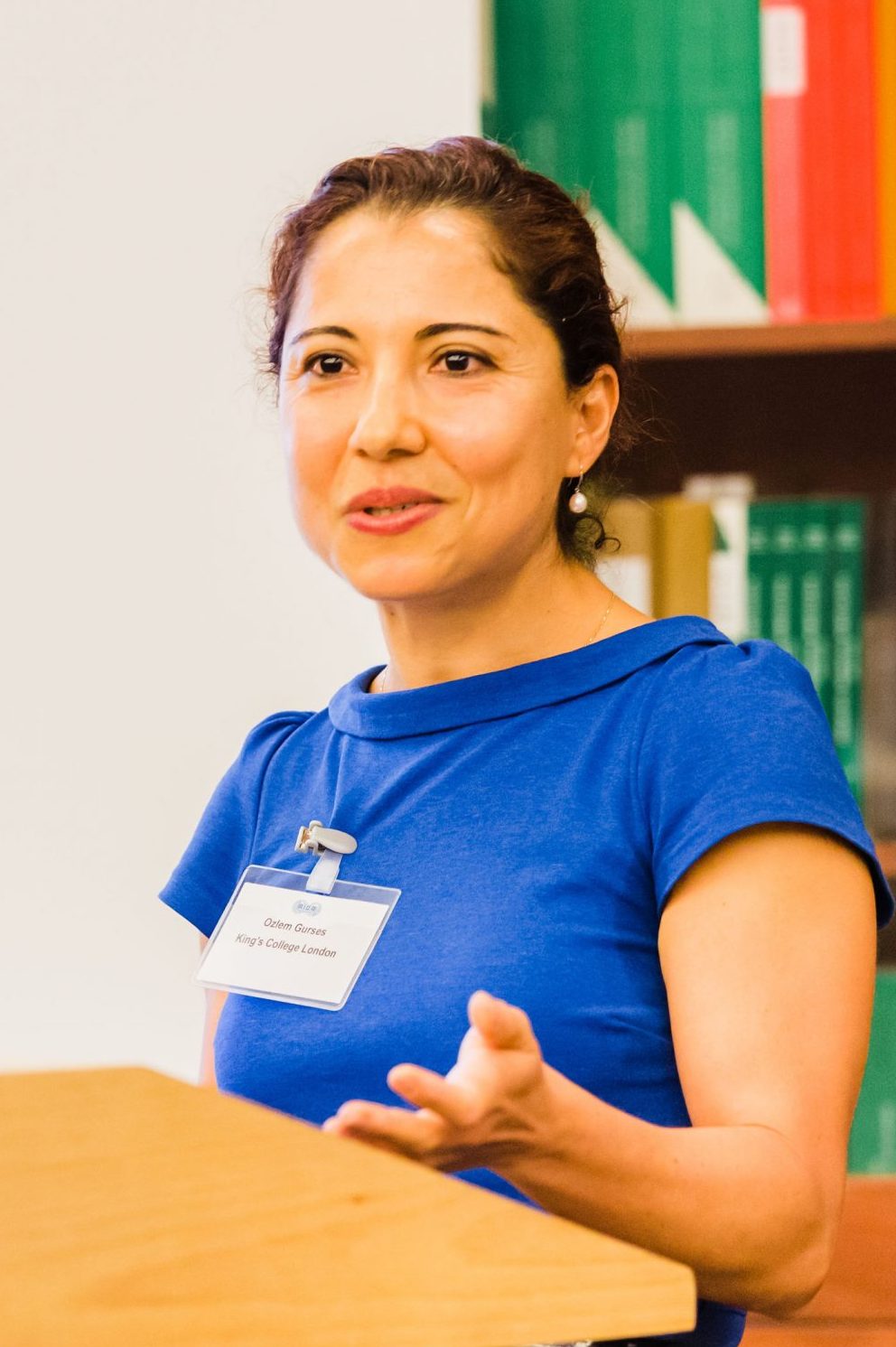
Özlem Gürses is Professor of Commercial Law at The Dickson Poon School of Law, King's College London. She previously taught at Norwich and Southampton Law Schools and holds law degrees from the University of Istanbul, an LLM in Maritime Law (with distinction) from the University of Southampton, and a PhD in Law from the same institution. She is a leading scholar in insurance and reinsurance law, with a focus on marine, compulsory, and emerging risk insurance. Her research interests include: Insurance and reinsurance law Marine and non-marine insurance Compulsory motor vehicle insurance Insurance of offshore installations and commercial risks Artificial intelligence in insurance contracts Her recent publications analyze business interruption insurance during the pandemic, public-private partnerships in reinsurance, subrogation immunity, and the legal treatment of emerging risks. She is the sole author of key texts such as The Law of Compulsory Motor Vehicle Insurance (2019), Marine Insurance Law (3rd ed, 2023), and Reinsuring Clauses (2nd ed, 2025), and has edited major reference works including the Edward Elgar Research Handbook on Marine Insurance Law (2024). She is actively involved in the legal academic community: Member of the Presidential Council, International Insurance Law Association (AIDA) Chair, Reinsurance Working Party of AIDA Vice-Chair, British Insurance Law Association Committee Professor Gürses teaches insurance law at both undergraduate and postgraduate levels and currently supervises four PhD students. She also lectures internationally in Germany, Singapore, China, Greece, and Italy. She has organized academic conferences and participates in research on the intersection of law, technology, and sustainability.
Prof. Oliver Faude is a Professor and Researcher at the Department of Motor Performance & Biomechanics within the University of Basel's Department of Sport, Exercise and Health (DSBG). His research focuses on exercise physiology, sports medicine, and the application of physical activity in managing chronic conditions like type 2 diabetes. He supervises doctoral students, including Vivien Hohberg, whose work on telephone-based health coaching for diabetes patients was published in the Journal of Science and Medicine in Sport. Faude collaborates on projects such as the dbcoach intervention, funded by Innosuisse and health insurers, demonstrating how personalized coaching increases physical activity in diabetic populations. His work also extends to musculoskeletal imaging innovations, such as the UMUD web application for ultrasonography data access, and the PrepAir study addressing chemotherapy-induced sensory dysfunction in children. Faude's interdisciplinary approach integrates clinical research, biomechanics, and public health, with a particular emphasis on aging populations and pediatric oncology. He contributes to injury prevention strategies in sports like badminton and soccer, while advancing methodologies for muscle volume assessment via 3D ultrasound and MRI comparisons. Key Projects: dbcoach program, PrepAir study, musculoskeletal imaging tools, agility training for frailty prevention. Grants: Innosuisse, SwissLife Foundation, Voluntary Academic Society of Basel. Students: Vivien Hohberg (PhD). Labs/Teams: Motor Performance & Biomechanics lab, collaborations with Prof. Bart Roelands (Vrije Universiteit Brussel) on overtraining syndrome research.
Dr. Beth McGinty is a Professor of Population Health Sciences and Division Chief of Health Policy and Economics at Weill Cornell Medical College . She serves as the Co-Founding Director of the Cornell Health Policy Center (2025–present), a cross-campus initiative for health policy research and training. Previously, she was a Professor at the Johns Hopkins Bloomberg School of Public Health (2022–2023) before joining WCM. PhD , The Johns Hopkins University Bloomberg School of Public Health (2013) MS , Columbia University (2006) BA , West Chester University (2004) Her research focuses on how health policies affect vulnerable populations, including those with mental illness , substance use disorders , and chronic pain , integrating public policy , health economics , and implementation science . Recent work examines telehealth expansion , opioid policy , and substance use stigma . Key grant activities include: National Institute of Mental Health (NIMH) funding (2024–2029) for studying healthcare integration for dual eligibles Commonwealth Fund grants (2024–2029) on healthcare equity and prenatal drug use law implementation Subawards from Janssen Research & Development (2024–2027) and Novartis Foundation (2023–2026)
Professor Özlem Gürses is a Professor of Commercial Law at King’s College London, specializing in insurance and reinsurance law. She concurrently serves as a Senior Fellow at the Melbourne Law Masters program at the University of Melbourne. Her academic journey includes undergraduate and postgraduate degrees from the University of Istanbul, followed by an LLM in Maritime Law and a PhD in Reinsurance Law from the University of Southampton. Her research focuses on marine insurance, motor vehicle insurance, and reinsurance clauses, with notable publications such as Marine Insurance Law (2023) and The Law of Compulsory Motor Vehicle Insurance (2019). She actively contributes to academic discourse through international conferences and edited volumes like the forthcoming Edward Elgar Research Handbook on Marine Insurance Law (2024). Prof. Gürses holds leadership roles in professional organizations, including membership in the Presidential Council of the International Insurance Law Association (AIDA) and chairing its Reinsurance Working Party. She also participates in the British Insurance Law Association (BILA) Committee, demonstrating her influence in shaping insurance legal frameworks globally.
Professor Ozlem Gürses is a Professor of Commercial Law at King’s College London, specializing in insurance and reinsurance law. She concurrently serves as Visiting Professor at the Centre for Maritime Law (CML) at NUS Law, where she conducts seminars on marine insurance developments. Her academic career includes teaching roles at Norwich and Southampton Law Schools. Bachelor’s/Master’s in Law from University of Istanbul LLM in Maritime Law from University of Southampton PhD in Reinsurance Law from University of Southampton Her research focuses on marine insurance, compulsory motor vehicle insurance, and reinsurance clauses, reflected in major publications like Marine Insurance Law (2023) and Edward Elgar Research Handbook on Marine Insurance Law (2024). She actively contributes to legal communities through roles in the International Insurance Law Association (AIDA) and British Insurance Law Association (BILA), including chairing AIDA’s Reinsurance Working Party. Her recent academic activities include a public seminar on ‘Insurance and Marine Insurance Law – Recent Developments’ at NUS Law on 1 February 2024.
Roles and Affiliations: Diana R Silver is the Vice Dean of Faculty Affairs and a Professor of Public Health Policy and Management at New York University’s School of Global Health. She holds a BA in History from Bates College, an MPH in Health Education from Hunter College, and a PhD in Public Administration from NYU. Her research focuses on the implementation and impact of public health policies, particularly addressing alcohol consumption, motor vehicle crashes, tobacco use, food safety, and access to healthcare services. She has been funded by entities like the NIH and the Robert Wood Johnson Foundation. Research Interests: Dr. Silver’s work explores policy effectiveness, including alcohol-impaired driving penalties, overdose mortality linked to fiscal policies, and firearm regulations. Her analyses often emphasize structural inequities, such as how policing expenditures correlate with overdose deaths or how social vulnerability affects healthcare access. She also investigates medication shortages and their sociodemographic impacts, as well as disparities in Medicare Advantage plan enrollment. Publications & Grants: Over 40 peer-reviewed articles highlight her contributions to public health policy, spanning journals like the American Journal of Preventive Medicine and Social Science & Medicine. Her research frequently employs innovative methods, such as fiscal analysis and latent class modeling. She has been an associate editor for the American Journal of Health Promotion since 2020. Awards & Recognition: Recipient of NYU’s Distinguished Teaching Award (2015), Steinhardt Goddard Award (2011), and others. Her work bridges academia and practice, influencing policies on overdose prevention, firearm safety, and healthcare equity.
Denny Yu is an Associate Professor at the Edwardson School of Industrial Engineering, Purdue University. His work bridges human factors, neuroergonomics, and healthcare safety through advanced sensor systems and AI. Primary Affiliation : Edwardson School of Industrial Engineering, Purdue University Research Themes : Surgical ergonomics, autonomous vehicle human factors, cognitive workload assessment, multimodal physiological sensing Dr. Yu's research focuses on neuroergonomics and human-robot interaction , particularly in surgical and transportation contexts. His team develops sensor-based systems for workload monitoring, including: EEG-eye tracking fusion for situation awareness Wearable exoskeletons for surgical posture support Computer vision tools for lifting task risk analysis Smart infusion pump usability frameworks AI-driven surgical coaching systems Recent publications emphasize deep learning applications in soft tissue deformation estimation and real-time adaptive systems for robotic surgery augmentation. His work spans both occupational health (veterinary surgeons, airport workers) and medical device innovation domains.
Professor Bruce Abernethy is Executive Director of UQ's Engagement with the 2032 Olympic and Paralympic Games, following his tenure as Executive Dean of the Faculty of Health and Behavioural Sciences (2014-2023) at the University of Queensland. His academic leadership includes previous roles as Deputy Executive Dean, Associate Dean (Research), and Head of the School of Human Movement Studies (1991-2003). He also served as inaugural Chair Professor at the University of Hong Kong's Institute of Human Performance (2004-2011). His educational background includes First Class Honours and University Medallist status from the University of Queensland, complemented by a PhD from the University of Otago. Professional recognition includes Fellowships from the American Academy of Kinesiology and Physical Education, Australian Sports Medicine Federation, and Exercise and Sport Science Australia. Abernethy's research centers on the interdisciplinary study of skilled movement control and acquisition, bridging human movement science, experimental psychology, neuroscience, and medical sciences. His work investigates expert perception and production of human movement patterns, with particular focus on deception detection in sports, visual-motor expertise, and fundamental movement skills development. This spans applications from elite athletic performance to pediatric movement disorders. Analysis of his recent publications reveals sustained focus on perceptual-cognitive aspects of sport expertise, with recurring themes in deception detection (particularly in football/cricket), gaze behavior analysis, and perceptual training methodologies. His work increasingly integrates interdisciplinary approaches across motor control, cognitive psychology, and sports biomechanics, with strong emphasis on practical applications for athletic training and movement rehabilitation. International Fellow, American Academy of Kinesiology and Physical Education Fellow, Australian Sports Medicine Federation Fellow, Exercise and Sport Science Australia University Medallist, University of Queensland Professor Abernethy has supervised eight PhD candidates to completion between 2003-2022, with research spanning cricket batting expertise, perceptual training, and movement disorders. His funding portfolio demonstrates exceptional grant acquisition success, including sustained support from the Motor Accident Insurance Commission (1997-2019), Australian Research Council (multiple projects 1995-2011), Australian Football League, Australian Sports Commission, and Hong Kong Research Grants Council. Current engagement with the 2032 Games represents strategic alignment of his expertise with major international sporting events. His research is conducted through the Centre for Extracellular Vesicle Nanomedicine within UQ's Faculty of Health and Behavioural Sciences, collaborating with interdisciplinary teams across sports science, psychology, and medical research domains. This network supports his translational research from basic motor control principles to applied sporting and clinical contexts.
Liana E. Brown is an Associate Professor in the Department of Psychology at Trent University. She holds degrees from the University of Waterloo (B.Sc., M.Sc.) and Pennsylvania State University (M.S., Ph.D.). Her research focuses on sensory-motor integration, exploring how vision, perception, and motor control interact during everyday tasks. Key interests include motor learning, proprioception, and the neural mechanisms underlying action-perception interactions. Dr. Brown’s research program investigates four core questions: 1) How hand use enhances vision/attention, 2) Limb spatial tracking mechanisms, 3) Motor capabilities’ influence on cognition, and 4) Observational motor skill acquisition. Her work bridges neuroscience, biomechanics, and clinical applications. She advises up to 2 Honours thesis students and 2 practicum students annually (2025-26 onward). Her lab (ACT Lab: https://actlab.squarespace.com/ ) explores motor learning, tool use, and neurorehabilitation strategies. Notable collaborations include studies on concussion assessment, Parkinson’s gait analysis, and motor skill development in cerebral palsy patients.
Chuck Collins, J.D., is an Assistant Teaching Professor at the Schmidthorst College of Business, Bowling Green State University, where he teaches Effective Business Communication. He holds a J.D. from the University of Toledo College of Law (1995), an MBA from Minnesota State University, Mankato (1989), and a B.S. in Business Administration and Criminal Justice from Defiance College (1986). Education: J.D., University of Toledo College of Law, 1995 MBA, Minnesota State University, Mankato, 1989 B.S., Defiance College, 1986 Before academia, Collins had a 25+ year legal career as a trial attorney at Eastman & Smith Ltd., arguing cases before the Ohio Supreme Court and influencing U.S. Supreme Court decisions. His practice focused on contract/business litigation, insurance disputes, and probate matters. Earlier, he worked as a Financial Analyst at Electronic Data Systems (EDS), managing government contracts, cost analysis for General Motors, and ensuring compliance with U.S. accounting standards during a Seoul, Korea assignment. He also served as a Juvenile Probation Officer in Defiance County. Grants/Awards: None explicitly listed. Collins brings interdisciplinary expertise from law, business analytics, and international operations to his teaching and academic role.
Norman Lewis serves as Part-Time Faculty (Adjunct Lecturer) in the Department of Technology, Information Systems and Analytics at Wayne State University's Business School since 2007, teaching Systems Analysis and Design courses (TIS5820/ISM5820) across multiple academic terms. His career spans corporate leadership at Ford Motor Company and technology innovation in healthcare and insurance sectors. His educational background includes: Ph.D. in Physics, Hebrew University, Jerusalem (1959) M.Sc. in Computer Science, Birkbeck College, University of London (1968) Diploma in Operations Research, Rutherford College of Technology (1964) B.Sc. (Hons) in Physics, University of the Witwatersrand (1954) B.Sc. in Physics and Chemistry, University of the Witwatersrand (1953) His research focuses on Data Analytics and quantifying IT's business value , examining both perceived and measured impacts of information systems on organizational performance through interdisciplinary systems analysis. Early publications (1960-1963) reveal foundational work in nuclear engineering and solid-state physics, covering reactor materials, fission product calculations, and crystal phosphorescence—demonstrating the scientific rigor that later informed his business technology leadership. As Manager of the NSF-funded IMSE project at Focus:HOPE (2002-2016), he co-developed a minority-focused computing pipeline integrating Wayne State University academics with Ford Motor Company experiential training to produce industry-ready IT candidates. He has directed technology teams across Ford Motor Company's global operations (1966-1995), founded Caretech at Compuware (1997-1999), and served as acting CIO for Kaufman Financial Group (2012-2014), applying systems engineering principles to business transformation.
Antonio Pietrabissa is an Associate Professor at the Department of Computer, Control, and Management Engineering “Antonio Ruberti” (DIAG) of the University of Rome Sapienza, where he earned his degree in Electronics Engineering (2000) and PhD in Systems Engineering (2004). He has been teaching Automatic Control and Process Automation since 2010 and holds the National Scientific Qualification as Full Professor in Systems and Control Engineering (09/G1). Research interests include networked systems, robust control, Markov decision processes, and deep reinforcement learning. His work spans telecommunications, biomedical applications, and space systems, with a focus on federated learning and decentralized control. He has authored ~70 journal papers (Scopus h-index 22) and co-invented a patent for model predictive control in motor disability assistance. Awards include the 2021 Cybersecurity Award and ETRI Journal Best Paper. Current projects are NANCY (6G networks) and CADUCEO (AI-driven medical diagnostics). He is also CEO of Sapienza startup Automation Intelligence and Control (AICO), commercializing AI solutions for space, telecom, and biomedical sectors.
Dr. Meghan Winters is an Assistant Professor in the Faculty of Health Sciences at Simon Fraser University (SFU). She holds a Ph.D. in Population and Public Health from the University of British Columbia (2011) and completed a postdoctoral fellowship at Vancouver Coastal Health Research Institute. Her research focuses on the interplay between health, transportation systems, and urban design, with particular emphasis on cycling safety, pedestrian infrastructure, and equity in active transportation. Education: PhD in Population and Public Health (2011, UBC); Postdoctoral work at Vancouver Coastal Health Research Institute (2011–2016). Research Interests: Built environment and health outcomes Non-motorized transport modes (cycling/walking) Equity in urban mobility Public health policy interventions Age-friendly infrastructure Recent work highlights include analyzing pandemic-era street reallocations, evaluating bike theft impacts, and investigating 15-minute neighborhood models in Surrey, BC. She collaborates closely with local governments and health authorities to translate research into actionable policy. Grants and Advising: While specific funding details are not listed here, her extensive publications indicate sustained research partnerships and advisory roles in urban health initiatives. Labs/Teams: Affiliated with SFU’s Urban Studies Program and active in interdisciplinary health geography networks.
Alex Moroz, MD, MHPE, is a Professor in the Department of Rehabilitation Medicine at NYU Grossman School of Medicine and Vice Chair of Education and Training at Rusk Rehabilitation. He specializes in Physical Medicine and Rehabilitation, Orthopedic Rehabilitation, and Sports Medicine, focusing on non-surgical treatments for musculoskeletal conditions such as shoulder pain, emphasizing integrative therapies like acupuncture and meditation. Dr. Moroz holds leadership roles, including Director of the Physical Medicine and Rehabilitation Residency Program, and teaches extensively, valuing academic collaboration to advance medical education and resident training. His research interests include medical education, feedback mechanisms, and assessment strategies in clinical practice. He is board-certified in PM&R with subspecialty certification in Sports Medicine. Dr. Moroz completed his MD at New York University (1996) and an MHPE from Maastricht University (2017). He practices at NYU Langone Orthopedic Center and accepts a wide range of insurance plans. Dr. Moroz’s academic contributions span over 95 publications, with recent work focusing on challenges in academic physiatry, feedback techniques in medical education, and evidence-based practices in pain management. His clinical expertise includes treating conditions like Achilles tears, ACL injuries, and sports hernias, with a commitment to rehabilitation partnerships that prioritize patient engagement. He leads initiatives to improve resident education and has pioneered workshops using video vignettes to enhance feedback conversations. Dr. Moroz is affiliated with Rusk Rehabilitation, a leader in multidisciplinary rehabilitation care. His research integrates clinical and educational domains, addressing gaps in physician training and patient outcomes. Notable work includes analyzing blinding techniques in back pain trials and developing frameworks for entrustable professional activities in residency programs. Despite his extensive academic roles, he maintains an active clinical practice, emphasizing holistic approaches to musculoskeletal and sports-related injuries.