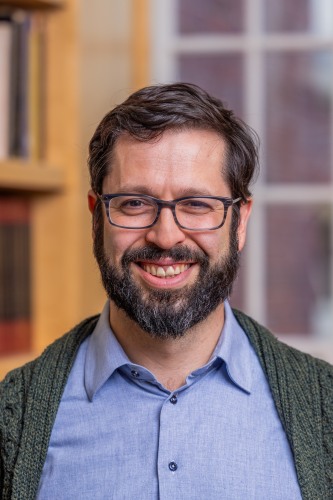
Claire Bowern is Professor of Linguistics at Yale University specializing in historical linguistics, language documentation, and Australian Indigenous languages. Her research employs computational phylogenetics to study language evolution and supports language revitalization through digital archives and fieldwork methodologies. Recent publications address: Phylogenetic signal in lexical evolution across language families Digital infrastructure for endangered language documentation (FLEx software analysis) Decolonizing linguistics pedagogy and research practices Her work consistently integrates linguistic, anthropological, and computational approaches to analyze language diversity and change. She contributes to global databases including Grambank and D-PLACE, examining links between linguistic, cultural, and environmental patterns.
Marlyse Baptista is the President's Distinguished Professor of Linguistics at the University of Pennsylvania, Department of Linguistics. She is affiliated with the School of Arts & Sciences and MindCore initiative. Her research focuses on language contact, creolization processes, bilingualism, and experimental methods in creole studies. Baptista leads the Language Contact and Cognition Lab, previously known as the Cognition, Convergence and Language Emergence (CCLE) group at the University of Michigan. Education includes a PhD in Linguistics (Harvard, 1997), MA degrees from Harvard and the Université de Bordeaux III, and extensive training in multilingual education. Her work bridges generative syntax with experimental approaches, including artificial language learning to study language convergence. Key themes include the cognitive underpinnings of creole formation, bidirectional influences in Cape Verdean Creole, and the role of congruence in language acquisition. Research highlights include studies on Cape Verdean Creole's grammatical properties, genetic-linguistic admixture correlations, and pedagogical resources for creole language education. Recent projects explore experimental validation of creole genesis theories through multilingual acquisition studies. Scientific Awards: President's Distinguished Professorship (University of Pennsylvania) Labs/Teams: Language Contact and Cognition Lab, MindCore Grants/Projects: MULTI Project (creole language educational resources), NSF-funded studies on creole genesis mechanisms Baptista's work emphasizes interdisciplinary approaches, integrating syntax theory, psycholinguistics, and sociolinguistics to address foundational questions in contact linguistics and creolistics.
Mark Post is a Senior Lecturer and Honours Coordinator in the Discipline of Linguistics at the Faculty of Arts and Social Sciences, The University of Sydney. He also serves as Deputy Head of School (Humanities) and is affiliated with the China Studies Centre, Sydney Southeast Asia Centre, and The Vere Gordon Childe Centre. His educational background includes a BA Hons from Wesleyan University, an MA from the University of Oregon, and a PhD from La Trobe University. Dr. Post's research focuses on describing and explaining the typologies and relationships among Greater Mainland Southeast Asian and Himalayan languages. His descriptive work relies exclusively on primary field data, with interests in improving fieldwork methodologies. He approaches linguistic explanation from a functional-diachronic perspective, viewing language as a dynamic process whose structures emerge from patterns of discourse and interaction. His extensive publication record reveals a strong focus on Eastern Himalayan languages, particularly Tani languages, with research spanning linguistic typology, historical linguistics, and language documentation. Key themes include classifiers, deixis, applicatives, and the ethnolinguistic prehistory of the Eastern Himalaya across more than 50 publications since 2004. His notable recognition includes: 2011 Recipient of the Association for Linguistic Typology's Pāṇini Award Dr. Post has supervised research students including Chintan SHETH on ethno-linguistic prehistory in the Eastern Himalaya. His grant history includes significant projects such as 'Pseudo grains and adaptiveness in the Eastern Himalayas' (ARC, 2023), 'Center for Cultural Linguistic Diversity - Eastern Himalayas' (Firebird Foundation, 2022), and 'A Documentation of the Upper Belt variety of Minyong (Adi)' (Endangered Languages Documentation Programme). He is a life member of the Galo Language Development Committee (Arunachal Pradesh, India) and actively participates in the Association for Linguistic Typology, Australian Linguistic Society, and North East Indian Linguistics Society.
Prof. Dr. Gülşen Eryiğit is a Professor at Istanbul Technical University within the Faculty of Computer and Informatics , Department of Artificial Intelligence and Data Engineering . She founded and directs the ITU Natural Language Processing Group , Turkey's leading team in Turkish-language NLP, and serves as Senior Action Editor for ACL RR , Director of ITU TÖMER (Turkish Language Teaching Center), and Co-Chair of the EU UniDive Cost Action WG3. Education: PhD in Computer Engineering from ITU (2007), MSc and BSc from ITU and Marmara University Research: Focuses on Natural Language Processing for Turkish, including dependency parsing , coreference resolution , multiword expressions , and language education technology Her recent work involves multilingual transfer learning , LLM applications for Turkish text simplification, and gamification for morphology education. She has received prestigious awards like the Siemens Excellence Award and TÜBİTAK's Above Threshold Award . Her research has produced 65+ publications and 29+ projects funded by EU, TÜBİTAK, and industry partners. Scientific Awards: Siemens Excellence Award (2007) Above Threshold Award (TÜBİTAK, 2015) Certificate of Appreciation (EU 7th Framework, 2012) Thank You Plaque (ITU, 2017) The ITU NLP Group under her leadership has developed Turkey's first licensed NLP software exported internationally. She collaborates with European institutions through COST actions and participates in ACL, CoNLL, and LREC conferences. Her lab focuses on language technology for Turkish , including sign language processing and social media normalization.
Jiwon Yun is an Associate Professor in the Department of Linguistics at Stony Brook University. She holds a Ph.D. in Linguistics from Cornell University (2013) and a B.S.E. in Computer Science & Engineering from Seoul National University (cum laude with honors). Her research focuses on speech prosody, syntax-semantics interfaces, and computational modeling of sentence processing, with special attention to East Asian languages like Korean, Mandarin, and Japanese. Dr. Yun teaches undergraduate and graduate courses in computational linguistics, semantics, pragmatics, and experimental phonetics. Her work bridges theoretical linguistics and experimental methods, examining how prosody interacts with syntactic and semantic structures. Recent publications investigate prosodic disambiguation of syntactic ambiguities, computational models of relative clause processing, and intonation patterns in Korean and Mandarin. She has developed tools for automated speech corpus analysis and maintains a Hangul-Yale Romanization Converter for linguistic research. Her research has been published in journals like Humanities and Social Sciences Communications , Linguistic Inquiry , and Journal of East Asian Linguistics . Teaching responsibilities include courses such as LIN 335 (Computational Linguistics) and LIN 627 (Computational Semantics).
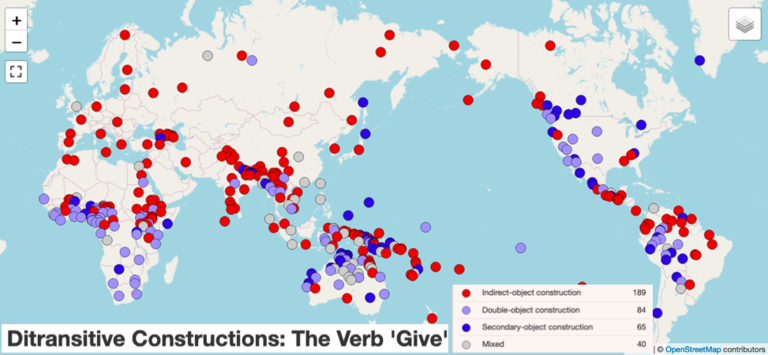
Martin Haspelmath is a Senior Research Scientist at the Department of Linguistic and Cultural Evolution at the Max Planck Institute for Evolutionary Anthropology (MPI-EVA), Leipzig, and an honorary (adjunct) professor at Leipzig University. His research focuses on comparative linguistics, language universals, and typology, particularly in syntactic and morphological systems. He co-edited the World Atlas of Language Structures (2005/2013) and co-founded Language Science Press . Education: PhD in Linguistics, Freie Universität Berlin (1990–1993) MA in Linguistics, University of Cologne and University at Buffalo (1985–1989) Undergraduate studies in Linguistics, University of Vienna (1983–1985) Research Interests: Haspelmath investigates global grammatical diversity, form-function correspondences, and universals in syntax, morphology, and lexical systems. His work emphasizes comparative concepts for cross-linguistic analysis and critiques traditional grammatical categories. Grants & Projects: ERC project leader at Leipzig University (2015–2020) Co-creator of Grambank , an open-access database of grammatical structures Leading initiatives for open-access publication and linguistic data sharing Labs/Teams: Active in the MPI's Department of Linguistic and Cultural Evolution, collaborating on projects like APICS (Atlas of Pidgin and Creole Language Structures) and ValPal (Valency Patterns Leipzig).
Mark Baker is a Professor of Linguistics and Cognitive Science at Rutgers University. His work focuses on comparative syntax, linguistic universals, semantic roles, and the study of Amerindian and African languages. He holds the title of Distinguished Professor and maintains an office in Scott Hall. As of 2021, his office hours were by appointment due to sabbatical leave. His research interests include syntactic diversity, its limits, and patterns across languages. Notable themes in his work involve logophoric pronouns, switch-reference mechanisms, and the relationship between case systems and agreement structures. He has contributed to discussions on language typology, formal syntax, and the cognitive foundations of linguistic structures. Baker teaches advanced syntax courses and has published extensively on topics ranging from Panoan languages to theoretical models in generative grammar. His recent articles explore syntactic variation, morphosyntactic alignment, and interdisciplinary connections between linguistics and cognitive science. He serves on editorial boards and has reviewed for journals such as Journal of East Asian Linguistics and Yearbook of Corpus Linguistics and Pragmatics . His work bridges formal linguistic theory with empirical cross-linguistic analysis, emphasizing the interplay between universal grammatical principles and lineage-specific traits.
Maj Schian Nielsen is a Senior Research Librarian at the University Library of the University of Agder. Her work focuses on multilingualism, crosslinguistic awareness, and German language pedagogy. She is affiliated with the research groups 'Media and Communication Studies' and 'Multilingualism in Society and Education (MUSE).' University of Agder Research Groups: Media and Communication Studies, MUSE Her research explores how multilingual awareness can enhance grammar instruction in German third-language (L3) teacher education programs across Denmark and Norway. Recent publications analyze curriculum structures, educational materials, and the integration of generative AI tools like ChatGPT in multilingual education contexts. Scientific output trends reveal a focus on: Cross-linguistic pedagogy L3 German acquisition Grammar teaching methodologies AI applications in language learning Teacher training for multilingual classrooms Systemic Functional Linguistics (SFL) frameworks She has not been publicly recognized with scientific awards listed in the available data.
Emily M. Bender is the Thomas L. and Margo G. Wyckoff Endowed Professor in the Department of Linguistics at the University of Washington. She also holds adjunct appointments in the School of Computer Science and Engineering and the Information School. Her research spans multilingual grammar engineering, computational linguistics, societal impacts of language technology, and sociolinguistic variation. She directs the Computational Linguistics Laboratory (The Treehouse) and leads the CLMS program. Bender is a Fellow of the AAAS (2022) and previously served as Howard and Frances Nostrand Endowed Professor (2019–2022). She has authored influential textbooks on NLP fundamentals and pioneered work on data statements to mitigate bias in NLP systems. Her work integrates linguistic theory with computational methods, emphasizing ethical AI and language documentation. Education: PhD in Linguistics from Stanford University (advisor: Ivan A. Sag), AB in Linguistics from UC Berkeley, with studies at Tohoku University. Past roles include NAACL Executive Board Chair (2016–2017) and current roles in the Association for Computational Linguistics leadership. Her Erdős number is 4. Research focuses on the LinGO Grammar Matrix, automatic grammar inference from interlinear glossed text (AGGREGATION project), and societal implications of NLP technologies like large language models. She co-leads the RAISE initiative and contributes to labs like the Tech Policy Lab and Value Sensitive Design Lab. Over 30 advisees have completed PhD and MS degrees under her mentorship. Teaching includes courses on syntax for NLP, societal impacts of language tech, and computational linguistics. Her 2020 ACL paper on form-meaning distinctions in NLP has been influential in ethical discussions. Current projects include The AI CON (2025) on combating tech hype.
Mohammad T. Alhawary is Professor of Arabic Linguistics and Second Language Acquisition at the University of Michigan's Middle East Studies department within the College of Literature, Science, and the Arts. He serves as Director of both the MA Program in Arabic for Professional Purposes (APP) and the MA Program in Teaching Arabic as a Foreign Language (TAFL). His educational background includes a Ph.D. from Georgetown University (1999). Prior to joining the University of Michigan, he contributed to developing Arabic and Middle Eastern Studies programs at various US institutions. Professor Alhawary's research spans both theoretical and applied Arabic linguistics, with particular focus on second language acquisition processes. His work examines how factors like age, input quality, output practice, and first language transfer affect Arabic language learning. He has made significant contributions to understanding Arabic language pedagogy, curriculum design, proficiency testing, and the application of technology in language learning. His research also extends to bilingualism, multilingualism, language impairment, and Arabic medieval grammatical traditions. His publications reflect a strong trajectory in Arabic linguistics research, with recent works focusing on practical language teaching applications, reading comprehension mechanisms, code-switching patterns in digital communication, and multilingual acquisition processes. The 2023 publication 'Teaching Arabic as a Foreign Language' represents his latest contribution to language pedagogy methodology. 2019 AATA Book Award for 'Arabic Second Language Learning and Effects of Input, Transfer, and Typology' As an academic leader, Professor Alhawary serves as Executive Director of the American Association of Teachers of Arabic and edits both the Journal of Arabic Linguistics Tradition and Al-'Arabiyya journal. He continues to develop empirical research on Arabic second language acquisition to inform teaching practices both in America and globally.
Roman Feiman is the Thomas J. and Alice M. Tisch Assistant Professor of Cognitive, Linguistic, and Psychological Sciences and an Assistant Professor of Linguistics at Brown University. He directs the Brown Language and Thought Lab, focusing on how humans combine words into meaningful sentences and develop logical reasoning abilities. His research integrates methods from cognitive developmental psychology, psycholinguistics, and formal semantics. Feiman holds a PhD in Psychology from Harvard University (2015), followed by postdoctoral training at Harvard and UC San Diego. His work explores the cognitive systems underlying language and thought, including negation comprehension, quantifier scope, and the development of exact equality concepts. He teaches courses such as Language Processing in Humans and Machines and Logic in Language and Thought . His research interests span cognitive development, linguistic pragmatics, and the language of thought hypothesis. Notable findings include studies on children’s understanding of negation and how logical principles shape early language acquisition. Feiman has been recognized with the 2023 Henry Merritt Wriston Fellowship. His lab investigates topics like word referencing, semantic development, and the interplay between language and nonverbal reasoning. Recent work examines how neural networks might model human cognitive processes, bridging AI and psychological theory.
Joakim Nivre is a Professor at Uppsala University's Department of Linguistics and Philology. He is a leading researcher in computational linguistics, with a focus on dependency parsing, Universal Dependencies (UD) framework development, and multilingual NLP applications. His recent work explores LLMs in climate change discourse analysis, pharmacovigilance explainability, and historical text processing. Key research areas: Dependency parsing theory, Universal Dependencies standardization, LLM evaluation Collaborations: SweSAT-1.0 benchmark development, ClimateEval project, PARSEME integration His 2025-2023 publications demonstrate expertise in explainable AI for healthcare, synthetic data generation for idioms, and multilingual benchmark design. Notably, he co-developed SweSAT-1.0 to evaluate Swedish LLMs and contributed to typology-informed UD revisions. Despite extensive work in NLP, no scientific awards are mentioned in available texts.
Niclas Abrahamsson is a Professor of Swedish as a Second Language at Stockholm University, where he also serves as the Director of the Centre for Research on Bilingualism . His research focuses on second language acquisition (SLA) , bilingualism , and phonological/phonetic development , particularly through the lens of age of acquisition and critical periods . He leads the MOB (Meta-research on Bilingualism) group, analyzing trends in bilingualism research and Swedish as a Second Language. PhD in Bilingualism (2001, Stockholm University) BA in Linguistics, Phonetics, and Psychology (1993) His research explores how age of onset and language aptitude influence nativelike attainment in L2 speakers, with a focus on voice onset time (VOT) analysis, neural constraints , and lexical deficits in bilinguals. His recent studies challenge the notion that bilingualism inherently causes linguistic costs, attributing observed deficits instead to second language acquisition processes. Abrahamsson has secured major grants from the Swedish Research Council (VR) , Bank of Sweden Tercentenary Foundation (RJ) , and Byggmästare Olle Engqvists Stiftelse . He supervises PhD students working on topics like Swedish compounding acquisition , language-dependent memory , and foreign accented speech perception . He teaches SLA, bilingual development, and psycholinguistics at all academic levels. Key Awards : VR Grant 2016-01630, RJ Sabbatical Grant SAB16-0051:1, Byggmästare Olle Engqvists Stiftelse Grant 200-0676 Abrahamsson's work frequently employs ERP studies and meta-analyses , emphasizing methodological rigor. He collaborates with institutions like the Multilingualism Lab and has contributed to foundational theories in critical period hypothesis and language aptitude research.
Jon Brennan is an Assistant Professor in the Department of Linguistics at the University of Michigan, affiliated with the College of Literature, Science, and the Arts (LSA). His research focuses on neurolinguistics, computational linguistics, and psycholinguistics, particularly investigating how the brain processes language structure and meaning. He leads the Computational Neurolinguistics Lab, which develops neurocomputational models to study language comprehension mechanisms. Brennan received an NSF Grant for collaborative research with Christophe Pallier (Paris) on neurocomputational models of natural language processing. His work integrates EEG, fMRI, and MEG techniques to decode linguistic features in neural signals. Key research areas include syntax-semantics interfaces, multilingual processing, and developmental disorders like dyslexia. Notable contributions include studies on hierarchical syntactic structure, minimal pairs in language models, and neural correlates of theory of mind in children. Brennan collaborates internationally, exemplified by the US-French NSF-CRCNS grant. He has published extensively on topics like neural decoding of grammatical features, LLM internal representations, and bilingual processing mechanisms. Scientific awards include the NSF Collaborative Research in Computational Neuroscience (CRCNS) Grant (2016). His research bridges computational modeling and experimental neuroscience, aiming to reveal how language mechanisms are implemented in neural systems.
Professor Vicky Chondrogianni holds the Personal Chair of Bilingualism and Language Development at the University of Edinburgh's School of Philosophy, Psychology and Language Sciences. She is affiliated faculty at CUNY Graduate Center's Department of Speech-Language-Hearing Sciences. Her research focuses on first/second language acquisition, child bilingualism, psycholinguistics, and developmental language disorders. She has held positions at Bangor University, Aalborg University, and the University of Reading before joining Edinburgh. Education: BA in Linguistics and Classics (University of Athens), MPhil in English and Applied Linguistics (University of Cambridge), PhD in Second Language Acquisition (University of Cambridge). Research interests include cross-linguistic aspects of acquisition in typically-developing and impaired children, production/comprehension relationships, and cognitive-language interactions. She currently supervises PhD students in topics like morphosyntax in bilingual children and employs eye-tracking methods. Grants/Projects: Includes studies on Gaelic-medium education, heritage children's eye-tracking data, and language disorders in multilingual settings. She has led over 20 projects since 2002, including work on Welsh-English bilingualism and L2 Greek acquisition. Labs/Teams: Active in Bilingualism Matters, a research center promoting bilingualism awareness. Serves as Editor for Linguistic Approaches to Bilingualism and holds roles in international associations like IASCL.