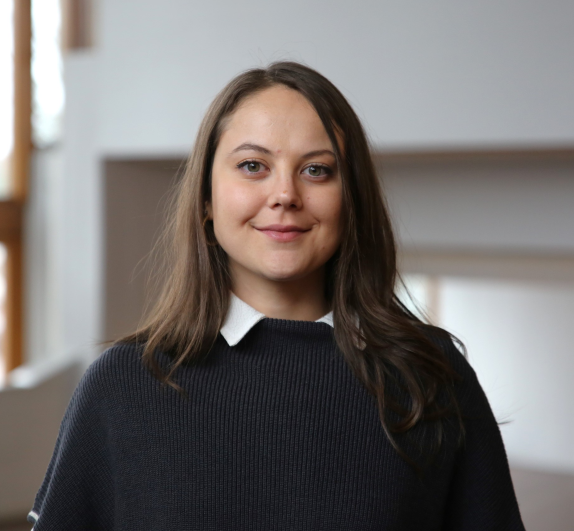
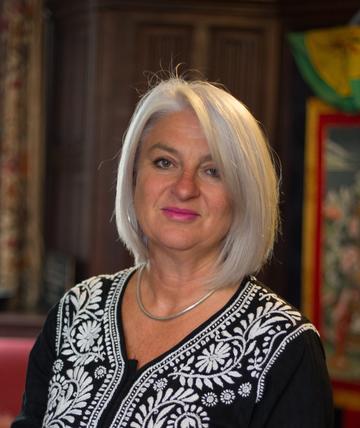
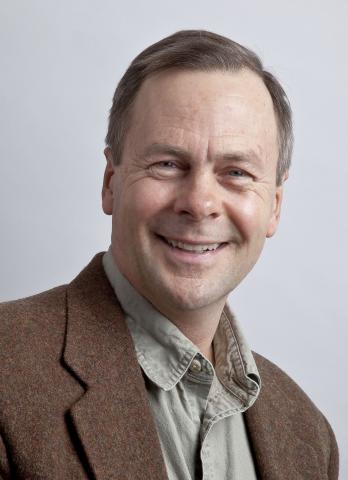
Dr. Luisa Calè is a Professor of Romantic and Nineteenth-Century Literature & Visual Culture and Research Lead at Birkbeck, University of London. She holds degrees from the University of Rome 'La Sapienza' (1993), University of Genoa (1997), and the University of Oxford (M.St. 1998, D.Phil 2002). Her research explores the interplay between literature and visual/material culture, focusing on book history, intermediality, and practices of reading/collecting. Her Leverhulme Trust-funded project 'The Book Unbound' examines how works by Blake, Walpole, and Dickens subverted traditional book formats. Education: PhD in Literary Studies, University of Genoa (1997) D.Phil., University of Oxford (2002) M.St. in English, University of Oxford (1998) Letters Degree, University of Rome (1993) Her research interests include Romantic aesthetics, material texts, and critical disciplinarity. Notable publications include Fuseli’s Milton Gallery (2006) and co-edited volumes like Dante on View (2007). She edits Blake/An Illustrated Quarterly and serves on editorial boards for Word & Image and Romantic Circles Gallery . Recent awards include a Leverhulme Trust Research Fellowship (2019) and a Mercator Fellowship (2018-19). She supervises graduate students in Romantic literature, material culture, and book history.
Charles Athanasopoulos is an Assistant Professor of African American and African Studies & English at The Ohio State University. His research focuses on intersections of Black rhetorics, media, and culture, with expertise in The Black Radical Tradition, Rhetorical Theory, and Cultural Critique. He earned his Ph.D. in Rhetoric & Communication from the University of Pittsburgh. His work analyzes racial progress, public symbols, and post/Ferguson America through lenses of iconoclasm and critical race theory. Education: Ph.D., Rhetoric & Communication, University of Pittsburgh. Research interests span Black American and Diasporic Cinema, Afro-Caribbean and Greek-Roma identity critiques. He has published in venues like Lateral: The Journal of the Cultural Studies Association and Western Journal of Communication. His 2024 book Black Iconoclasm explores dismantling racial symbols in public discourse. Recent articles address Fanonian thought, anti-racist campus rhetoric, and transnational Blackness studies. His publications critically engage with visual activism, film analysis, and decolonial theories. Current projects include studies on sonic rhetorics in Black women’s music and global race discourses in Mediterranean contexts.
Magda Posani is an Assistant Professor in the Department of Civil Engineering at Aalto University, focusing on building physics, hygrothermal behavior of materials, and environmental sustainability. Her research explores the use of bio-based insulation, thermally massive stone and earth walls, and additive manufacturing techniques to enhance indoor comfort and address climate change challenges in Nordic regions. Integrated Master's Degree in 'Building Engineering and Architecture' from the University of Bologna (Italy) Ph.D. in Civil Engineering from the National Laboratory for Civil Engineering (LNEC) and the University of Porto (FEUP, Portugal) Postdoctoral Research at ETH Zürich (Switzerland) Her research integrates vernacular solutions with modern technology, such as combining additive manufacturing with super-hygroscopic materials to develop components for passive humidity regulation. She addresses critical issues like occupant comfort, health risks from improper humidity, and climate change impacts on traditional constructions. The articles highlight her work on low-carbon materials, 3D-printed building components, and strategies for enhancing hygrothermal performance in both modern and historic structures. Key themes include moisture buffering, thermal insulation compatibility, and climate-resilient renovation.
Clare Harris serves as Professor of Visual Anthropology and Head of the School of Anthropology and Museum Ethnography at the University of Oxford, concurrently holding curatorship of Asian Collections at the Pitt Rivers Museum and a Fellowship at Magdalen College. Her academic leadership spans institutional administration, museum curation, and doctoral supervision within Oxford's anthropological ecosystem. Her educational foundation includes a BA from the University of Cambridge and MA/doctorate from SOAS, University of London. Early career roles comprised Lecturer in Anthropology of Art at the University of East Anglia (1994-1998) before her Oxford appointment. Harris pioneers research at the intersection of visual anthropology, Tibetan studies, and museum decolonization. Her work critically examines Himalayan visual culture, colonial/post-colonial photography, and museum representation politics, evolving toward digital repatriation and community-centered curation. She integrates anthropological fieldwork (conducted in Tibetan diaspora communities since the 1990s) with art historical analysis and archival research. Her 13 recent publications (2004-2022) reveal a progressive trajectory from Tibetan art history toward urgent museum decolonization debates, with consistent focus on photographic practices and cross-cultural representation. Key thematic developments include the shift from historical analysis to active digital repatriation projects and increased engagement with contemporary artists. Harris's accolades include: Fellowship of the British Academy (2019) E. Gene Smith Prize for The Museum on the Roof of the World (2014) Visual Anthropology Prize for In the Image of Tibet (2000) She currently supervises five DPhil students while examining over 25 completed doctorates globally. Research funding spans British Academy personal grants, Leverhulme Trust support, and major collaborative projects including AHRC, Wenner-Gren Foundation, and EU grants—most notably the current AHRC-funded Decolonising the Museum: Digital Repatriation of the Gaidinliu Collection . At the Pitt Rivers Museum, Harris leads high-impact curatorial initiatives including the Abramović collaboration ( Gates and Portals ), Nyema Droma's Performing Tibetan Identities , and community projects like My Tibet Museum , establishing innovative frameworks for museum-public engagement.
Stephen Cushman is the Robert C. Taylor Professor at the University of Virginia, specializing in American literature and poetry. His interdisciplinary work bridges Civil War studies, 19th-century poetry, and environmental literature. He earned his Ph.D. (1982), M.Phil. (1981), and M.A. (1980) from Yale University, and a B.A. from Cornell University (1978). His research explores how literary forms shape historical understanding, particularly through works like *The Generals' Civil War* (2021) and *Belligerent Muse* (2014). He has edited major volumes such as *The Princeton Handbook of Poetic Terms* (2016) and *Civil War Writing* (2019). His poetry collections include *Keep the Feast* (2022) and *Hothead* (2018), blending personal reflection with historical inquiry. Cushman has received prestigious awards including the Cavaliers' Distinguished Teaching Professorship (2014–2016) and the All-University Teaching Award (1992). His writing often intersects with Virginia’s literary landscape, as seen in *After Great Pain, Dickinson in Charlottesville* (2018). He actively engages with environmental themes in works like *Pope Francis, Laudato Si’, and U.S. Environmentalism* (2017). His articles critically analyze figures like Lincoln, Sherman, and Thoreau, while exploring modernist engagements with biblical texts and Civil War memory. He serves as a leading voice in American literary history, emphasizing the interplay between form, content, and cultural context.
Kyle Bellucci Johanson serves as a Visiting Critic in Cornell University's College of Architecture, Art, and Planning, Department of Art. Holding an MFA from California Institute of the Arts and a BA in Art and Reconciliation Studies from Bethel University, he merges artistic practice with critical theory through performance architecture and collaborative media. Whitney Independent Study Program (2022–23) Founding fellow at land's edge free school (Los Angeles) Teaching experience at SAIC, UIC, CUNY, and Cooper Union His research investigates: Power structures through spatial interventions Critical theory applications in art practice Post-capitalist imaginaries Hauntology and historical materialism Transdisciplinary approaches to social critique Project trends reveal: Reinterpretation of Soviet design principles Investigation of worker identity in post-industrial contexts Temporal and spatial dislocation in artistic practice Monument critique through performative methods Quantum theory-inspired architectural concepts Reimagining of common spaces as political sites Scientific awards include: Creative Research Grant (2025) Whitney ISP participation (2022–23) Automata Studio Residency (2022) Artists Run Chicago Grant (2021) BOLT Residency (2020–21) Through projects like KLUB WRKR —a nomadic workers' club reimagined for the gig economy—and table (2018–2022), a Chicago-based experimental space for artistic practice, he interrogates institutional frameworks while fostering community through discursive meals and collaborative exhibitions.
Ali Mousavi is Assistant Professor of Iranian Archaeology in UCLA’s Department of Near Eastern Languages and Cultures and a core faculty member of the Cotsen Institute of Archaeology. A Berkeley PhD and former fellow of the Smithsonian, Maison de l’Orient and Global Heritage Fund, he has directed excavations and UNESCO World-Heritage projects at Pasargadae, Bam, Susa, Sultaniyeh and Turang Tepe and authored prize-winning volumes Ancient Iran from the Air and Persepolis: Discovery and Afterlife of a World Wonder . Education PhD, Near Eastern Studies (Archaeology), University of California, Berkeley (2005) MA, Archaeology, History and Languages of Old World Civilizations, Université Lyon II, France (1997) BA, Archaeology and Art History of Europe and the East Mediterranean, Université Lyon II, France (1996) Research interests span the archaeology and art history of Iran from the Neolithic to the early-20th century, with particular focus on Achaemenid and Sasanian monumental architecture, ancient irrigation (qanats), landscape archaeology, digital heritage, and the modern historiography of Iranian archaeology. His field projects integrate remote sensing, epigraphy, GIS and conservation science to investigate imperial capitals, rock-cut monuments and water-management systems across the Iranian plateau. Across more than 30 peer-reviewed articles and book chapters, Mousavi has re-examined dating criteria for Achaemenid stone monuments, analysed royal inscriptions as visual displays, traced medieval Persian pilgrims’ graffiti at ancient sites, and produced synthetic archaeological surveys of the Sasanian empire and the Central Alborz Iron-Age cultures. The corpus reflects a sustained engagement with primary field data, archival research and critical historiography of 19th- and 20th-century excavations. Selected honours Ehsan Yarshater Book Award (2014) Iranian Ministry of Culture World Book Award (2014) Leon Levy – Shelby White publication grant (2008) UNESCO award for World-Heritage nomination files (2003) Iran Heritage Foundation field-work award (2003) Guitty Azarpay Fellowship, UC Berkeley (2000-2003) IFRI Fellowship, Paris (1998) At UCLA he offers undergraduate courses “Archaeology of Iran” and “Ancient Cities of Iran (4000 BC-AD 1900)” and mentors graduate researchers in the Cotsen Institute. His grants and fellowships from NSF-equivalent European and American agencies underwrite both field seasons and publication of critical archaeological corpora, while his service on Iranian, UNESCO and international heritage boards continues to link scholarly output with heritage-management policy.
Judit Bodnar is a Professor in the Department of Sociology and Social Anthropology at Central European University (CEU), affiliated with the Doctoral School of History. Her research spans urban theory, political economy of globalization, public space, and the cultural dimensions of capitalism. She actively contributes to academic discourse through publications and editorial roles. Research Interests: Urban theory and history Modernity and capitalism (comparative and historical) Uneven development Public space and public art Political economy and culture of globalization Sharing economy and digital platforms Food and politics Her recent work focuses on the transformation of public and private boundaries in the context of digital platforms like Airbnb and home restaurants, as well as the racial and spatial segregation of Roma communities in urban Europe. She critically examines the legacies of 1968 as a global moment and the gentrification of urban spaces such as Chicago’s Cabrini Green. The publication trends reflect a deep engagement with urban sociology, political economy, and cultural critique, especially in the context of neoliberalism, digital transformation, and global inequality. Her work bridges historical analysis with contemporary urban challenges. Editorial Role: Co-editor, Critical Historical Studies , University of Chicago Press Academic Events: Privacy Goes Public: Airbnb, Home Restaurant and the Reconfiguring of Public and Private in the Sharing Economy (November 24, 2021) Racial Cities: The Segregation of Roma in Urban Europe (October 5, 2017) She advises doctoral students in the Doctoral School of History and supervises research on urban and historical sociology. Her work is supported by interdisciplinary collaborations and engagement with global scholarly networks. She is involved in critical urban research, often linking theory with social justice concerns. Labs and Research Groups: Active participant in urban sociology and globalization research clusters at CEU Contributor to transnational dialogues on the right to the city and urban commons
Diliana Angelova serves as Associate Professor at the University of California, Berkeley, with scholarly specialization in Byzantine and Roman historical studies emphasizing gender dynamics, religious frameworks, and artistic expression. Education: BA, American University in Bulgaria, 1995 MA, Southern Methodist University, 1998 MA, Harvard University, 2002 PhD, Harvard University, 2005 Her research program critically investigates female agency within imperial systems through interdisciplinary analysis of textual sources, architectural patronage, and material artifacts. Core methodologies integrate gender theory with art historical analysis to reconstruct women's roles in religious and political spheres across late antiquity and early Byzantium, particularly examining how empresses leveraged sacred discourse for authority. Publication trends reveal sustained engagement with imperial ideology through physical manifestations—buildings, ivories, and urban landscapes—demonstrating how female rulers like Pulcheria and Ariadne engineered religious and architectural programs to project power. Thematic continuity connects her monograph on founding narratives with earlier articles exploring material culture as political language. Scientific Awards: Van Courtlandt Elliott Prize, Medieval Academy of America (2006) for outstanding first article in medieval studies Information regarding graduate student supervision and external research funding remains unspecified in available documentation, though her scholarly output indicates active contribution to Byzantine gender studies through major publications and academic reviews.
Tania Islas Weinstein is an Assistant Professor of Political Science at McGill University’s Department of Political Science. Her work bridges art, politics, and aesthetics, particularly in the context of Mexico’s democratic transitions and socio-cultural dynamics. She holds a PhD from the University of Chicago and has held academic appointments at institutions including the University of Colorado Denver and the University of Chicago. Education: PhD in Political Science, University of Chicago (2019) MA in Political Science, University of Chicago (2011) BA in Political Science and International Relations, Centro de Investigación y Docencia Económicas (CIDE), Mexico (2007) Research focuses on how art shapes political imaginaries, with a current book project analyzing Mexico’s cultural policies post-autocratic rule. Key themes include nationalism, racial justice, and the intersection of art with state violence. She co-edited Beyond Mestizaje: Contemporary Debates on Race in Mexico (2024) and has published in Journal of Latin American Studies and Signs . Awards include a FQRSC Team Grant for governance research in Latin America and fellowships from the University of Chicago and CONACyT. She actively collaborates with artists, such as on Sun Ra’s poetry translation, and teaches courses on art politics, qualitative methods, and anti-racism in Latin America.
Wu Hung is the Harrie A. Vanderstappen Distinguished Service Professor at the University of Chicago, affiliated with The College , the Department of Art History , and the Department of East Asian Languages and Civilizations . He serves as Director of the Center for the Art of East Asia and Consulting Curator at the Smart Museum of Art .
David Mwambari serves as Associate Professor at KU Leuven's Faculty of Social Sciences within the Unit Leuven International and European Studies (LINES). He leads the ERC-funded TMSS project on Life Narratives of Violence Among Refugees from Africa's Great Lakes Region and holds affiliations with the Oxford Consortium on Human Rights and the Centre for Mediation in Africa at the University of Pretoria. His educational background includes BA/MA in International Relations from United States International University-Africa, MA in Pan-African Studies from Syracuse University, and PhD in History from La Trobe University. He previously held academic positions at King's College London, Ghent University, and United States International University-Africa. Mwambari's research centers on memory studies with emphases on post-genocide Rwanda, colonial durabilities, and refugee narratives. His work examines how cultural memory shapes state formation, peacebuilding, and identity politics through interdisciplinary methodologies blending historical analysis, ethnography, and critical theory. Recent projects investigate vernacular memory practices during crises and the spatial dimensions of post-conflict reconstruction. His scientific contributions include the monograph Navigating Cultural Memory (Oxford University Press, 2023), co-edited volume Beyond History (Rowman & Littlefield, 2020), and editorial roles for Qualitative Research journal and Brill's 'Mobilizing Memory' series. His publications demonstrate evolving focus from leadership studies toward memory politics and decolonial research methodologies. European Research Council (ERC) Grant for TMSS Project Fellow at Churchill College, University of Cambridge African Academic Diaspora Fellow at CODESRIA FWO Postdoctoral Research Fellowship Mwambari actively mentors early-career scholars across Africa, Latin America, and East Asia while contributing to public discourse through Al Jazeera and community projects training history teachers in East Africa. His consultancy work addresses cross-disciplinary challenges in healthcare, education, and security, reflecting his commitment to applied scholarship beyond traditional academic boundaries.
Tom McDonough is a Professor of Art History at Binghamton University, specializing in modern and contemporary art with a focus on avant-garde movements, particularly the Situationist International. His research explores intersections between art, politics, and social movements in postwar Europe. He holds degrees from Rutgers University (BA), New York University’s Institute of Fine Arts (MA, PhD), and has taught at Harvard University and UC Berkeley. Education: Bachelor’s Degree: Rutgers University MA and PhD: Institute of Fine Arts, New York University His research interests include postwar European avant-gardes, postwar French architectural history, and contemporary Black American art. Key publications include "The Beautiful Language of My Century" and edited volumes on the Situationist International and urban theory. McDonough received the SUNY Chancellor’s Award for Excellence in Scholarship (2024) and has held fellowships at institutions such as the Institute for Advanced Studies in the Humanities and the Académie de France à Rome/Villa Medici. Teaching focuses include 19th-century Parisian art, Black Monument sculptors, and film theory. His work bridges art criticism with broader socio-political analysis, emphasizing radical artistic movements’ societal impacts.
Kajri Jain is a Professor of Indian Visual Culture and Contemporary Art at the University of Toronto . She holds undergraduate appointments in the Department of Visual Studies (UTM) and graduate appointments in the Department of Art (St. George) , with cross-appointments at the Institute for Cinema Studies and the Centre for South Asian Studies . Education: PhD, Art History and Theory, University of Sydney MA, Art History and Theory, University of Sydney PEP, Visual Communication, National Institute of Design, Ahmedabad Research Interests: Jain’s work explores how images derive meaning not just from their visual content but from their production, circulation, and material use. Her research spans modern and contemporary Indian visual culture , including bazaar icons, monumental statues, theme parks, and representations of nature in religious and popular contexts. She employs ethnographic methods to examine the intersections of religion, politics, commerce, and aesthetics in postcolonial India. Her teaching and writing critically interrogate the legacies of European Romanticism and secular modernism in art history and visual studies. Publications & Themes: Jain has authored two major monographs— Gods in the Time of Democracy (2021) and Gods in the Bazaar (2007)—and numerous essays on topics such as mass reproduction, political iconography, urban nature, and postcolonial aesthetics. Her articles consistently engage with image theory, postcolonial critique, and the sensory politics of caste and religion in visual culture. Scientific Awards: No specific awards listed in the provided text. Advising & Affiliations: While no specific students are named, Jain teaches a wide range of undergraduate and graduate courses and is affiliated with multiple research centers at the University of Toronto. Her work bridges departments and disciplines, fostering interdisciplinary dialogue in South Asian visual studies. Labs & Teams: Jain is associated with the Graduate Department of Art History and the Centre for South Asian Studies at the Munk School of Global Affairs and Public Policy, University of Toronto.
Dr. Rahul Rao is a Reader in International Political Thought at the University of St Andrews' School of International Relations. Previously, he held Reader positions at SOAS University of London and was a Term Fellow at the University of Oxford. A Rhodes Scholar, he holds a DPhil from Balliol College, Oxford, and an LLB from National Law School of India University. His work focuses on postcolonial and queer theory, South Asian politics, and identity-based global politics. Key publications include Third World Protest (2010), Out of Time: The Queer Politics of Postcoloniality (2020), and The Psychic Lives of Statues (2025). Rao’s research explores intersections of race, caste, and gender, supported by Leverhulme and Netherlands Institute for Advanced Study fellowships. Education: BA, LLB (Hons.), National Law School of India University DPhil in International Relations, Balliol College, Oxford (as Rhodes Scholar) Research Interests: Queer theory and its postcolonial intersections Racial, caste, and gender dynamics in global politics South Asian political movements and nationalism Decolonial thought and monument studies Awards: Rhodes Scholarship Leverhulme Trust Fellowship Netherlands Institute for Advanced Study Fellowship Doctoral Supervision: Current advisees include Gray Black, Marta Fernandez Albuerne, and Anezka Ferreira. Rao welcomes PhD proposals exploring Marxist/post-Marxist approaches to the more-than-human turn in humanities. Labs/Teams: Member of Radical Philosophy editorial collective, engaging in critical political discourse and intellectual curation.