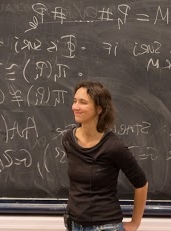
Maxim Kontsevich is a permanent professor at the Institut des Hautes Études Scientifiques (IHÉS), holding the AXA Chair for Mathematics since 1995 and a visiting chair at Rutgers University (one month annually since 1997). Born in 1964 in Khimki, USSR, he earned his PhD from Bonn University in 1992. His career includes visiting positions at Harvard, the Institute for Advanced Study, and Berkeley, where he was a professor from 1993 to 1995. His research spans mathematical physics, algebraic geometry, and non-commutative geometry. Notable contributions include deformation quantization, mirror symmetry, and motivic integration. His work bridges algebraic structures with geometric and physical concepts, influencing areas like topological field theories, string theory, and integrable systems. Awardees of Fields Medal (1998), Crafoord Prize (2008), and Breakthrough Prize (2014), he also holds editorial roles at Compositio Mathematica and Publications Mathématiques IHÉS. His over 50 publications explore advanced topics such as quantum cohomology, Hodge theory, and categorical structures in geometry.
Nathalie Wahl is a Professor at the Department of Mathematical Sciences, University of Copenhagen, and serves as the Center Director for the Copenhagen Centre for Geometry and Topology (GeoTop). Her research focuses on algebraic topology, particularly mapping class groups of surfaces and 3-manifolds, homological stability, topological field theory, and loop spaces. PhD from Oxford University (2001) Current leadership of GeoTop (since 2020) Her recent work explores homological stability across automorphism groups, string topology, and structured algebras. Key collaborations include Allen Hatcher, Craig Westerland, and Nancy Hingston. She has received prestigious awards such as the ERC Consolidator Grant and the Young Elite Researcher Award. ERC Consolidator Grant (2018-2023) Female Research Leader Scholarship (2009-2013) Marie Curie European Fellowship (2003-2004)
Søren Galatius is a Visiting Professor at the Department of Mathematical Sciences, University of Copenhagen. His research focuses on algebraic topology with an emphasis on moduli spaces, homology spheres, K-theory, and cobordism categories. He holds a PhD and has established himself as a leading figure in geometric topology and algebraic structures in mathematics. Recent research has explored topics such as general linear groups over finite fields, Pontryagin classes, and tropical geometry applications to moduli spaces. His work bridges pure algebraic topology with geometric and combinatorial methods, contributing foundational insights into modern mathematical frameworks. Key collaborations include projects with Oscar Randal-Williams and Martin Hairer, advancing understanding of cobordism categories and topological field theories. His articles consistently appear in top-tier journals like Annales Scientifiques de l'Ecole Normale Superieure and Inventiones Mathematicae . No scientific awards or grants are explicitly listed in the provided materials, though his publication record speaks to significant academic contributions. No advisee students are documented here.
Konstantin Wernli is an Assistant Professor in the Department of Mathematics and Computer Science at the University of Southern Denmark, affiliated with the Quantum Mathematics research group. His research focuses on quantum field theory, geometric quantization, and mathematical physics, with a particular emphasis on topological field theories and perturbative methods. He has contributed to foundational work in Chern-Simons theories, BV-BFV formalisms, and geometric analysis. His research interests include quantum field theories, algebraic geometry, and the intersection of topology with physics. Notably, he explores combinatorial approaches to quantum field theory, geometric quantization frameworks, and the application of advanced mathematical tools to solve problems in theoretical physics. Recent work includes studies on partition functions, constrained dynamical systems, and the globalization of sigma models. His articles often bridge abstract mathematics with physical applications, such as analyzing heat kernels, theta invariants, and entanglement polytopes. Wernli is a project participant in the Sapere Aude grant 'FROM PERTURBATIVE TO NON-PERTURBATIVE QUANTUM FIELD THEORY BY CUTTING AND GLUING' (2024–2028), which aims to advance non-perturbative QFT techniques. He has advised on research projects involving heat kernel analysis and geometric quantization, though no formal student advisees are listed.
Jørgen Ellegaard Andersen is a Professor and Center Director at the Department of Mathematics and Computer Science, University of Southern Denmark (SDU), and holds the D-IAS Chair at the Danish Institute for Advanced Study (DIAS). He is also a Distinguished Visiting Professor at the California Institute of Technology since 2013, reflecting his international stature in mathematical sciences. University: University of Southern Denmark School: Faculty of Science Department: Department of Mathematics and Computer Science Position: Professor, Center Director, D-IAS Chair Andersen earned his DPhil in Mathematics from the University of Oxford in 1992, with a thesis on Jones-Witten theory and the Thurston Compactification of Teichmüller space. His research lies at the intersection of quantum theory and geometry, focusing on quantum topology, geometric quantization of moduli spaces, topological quantum field theory, low-dimensional geometry, and applications to RNA and protein folding. His work combines deep mathematical rigor with potential applications in quantum computing and biophysics. The trends in his recent publications show a consistent focus on quantization of moduli spaces, topological recursion, mapping class group representations, and quantum Chern-Simons theory. His work often bridges pure mathematics and theoretical physics, with increasing attention to computational and applied aspects in quantum technologies. ERC Synergy Grant ReNewQuantum (EUR 10m, Principal Investigator) Distinguished Visiting Professor, Caltech Andersen leads major research projects such as ReNewQuantum and TopQC2X, securing significant funding from the EU and Danish agencies. He actively supervises PhD students and collaborates with leading mathematicians worldwide, including Maxim Kontsevich and Bertrand Eynard. His work is frequently highlighted in the media for its potential impact on quantum computing and Danish industry. He is a central figure in the Quantum Mathematics center at SDU and collaborates with institutions like MSRI and the University of Hamburg. His research group is part of international networks focused on geometric and topological methods in quantum theory.
Fabian Haiden is an Associate Professor in the Department of Mathematics and Computer Science at the University of Southern Denmark, affiliated with the Quantum Mathematics research group. His academic work focuses on advanced topics in algebraic geometry, category theory, and mathematical physics. He holds a prestigious Sapere Aude Research Leader Grant (2023), enabling him to lead a research group exploring categorical structures in geometry. Research interests include derived categories, Calabi-Yau categories, stability conditions, and their applications to Teichmüller theory, spectral networks, and geometric topology. His recent work bridges algebraic structures with dynamical systems, such as pseudo-Anosov autoequivalences and iterated logarithms in gradient flows. Key Projects: Leading the Emergent Geometry of Categories project (2024–2028), funded by the Danish Ministry of Higher Education and Research. Grants & Awards: Sapere Aude Research Leader Grant (DKK 6.192.000). Publications span journals like Advances in Mathematics , Duke Mathematical Journal , and Communications in Mathematical Physics , reflecting his expertise in algebraic structures, geometric categorification, and stability phenomena. His research often intersects with topological and physical systems, such as knot polynomials and quantum topology.
Oscar Bendix Harr is a PhD Fellow at the Department of Mathematical Sciences , affiliated with the Copenhagen Centre for Geometry and Topology at the University of Copenhagen. His research focuses on advanced mathematical structures in geometry and topology. Education : MSc in Mathematics with a thesis on Homology Stability of O_n for Henselian Local Rings. Harr's research interests center on algebraic topology and geometric structures , particularly exploring homology stability, disordered arcs, and Harer stability. His work contributes to understanding topological properties of moduli spaces and algebraic structures. Harr's recent publication in Higher Structures (2024) titled Disordered arcs and Harer stability examines geometric and topological stability phenomena. Collaborators include Nathalie Wahl and Martin Vistrup. Contact: obh@math.ku.dk
Vivek Shende is a Professor in the Department of Mathematics and Computer Science at the University of Southern Denmark (SDU), where he leads research in quantum mathematics, symplectic geometry, and mathematical physics. His work bridges deep theoretical mathematics with concepts from string theory and quantum field theory. His primary research interests include: Homological Mirror Symmetry Fukaya Categories and Wrapped Fukaya Categories Microlocal Sheaf Theory Topological Open Strings Lagrangian and Symplectic Geometry Algebraic Geometry and Higgs Bundles Shende's recent publications (2023–2025) in premier journals reflect a consistent focus on categorical and geometric structures in mirror symmetry, with frequent collaborations with leading mathematicians such as Sheel Ganatra, John Pardon, and David Nadler. His work often involves advanced tools from derived categories, homological algebra, and microlocal analysis to solve problems in symplectic topology and mathematical physics. He has been recognized with the Villum Investigator Grant (2021), a major Danish research award supporting his project Mathematics of the topological open string (2021–2027). He was also a participant in the DNRF Chair project (2021–2024), further affirming his status as a leading figure in mathematical research. Shende has no named advisees listed in the provided material, but his role as Principal Investigator indicates leadership in mentoring and guiding research. He is actively involved in large-scale collaborative research and has no indication of retirement or former status.
Cristiano Spotti is a Professor at the Department of Mathematics in Aarhus University , Denmark. His research focuses on interactions between Complex Differential Geometry and Algebraic Geometry, particularly Kähler-Einstein metrics and moduli spaces. He has held postdoctoral positions at institutions like Imperial College London, the University of Cambridge, and IHÉS. Spotti has led projects such as Geometry of Collapse (2023–2026) and Complex Shapes (2018–2024). Education: PhD in Geometry from Imperial College London (2012). Recent teaching includes Complex Geometry (Spring 2024) and Geometry of Bundles and Chern-Weil Theory (Fall 2024). Research Interests: Non-Kähler Complex Geometry, canonical metrics, and geometric formations of singularities. His work bridges differential and algebraic geometry, emphasizing moduli compactifications and degenerations. Publications: Over 30 articles in leading journals, including Mathematische Annalen and Transformation Groups . Recent work explores Chern-Ricci flat metrics and bubbling phenomena in Kähler-Einstein metrics. Awards: Recipient of the Villum Young Investigator (2018) and Villum YIP+ (2023). Active in conferences, organizing events like the Aarhus Complex Geometry Workshop 2024 .
Fabien Pazuki is a Professor at the Department of Mathematical Sciences , University of Copenhagen, specializing in Arithmetic Geometry , Diophantine Geometry , and Number Theory . His research spans Abelian Varieties , Moduli Spaces , and L-functions , with a focus on Height Theory and Isogenies . Education : Habilitation in Arithmetic Geometry, University of Bordeaux (2017) Research Trends : Fabien Pazuki's recent publications (2022-2025) explore explicit bounds on modular polynomials, supersingular isogeny attacks, Northcott properties for L-functions, and regulators in arithmetic geometry. These works intersect with Cryptography , Function Fields , and Computational Number Theory . Contact : fpazuki@math.ku.dk | ORCID | Personal Website
Helene Irene Paulette Esnault serves as a Professor in the Department of Mathematical Sciences at the Faculty of Science, University of Copenhagen, Denmark. Her office is located at Universitetsparken 5, 2100 København Ø, with contact details including telephone +4535332037 and email he@math.ku.dk. Her research centers on Algebraic Geometry and Arithmetic Geometry, with significant contributions to Complex Geometry, Number Theory, and the study of Local Systems and Moduli Spaces. She investigates deep connections between geometric structures and arithmetic properties, advancing foundational knowledge in pure mathematics. Her 2023 publication in the Notices of the American Mathematical Society exemplifies her focus on complex local systems, reflecting ongoing trends in geometric number theory and algebraic structures within contemporary mathematical research.

.jpg)