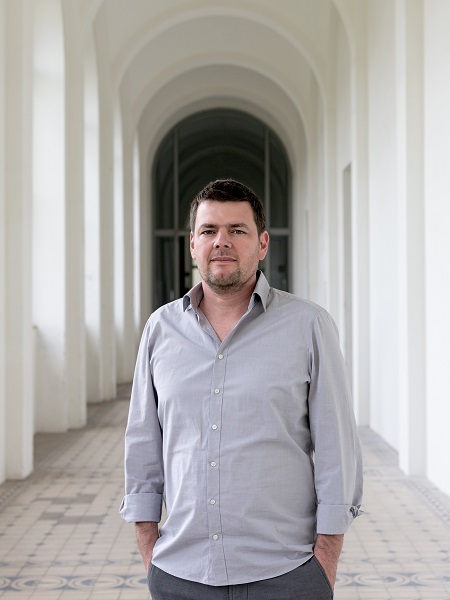
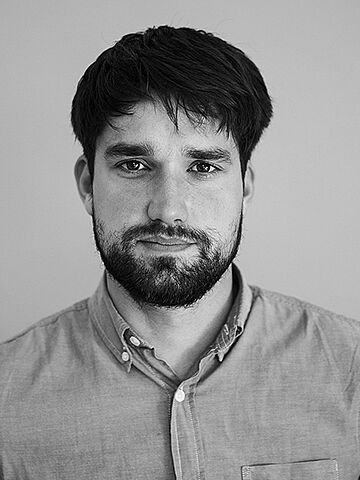
Dr. João Lourenço is a Researcher at the Mathematisches Institut of the University of Münster , affiliated with the Cluster of Excellence Mathematics Münster: Dynamics - Geometry - Structure (CRC 1442) . His research focuses on arithmetic geometry and representation theory, with contributions to Schubert varieties, moduli spaces, and geometric Satake equivalences in mixed characteristic contexts. He actively participates in research projects T1–T4 under the CRC program. Key research interests include arithmetic geometry , representation theory , and the interplay between algebraic groups and cohomology. His work addresses foundational questions in p-adic geometry, Bruhat-Tits theory, and the structure of affine Grassmannians. Recent publications explore normality of Schubert varieties in positive characteristic and tubular neighborhoods of local models. Dr. Lourenço collaborates with international researchers such as Thomas Haines, Timo Richarz, and Simon Riche. His research is supported by the CRC 1442, focusing on geometric deformations and rigidity phenomena. He has contributed to foundational papers in Annales Scientifiques de l’École Normale Supérieure and Forum of Mathematics, Sigma , among others.
Dr. Ksenia Fedosova is a mathematician affiliated with the Mathematical Institute at the University of Münster, Department of Mathematics and Computer Science. Previously, she held roles at the Albert-Ludwigs-University of Freiburg, including teaching and research. Her work focuses on global analysis, spectral geometry, number theory, and mathematical physics, with applications to hyperbolic surfaces, scattering theory, and automorphic forms. She has published extensively on topics such as resonances, zeta functions, and analytic torsion. Her research often involves interdisciplinary methods from harmonic analysis, ergodic theory, and differential geometry. Affiliations: University of Münster (current), University of Freiburg (past) Roles: Lecturer, Researcher, Course Organizer Key Areas: Spectral Geometry, Analytic Number Theory, Hyperbolic Dynamics Her teaching includes advanced courses such as Analytic Number Theory, Fourier Series, and Elementary Geometry. She has organized academic events like the 'Hypoelliptic Laplacian and Applications' lecture series in 2019. Her research outputs emphasize theoretical contributions to zeta functions, scattering theory, and geometric analysis.
Prof. Dr. Vytautas Paškūnas is a Professor at the Faculty of Mathematics, University of Duisburg-Essen. His research focuses on number theory, algebraic geometry, and representation theory, with a particular emphasis on Galois representations and the Langlands program. He advises doctoral and master’s students and contributes to academic collaborations like the Arithmetic Day: Bonn-Essen-Münster conference. His former PhD students include Paulina Fust (2019–2023), Robin Witthaus (2018–2022), Shen-Ning Tung (2015–2019), Alexandre Pyvovarov (2013–2017), and Fabian Sander (2011–2015). Notable master’s theses supervised include works on deformation rings, Galois representations, and cohomology theories. He organizes academic events such as the Arithmetic Day conference (January 2025), featuring talks on advanced topics like the Fargues-Fontaine curve and Shimura varieties. His research group (Essen Seminar RG Paškūnas) engages with cutting-edge problems in arithmetic geometry and representation theory.
Dr. Lennart Gehrmann is a researcher affiliated with the Faculty of Mathematics at Universität Bielefeld . His work focuses on Integral Structures in Geometry and Representation Theory , specifically within the collaborative project SFB / Transregio 358 and its subproject B6: Equivariant cohomology and Shimura varieties . His research intersects advanced mathematical concepts with applications in geometry and number theory. Key research topics include Plectic Stark-Heegner points and Rigid meromorphic cocycles , contributing to the Mathematical World strategic research area at Bielefeld University. Gehrmann's academic profile emphasizes interdisciplinary exploration of modular forms, L-invariants, and their geometric interpretations.
Peter Smillie is a Research Group Leader (W2-Junior Professor) at the Max Planck Institute for Mathematics in the Sciences , Leipzig, with a research focus on differential geometry , harmonic maps , and Teichmüller theory . He previously held positions at the University of Heidelberg and Caltech. Education: Ph.D. in Mathematics, Harvard University (2018), advised by Shing-Tung Yau B.S. in Mathematics, Stanford University (2011) Smillie's research explores moduli spaces of geometric structures , particularly their intrinsic geometric properties. His work bridges pure mathematics and applications to general relativity and physics , with projects like Organic Materials by Geometrical Design at HITS. He also investigates minimal surfaces in symmetric and hyperbolic spaces, and their connections to integrable systems. Recent publications highlight trends in minimal surface theory , harmonic maps , and fullerene graph enumeration , often appearing in journals like Duke Mathematical Journal and Commentarii Mathematici Helvetici . Scientific Awards: NSF Graduate Research Fellowship (2011-2014) Smillie has advised students such as Dominique Ostermayer (joint Ph.D. with HITS) and Julia Piazolo (bachelor’s thesis on minimal surface index). His teaching spans Differential Geometry at Heidelberg and Harmonic Maps at Caltech. He is affiliated with the Heidelberg Experimental Geometry Lab (HEGL) and has presented at conferences including the Geometric Structures (re)United workshop and Higher Teichmüller Theory conference.
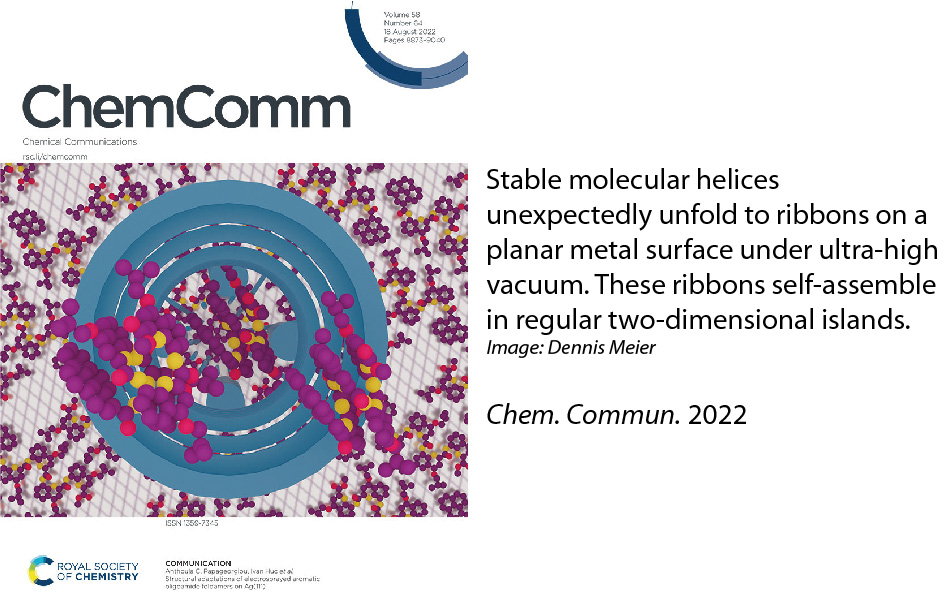
Anthoula Papageorgiou leads the Papageorgiou Group at Technical University of Munich's Physics Department (Surface and Interface Physics, E20). Her work focuses on surface processes and properties of molecular and supramolecular systems, using advanced microscopy and spectroscopic techniques. She has pioneered studies on porphyrins, carbenes, and 2D coordination networks. Education: BSc Physics (2000, Queen Mary & Westfield College), MSc Processes & Advanced Materials Technology (2004, Aristotle University), PhD Physical Chemistry (2007, UCL), Habilitation in Experimental Physics (2019, TUM) Research interests include surface-confined chemistry, nanoscale templating, and form-function relationships in surface nanostructures. Her group employs scanning tunneling microscopy (STM), X-ray photoelectron spectroscopy, and electrospray ion beam deposition. Key projects involve modular assembly of functional materials and understanding surface reaction mechanisms. Recent articles highlight discoveries like molecular raffle wheels, NHC-porphyrin interactions, and graphene nanoribbon synthesis. Funded projects include DFG priority programme COORNETs. Collaborations span theory (condensed matter physics), molecular synthesis, and surface science. The group actively mentors students from bachelor to doctoral levels.
Prof. Dr. Ulrich Görtz is a full-time faculty member at the University of Duisburg-Essen, leading the Research Group Görtz in the field of Arithmetic Geometry and Number Theory. His work bridges abstract algebraic geometry with number-theoretic structures, focusing on topics like Shimura varieties, Frobenius traces, and abelian varieties in positive characteristic. Research Areas: Arithmetic Geometry, Number Theory, Abelian Varieties, Positive Characteristic Geometry Organized Workshops: Oberwolfach workshops (2015, 2019) on reduction of Shimura varieties His research group includes current PhD students Giulio Marazza and Thiago Solovera e Nery, along with former members such as Francesc Fité, Xavier Guitart, and Martin Kreidl. He has collaborated with institutions like the Mathematisches Forschungsinstitut Oberwolfach and the Hausdorff Center in Bonn. The group's publications span p-adic geometry, moduli spaces, and vector bundle theory, with contributions to the understanding of Iwahori level structures, Sato-Tate groups, and Demazure resolutions. His work has appeared in journals like Ann. Inst. Fourier , Compos. Math. , and Math. Z. Prof. Görtz is actively involved in mentoring students and postdocs, with a team including secretary Julia Schulte-Kellinghaus and former collaborators like Ulrich Terstiege and Christian Kappen. His contact details include an email address ulrich.goertz@uni-due.de .
Ulf Kühn serves as Professor of Number Theory within the Department of Mathematics at the University of Hamburg, where he actively teaches seminars on Arithmetic Geometry and Number Theory and maintains research leadership in algebraic and number-theoretic disciplines. His research program centers on Number Theory and Algebraic Geometry, with specialized expertise in Arakelov theory, arithmetic algebraic geometry, modular forms, modular curves, and multiple zeta values. He contributes to academic discourse as an editorial member of the Papers from the Mathematical Seminar of the University of Hamburg and through participation in the Hamburg Colloquium on Pure Mathematics, while maintaining active connections to global number theory resources including arXiv archives and the Number Theory Web. Professor Kühn supervises doctoral and master's theses, provides examination guidance, and offers individual office hours by appointment. His contact is facilitated through the Department of Mathematics (AZ) at the Geomatikum building, with correspondence directed to ulf.kuehn@uni-hamburg.de for academic inquiries and supervision opportunities.
Bernardo Bader is Professor of Architecture and Art at the Academy of Fine Arts Munich, where he leads the Master’s program in Architecture and Art. He is also the founder and principal of bernardo bader architekten , based in Dornbirn, Austria. His academic and professional work is deeply rooted in the architectural traditions of the Alpine region, with a strong emphasis on material authenticity, craftsmanship, and environmental integration. Academy of Fine Arts Munich – Faculty of Architecture University of Liechtenstein – Guest Lecturer, Master’s Program in Architecture His research and design practice focus on sustainable architecture, cultural identity, sacred spaces, and public infrastructure. Bader’s projects often explore the relationship between built form and landscape, using timber and stone to create structures that are both timeless and contextually responsive. His work bridges artistic expression with functional rigor, particularly in educational, religious, and civic buildings. The 15 most recent publications reflect a consistent engagement with themes of sustainability, cultural continuity, and architectural poetics. Projects such as the Islamic Cemetery in Altach, the Alpine Sports Center in Schruns, and the revitalization of Hohenems’ Old Town demonstrate a deep commitment to social responsibility, ecological performance, and aesthetic clarity. These works span residential, institutional, and urban scales, united by a minimalist yet expressive architectural language. Bernardo Bader has received numerous awards and recognitions: Piranesi Award 2012 Mies van der Rohe Award Nomination (2013, 2019) Aga Khan Award for Architecture 2013 State Prize 2024 | Architecture and Sustainability International Architecture Award 2014 Dezeen Awards 2019 Nomination Colour-Structure-Surface 1st Prize Vorarlberg Building Owners' Prize 2015 Design Award of the Wüstenrot Foundation European Public Space Award Finalist 2014 He actively mentors students through studio reviews, juries, and academic collaborations at institutions including ETH Zurich, the University of Liechtenstein, and his own department in Munich. While no formal list of advisees is available, his pedagogical influence extends across Europe. His studio has secured multiple competition wins and public commissions, indicating sustained grant and project funding. Bader’s work is often developed through competitive processes and public contracts, reflecting strong institutional support. Bernardo Bader leads bernardo bader architekten , a design studio known for its rigorous conceptual approach and high-quality execution. The team collaborates with engineers, landscape architects, and artists on projects that serve both local communities and broader cultural discourse. The studio functions as a living laboratory for architectural innovation, particularly in timber construction and sustainable urban development.
Liam Tirpitz is a researcher and PhD candidate at the Department of Computer Science, Faculty of Mathematics, Computer Science and Natural Sciences, RWTH Aachen University. He is affiliated with the Chair of Computer Science i5 (Information Systems and Databases) and the Data Stream Management and Analysis Group, where he has been working since February 2022. Education : Master's degree in Computer Science from RWTH Aachen University (2021). His research focuses on data stream processing, in-network computing, and FAIR data ecosystems, with applications in industrial and cyber-physical systems. He explores methods for efficient data aggregation, stability detection, and cross-organizational data sharing, often leveraging technologies like WebAssembly and knowledge graphs. His work integrates distributed systems principles with database technologies to enable scalable and secure data processing in industrial environments. The recent publications of Liam Tirpitz reflect a strong focus on industrial data management, with trends toward in-network computing, edge-based stream processing, and FAIR principles. His work spans both theoretical architectures (e.g., GALOIS) and applied implementations in domains like manufacturing and health data, demonstrating interdisciplinary collaboration and real-world impact. Liam Tirpitz is actively involved in teaching and academic supervision. He has taught courses such as Data Ecosystems Lab and Implementation of Databases, and is currently supervising multiple thesis projects on topics including WebAssembly-based query functions, anomaly detection, and hybrid stream processing. He participates in research projects like StreamFröst and the Cluster of Excellence Internet of Production, contributing to the development of digital infrastructure for sustainable industrial systems. He is based at the Chair of Computer Science i5, a leading research group in information systems and databases at RWTH Aachen, which supports his work in data-intensive applications and distributed computing environments.
Frank Vallentin is a full professor of applied mathematics (computer science) at the Mathematical Institute of the University of Cologne, Germany. He has held academic positions at Technische Universiteit Delft, Centrum Wiskunde & Informatica (CWI), and the Hebrew University of Jerusalem. His research spans optimization, discrete geometry, harmonic analysis, and computational mathematics. Research Interests: His primary mathematical interests include semidefinite programming, combinatorial optimization, harmonic analysis, discrete geometry, combinatorics, geometry of numbers, special functions, computational complexity, and coding and information theory. These areas reflect a deep integration of theoretical mathematics with algorithmic and computational techniques. The 15 most recent publications reveal a strong focus on geometric optimization, lattice problems, energy minimization, and semidefinite programming bounds. Key themes include chromatic numbers of lattices, symplectic capacities, polarization phenomena, and algorithmic solutions to geometric problems. His work often involves recursive SDP hierarchies, extremal configurations, and computational verification of theoretical bounds. Scientific Awards and Grants: SIAG/Optimization Prize (2011, with Christine Bachoc) NWO VIDI Grant (2010–2015): Semidefinite programming and harmonic analysis DFG Project: Symplectic capacities of polytopes (2017–) EU Horizon 2020 MINOA Project: Optimization with limited quantum resources (2017–) DFG Project: Spectral bounds in extremal discrete geometry (2019–) Advising and Grants: Vallentin has advised numerous PhD and master’s students at TU Delft and the University of Cologne, covering topics in discrete geometry, optimization, coding theory, and quantum information. He has secured major research funding from NWO, DFG, and the EU, supporting interdisciplinary projects in algorithmic optimization and mathematical physics. He is actively involved in organizing workshops and summer schools. Labs and Teams: He leads a research group at the University of Cologne focusing on optimization and discrete geometry, with strong collaborations with CWI Amsterdam, TU Delft, and international institutes. His team works on theoretical and computational aspects of geometric optimization, often using symmetry reduction and harmonic analysis.
Davide Cesare Veniani is a Postdoctoral Assistant at the University of Stuttgart, affiliated with the Institute of Discrete Structures and Symbolic Computing and the Chair of Differential Geometry. He holds a Privatdozent (Priv.-Doz.) title and completed his habilitation in Mathematics at Stuttgart in 2021. His research focuses on algebraic geometry, particularly K3 surfaces, Enriques surfaces, and their symmetries, enumerative problems, and connections to number theory. Education: PhD in Mathematics (2016), Leibniz Universität Hannover, under Prof. Matthias Schütt Postdoctoral positions at Johannes Gutenberg-Universität Mainz (2016–2019) and Universität Stuttgart (2019–present) His research interests include the geometry of algebraic surfaces, their moduli spaces, automorphisms, and applications to arithmetic geometry. He has organized events such as the 2023 FrAGe conference and contributed to international summer schools on arithmetic geometry. Teaching includes courses on mathematics for economics, advanced geometry topics, and seminars on group theory and algorithmic applications. His publications span high-impact journals, exploring subjects like elliptic fibrations, symplectic rigidity of hyperkähler manifolds, and Hensel lifting algorithms for quadratic forms.
Stephan Schulz is a Professor at Hochschule Wismar University of Applied Sciences Technology, Business and Design since 2017. He previously served as a Visiting Professor at Burg Giebichenstein – University of Art and Design Halle in 2016 and as a teaching assistant at Halle University of Art and Design from 2011-2015. Industrial design education at Halle University of Art and Design (2003-2009) with Erasmus exchange at Design Academy Eindhoven (2007-2008) 2013 German Design Award Newcomer Finalist His research focuses on Sustainable Materials , Product Design , and Material Innovation , particularly with clay and concrete. Notable projects include the Modular Clay Wall System (2012) for ecological climate control and the Neo Luna Park (2016) that reimagined funfairs as learning environments. His work emphasizes user interaction and material authenticity . Recent projects (2012-2022) demonstrate consistent innovation in domestic applications of industrial materials, with 15+ designs spanning furniture, lighting, and architectural elements. Key collaborations include Volkswagen AG , Calvin Klein Collection , and Bauhaus Dessau Foundation . 2013 German Design Award Newcomer Finalist He has directly supervised 13+ design students, particularly during the Neo Luna Park project (2016). His practice integrates academic research with commercial product development , as seen in partnerships with Betoniu, Moormann, and BMW.
Ann Sychterz is an Assistant Professor at the University of Illinois Urbana-Champaign in the Civil and Environmental Engineering department. She leads the SMARTI Lab, focusing on adaptive structures, tensegrity systems, and machine learning for civil infrastructure. Her research integrates computational design with experimental validation to create deployable systems for climate resilience. PhD, Swiss Federal Institute of Technology Lausanne (2018) M.A.Sc, University of Waterloo (2014) B.A.Sc, University of Waterloo (2012) Her research interests span structural dynamics, form-finding, machine learning, and adaptive infrastructure. Recent work involves MLRAM materials for tensegrity structures, origami-based coastal anchors, and sensor-actuator optimization. 2024-2025 highlights include a Visiting Professorship at University of Stuttgart and SEAOI Outstanding Young Engineer Award . Key trends across her 2023-2025 publications include: Advancements in tensegrity and origami structural modeling Integration of machine learning for damage detection Functionally graded materials for geotechnical applications Experimental validation of full-scale deployable systems Scientific recognition includes: ASCE SEI Future Leaders Award (2024) Best Paper/Poster Awards (2021-2025) NSERC and Ontario Graduate Scholarships Leadership roles in ASCE Technical Committees She advises PhD students in structural control, oversees the SMARTI Lab, and collaborates with the Beckman Institute and National Center for Supercomputing Applications. Her work addresses climate-driven infrastructure challenges through deployable, biomimetic designs.
Laura Balangé is a doctoral researcher at the University of Stuttgart's Institute of Engineering Geodesy (IIGS), Faculty 6: Aerospace Engineering and Geodesy. She contributes to the Cluster of Excellence IntCDC through computational design and quality assurance research. Her work focuses on: Holistic Quality Modeling for sustainable construction Terrestrial Laser Scanning applications Coreless Filament Winding fabrication Modular Timber Shell structures Graded Concrete component monitoring Multi-Domain Co-Design frameworks Notable contributions include: 2025: Point cloud datasets for Biomimetic Shell construction 2024: Extended interrelation analysis in quality modeling 2023: Data normalization methods for co-design 2022: Production monitoring for fibrous structures 2021: Graded concrete component verification 2020: Foundational technical quality concepts She supervises academic works in: Geometric quality control Fiber cross-section analysis BIM modeling Neural network object detection Concrete positioning systems Timber fabrication quality Active in the IntCDC cluster, she collaborates with teams across architecture, engineering, and computational design domains.