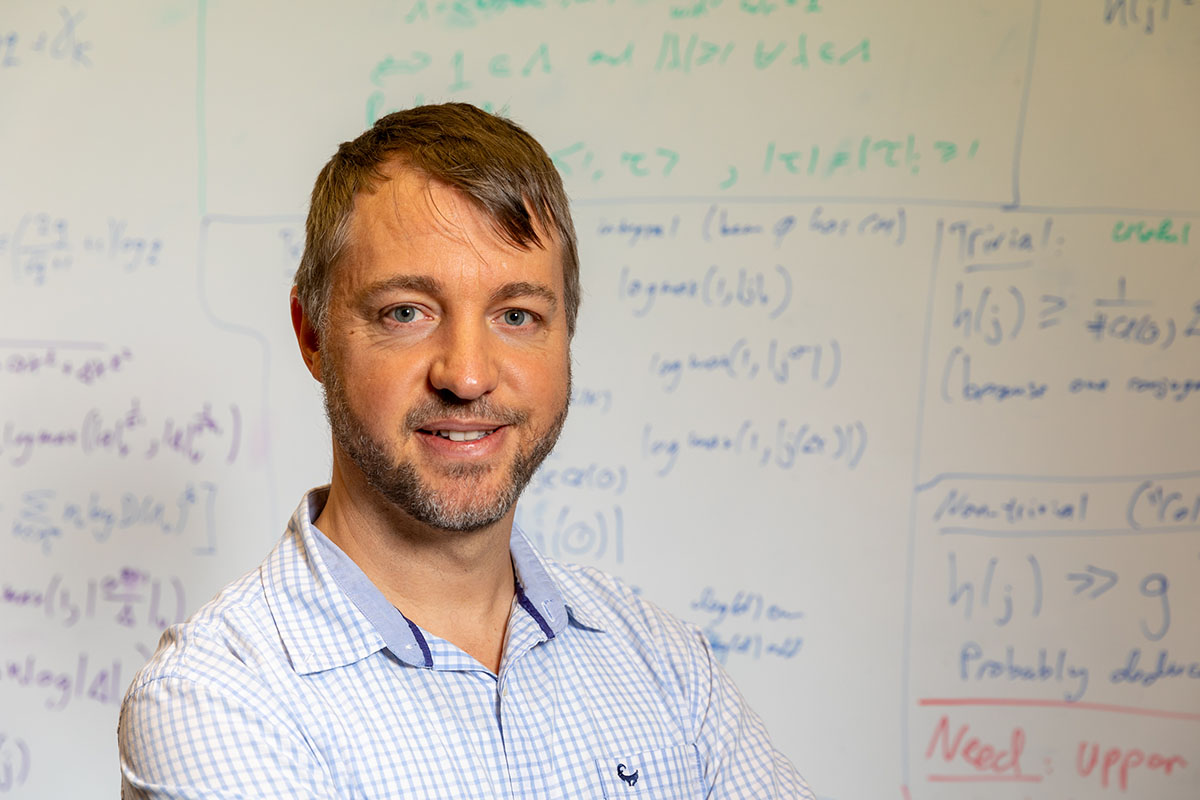
Prof. Dr. Guido Kings is a Professor of Pure Mathematics at the Faculty of Mathematics, University of Regensburg. His research focuses on Special Values of L-functions , Tamagawa Number Conjecture , and Polylogarithms , with significant contributions to Iwasawa Theory and Arithmetic Geometry . He has held leadership roles in research projects such as the CRC Higher Invariants. Prof. Kings has authored influential papers on topics like Eisenstein-Kronecker classes , p-adic interpolation , and regulators in arithmetic geometry . He received the Frontier of Science Award in recognition of his work. His team includes doctoral students and postdoctoral researchers, such as Bernadette Melichar and Julio de Mello Bezerra. Current Affiliations: Faculty of Mathematics, University of Regensburg Recent Courses Taught: Analysis II, Advanced Seminar in Arithmetic Geometry, and Modular Forms Research Group: Comprises scientific staff (e.g., Han-Ung Kufner) and doctoral students working on number theory and algebraic geometry. His publications are widely cited in Annals of Mathematics , Duke Mathematical Journal , and Inventiones Mathematicae , reflecting his expertise in connecting motivic cohomology with p-adic analysis.
Professor Jörn Steuding holds the Professorship for Number Theory at the University of Würzburg since 2006, where he is affiliated with the Institute of Mathematics within the Faculty of Mathematics and Computer Science. His academic career includes a Ramon y Cajal research position at Universidad Autónoma de Madrid (2004-2006), postdoctoral work at the University of Frankfurt under Professors W. Schwarz and J. Wolfart (1999-2004), and completion of his habilitation at Frankfurt in 2004. His educational background includes a PhD from the University of Hannover in 1999 under Prof. G.J. Rieger, where he also served as an assistant from 1996-1999, and undergraduate studies in mathematics at Hannover from 1991-1995. Professor Steuding's research spans multiple areas of number theory, with particular focus on Zeta and L-functions (including zero distribution, universality properties, and connections to Random Matrix Theory), Diophantine analysis (covering approximation theory, equations, and the abc conjecture), elliptic curves and modular forms , algebraic number theory (including arithmetically equivalent fields), and elementary number theory with applications to primality testing and factorization. His work often bridges theoretical foundations with historical perspectives, as evidenced by his research on the Hurwitz brothers' contributions to complex continued fractions. His publication record demonstrates consistent contributions to leading journals in number theory, with research trends showing evolution from foundational work on Riemann zeta function zeros to broader investigations of L-functions in the Selberg class, Diophantine problems over quadratic fields, and historical aspects of number theory. His publications appear in prestigious journals including Mathematische Annalen, Acta Arithmetica, and the Bulletin of the American Mathematical Society. Professor Steuding has authored significant monographs including Diophantine Analysis (CRC Press/Chapman-Hall, 2005), Value distribution of L-functions (Springer Lecture Notes in Mathematics 1877, 2007), and Elementary Number Theory: A Gentle Introduction to Higher Mathematics (Springer Spektrum, 2015, co-authored with N. Oswald). He serves as the Erasmus Coordinator for his department alongside Dr. Jens Jordan, facilitating international academic exchanges. His research collaborations span multiple institutions, with notable co-authors including N. Oswald, M. Technau, H. Nagoshi, and L. Pankowski. Professor Steuding leads the Number Theory team at the University of Würzburg, maintaining an active research group focused on contemporary problems in analytic and algebraic number theory. His work continues to explore connections between classical number theory and modern mathematical physics through Random Matrix Theory applications.
Prof. Dr. Marc Nieper-Wißkirchen is a University Professor (W3) for Algebra and Number Theory at the Institute of Mathematics, University of Augsburg, since 2008. He has held visiting positions at the Max Planck Institute for Mathematics in Bonn and the University of Cambridge, and served as a Junior Professor at Johannes Gutenberg University Mainz (2004–2008). Since October 2021, he has been Vice Dean of the Faculty of Mathematics, Natural Sciences and Technology (MNTF). Education: Diploma in Mathematics (2000) from the University of Cologne, preceded by preliminary diplomas in physics (1997) and mathematics (1997). His doctoral studies (2000–2002) under Prof. Daniel Huybrechts focused on characteristic classes and Rozansky-Witten invariants of hyperkähler manifolds. His research spans algebraic geometry, differential geometry, and mathematical physics, with a focus on hyperkähler manifolds, Hilbert schemes of points, irregular singular connections, and Stokes phenomena. He has contributed to the understanding of Rozansky-Witten invariants, Chern numbers, and topological aspects of differential equations. Recent publications include works on Betti structures of hypergeometric equations (2022) and Stokes matrices for confluent hypergeometric equations (2022), reflecting his ongoing exploration of differential equations' geometric underpinnings. Earlier works address Hochschild homology, equivariant cohomology, and operads in algebraic contexts. His computational contributions include software demonstrations for elliptic curve arithmetic, Collatz sequences, and Google Matrix simulations. Technical expertise includes programming languages (TeX, PHP, HTML) and systems (Unix/Linux, Zope/Plone).
Don Zagier is a distinguished mathematician holding positions as Scientific Member and former Director at the Max Planck Institute for Mathematics in Bonn. He has been a Professor at the University of Bonn, University of Maryland, Kyushu University, University of Utrecht, and Collège de France. His work bridges number theory, algebraic geometry, topology, and mathematical physics. Born in 1951, he studied at MIT (1966–1968), earned a D.Phil. from Oxford (1971), and completed his habilitation at Bonn (1975). He has held roles in the Sonderforschungsbereich (SFB) Theoretische Mathematik, served as ICTP Distinguished Staff Associate since 2014, and is an Honorary Member of the London Mathematical Society (2019). Research interests include modular forms, zeta functions, quantum invariants, and algebraic geometry. Notable works include studies on the Birch-Swinnerton-Dyer conjecture, polylogarithms, and the theory of Jacobi forms. His contributions span over 200 publications, including foundational texts like Zetafunktionen und quadratische Körper (1981) and co-edited volumes on modular forms. His awards include the Carus Prize (1984), Frank Nelson Cole Prize (1987), and Karl Georg Christian von Staudt Prize (2001). Research trends in his articles focus on modular forms, knot theory, quantum topology, and the interplay between number theory and geometry. Grants and collaborations are extensive, though specifics remain unspecified. He leads research at the MPI and contributes to global mathematical communities through educational initiatives and editorial roles in journals like Communications in Number Theory and Physics .
Prof. Dr. Georg Hein is a Professor in the Department of Mathematics at the University of Duisburg-Essen, Campus Essen. His office is located at WSC-O-3.58, Thea-Leymann-Str. 9, 45117 Essen, with office hours held every Tuesday from 2-3 PM and by appointment. He serves as Director of the Research Group Hein, focusing on Algebraic Geometry. His research centers on Algebraic Geometry with specific expertise in vector bundles, moduli spaces, elliptic surfaces, and sheaf theory. Hein's work demonstrates deep engagement with stability conditions, Fourier-Mukai transforms, and geometric invariant theory. His publications reveal a consistent focus on foundational structures in algebraic geometry, particularly through the lens of vector bundles on curves and surfaces. Analysis of his 15 most recent publications (2017-2007) shows a strong thematic continuity in moduli space theory and vector bundle classification. His work bridges abstract algebraic constructions with computational approaches, as evidenced by algorithmic developments for elliptic surfaces and lattice-theoretic investigations. The publications collectively emphasize stability criteria across diverse geometric contexts. Hein actively supervises PhD students including Asbjørn Michelsen, with former advisees Quyet Thang Truong and Dr. Dario Weißmann. He contributes to academic outreach through the Essen Math Circle for students, organizing weekly sessions for grades 5-13 covering advanced mathematical topics beyond standard curricula. His teaching portfolio includes courses such as Mathematische Miniaturen and Topologie .
Viktoriya Ozornova is a Researcher at the Max Planck Institute for Mathematics in Bonn, specializing in algebraic topology with a focus on abstract homotopy theory and higher category theory. Her work explores foundational questions in (∞,n)-categories and their applications to mathematical physics. She collaborates extensively with researchers such as Martina Rovelli, Emily Riehl, and others on topics including model structures, categorical equivalences, and homotopy coherence. Her research has been published in leading journals like Advances in Mathematics , Algebraic & Geometric Topology , and Transactions of the American Mathematical Society . She co-organized workshops on infinity categories and Picard groups of topological modular forms (TMF). She has supervised students including Julian Brüggemann (PhD) and mentored numerous bachelor and master theses on topics ranging from elliptic curves to homotopy theory. Ozornova has taught at institutions including the University of Bochum and Bonn, covering courses in topology, analysis, and number theory. Her pedagogical contributions include designing online curricula for engineering mathematics and organizing seminars on advanced topics like Lie groups and braid theory.
Alexandros Leivaditis is a researcher in the Algebra group within Ruhr-Universität Bochum's Faculty of Mathematics. His research focuses on structural graph theory and combinatorial algebra, particularly Ramanujan graphs and graph minor obstructions. Recent publications investigate connections between quaternion algebras, supersingular elliptic curves, and Ramanujan graph constructions. Additional research characterizes minor obstructions for apex graphs and pseudoforest structures. Leivaditis contributes to the Research Team Röhrle, investigating combinatorial aspects of algebraic structures. No information is available regarding teaching activities or research supervision.
Prof. Dr. Claudia Alfes is a faculty member at the Faculty of Mathematics, University of Bielefeld , holding a W2 Professorship since 2021. Formerly, she occupied a W1 Professorship at the University of Paderborn (2017-2021) and postdoctoral positions at the Universities of Cologne, Heidelberg, and TU Darmstadt. PhD in Mathematics (summa cum laude) at TU Darmstadt (2010-2015) MA in Mathematics at University of Wisconsin-Madison (2008-2009) via Fulbright Diploma in Mathematics at RWTH Aachen (2005-2010) Her research lies at the intersection of modular forms , number theory , and representation theory , focusing on real-analytic generalizations and higher-rank groups. Recent work includes polyharmonic Maaß forms, Shintani theta lifts, and cycle integrals of meromorphic modular forms. Key trends in her 15 most recent articles (2010-2025) include: Advances in harmonic weak Maass forms and their classifications Applications to CM points, singular moduli, and rationality questions Connections between quiver representations, Ehrhart polynomials, and symplectic Hecke eigenbases Development of summation formulas and automorphic periods Scientific distinctions include Admission to the Junge Kolleg (2020) Summa cum laude doctorate (2015) She leads Subprojects A01 and B01 in the SFB TRR 358/1 (2023-2026) and received grants from the Klaus Tschira Boost Fund (2021-2022) and Daimler & Benz Foundation (2021).
Prof. Irene I. Bouw is a full professor at the University of Ulm's Institut für Algebra und Zahlentheorie, specializing in algebraic geometry and number theory. Her research focuses on arithmetic geometry, coding theory, and the interplay between algebraic curves and Galois groups. She teaches advanced courses such as Algebra (Master's), Algebraic Geometry, and Coding Theory, with consultations available by appointment. Her work includes studies on superelliptic curves, L-functions, and modular curves, with notable projects like the DFG-funded 'Quotient singularities and semistable reduction.' She serves on editorial boards for Research in Number Theory and Journal de Théorie de Nombres de Bordeaux . Bouw's publications explore topics like conductor-discriminant inequalities, dynamical Belyi maps, and semistable reduction techniques. Her research often bridges theoretical insights with computational methods, contributing to both pure mathematics and applications in cryptography.
Prof. Dr. Johannes Sprang is a Professor at the University of Duisburg-Essen, Faculty of Mathematics, leading the Research Group Sprang (RG Sprang). His research focuses on algebraic number theory, p-adic analysis, and Iwasawa theory, with notable contributions to zeta values, elliptic polylogarithms, and cohomological realizations. He advises two PhD students: Guillermo Gamarra Segovia and Riccardo Tosi. His academic background includes a PhD in Mathematics (2017) from the University of Duisburg-Essen, with a thesis on Eisenstein series via the Poincaré bundle and applications. His research interests span p-adic L-functions, transcendence theory, and complex geometry, with a particular emphasis on modular forms and abelian varieties. Teaching responsibilities include courses such as Algebraic Number Theory , Complex Geometry , and Iwasawa Theory . Recent courses highlight his expertise in number theory and geometric methods. His work frequently intersects with algebraic topology and arithmetic geometry, addressing topics like syntomic cohomology and topological modular forms. Prof. Sprang’s publications emphasize the irrationality of zeta values, p-adic interpolation, and cohomological comparisons. His research group collaborates internationally, with projects involving co-authors such as Guido Kings, Wadim Zudilin, and Nobuaki Naumann. No scientific awards are explicitly listed, though his contributions are widely recognized in number theory circles.
Dr. Timo Keller is a Visiting Professor of Mathematics at the Institute of Mathematics, University of Würzburg, holding a temporary professorship from October 2024 to March 2027. His academic position is specifically in the Chair of Mathematics I (Algebra), with his office located in Building 30 (Mathematik West), Room 03.010 at Emil-Fischer-Straße 30, 97074 Würzburg. Dr. Keller's research focuses on Arithmetic Geometry, particularly the arithmetic and computational aspects of curves and abelian varieties over arithmetic fields. His work encompasses rational points (especially of modular curves), modular forms, Galois representations, L-functions, and cohomology of abelian varieties. A significant portion of his research addresses the Birch–Swinnerton-Dyer conjecture, which establishes profound connections between algebraic and analytic, local and global invariants of elliptic curves over Q and more generally abelian varieties over global fields. He also investigates rational points on modular curves, which serve as moduli spaces for elliptic curves with additional data like level structure. His recent scholarly output demonstrates a strong emphasis on computational methods in number theory, particularly the Chabauty–Kim method for finding rational points, verification of the Birch-Swinnerton-Dyer conjecture for abelian varieties, and exploration of modular curves. His work bridges theoretical developments with computational implementations, as evidenced by his GitHub repository for published article code. Marie Skłodowska-Curie postdoctoral fellowship Dr. Keller previously held positions at Leibniz Universität Hannover and Universität Bayreuth before his postdoctoral fellowship in Groningen. His academic trajectory reflects a deep engagement with arithmetic geometry, with a consistent focus on computational approaches to classical problems in number theory.
Prof. Dr. Gerd Laures is a Professor of Topology at the Ruhr-Universität Bochum, Faculty of Mathematics. His research focuses on algebraic topology, particularly homotopy theory, bordism theory, and elliptic cohomology. He explores connections between topology and string theory, applying elliptic curve theory to manifold studies. He has advised numerous PhD and Master's students, including Laurent Smits, Daniel Garrido, and Leonard Tokic. His teaching includes advanced courses on algebraic topology, differential topology, and topology-related subjects. Key research areas include Toda brackets, topological modular forms (TMF), and K-localized bordism spectra. He collaborates on projects linking topology to physics, such as string theory foundations. His publications span journals like Inventiones Mathematicae and Advances in Mathematics . He is affiliated with the Floer Center of Geometry and actively supervises research in topology, mentoring students in topics like elliptic cohomology and manifold classifications. His work bridges algebraic geometry, differential geometry, and global analysis, advancing interdisciplinary mathematical frameworks.
Yassine El Maazouz is a Harry Bateman Postdoctoral Scholar in the Division of Physics, Mathematics and Astronomy at Caltech, mentored by Matilde Marcolli. His research focuses on interactions between algebraic geometry, non-Archimedean geometry, number theory, and probability theory. He holds teaching roles at Caltech and UC Berkeley, including courses like Toric Geometry (Ma132C) and Probability (Ma140B). His work bridges pure mathematics with applications in mathematical physics and combinatorics. Research Interests: Algebraic Geometry (Tropical/Non-Archimedean aspects) Combinatorics (with applications to Grassmannians and cluster algebras) Number Theory (p-adic measures and arithmetic geometry) Mathematical Physics (amplitude calculations and spinor-helicity formalism) Recent Work Trends: Developing geometric frameworks for p-adic manifolds and invariant measures Exploring positive geometries in scattering amplitudes Investigating combinatorial structures in matrix algebras and valuations Teaching & Mentorship: Instructed advanced courses on toric varieties and probability theory at Caltech. Supervised student projects in algebraic geometry and stochastic processes. Active mentor in UC Berkeley's Statistics bridge program.
Florian Breuer is a Professor of Mathematics at the University of Newcastle , Australia, affiliated with the School of Information and Physical Sciences . He was on sabbatical at the University of Heidelberg, Germany (July–December 2024) and is a member of CARMA (Priority Research Centre in Computer-Assisted Research Mathematics and its Applications). His research focuses on Number Theory , particularly Arithmetic Geometry , Elliptic curves , Drinfeld modules , and Drinfeld modular forms . He also explores quadratic number fields and Cohen-Lenstra-Martinet heuristics . He serves on the editorial boards of the Journal of Number Theory and Quaestiones Mathematicae . His work often intersects with cryptography, as seen in projects like SeCritMass , a threshold secret petition protocol. His research interests also include Ducci sequences and orders of elements in finite fields . Recent trends in his publications emphasize modular polynomials , heights in algebraic geometry , and Drinfeld modular forms of arbitrary rank . Collaborations with mathematicians like Fabien Pazuki and Dirk Basson highlight his contributions to arithmetic geometry and modular forms. Breuer’s work bridges theoretical number theory with computational methods, evident in his GitHub repository for OEIS sequence A130229 analysis. His research often addresses foundational questions in algebraic structures and their applications in cryptography and computational mathematics.
Prof. Dr. Timo Keller is an Associate Professor at Universität Würzburg , focusing on computational and theoretical aspects of arithmetic geometry . His research spans modular curves , abelian varieties , L-functions , and the Birch–Swinnerton-Dyer conjecture . Current affiliation: Universität Würzburg Former positions: Marie Skłodowska-Curie Postdoctoral Fellow (Groningen), Leibniz Universität Hannover , Universität Bayreuth His work combines explicit computation with deep theoretical questions, particularly in: Arithmetic and computational properties of curves over global fields Modular forms and their Galois representations Rational points on modular and hyperelliptic curves Applications of the Chabauty–Kim method Tamagawa numbers and component groups Recent publications in arXiv and Magma code repositories address verification of the strong BSD conjecture for genus 2 curves, rational points on quotients of X0(N), and inverse Galois problems for 17T7. He has received a Marie Skłodowska-Curie Fellowship and contributes to the LMFDB project via open-source code. GitHub: TimoKellerMath (repositories include strongBSDgenus2 , QuadraticPoints , ModularCurvesX0plusG4-6 )