Magnus Boman is a Professor of AI and Health at the Department of Medicine, Solna, Karolinska Institutet (KI), where he leads the AI@KI initiative to support researchers in AI integration. He is affiliated with the Chronic Inflammatory Disease Epidemiology research group under Johan Askling. His research focuses on AI applications in precision medicine, multimodal prediction, ethical norms in AI systems, energy-efficient computing, and quantum sensor data interpretation. Research Interests: Artificial Intelligence in healthcare and precision medicine Multimodal data analysis for disease prediction and treatment Machine learning for clinical decision support systems Ethical and societal implications of AI Grants: Swedish Research Council: Improving breast cancer histology image classification (2024-2026) Scalable Federated Learning (2022-2025) Ai in sustainable cities (VINNOVA, 2019) Advising & Students: Supervised over 50 PhD and Master's students across KI, KTH, and Stockholm University, focusing on AI applications in healthcare, machine learning, and computational epidemiology. Notable projects include predictive modeling for mental health outcomes and variant filtering in genetic data. Labs & Teams: Leads AI@KI, fostering AI adoption in medical research. Collaborates with the Johan Askling group on epidemiology and chronic disease studies.
Ronald Hedden is a Professor of Practice in the Department of Chemical and Biological Engineering at Rensselaer Polytechnic Institute (RPI), where he focuses on innovations in undergraduate education and polymer science. Previously, he served as an Associate Professor at Texas Tech University (2009–2017). His current research emphasizes Virtual Reality (VR) integration into chemical engineering education, including the development of a Virtual Chemical Plant (VCP) simulation to provide safe, cost-effective access to process equipment. His research interests span chemical engineering, polymer science, soft materials, and nanomaterials. Notable projects include applying VR for teaching process safety and dynamics, as well as exploring nanocomposite materials and membrane technologies. He also investigates polymer rheology and structure-property relationships using advanced characterization techniques like NMR and SANS. Hedden teaches both core chemical engineering courses and interdisciplinary engineering subjects. His work bridges academic research and practical applications, with contributions to biofuel refining, asphalt modification, and nanoparticle incorporation in polymers. While no specific awards are listed, his extensive publication record highlights impactful contributions to materials science and educational technology. His advisory work involves student projects on VR simulations and materials engineering. He collaborates on initiatives like the VCP platform, aimed at advancing safety training and process control education. Hedden’s career reflects a commitment to both cutting-edge research and transformative pedagogy in engineering education.
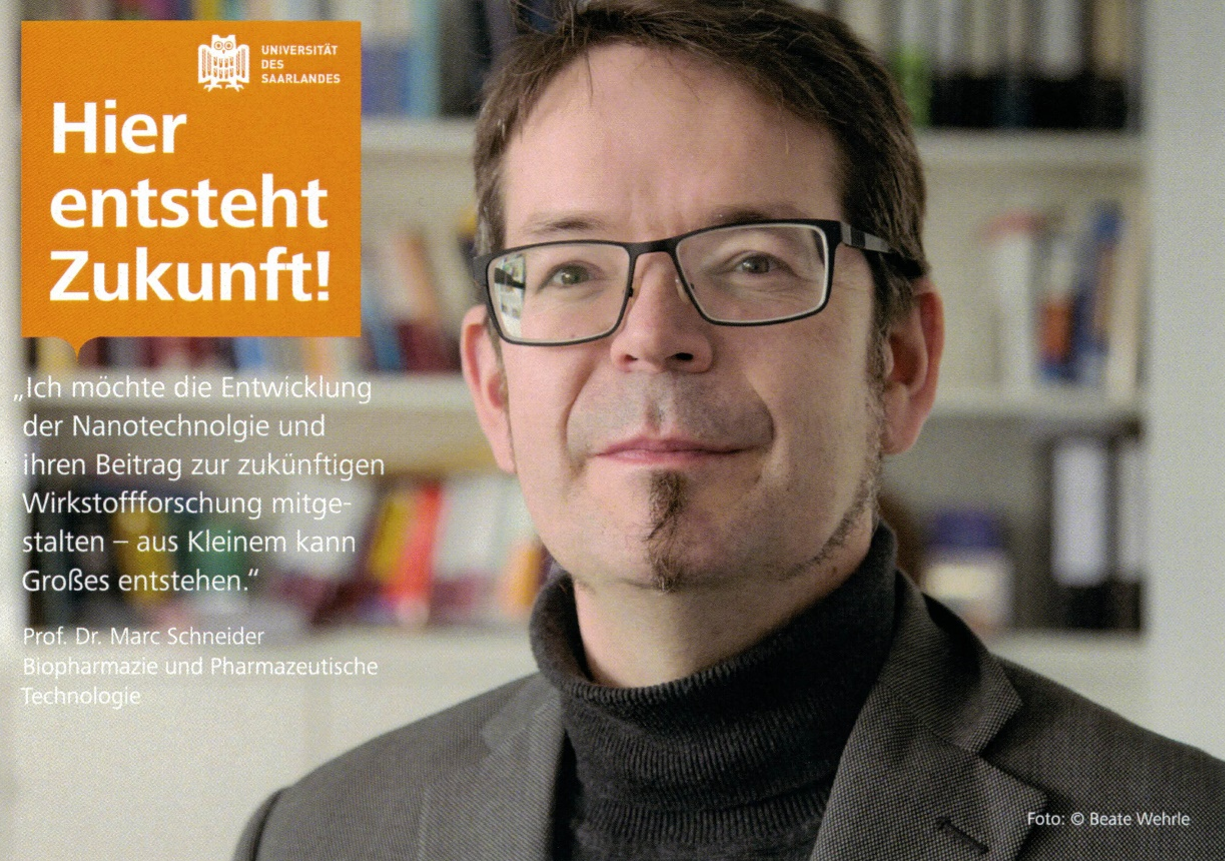
Prof. Dr. Marc Schneider holds a professorship in Biopharmaceutics and Pharmaceutical Technology at Saarland University's College of Pharmacy . His research focuses on colloidal drug delivery systems, particularly nanostructured and non-spherical particle engineering for overcoming biological barriers in pulmonary and transdermal applications. He leads an internationally recognized lab in Saarbrücken, collaborating with Helmholtz Institute for Pharmaceutical Research Saarland (HIPS) and trinational institutions. Research Highlights: Development of inhalable nano/microparticle systems Surface modification of gelatin nanoparticles Characterization of mucus-penetrating particles 3D printing for microneedle fabrication Atomic Force Microscopy (AFM) for nanoparticle analysis Selected Scientific Awards: European Journal of Pharmaceutics and Biopharmaceutics Best Paper Award (2018) for mucus-penetrating nanoparticles Recognized in 'Ausgezeichnete Orte im Land der Ideen' competition (2018) for 'Nano-Mais' drug delivery system Collaborative Networks: Co-editor for Advanced Drug Delivery Reviews special issue on biological barriers Key participant in trinational Master's program in Biomedicine with Strasbourg, Mainz, and Luxembourg Active in Controlled Release Society (CRS) conferences and local chapters
Dr. Calum Gabbutt is a Chapman-Schmidt AI in Science Postdoctoral Research Fellow at Imperial College London's Department of Mathematics (Faculty of Natural Sciences) and a Postdoctoral Training Fellow at the Institute of Cancer Research (ICR), London. He holds a PhD in Mathematical Biology from Queen Mary University of London (2017–2021) and an MPhys from the University of Oxford (2013–2017). His research focuses on mathematical and computational methods to understand clonal dynamics and cancer evolution, particularly leveraging genomic and lineage tracing data. He develops Bayesian inference models to analyze evolutionary processes in cancer, aiming to improve clinical outcomes through precision medicine. Key areas include genetic barcoding, methylation-based molecular clocks, and phylogenetic reconstruction of tumor evolution. Recent work spans large-scale genomic analyses of cancer evolution, computational tools like PISCA-box for somatic chromosomal alterations, and studies on phenotypic plasticity in metastasis and therapy resistance. His research integrates AI-driven approaches to decode cancer heterogeneity and temporal dynamics in human tissues. Collaborations span institutions like the ICR and Queen Mary University of London, emphasizing interdisciplinary methods at the intersection of mathematics, computational biology, and oncology.
Athanasios Rontogiannis is an Associate Professor at the School of Electrical and Computer Engineering of the National Technical University of Athens (NTUA). He holds a PhD in Signal Processing from the National University of Athens (1997) and has held roles including Research Director at the National Observatory of Athens (2017–2021). His research focuses on signal processing, machine learning, and hyperspectral image analysis. Education: MEng (Electrical Engineering, NTUA, 1991), M.A.Sc. (University of Victoria, Canada, 1993), PhD (Signal Processing, National University of Athens, 1997). Research interests include adaptive algorithms, sparse representations, and tensor models. He has served on editorial boards of IEEE Transactions on Signal Processing and EURASIP journals, receiving an honorary distinction in 2020. He is a Senior Member of IEEE and affiliated with EURASIP and the Technical Chamber of Greece. Key contributions span hyperspectral unmixing, Bayesian algorithms, and space data exploitation. His work integrates machine learning for applications in space science and signal processing.
Dr. Masoumeh Dashti is an Associate Professor in Mathematics at the University of Sussex, UK, affiliated with the School of Mathematical and Physical Sciences. She holds a PhD in Mathematics from the University of Warwick (2008) and prior degrees in Mechanical Engineering from Sharif University of Technology and Tehran Polytechnic. Her research focuses on Partial Differential Equations, Inverse Problems, Bayesian Inference, and their applications in fluid dynamics and epidemiology. Key research interests include: Bayesian approaches to inverse problems, sparsity-promoting estimators, uncertainty quantification, and mathematical modeling of epidemics on networks. She has contributed to foundational work on Besov priors and MAP estimator consistency in nonparametric Bayesian frameworks. Her publications span topics like network inference from epidemic data, contraction rates of posterior distributions, and fluid-structure interaction problems. She has secured grants including 'Two-dimensional stochastically perturbed shallow water equations' (2019-2023) and 'Confronting High Dimensional Network Models With Data' (2018-2022). Currently, she serves as an Associate Editor for SIAM-ASA Journal on Uncertainty Quantification and AIMS Foundations of Data Science . Teaching expertise includes Functional Analysis, Partial Differential Equations, and Calculus of Several Variables at both undergraduate and postgraduate levels.
Ulrik Wisløff is a Professor and Head of the Cardiac Exercise Research Group (CERG) at the Norwegian University of Science and Technology (NTNU), Department of Circulation and Medical Imaging. He also holds an Honorary Professorship at the University of Queensland, Australia, and serves as Head of Physical Performance at Rosenborg FC. His research focuses on exercise physiology, translating experimental findings into clinical applications, and developing health technologies like the PAI (Personal Activity Intelligence) metric. Wisløff leads CERG, a 55-member group renowned for groundbreaking studies on exercise in cardiovascular health, aging, and disease prevention. He has authored over 340 peer-reviewed papers, with 127,000+ citations, and been recognized as one of the world's top-cited exercise scientists. Key achievements include the Fitness Calculator (used by 80.5 million people) and PAI, a free app with 70 million users worldwide. Current projects include NorEx (9,700 patients with myocardial infarction) and ExPlas (Alzheimer’s cognitive function trials). Wisløff has mentored 22 postdocs and 38 PhD students, advancing the next generation of researchers. His leadership extends to innovative ventures like the 'My Medical Digital Twin' project, spun into Mia Health Ltd. Scientific contributions span exercise physiology, cardiovascular risk prediction, and high-intensity training efficacy. Awards include Norway’s highest honor in heart research (2020). Research spans molecules-to-society translational medicine, emphasizing global health impact through physical activity advocacy.
Michael O'Dea is a Senior Lecturer in the Department of Computer Science at the University of York, United Kingdom. He has held previous academic positions at York St John University, Beijing University of Technology, University of Hull, and Waikato Institute of Technology, bringing extensive international experience in computer science education. He is actively engaged in pedagogical scholarship and leadership in higher education innovation. Senior Lecturer, Department of Computer Science, University of York Senior Lecturer in Computer Science, York St John University Lecturer in Software Engineering, Beijing University of Technology, China Lecturer in Computer Science, University of Hull Lecturer in Information Technology, Waikato Institute of Technology, NZ Dr. O'Dea earned his Ed.D. in Computer Based Learning from the University of Leeds. His research centers on the integration of artificial intelligence into educational practices, with a strong emphasis on AI literacy, the effectiveness of generative AI in teaching and learning, and the evolving landscape of technology acceptance in higher education. He investigates how AI tools can enhance student learning, faculty development, and institutional policy. His recent publications span topics such as AI literacy assessment, the future of online and blended learning, the application of machine learning in earthquake prediction, and international study abroad effectiveness. These works reflect a broad interdisciplinary approach, combining computer science, educational theory, and policy analysis. His scholarship is increasingly focused on the transformative potential of generative AI in academic settings, as evidenced by his leadership in special journal issues and funded research projects. Dr. O'Dea holds significant editorial responsibilities as Associate Editor and Lead Guest Editor for the Journal of University Teaching and Learning Practice and as Guest Editor for a special issue in Education Sciences on generative-AI-enhanced learning. He is also an Invited External Academic Affiliate at the King's Institute for Artificial Intelligence, King's College London. Associate Editor - Special Issues, Journal of University Teaching and Learning Practice Lead Guest Editor, Special Issue on Technology Acceptance Models, JUTLP (2024) Guest Editor, Special Issue on Generative-AI-Enhanced Learning, Education Sciences Principal Investigator, QAA Collaborative Enhancement Project on Graduate Attributes in the Era of GenAI (2025) He has delivered numerous invited talks and workshops at institutions such as the University of York, Queen Mary University of London, and international conferences including the Academy of Management and the International Conference on Artificial Intelligence in Education. His work bridges research, practice, and policy in higher education, with a strong commitment to inclusive and innovative teaching methodologies.
Jeff Offutt is a Professor and Chair of the Department of Computer Science at the University at Albany, College of Nanotechnology, Software, & Engineering. Previously, he was a Full Professor with Tenure in Software Engineering at George Mason University since 2005. He received his PhD in Information & Computer Science from the Georgia Institute of Technology in 1988. His research spans software testing, mutation testing, model-based testing, automatic test data generation, web application testing, and software engineering education. He has led significant projects such as the NSF-funded integration of CS into K-5 classrooms and the Google-funded SPARC project for scalable CS1/CS2 instruction. The 15 most recent articles reflect a continued focus on mutation testing cost reduction, model-based testing oracles, educational innovations, and security aspects of web applications. Trends include empirical validation, industrial applicability, and bridging theory with practice in software testing and engineering education. John Toups Presidential Medal for Excellence in Teaching (2020) George Mason University’s Alumni Association Faculty Member of the Year (2020) Outstanding Faculty Award from the State Council of Higher Education for Virginia (2019) Best Paper Award at ICST 2021 10-Year Most Influential Paper Award at MODELS 2020 George Mason University Teaching Excellence Award (2013) ACM Notable Article Award (2013) Jeff Offutt has mentored numerous graduate students including Upsorn Praphamontripong, Nan Li, and Yu-Seung Ma, and has led major grant-funded projects such as the SPARC educational model and NSF initiatives on K-5 CS integration. His textbook Introduction to Software Testing (with Paul Ammann) is widely adopted globally. He led the MS in Software Engineering program at GMU and developed several new courses in software testing, web engineering, and usability. He pioneered innovative teaching methods using web technologies and asynchronous learning models. He also co-founded the IEEE International Conference on Software Testing, Verification and Validation (ICST) and served as Editor-in-Chief of Software Testing, Verification and Reliability from 2007 to 2019.
Caner Ünlü is an Associate Professor in the Department of Chemistry at Istanbul Technical University with 39 publications and 10 active research projects through 2025. His work focuses on quantum dot synthesis, photophysical characterization, and applications in environmental sensing and renewable energy systems. Research interests center on carbon dots, chalcogenide quantum dots, and their interactions with biological systems. Key areas include tunable emission design, photosynthetic enhancement for algae biomass production, eco-friendly ATP sensing, and micropollutant removal. His methodology integrates experimental synthesis with computational modeling and machine learning for nanomaterial optimization. Recent publications (2024-2025) demonstrate strong thematic coherence in quantum dot engineering for specific functionalities: dopant-driven metal ion sensing, defect state manipulation in chalcogenides, and spectral modulation of photosynthetic complexes. This work bridges nanomaterials science with biotechnology and environmental engineering. Scientific awards: None mentioned in source material. Ünlü has supervised 14 research students and secured multiple grants including TÜBİTAK funding for quantum dot applications in solar cells and environmental remediation. Current projects involve quantum dot integration with metal-organic frameworks and development of fuel-marking nanomaterials. While specific lab names are unreported, his collaborative projects indicate active participation in interdisciplinary teams advancing quantum dot technology for energy and environmental solutions.
Ariel Rubinstein is a prominent Israeli economist and Professor of Economics at Tel Aviv University's School of Economics and the Department of Economics at New York University. Born on April 13, 1951, he has established himself as a leading figure in game theory and economic theory over his decades-long career. His research spans Game Theory, Bounded Rationality, Economic Theory, and Experimental Economics. Rubinstein is particularly renowned for developing the Rubinstein bargaining model, published in 1982, which describes two-person bargaining as an extensive game with perfect information. He also co-authored the highly influential A Course in Game Theory (1994) with Martin J. Osborne, which has been cited over 4,000 times. His recent scholarly output shows continued productivity across multiple subfields of economic theory, with a focus on behavioral aspects of decision-making, implementation theory, and the philosophical foundations of economic modeling. His work often challenges conventional approaches in economics while maintaining rigorous theoretical foundations. Honorary Fellow recognition Author of highly cited textbooks and scholarly articles Creator of educational resources including game theory experiments website Rubinstein maintains an active teaching role at NYU, where he has taught PhD microeconomics courses through 2024. His work extends beyond traditional academic boundaries through his 'Rubinstein's Atlas of Cafes where one can think,' his political commentary, and his engagement with public discourse on economic methodology and social issues. He has created protest materials and written extensively on contemporary political matters, particularly regarding the Israeli-Palestinian conflict. His laboratory focuses on Economic Theory, Bounded Rationality, Game Theory, and Experimental Economics, reflecting his interdisciplinary approach to understanding human decision-making within economic frameworks.
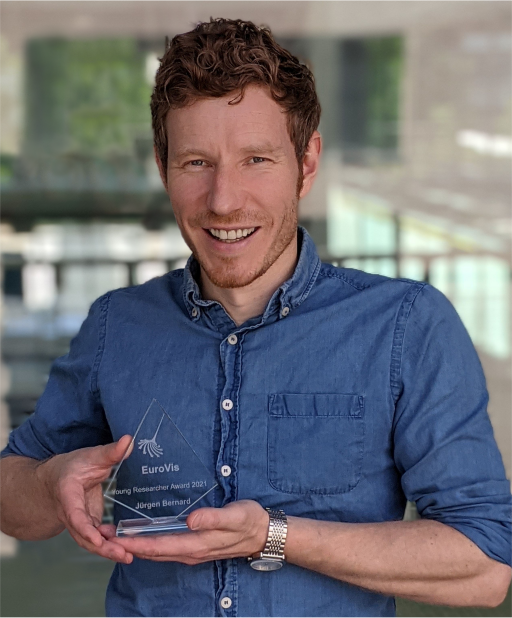
Jürgen Bernard is an Assistant Professor of Computer Science at the University of Zurich , leading the Interactive Visual Data Analysis (IVDA) Group . He is associated with the Digital Society Initiative (DSI) and holds a PhD in Computer Science from Technische Universität Darmstadt (2015) with a focus on time-oriented data analysis. His academic journey includes postdoctoral research at TU Darmstadt and the University of British Columbia. Education : Diploma in Computer Science (2009, TU Darmstadt) PhD in Computer Science (2015, TU Darmstadt) Research Interests : Dr. Bernard specializes in interactive visual data analysis , explainable machine learning , and human-centered AI . His work explores time series analysis , multivariate data exploration , and user-driven preference elicitation . He develops visual analytics systems for domains like healthcare , digital humanities , and industrial applications , with a particular focus on responsible AI and transparency in algorithmic systems . Research Trends : His publications emphasize interactive machine learning workflows , visual analytics for healthcare , and time-stamped event sequence analysis . Recent work includes LLM validation frameworks (Human-Data-Model Interaction Canvas) and personalized ranking systems funded by the Swiss National Science Foundation. He integrates temporal data with multivariate analysis across applications from medical manufacturing to chronic disease management . Scientific Recognition : EuroGraphics Young Researcher Award (2022) EuroVis Young Researcher Award (2021) Best Paper Awards at IEEE VIS (2021), EuroVA (2021, 2025) Dirk Bartz Prize (2017), Hugo-Geiger Preis (2016) Teaching & Grants : He teaches Interactive Visual Data Analysis (6 ECTS), Digital Health Seminars , and People-Oriented Computing . Currently leads a SNF Grant on Personalized Visual Analytics for multi-criteria decision support (2024-2028) with ETH Zurich's Prof. M. El-Assady.
Chao Liu is a Research Scientist at CNRS (French National Center for Scientific Research) since 2008, affiliated with the DEXTER team and the Department of Robotics, LIRMM at University of Montpellier, France. He earned his Ph.D. in Electrical & Electronic Engineering from Nanyang Technological University, Singapore (2006). Current research focuses on surgical robotics , haptics , teleoperation , and nonlinear control theory with applications in computer vision. His work addresses challenges in robotic-assisted telesurgery, including: Stable and transparent human-robot interaction through wave variable compensators and passivity filters Physiological motion compensation using spatio-temporal LSTM and dual Kalman filters EMG-based motion recognition for surgical skill assessment 3D soft-tissue reconstruction with stereo-endoscopes and deep learning Dr. Liu leads European and French projects like: TS2RT (CNRS-funded): Safer teleoperation with motion compensation ROBACUS (ANR-funded): Needle positioning with MPC control HaTUMoCo (CNRS-funded): Haptic teleoperation with uncertainty handling ARAKNES (EU-funded): Microrobotic systems for endoluminal surgery Scientific honors include Senior Member of IEEE and Member of Sigma Xi . He supervises Ph.D. and Master's students working on topics such as concentric tube robot optimization, haptic teleoperation, and EMG-based force estimation. Dr. Liu serves on IEEE Technical Committees for Telerobotics and Haptics , and as Technical Editor of IEEE/ASME Transactions on Mechatronics.
Professor David Ackerley (Victoria University of Wellington) is a leading microbiologist and enzyme engineer specializing in directed evolution of bacterial enzymes for biotechnological applications. As Biotechnology Programme Director since 2006, he lectures in foundational courses like BTEC101 and BTEC201. Academic rank: Professor of Biotechnology Institutional affiliation: Victoria University of Wellington Research focus areas: Microbial Biotechnology, Drug Discovery, Synthetic Biology His research employs Darwinian evolutionary principles to engineer enzymes with enhanced activities, particularly targeting non-ribosomal peptide synthetases and nitroreductases for antibiotic development and cancer therapy. Recent work explores metagenomic domain substitution in pyoverdine biosynthesis and Purpuramine R from marine sponges. Key publications demonstrate innovations in metagenomic library construction , CRISPR screening for regeneration genes, and structural characterization of engineered enzymes. His team has developed NTR 2.0 , a high-efficacy nitroreductase for targeted cell ablation. Current research projects include: Clean solutions from dirty genes: Plastic-degrading enzyme discovery Engineering enzymes for CAR T-cell-chemotherapy synergy Repurposing niclosamide against Gram-negative superbugs Grants from the Health Research Council of New Zealand, Royal Society of New Zealand, and Cancer Society of NZ support his work. Collaborations span biomedical research, synthetic biology, and environmental applications.
Elliot J. Crowley is a Senior Lecturer (Associate Professor) at the School of Engineering, University of Edinburgh, where he co-leads the Bayesian and Neural Systems research group. He serves as Programme Manager for Electronics and Electrical Engineering and has developed a comprehensive machine learning course for 4th year electronic engineering students at the University of Edinburgh. Dr. Crowley's research focuses on simplifying machine learning systems with specific expertise in automated machine learning, low-resource deep learning, and engineering applications of machine learning. His work bridges theoretical advances with practical implementations, particularly in neural architecture search and computer vision applications, with emphasis on making complex ML systems more accessible and efficient. His recent publications demonstrate significant contributions to neural architecture search spaces, training-free instance segmentation, and state space models for visual recognition, appearing in top venues including NeurIPS 2024, BMVC 2024, and AutoML 2025. These works show a consistent focus on developing practical ML solutions that can operate effectively in resource-constrained environments. Selected awards and grants: EPSRC New Investigator Award Investigator on the dAIEdge Horizon Network Co-investigator on the EPSRC AI Hub for Causality in Healthcare AI Dr. Crowley currently supervises several researchers including Postdoc Linus Ericsson and PhD students Miguel Espinosa, Shiwen Qin (with Shay Cohen), and Cameron Barker (with Henry Gouk). His former students include Chenhongyi Yang (now a Research Scientist at Meta) and Jack Turner (now a Software Engineer at Qualcomm). He actively seeks new PhD students with strong research proposals and available funding for UK students through CDTs. His research group, the Bayesian and Neural Systems group, focuses on developing practical machine learning solutions that can be deployed in resource-constrained environments, with particular emphasis on making complex ML systems more accessible to engineers and practitioners.