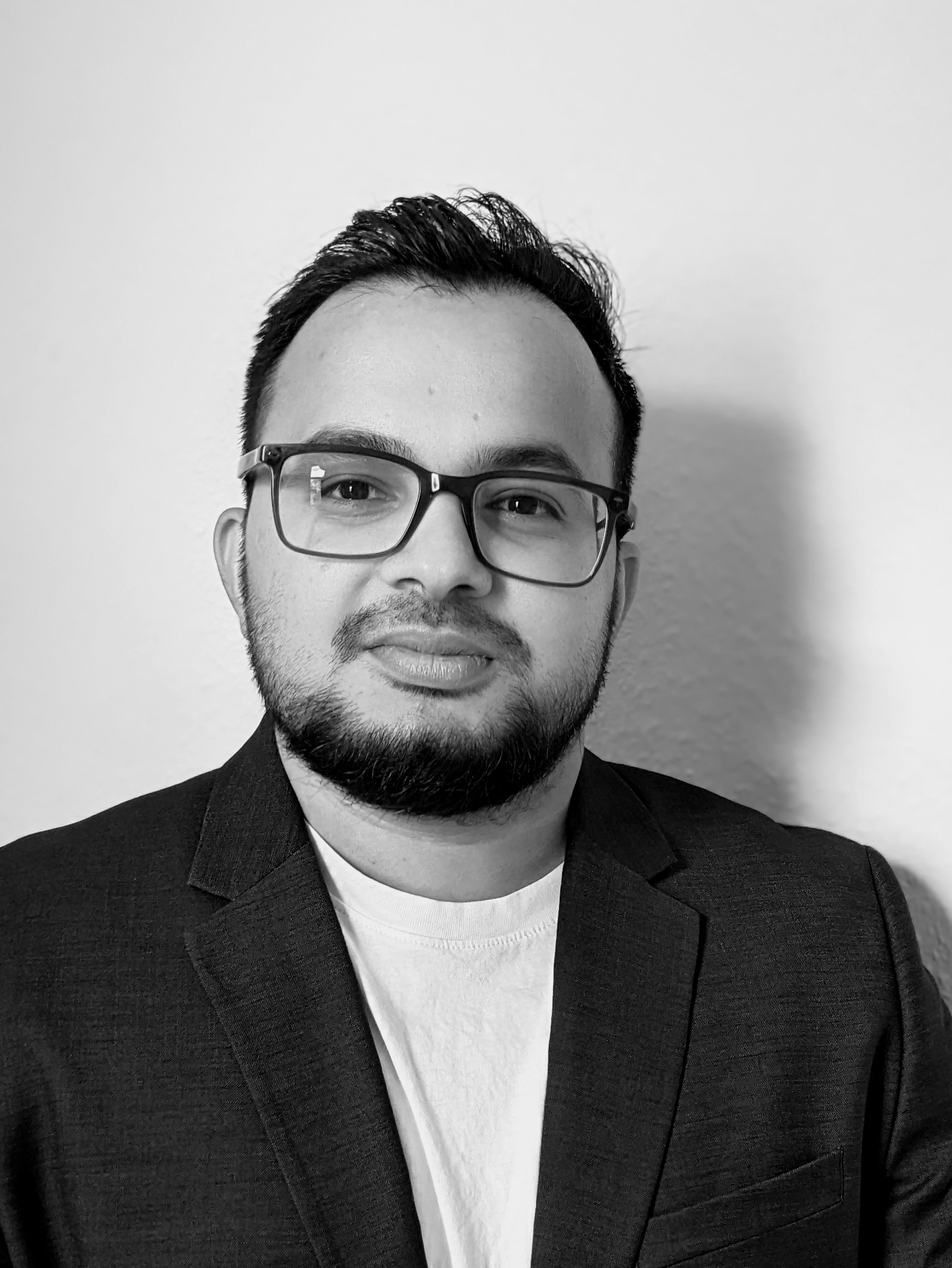
Shawkat K. Guirguis is an academic researcher with a focus on cybersecurity, machine learning, and IoT technologies. His work spans across intrusion detection systems, botnet prevention, and adaptive algorithms for network security. He has contributed to advancements in deep learning applications for social media analysis and real-time trajectory compression. His research often intersects with practical implementations in smart cities and healthcare authentication systems. Key areas of exploration include the use of boosting algorithms, tree-based models, and blockchain integration to enhance IoT security. His publications highlight contributions to wireless sensor networks and stock prediction models. Despite extensive research output, affiliations such as university or department remain unspecified in available records.
Dr. Hussein Mohammed is a Researcher and Head of the Visual Manuscript Analysis Lab at the University of Hamburg's Centre for the Study of Manuscript Cultures (CSMC). He leads the Cluster of Excellence 'Understanding Written Artefacts' (UWA) and the Visual Manuscript Analysis (VMA) Lab. His roles include Principal Investigator and Project Lead for initiatives like 'Similarity Measurement of Visual Patterns in Written Artefacts' and 'Pattern Recognition in 2D Data from Digitized Images.' He holds a doctoral degree (Dr. rer. nat.) in computer science from Hamburg University, focusing on computational analysis of handwriting styles. His research emphasizes pattern recognition, machine learning, and computer vision applied to historical manuscripts. Key projects include developing tools like the Pattern Analysis Software Tools (PAST), AFAT, and HAT to analyze visual features and aid cultural heritage preservation. His work bridges computer science and humanities, with contributions to palimpsest deciphering via generative AI, artifact feature analysis, and multimodal data integration. Notable awards include the Erasmus Mundus Scholarship (2012). He also contributes to academic outreach through lectures on computational paleography and manuscript digitization.
Alexander Nutz is a Researcher at the University of Freiburg's Department of Computer Science, affiliated with the Software Modeling and Verification Group. His primary research focuses on software model checking, satisfiability modulo theories (SMT), and Craig interpolation. He contributes to the development of verification tools such as SMTInterpol and the Ultimate Program Analysis Framework. Nutz has held teaching roles in courses like Automata Theory, Decision Procedures, and Program Analysis since 2012, collaborating extensively with colleagues on seminar leadership and course assistance. Education: PhD in Computer Science from the University of Freiburg (2019), focusing on 'Data Flow in Program Verification.' Professional activities include jury membership in the SV-COMP competition (2014-2016, 2018) and contributions to the AVACS research project. His work emphasizes program analysis, verification frameworks, and automated reasoning techniques. Research interests span formal methods, program analysis, and the application of SMT solving to real-world systems like smart contracts. Nutz's projects include enhancing verification tools for memory safety checks and integrating data flow graphs into verification processes. Key contributions: Development of Ultimate Kojak and Automizer tools, exploration of map abstraction techniques, and advancements in interpolation-based verification methods. His publications address challenges in non-linear arithmetic verification and automated reasoning for complex software systems.
Heinrich Hußmann is a Professor at Ludwig Maximilian University of Munich with an extensive research career spanning from 1985 to present. His work primarily focuses on Human-Computer Interaction, with significant contributions to Virtual Reality, Tangible User Interfaces, and intelligent systems. Over his career, he has published nearly 250 papers in top-tier conferences and journals. His research interests center around understanding and improving human interaction with emerging technologies. Key focus areas include cinematic virtual reality experiences, tangible interfaces for education and collaboration, privacy in mobile contexts, and user understanding of intelligent systems. His work often bridges theoretical HCI principles with practical applications that address real-world user needs. Analysis of his recent publications (2020-2023) reveals a strong emphasis on tangible interaction for educational contexts, particularly for children's learning. He has also made significant contributions to understanding social aspects of cinematic virtual reality and developing frameworks for user understanding of AI systems. His work consistently demonstrates a user-centered approach that considers psychological, social, and technical dimensions of interaction. Professor Hußmann has mentored numerous students who have become active researchers in the HCI field, including Sarah Theres Völkel, Malin Eiband, and Daniel Buschek, among others. His collaborative network spans multiple institutions and disciplines, reflecting the interdisciplinary nature of modern HCI research. His research has practical implications for the design of more intuitive, privacy-respecting, and educationally effective interactive systems. Current projects suggest continued exploration of how physical and digital elements can be integrated to create meaningful user experiences that support learning, collaboration, and mindful technology use.
J. Edward Swan II is a Professor in the Department of Computer Science and Engineering at Mississippi State University. His research focuses on Augmented Reality (AR), Virtual Reality (VR), and Human-Computer Interaction (HCI), with an emphasis on perceptual aspects of AR/VR systems, calibration techniques, and user experience optimization. He has contributed extensively to advancing AR/VR technologies through studies on depth perception, text legibility, and system accuracy. Key roles: IEEE VR Steering Committee member, conference program chair, and guest editor for top journals. Research areas include optical see-through AR systems, user performance evaluation, and spatial perception in virtual environments. His work spans over 120 publications since 1995, with recent contributions addressing font optimization for AR displays, eye-tracking-based depth measurement, and X-ray vision systems for situational awareness. Notable recognition includes the VGTC Virtual Reality Service Award (2023).
Florian Nouviale is a researcher specializing in virtual reality (VR), human-computer interaction, and collaborative systems. His work spans applications in medical training, historical reconstruction, and industrial design. He has collaborated extensively with institutions and researchers in France, focusing on projects such as the development of wheelchair simulators for rehabilitation and frameworks for no-code interactive applications. Key contributions include EvoluSon (an interactive music history platform) and Xareus (a no-code VR framework). His research emphasizes usability, user-centered design, and interdisciplinary collaboration. Research Interests: Virtual Reality Applications in Medicine and Rehabilitation Collaborative Systems and Frameworks for Interactive Environments Historical and Cultural Heritage Visualization Non-Verbal Communication and Emotional Expression in VR Publications: Focus on VR frameworks, medical simulators, and interactive systems, with a trend toward user-centered design and accessibility. Recent work explores emotional expression through body postures and no-code development tools.
Dr. Andrey Sobolev is a PostDoc researcher at the Faculty of Biology, Ludwig Maximilian University of Munich, affiliated with the Benedikt Grothe Research Group. His work focuses on neurophysiological data management, electrophysiological data handling, and neural systems analysis. Key contributions include developing the Neo Python library for electrophysiology data handling and the G-Node Python Client for reproducible research workflows. Research interests span computational neuroscience, data management systems, and behavioral paradigms in freely moving animals. Notable publications include studies on hippocampal ensemble remapping under sensory conflicts (2021), the Sensory Island Task behavioral paradigm (2020), and metadata standards in neurophysiology (2016). Technical contributions include creating integrated platforms for electrophysiological data storage (2014) and foundational database systems for biomedical applications (2011). Collaborates widely with neuroscientists and software engineers to advance open science practices in neuroscience research.
Richard Bubel is a Researcher in the Software Engineering group at Technische Universität Darmstadt. His work focuses on formal methods, deductive verification, and automated theorem proving with applications in software engineering and smart contract development. He has contributed to the KeY verification tool and is involved in projects like SF 4.0 and KeY's development. Bubel has participated in numerous academic committees and reviewing activities, including roles in TASE, FMSPLE, and the KeY Symposium. His research interests span formal specification, program analysis, and security, with a particular emphasis on ensuring software reliability through rigorous verification techniques. His affiliations include: Technische Universität Darmstadt, Department of Computer Science KeY Project (main developer and coordinator) European research initiatives (EU FP7, COST IC0701) Research Interests: Formal methods, deductive verification, automated theorem proving, software engineering, smart contracts, and program analysis. Key contributions include the development of the KeY verification tool, formalization of Java strings, and work on trace-based verification. His community involvement includes organizing conferences and workshops, such as the KeY Symposium and HATS Annual Meeting.
Michael Haustermann is a Researcher at the University of Hamburg's Faculty of Informatics, within the Theoretical Foundations Group. His work focuses on Petri net-based modeling tools, software engineering methodologies, and domain-specific languages. He contributes to the development of the Renew toolset for Petri net modeling and simulation, emphasizing formal methods and their application in collaborative systems. His research spans IoT architectures, agent-oriented software systems, and education technologies like adaptive testing frameworks (VideoFOS and FormAdTe). He has published extensively on Petri net applications in concurrency, software engineering, and system design, collaborating with institutions globally. Current projects include advancing Petri net tools for model-based development and exploring edge computing architectures.
Dr. Hariprasath Ganesan is a Senior Scientist at the Research Center Jülich, affiliated with the Institute for Advanced Simulation (IAS) and the Materials Data Science and Informatics (IAS-9) department. His expertise spans Atomistic Simulations, Nanomechanics, and Materials Informatics, focusing on computational modeling of materials' behavior under extreme conditions. He leads research into high-temperature deformation mechanisms in advanced alloys like TiAl, leveraging multiscale simulation techniques such as molecular dynamics and Monte Carlo methods. His work emphasizes GPU-accelerated computational approaches for atomistic simulations, improving efficiency in studying solute segregation, interface dynamics, and thermal-mechanical properties. Recent studies include ultrafast laser-material interactions and creep behavior in nanomaterials. Collaborations bridge theoretical models with practical applications in materials design and additive manufacturing. Publications highlight contributions to understanding lamellar interface stability, Cottrell atmosphere formation, and parallel computing frameworks for scale-bridging simulations. His research aligns with Helmholtz energy and materials science initiatives, advancing computational tools for next-generation materials discovery.
Björn Fiedler is a Lecturer at Leibniz Universität Hannover's Department of Computer Science, specializing in Real-Time Systems and Operating System Engineering. He leads the SRA Group and focuses on static analysis, compiler optimization, and embedded systems specialization. His work emphasizes improving non-functional properties of system software through automated hardware abstraction and compiler-driven specialization. Education: PhD in Computer Science (Leibniz Universität Hannover, 2023). Research Interests: Real-Time Operating Systems (RTOS), multi-core specialization, system call optimization, static analysis, and compiler frameworks like ARA. His projects include AHA (Automated Hardware Abstraction) and MultiSSE, targeting performance and predictability in embedded and real-time systems. Publications: Focus on static analysis techniques, RTOS optimization, and compiler-driven system specialization. Notable work includes ARA's whole-system compiler framework and the MultiSSE syscall elision method. Awards: Best Paper Award at OSPERT 2018 Advising: Supervised 8+ theses on topics like static system object instantiation, sparse data structures, and FreeRTOS kernel specialization. Active in grant projects funded by DFG (e.g., AHA: LO 1719/4-1). Labs/Teams: Core member of the SRA Group, collaborating on projects involving LLVM-based compilation, embedded RTOS development, and real-time system analysis.
Leif Bonorden is a Research Associate and Doctoral Student at the Department of Informatics, Faculty of Mathematics, Computer Science and Natural Sciences, University of Hamburg. He works within the Software Engineering and Construction Methods research group led by Professors Matthias Riebisch and André van Hoorn. His academic background includes a B.Sc. and M.Sc. in Mathematics from Technische Universität Berlin (2010-2018), with thesis work in Probability Theory and Functional Analysis. Since 2019, he has been pursuing doctoral research at the University of Hamburg while also studying for an M.A. in Higher Education. 2010-2018: Student, B.Sc. and M.Sc. Mathematics, Technische Universität Berlin 2012-2015: Student Teaching Assistant, Software Engineering group, TU Berlin 2015-2017: Assistant Researcher, FZI Forschungszentrum Informatik 2019-present: Research Associate & Doctoral Student, University of Hamburg 2020-present: M.A. Higher Education student, University of Hamburg Bonorden's research centers on API evolution and deprecation processes, with particular focus on how deprecated web APIs can be detected through tracing techniques. His work bridges theoretical software engineering with practical applications in API design and documentation. He has developed expertise in systematic mapping studies of API deprecation practices and their impact on software maintenance. His publication record demonstrates consistent focus on API-related research, with multiple systematic studies and empirical analyses. He has also contributed significantly to software reengineering knowledge through the SREBOK initiative and explored innovative educational approaches for teaching software engineering concepts through research-based learning. Active member of Software Engineering and Construction Methods research group Contributor to German Informatics Society's software reengineering special interest group Member of ACM, GI (Gesellschaft für Informatik), and DMV professional organizations Bonorden serves on multiple university committees including the Committee for Teaching and Studies, Building Committee, Faculty Council, and various examination boards for computer science programs. His teaching portfolio includes Software Design, Introduction to Software Engineering, and Bachelor Seminars in Software Engineering at both University of Hamburg and TU Berlin.
Florian Kern is a PhD candidate in Human-Computer Interaction at the University of Würzburg, supervised by Prof. Marc Erich Latoschik. He holds an M.Sc. in Computer Science focusing on HCI (2018). His research centers on Extended Reality (XR), particularly text input methods, surface alignment for handwriting/sketching, and VR applications in rehabilitation. Key projects include the Off-The-Shelf Stylus framework for XR interaction and the Reality Stack I/O modular framework for cross-platform XR development. Research Interests: XR Interaction: Handwriting/sketching in VR/AR, physical-virtual surface alignment. Rehabilitation Technology: VR-based gait training (e.g., Homecoming application for MS/stroke patients). Framework Design: Cross-platform tools like Reality Stack I/O, modular animation pipelines. User Experience: Evaluating input techniques, sketching behavior, and usability in immersive systems. Publications emphasize technical innovations (e.g., stylus calibration, surface refinement) and interdisciplinary applications (e.g., healthcare VR). Collaborations span HCI, psychology, and engineering departments.
Dr. Sebastian Kuckuk is a researcher and head of training at the Erlangen National High Performance Computing Center (NHR@FAU), Friedrich-Alexander-Universität Erlangen-Nürnberg. He is affiliated with the Department of Computer Science and contributes to the Chair of System Simulation. His work bridges research, training, and software development in high-performance computing. Education: PhD in Computer Science, Friedrich-Alexander-Universität Erlangen-Nürnberg (2019) His research focuses on enhancing performance portability and programmer productivity using domain-specific languages, code generation, automatic parallelization, and GPU programming. These techniques are applied to develop massively parallel numerical solvers for computational fluid dynamics, particularly for the shallow water equations. He is a core developer of the ExaStencils framework, which enables automated generation of efficient multigrid solvers for structured and patch-structured grids. Analysis of his recent publications (2020–2025) reveals a consistent focus on code generation, GPU acceleration, and solver optimization for fluid dynamics problems. Key themes include heterogeneous computing, block-structured grids, and adaptive methods. His work integrates advanced compiler techniques with numerical mathematics to improve scalability and performance on modern HPC architectures. Scientific Recognition: NVIDIA Deep Learning Institute (DLI) University Ambassador Certified Instructor for DLI courses in GPU programming and CUDA He actively contributes to teaching and training through courses such as Programming Techniques for Supercomputers and High-End Simulation in Practice . He conducts workshops and tutorials on GPU programming and performance optimization. While no formal students are listed, his mentoring role is evident through collaborative research and training activities. He has no recorded grants in the provided text, but his involvement in NHR and KONWIHR projects indicates active participation in funded HPC initiatives. Laboratories and Projects: Lead developer of ExaStencils , a code generation framework for multigrid solvers Contributor to GHODDESS , a module for higher-order discretizations in shallow water modeling Active in NHR@FAU and KONWIHR projects focused on GPU computing and performance optimization
Sarath Menon is a computational materials scientist at Ruhr-University Bochum and Max-Planck-Institut für Eisenforschung GmbH. His work focuses on atomistic simulations, machine learning interatomic potentials, and thermodynamic property calculations. He contributes to open-source software like pyiron and pace. Doctor of Engineering, Mechanical Engineering (2021) Master of Science, Materials Science and Simulation (2018) Bachelor of Technology, Mechanical Engineering (2012) His research centers on developing machine learning potentials for thermodynamic modeling, with applications in phase diagrams and nucleation studies. He employs methods like transition path sampling and hyperdynamics. Menon teaches Python programming, electronic structure methods, and atomistic simulation techniques. He has organized workshops on reproducible workflows and quantum mechanics in solid-state physics. Key software contributions include: pyscal : Structural analysis tool for atomic environments pace : High-performance Atomic Cluster Expansion implementation calphy : Free energy calculation library atomRDF : Ontology-based structure manipulation