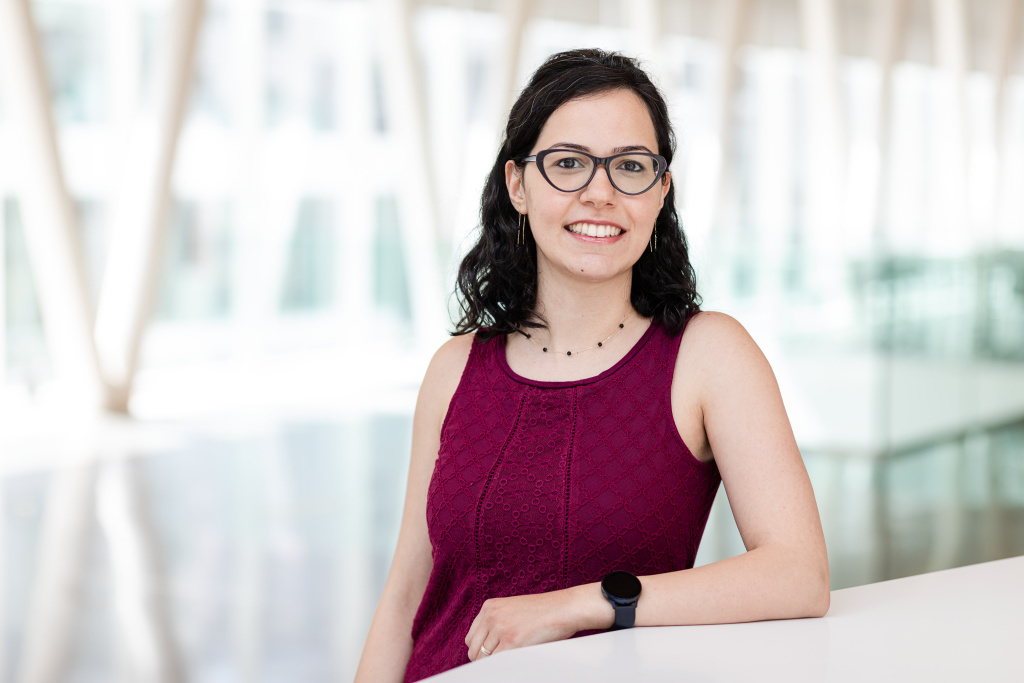
Georges Kaddoum is a Professor at École de technologie supérieure (ÉTS) , specializing in Electrical Engineering. He holds the Canada Research Chair in Unlocking the Power of IoT 6G-Networks and the LACIME – Communications and Microelectronic Integration Laboratory affiliation. His work bridges wireless communications, IoT, and machine learning. Research Interests include wireless communication systems, physical layer security, machine learning for networking, and 6G technologies. He focuses on optimizing network performance in challenging environments (impulsive noise, underwater, non-terrestrial networks) and developing AI-driven solutions for jamming mitigation, resource allocation, and secure IoT frameworks. Recent Publications highlight 6G-enabled vehicular networks, quantum-safe blockchain integration, federated learning for transportation systems, and deep learning-based receivers for chaotic communication systems. His work emphasizes semantic communication, interference management, and digital twin applications. Awards IEEE TCSC Award for Excellence in Scalable Computing (2022) Prix d’excellence de la relève (Université du Québec, 2018) Prix d’excellence en recherche (ÉTS, 2018) Multiple IEEE Exemplary Reviewer and Best Paper Awards (2014–2022) Supervision includes 15+ PhD/Master’s students working on topics like index modulation, physical layer security, UAV communications, and intelligent resource management. Research Units Ultra Research Chair on Intelligent Tactical Wireless Networks LACIME Laboratory Canada Research Chair in IoT 6G-Networks
Dr. Azadeh Ghari-Neiat is a Senior Lecturer in Software Engineering at the University of Queensland's School of Electrical Engineering and Computer Science. She completed her PhD in Computer Science from RMIT University in 2018. Prior to joining UQ, she held academic positions at Deakin University as a Senior Lecturer and at the University of Sydney as a postdoctoral research fellow. Her research focuses on the intersection of Internet of Things (IoT), Mobile Computing, Crowdsourcing, and Cybersecurity. She develops innovative solutions for enhancing connectivity and security in modern computing environments through crowdsourced approaches. Key areas include service composition in sensor clouds, trust management frameworks, and optimization of drone-as-a-service systems. Her publications demonstrate consistent focus on IoT service ecosystems, with recent work exploring blockchain applications and machine learning techniques for dynamic systems. The research trends show evolution from fundamental service composition to AI-driven optimization in distributed environments. Dr. Ghari-Neiat leads projects involving energy service crowdsourcing and secure architectures for cyber-physical systems. Her work maintains strong emphasis on practical applications in delivery systems, UAV networks, and IoT marketplaces.
Prof. Andrew Zhang is a Professor at the School of Electrical and Data Engineering, University of Technology Sydney (UTS). He leads the UTS Radio Sensing and Pattern Analysis (RaSPA) Lab and serves as Technical Director of the UTS-TPG Network Sensing Lab. His research focuses on integrated sensing and communications (ISAC), wireless signal processing, and autonomous vehicular networks. He holds a PhD from the Australian National University and has over 15 years of industry experience, including roles at CSIRO and ZTE Corp. Education: B.S. (Xi’an Jiaotong University), M.Sc. (Nanjing University of Posts and Telecommunications), Ph.D. (Australian National University). Research Interests: ISAC, radio sensing, machine learning for communications, and 6G waveform design. Key projects include developing perceptive mobile networks and flood/storm sensing via ISAC. Publications: Over 290 papers, 5 patents, and notable works on ISAC frameworks, joint communication-sensing systems, and mmWave technologies. Recent trends emphasize ISAC, 6G waveforms, and IoT integration with federated learning. Awards: CSIRO Chairman’s Medal, Australian Engineering Innovation Award, and multiple best paper awards. Active in IEEE leadership roles, including Editor-in-Chief of ISAC-Focus. Grants: ~$8M in research funding. Advises on ISAC-ETI initiatives and collaborates with industry partners like TPG Telecom. Labs: RaSPA Lab (radio sensing analytics) and UTS-TPG Lab (ISAC industrial solutions).
Zixiang Xiong is a Professor and Associate Department Head in the Department of Electrical and Computer Engineering at Texas A&M University, holding the Robert M. Kennedy '26 Endowed Professorship II. He earned his Ph.D. in Electrical Engineering from the University of Illinois at Urbana-Champaign in 1996. His career includes roles at Princeton University, University of Hawaii, and Texas A&M since 1999. Education: Ph.D., Electrical Engineering, University of Illinois at Urbana-Champaign, 1996 Visiting Research Associate, Princeton University, 1995–1997 University of Hawaii, 1997–1999 Research Interests: Focuses on machine learning, image/video processing, federated learning, network information theory, biomedical engineering, and communications. His work spans distributed source coding, genomic signal processing, and energy-efficient systems. Publications & Awards: Over 200 publications, including seminal works on distributed video coding and network information theory. Notable awards include the NSF Career Award (1999), ONR Young Investigator Award (2001), IEEE Fellow (2006), and the ECE Outstanding Faculty Award (2024). His research has led to patents in video compression and multimedia systems. Grants & Advising: Active in NSF-funded projects on coding theory and energy-delay tradeoffs. Advises numerous PhD and MS students, with over 50 alumni in academia and industry. Collaborates on biomedical imaging, remote sensing, and federated learning initiatives. Labs & Teams: Leads a dynamic research group at Texas A&M, focusing on cutting-edge projects in signal processing and machine learning applications. Collaborates with industry and governmental agencies on applied research.
Dr. Wenjuan Yu is a Lecturer at the School of Computing and Communications (SCC), InfoLab21, Lancaster University, UK. She holds a PhD in Communication Systems from Lancaster University and has held prior roles, including Research Fellow at the 5G Innovation Centre (5GIC), University of Surrey (2018–2020), and part-time Research Officer at the University of Essex (2017–2018). She is a Fellow of the Higher Education Academy and a Senior Member of IEEE. Her research focuses on communication systems, with emphasis on radio resource management, mMTC, low-latency communications, B5G/6G, MEC, and machine learning. She actively contributes to IEEE conferences as a Technical Program Committee (TPC) member and holds editorial roles, including Executive Editor for Transactions on Emerging Telecommunications Technologies (2019–2022). Current teaching includes CNSCC141 Professionalism in Practice and CNSCC365 Advanced Networking . Dr. Yu supervises PhD students in EE/CS, particularly welcoming applicants from China via CSC scholarships. Her projects include DSI-funded initiatives on sustainable AI-driven resource allocation for 6G and Smart Multi-RAT Traffic Steering for V2X systems. She leads research groups in Security Lancaster (Networks, Systems, Distributed Systems).
Mohamed-Slim Alouini is a Professor of Electrical Engineering and Associate Dean of the Computer, Electrical and Mathematical Science and Engineering (CEMSE) Division at King Abdullah University of Science and Technology (KAUST) in Saudi Arabia. He also serves as the Associate Vice President for Research and holds the UNESCO Chair in Education to Connect the Unconnected. With over 500 journal publications and more than 46,000 citations, he is a world-renowned expert in wireless communications who was elected IEEE Fellow in 2009 at the age of 39. Education: PhD in Electrical Engineering, California Institute of Technology (Caltech), 1998 MS in Electrical Engineering, Georgia Institute of Technology (Georgia Tech), 1995 Diplôme d'Etudes Approfondies (DEA) in Electronics, Université Pierre & Marie Curie (Sorbonne University), 1993 Diplôme d'Ingénieur, École Nationale Supérieure des Télécommunications (Télécom Paris Tech), 1993 Habilitation, Université Pierre & Marie Curie (Sorbonne University), 2003 Dr. Alouini is a world-renowned expert in wireless communication and networking with research interests spanning diversity combining techniques, MIMO systems, multi-hop/cooperative communications, optical wireless systems, cognitive radio, UAV communications, and advanced modulation schemes. His current focus addresses the technical challenges of uneven information and communication technology distribution, particularly targeting rural, low-income, disaster-prone, and hard-to-reach areas through integrated ground-airborne-space networks. His work bridges theoretical foundations with practical implementations to solve real-world connectivity problems. His recent publications (2020-2024) demonstrate a clear research trajectory toward integrated communication networks combining terrestrial, aerial, and space components. There's growing emphasis on UAV communications, satellite systems, optical wireless technologies, and rural connectivity solutions, with increasing integration of machine learning techniques for network optimization. His work shows consistent focus on addressing the digital divide, with several publications specifically targeting 6G challenges for connecting underserved populations and recycling existing infrastructure for enhanced rural connectivity. Scientific Awards: Member of the European Academy of Sciences and Arts (2019) Fellow of the African Academy of Sciences (2018) IEEE Fellow (2009) Abdul Hameed Shoman Award for Arab Researchers (2016) OIC Science & Technology Achievement Award (2017) Multiple recognitions as Highly Cited Researcher NSF CAREER Award (1999) Dr. Alouini has mentored numerous successful students and post-doctoral fellows who have secured positions at top institutions worldwide including Harvard, Caltech, Imperial College, and faculty positions at Korea University, Hanyang University, and universities across the Middle East. His December 2018 PhD graduate Qurrat-Ul-Ain Nadeem received the prestigious Marconi Society Paul Baran Young Scholars award, while post-doctoral fellows have won IEEE ComSoc Young Professionals Best Innovation Award and attended the Lindau Nobel Meeting. His Communication Theory Lab at KAUST drives significant research in wireless communications with funding supporting extensive publication output and innovative projects. Dr. Alouini leads the Communication Theory Lab at KAUST and holds the UNESCO Chair in Education to Connect the Unconnected, focusing specifically on technical solutions for connecting underserved communities. His lab works on integrated ground-airborne-space networks to bridge the digital divide, with particular emphasis on rural, low-income, and hard-to-reach areas. The team develops practical solutions using UAVs, satellite communications, and recycled infrastructure to provide cost-effective connectivity where traditional approaches fail.
Dr. Erma Perenda serves as Professor and Chair of Distributed Signal Processing at RWTH Aachen University, Germany, leading research within the Department of Distributed Signal Processing. Her contact details include email perenda@dsp.rwth-aachen.de and phone +49 241 80-27879, with office location at Kopernikusstraße 16, 52074 Aachen in the ICT Cubes facility. Her research spans: Distributed Signal Processing Wireless Communications Machine Learning (Deep Reinforcement Learning, Federated Learning) Modulation Classification AI-driven Network Optimization She focuses on solving real-world challenges in wireless systems including hardware impairments, channel variations, and energy efficiency through advanced AI techniques. Analysis of her 2018-2024 publications reveals consistent innovation in applying multi-agent deep reinforcement learning to wireless power allocation, developing robust modulation classification methods resilient to channel impairments, and implementing federated learning for industrial edge computing. Her work bridges theoretical machine learning with practical wireless communication constraints. Scientific Awards: No awards documented in available sources Advising and Grants: No student advisees or grant information provided Labs and Teams: Leads Distributed Signal Processing research group at RWTH Aachen University Based in ICT Cubes building focusing on wireless AI systems
Mohammad Ali Salahuddin is a Research Assistant Professor at the David R. Cheriton School of Computer Science, University of Waterloo , specializing in networking and machine learning. He holds a Ph.D. in Computer Science from Western Michigan University (2014), with prior academic roles at Université du Québec à Montréal and Concordia University. His research spans 5G network slicing, vehicular networks, and secure content delivery systems. Education: Ph.D. (2014, Western Michigan University); M.S. (2003, Western Michigan University); M.S. (2001, SZABIST); B.S. (1999, FAST-NUCES) Dr. Salahuddin's research focuses on 5G/6G network softwarization , autonomous threat mitigation , and machine learning for network management . His work integrates reinforcement learning and federated learning for scalable solutions in SDN/NFV , IoT , and edge computing . Recent studies address data drift in encrypted traffic classification and DDoS detection using outlier exposure-based federated learning . He has received multiple best paper awards at IEEE/IFIP NOMS (2023, 2022), IEEE CNOM (2021), and Kenneth C. Sevcik Outstanding Student Paper Award (ACM SIGMETRICS, 2021). His NSF-funded projects include vehicular cloud resource management and localization techniques. Dr. Salahuddin actively contributes to academic service as Vice-Chair of IEEE KW Section's Communications Society and TPC member for top conferences.
Yan Kyaw Tun is a Tenure Track Assistant Professor in the Department of Electronic Systems at Aalborg University's Technical Faculty of IT and Design, located in Copenhagen, Denmark. His research lies at the intersection of wireless communications, edge computing, and artificial intelligence, with a strong focus on next-generation networks (5G/6G), UAV-assisted systems, and intelligent resource management. His educational background includes a Ph.D. in Computer Engineering from Kyung Hee University, South Korea, where he was awarded the Best Ph.D. Thesis Award in 2021, and a Bachelor of Engineering in Marine Electrical Systems and Electronic Engineering from Myanmar Maritime University. Dr. Tun's research interests span Edge Computing , Multi-Access Edge Computing (MEC) , Resource Allocation , Unmanned Aerial Vehicles (UAVs) , Reinforcement Learning , Energy Efficiency , and Integrated Sensing and Communication (ISAC) . His work leverages AI and optimization techniques to enhance the performance of wireless networks, particularly in space-air-ground integrated systems and satellite-HAP environments. The recent publications highlight a clear trend toward intelligent and sustainable networking: the integration of STAR-RIS (Simultaneously Transmitting and Reflecting Reconfigurable Intelligent Surfaces), Federated Learning for satellite-HAP systems, and AI-driven optimization for UAV trajectories and beamforming. These works are published in high-impact venues such as IEEE Transactions on Mobile Computing and IEEE ICC , showcasing his leadership in cutting-edge communication technologies. His scientific accolades include: IEEE ComSoc Outstanding Young Researcher Award for EMEA Region (2024) Best Ph.D. Thesis Award (2021) Student Best Paper Award at APNOMS 2019 Korea Network Operation and Management Conference Award (2020) Korea Computer Congress 2018 Award Dr. Tun is actively engaged in the academic community as an advisor and grant participant. Though no direct advisees are listed, his involvement in large collaborative projects—evidenced by co-authorship with senior researchers like Prof. Choong Seon Hong—indicates mentorship and team leadership. He has served on the editorial boards of IEEE Internet of Things Journal , IEEE Open Journal of the Communications Society , and IEEE Network , and has secured research support through participation in IEEE-organized workshops and special issues. He is a key organizer of upcoming workshops, including the 'Sustainable AI for Next-Generation Wireless Communications and Networking' at IEEE GLOBECOM 2025 and the 'Digital Twin Networks' workshop at IEEE/CIC International Communications in China 2025, reflecting his role in shaping future research directions in intelligent and green networking.
Prof. Dr. Haris Gačanin is a faculty member at RWTH Aachen University, affiliated with the Institute for Distributed Signal Processing under the College of Electrical Engineering. His research focuses on integrating machine learning with wireless communication systems, particularly in industrial IoT, edge computing, and network optimization. Current academic rank: Professor Contact: harisg@dsp.rwth-aachen.de Research Interests: Wireless systems, machine learning, signal processing, and network optimization. Key contributions include: Adaptive resource allocation in IIoT and vehicular networks AI-driven channel estimation and feedback mechanisms Security-oriented emitter identification via metric learning Federated/transfer learning for edge environments Hardware-efficient deep learning models for mmWave and THz communications Methodological Focus: Combines reinforcement learning, attention mechanisms, and robust neural architectures with practical implementations on FPGA and vehicular systems.
Pietro Manzoni is a Professor of Computer Engineering at the Polytechnic University of Valencia (UPV), Spain. He holds a Master's from the University of Milan (1989) and a Ph.D. from Politecnico di Milano (1995). His research focuses on IoT, edge computing, and wireless networks, with emphasis on TinyML, LPWAN, and edge-cloud systems. He coordinates the Computer Networks Research Group (GRC) and is active in IEEE committees. Education includes a Master's in Computer Science (Università degli Studi di Milano, 1989) and a Ph.D. in Computer Science (Politecnico di Milano, 1995). He interned at Bellcore Labs (USA, 1992–1993) and ICSI (USA, 1994). Research interests span IoT applications, resource-constrained devices, and distributed systems. His work prioritizes empirical validation through prototypes. Teaching includes courses on Networks and Security, Intelligent IoT Systems, and IoT fundamentals in Spanish programs. Publications emphasize IoT protocols, UAV swarms, and TinyML. No scientific awards listed, but over 130 theses advised. Coordinates GRC projects and contributes to editorial boards and conferences.
Diala Naboulsi is a Professor at the École de technologie supérieure (ÉTS) in the Department of Software Engineering and IT. Her research focuses on mobile networks, wireless systems, and cybersecurity, with a strong emphasis on machine learning applications in network optimization. She holds an M.Eng. from the Lebanese University and M.Sc. and Ph.D. degrees from INSA Lyon. Research Units: Summit Tech Research Chair, LASI Lab, Imagin Lab Expertise: Network virtualization, resource allocation, mobility management, UAV-based computing Her work spans resilience in wireless backhaul networks, energy-efficient frameworks in RAN slicing, and federated learning for privacy-aware traffic forecasting. She has advised numerous doctoral students, including Ahmed Abdelmoaty, Hnin Pann Phyu, and Philippe Lavoie. Key contributions include deep reinforcement learning approaches for network topology optimization and UAV-assisted MEC systems for Industry 5.0. Recent publications highlight advancements in 6G networks, network slicing, and edge computing. Her research aligns with strategic initiatives in sustainable and secure communication systems.
Marcello Pietri is a Researcher (td art. 24 c. 3 lett. A) and Contract Professor at the Department of Engineering Sciences and Methods (DISMI) at the University of Modena and Reggio Emilia. His work focuses on Information Processing Systems, with expertise in IoT, Edge Computing, and Digital Twins. He teaches courses like 'Sistemi Informativi' (Information Systems) for the Engineering Management program, emphasizing database design, SQL, and web application development with Python. His research explores advanced topics including Digital Twin integration in Industry 5.0, Fluid Computing in IoT ecosystems, and Smart City data fusion using 5G MEC architectures. He collaborates with institutions like the DIPI Lab (Distributed and Pervasive Intelligence Group), contributing to projects on telecom security, energy forecasting, and human-centric manufacturing systems. Recent publications highlight innovations in operator digital twins for workplace well-being, distributed data mesh models for IoT-edge-cloud systems, and adaptive monitoring algorithms for large-scale cloud environments. His work bridges theoretical advancements with practical implementations, addressing challenges in scalability, real-time data processing, and interdisciplinary collaboration.
Professor Javid Taheri is a leading academic at Karlstad University (2019–present), previously serving as Associate Professor (2015–2019) and Senior Lecturer (2015). His research focuses on cloud computing, edge computing, distributed systems, and AI-driven networking. He holds a Ph.D. in Information Technologies from The University of Sydney (2007) and an M.Sc./B.Sc. in Electrical Engineering from Sharif University of Technology (2000/1998). Research interests include cloud-edge continuum systems , resource optimization , 5G/6G networking , and AI for IoT . Notable contributions include frameworks like PerfSim (microservice performance simulation) and MultiScaler (auto-scaling for cloud applications). Publications highlight innovations in edge computing optimization, security for distributed systems, and machine learning for resource management. He has co-authored over 150 papers across top venues like IEEE Transactions and ACM conferences. Academic leadership includes roles as conference chair (IC2E 2023) and editorial work for journals on cloud and edge computing.
Adlen KSENTINI is a Professor at EURECOM's Communication Systems department, specializing in advanced networking technologies. His research focuses on Mobile and Wireless Networks, Software Defined Networking (SDN), Mobile Edge Computing (MEC), Network Function Virtualization (NFV), and Content Delivery Networks (CDN), with an emphasis on performance evaluation and network virtualization. He has contributed to projects like AC3 and 6G-BRICKS, exploring cloud-edge continuum integration and 6G infrastructure. Key research interests include virtualized mobile core networks, carrier cloud systems, and AI-driven network management. He has received Best Paper Awards at IEEE WCNC 2018 and IWCMC 2016 for works on network slicing and LTE modeling accuracy. His work often integrates machine learning for optimization, sustainability, and security in 5G/6G networks. Distinctions: Two Best Paper Awards Labs/Teams: Involved in EU-funded projects like AC3 and 6G-BRICKS Grants: Not explicitly listed, but active in collaborative research initiatives