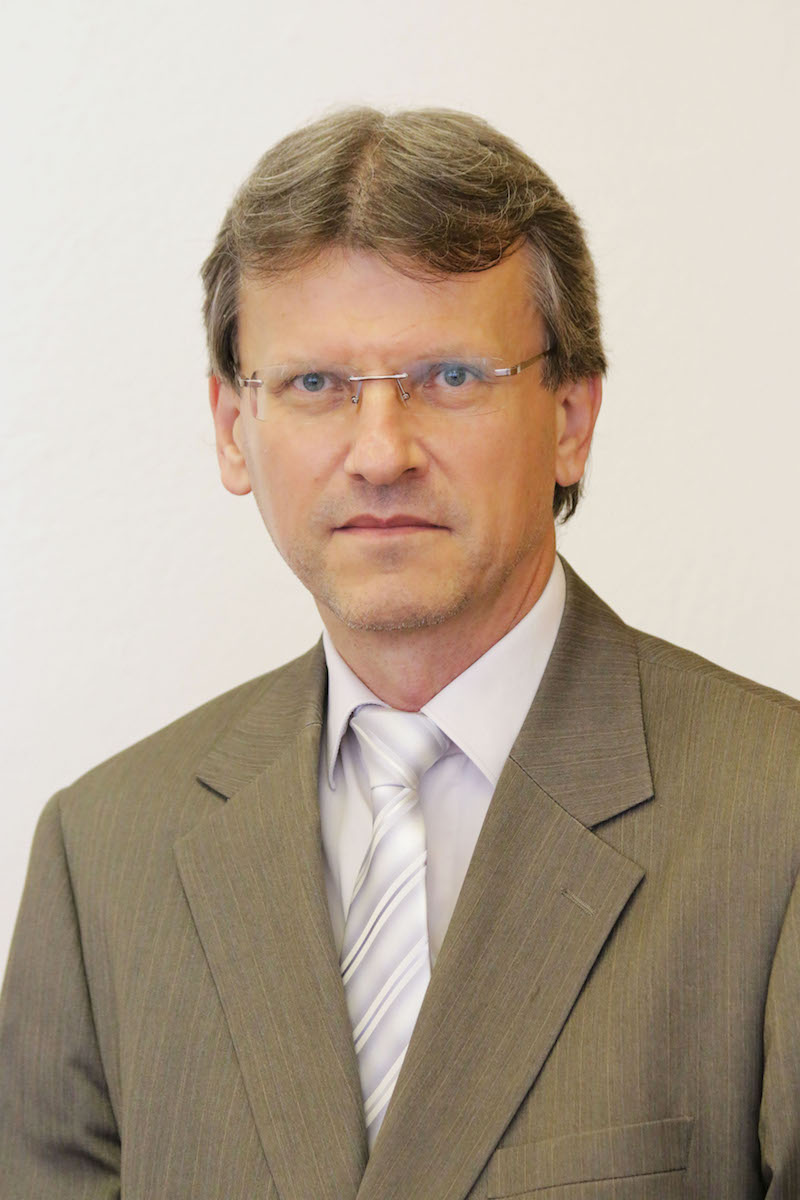
Prof. Ing. Juraj Beniak, PhD is a leading academic at the Institute of Production Engineering and Production Quality (Faculty of Mechanical Engineering, Slovak University of Technology in Bratislava, STU). He serves as a Professor CSc., PhD and holds external collaborator roles at the Institute of Computer Engineering and Applied Informatics (FIIT) and the Institute of Manufacturing Technologies (MTF). His research bridges mechanical engineering and sustainable production. Office: U.V.I.P. SjF, Office 537 Contact: +421 2 57296 537 | +421 905 593 953 (mobile) Beniak's research focuses on additive manufacturing , biomass compaction , and smart production technologies . He investigates 3D printing parameter optimization, surface modification techniques, and composite material development from renewable sources. His work addresses both industrial applications and environmental sustainability through advanced manufacturing. Key projects include: OP R&I: Automation in freight railway vehicle production (2019–2023) APVV-18-0527: Additive manufacturing technology development (2019–2022) Recovery Plan: AI-driven waste management systems (2024–2026) As a KEGA grant guarantor and APVV co-investigator , he leads initiatives in CAx education, virtual laboratories, and biofuel production optimization. His contributions span from experimental equipment design to mathematical modeling of compaction processes.
Assoc. Prof. Hana Vančová, PhD., is a dedicated academic at Trnava University's Faculty of Education, where she has served as an Associate Professor in the Department of English Language and Literature since 2013 (promoted from Assistant Professor following her 2022 habilitation). Currently Deputy Head of Department for Education, she oversees curriculum development and serves as study advisor for single-subject and combined English language teacher education programs at bachelor's, master's, and doctoral levels. Her institutional commitment spans over a decade with full-time employment since 2013. Education: 2004–2009: Master of Arts (Mgr.) in English Language and Literature – Slovak Language and Literature, Faculty of Education, Trnava University 2009–2012: Doctor of Philosophy (PhD.) in Pedagogy, Faculty of Education, Trnava University 2019: Professional Development: "Teaching languages in the digital era: the best apps, web platforms and ICT solutions for learning languages", Institute for Training, Employability and Mobile Learning Hana Vančová's scholarly work centers on English pronunciation pedagogy , with pioneering research in technology-enhanced instruction . Her primary domains include phonetics and phonology , lexicology , and digital language learning tools , investigating how AI, mobile applications, and multimedia resources optimize pronunciation acquisition. She bridges theoretical linguistics with practical classroom applications through ergonomic educational design, emphasizing learner-centered methodologies that address sociolinguistic factors like accent identity and intelligibility. Her habilitation thesis established her as a key innovator in pronunciation technology. Analysis of Vančová's publication trajectory (2014-2024) reveals a decisive shift from foundational studies on Slovak learners' pronunciation errors toward cutting-edge research on AI-driven pronunciation training. Her recent work explores karaoke-based methods and ethical AI implementation in CALL (Computer-Assisted Language Learning), highlighting human-AI interaction dynamics. The consistent thread is her commitment to making pronunciation instruction accessible through technological innovation, with publications increasingly addressing inclusivity, ethical considerations, and ergonomic design in digital language learning environments. While no specific scientific awards are documented beyond her academic promotion, Vančová's habilitation procedure—evaluated by an international committee including scholars from Poland, Czech Republic, and Slovakia—represents significant scholarly recognition. Her work has received 36 citations (14 foreign, 22 domestic) as of 2021. As study advisor for English language teacher training programs, Vančová mentors students across bachelor's, master's, and doctoral studies, guiding curriculum development for profile subjects in phonetics, lexicology, and digital language education. She maintains structured consultation hours (Wednesdays 10:00-11:30, study advising 11:30-13:00 via MS Teams) and demonstrates sustained research productivity through monographs, textbooks, and peer-reviewed articles. Though specific grant funding isn't detailed, her habilitation thesis exemplifies capacity for substantial scholarly projects with practical pedagogical impact. No dedicated laboratories or formal research teams are documented; Vančová's academic activities operate within the Department of English Language and Literature framework, focusing on individual research initiatives and departmental leadership in educational technology integration.
Patrik Voštinár is an Assistant Professor at the Department of Computer Science , Faculty of Natural Sciences , Matej Bel University . Holding a PhD in Applied Computer Science from the same university (2014-2017), he teaches courses in Programming , Discrete Mathematics , Web Technologies , and Android Programming . As department head and study advisor, he actively shapes academic programs and student experiences. Matej Bel University (2017-present) Department of Computer Science Faculty of Natural Sciences His research focuses on computer science education and educational technology , with particular emphasis on: VR/AR applications in teaching Game-based learning environments Microcontroller programming pedagogy Mobile application development education Physical computing tools for K-12 Adaptive learning interfaces His work with MakeCode , micro:bit , and EEG-controlled games demonstrates innovative approaches to programming education. He has received multiple eLearning competition awards for educational courseware development. Heart on the palm (Project of the year 2019) 2nd price in eLearning competition (2023) for Discrete Mathematics course Price of České společnosti pro systémovou integraci (2023) for Web Technologies 1st price in eLearning competition (2023) for Geometry Didactics Voštinár actively contributes to academic communities through: Membership in DIDINFO conference program (since 2017) Editorial Board member of Elementary Mathematics Education Journal Organizing workshops for primary/secondary students Popularizing informatics through extracurricular programs
Ota Pavlíček is a Senior Researcher at the Institute of Philosophy, Czech Academy of Sciences, where he has been affiliated since 2008. He currently serves as coordinator of the TRIPTIC-EU research group, Principal Investigator for the ERC ACADEMIA project, and deputy head of department. Previously, he held positions as Postdoctoral Researcher (2015–2019) and Researcher (2019–2020), and served as Scientific Secretary of the Collegium Europaeum until 2021. His academic credentials include: PhD in History of Philosophy, Université Paris-Sorbonne (2014), final mark: très honorable avec félicitations du jury ThD in Hussite Theology, Hussite Faculty of Theology, Charles University, Prague (2014), final mark: summa cum laude MA (Mgr.) in Teaching of Philosophy, Ethics, and Religion, Hussite Faculty of Theology, Charles University, Prague (2007), final mark: summa cum laude Pavlíček specializes in the history of knowledge production at Late Medieval and Early Modern European universities, with particular focus on Central European Faculties of Liberal Arts and their connections to Western Europe. His research spans philosophical discussions (metaphysics, logic, astrology), theological debates (especially philosophical theology of the Reformation), and intellectual practices including Arts quodlibets. He actively integrates Digital Humanities methodologies for analyzing medieval textual corpora, bridging historical scholarship with computational approaches. His work demonstrates exceptional expertise in Bohemian intellectual history, particularly the University of Prague's academic culture around 1409. Analysis of his recent publications reveals a consistent trajectory exploring quodlibetal debate structures, the philosophical theology of Jerome of Prague and Jan Hus, and the transmission of Wycliffite ideas in Central Europe. His scholarship uniquely combines critical edition work with theoretical analysis of medieval academic practices, while his Digital Humanities projects create innovative pathways for studying historical knowledge production. His scientific recognition includes: 2023 ERC Proof of Concept, Seal of Excellence (project WHEEL) 2020 ERC Starting Grant (project ACADEMIA) 2019 Humboldt Research Fellowship for Postdoctoral Researchers 2016 Otto Wichterle Award of the Czech Academy of Sciences Multiple early-career prizes including Josef Hlávka and Bernard Bolzano Awards Pavlíček directs major research initiatives including the ERC ACADEMIA project reconstructing Arts quodlibetal traditions (1370–1700) and Czech Science Foundation projects on Prague's Faculty of Arts. He has organized over forty international conferences including the annual Studying the Arts in Late Medieval Bohemia series and Prague Talks on Digital Humanities. His public engagement includes co-authoring major exhibitions (Sedm věží, Heretical University), media appearances, and educational materials for schools. He serves on editorial boards for Latinitatis medii aevi lexicon Bohemorum and Questions from History Journal, and maintains active membership in international scholarly societies including SIEPM and Societas Artistarum. He leads the TRIPTIC-EU research group at the Institute of Philosophy, which focuses on medieval knowledge production through interdisciplinary collaboration between historians, digital humanities specialists, and philologists, with particular emphasis on reconstructing academic practices through digital tools.
Prof. Martin Lukáčik, PhD, is a Professor at the Department of Operations Research and Econometrics, Faculty of Economic Informatics, University of Economics in Bratislava. His academic career spans over two decades, focusing on econometric modeling, macroeconomic analysis, and operations research applications. Education: 2005: PhD in Econometrics and Operations Research, University of Economics in Bratislava 1998: Master's in Operations Research and Econometrics, University of Economics in Bratislava His research interests include econometrics, operations research, spatial spillover effects, and fuel price asymmetry. Recent projects analyze pandemic impacts on EU economies, asymmetric fuel pricing, and spatial economic dynamics. He has supervised doctoral students such as Ádám Csápai (2021–2024), Martin Benkovič (2013–2018), and Patrik Kupkovič (2013–2016). Grants include VEGA 1/0052/24 (structural parameter estimation) and KEGA 026EU-4/2024 (interactive economics books). Prof. Lukáčik is actively involved in international collaborations, including ERASMUS+ mobilities in Prague, Ostrava, and Split. He serves on scientific councils and editorial boards for journals like Equilibrium .
Igor Košťál is an Assistant Professor at the Department of Applied Informatics within the Faculty of Economic Informatics at the University of Economics in Bratislava . His research focuses on Distributed Technologies , Parallelization of Applications , and Data Structure Optimization , particularly in the context of .NET frameworks and industrial robotics. University: University of Economics in Bratislava School: Faculty of Economic Informatics Department: Department of Applied Informatics Academic Rank: Assistant Professor Košťál's work emphasizes software performance testing , with publications analyzing execution efficiency in .NET applications using parallel programming , Dijkstra's algorithm , and symbol table implementations . His recent research explores modern UI development in mobile applications and algorithm optimization for industrial robotics. Key trends in his 15 most recent articles (2014-2022) include: Performance analysis of parallel and sequential algorithms in .NET environments Optimization of data structures (arrays, linked lists, skip lists) for search efficiency Integration of asynchronous methods in WCF services and clients Testing precision in KUKA welding robots through structured data extraction
Šlapak Eugen is an Assistant Professor at the Technical University of Košice. His research focuses on autonomous driving systems, edge computing, and network optimization, with a particular emphasis on applying neural networks and blockchain technologies in vehicular and 5G networks. Eugen Šlapak holds a PhD in [specific field not explicitly stated, likely Engineering/Computer Science] and an Ing. (engineer) degree. His academic background combines technical expertise in telecommunications and computer science. His research interests span autonomous driving technologies, including simulation and control systems, as well as edge computing and metaverse integration. He also explores blockchain applications in vehicular networks, resource allocation in 5G and beyond, and the use of graph neural networks for network optimization. His work intersects machine learning, robotics, and telecommunications to address challenges in modern communication systems and intelligent transportation. Recent publications highlight advancements in neural radiance fields for industrial robotics, distributed edge video compression for autonomous driving, and blockchain-based resource allocation in connected vehicles. Earlier work includes optimization of UAV-assisted networks and HetNet topology design using machine learning clustering methods. While no formal awards are listed, his contributions to vehicular networks, edge computing, and AI-driven network design reflect significant scholarly impact. Advising details are not documented here, but his research collaborations likely involve cross-disciplinary teams focusing on autonomous systems and 5G infrastructure. No lab affiliations or teams are explicitly mentioned, though his teaching role in the course Stochastické modelovanie a analýza dát (SMaAD) suggests involvement in data analysis and stochastic modeling initiatives.
Alžbeta Michalíková serves as Associate Professor at Matej Bel University's Faculty of Arts, Department of Computer Science. Her academic profile spans mathematical foundations and applied computational research with significant contributions to fuzzy logic systems. Her research focuses on Fuzzy Sets and Intuitionistic Fuzzy Sets with applications in Computer Vision, Biology, and Medicine. She investigates mathematical properties of these structures and explores integrations with Neural Networks and Evolutionary Algorithms. Recent work emphasizes smart city applications, air quality analysis, and digital education tools. Her publication trends show evolution from theoretical fuzzy mathematics (2005-2015) to applied AI systems (2020-present), particularly in environmental monitoring and transportation systems. Key themes include uncertainty modeling, image classification, and real-time data processing for urban applications. Erasmus+ KA2 projects on air pollution technologies (2022-2024) KEGA projects for digital educational tools (2020-2025) VEGA research on fuzzy models (2011-2017) APVV projects on scientific outreach She teaches Mathematics for Computer Scientists, Numerical Methods, and specialized Fuzzy Sets courses. Her technical infrastructure includes ORCID (0000-0002-0568-9279), SCOPUS (24448471500), and ResearchGate profiles. Current work focuses on digital identification keys for mycology education and AI-driven smart city analytics.
Zuzana Čičková is an Associate Professor at the Department of Operations Research and Econometrics, Faculty of Economic Informatics, University of Economics in Bratislava. Her work bridges computational intelligence, game theory, and economic modeling, with a focus on spatial competition, logistics, and market dynamics. Academic Rank: Associate Professor Department: Operations Research and Econometrics University: University of Economics in Bratislava Her research spans game theory, vehicle routing, and econometric modeling. Recent projects include multi-criteria game theory applications in spatial allocation (2022), analysis of Arctic shipping routes (2022), and optimization of recycling networks under VEGA grants. She has contributed to algorithm design (SOMA/DE) and market concentration indicators like the Herfindahl-Hirschman Index. Her publications reflect expertise in computational intelligence for economic problems, including vehicle routing with time windows , spatial competition models , and data-driven decision support systems . While no explicit awards are listed, her leadership in VEGA projects (2017-2025) and international collaborations with institutions like Bifröst University and Óbuda University underscores her academic impact. 31 Web of Science/Scopus publications with 98 citations 8 invited lectures at international/national conferences PhD in Econometrics and Operations Research (2005) Teaching since 2001, advising 38 master’s theses She has undertaken international mobilities in Iceland (2014, 2022), Germany (2007), Czech Republic (2022), and Spain (2022), focusing on research and pedagogical innovation. Her current projects include VEGA 1/0115/23 on cooperative game theory in international relations (2023-2025).
Martin Mišút is an Associate Professor at the Department of Applied Informatics, Faculty of Economic Informatics, University of Economics in Bratislava. His work focuses on academic research, teaching, and leadership as the chair of the Academic Senate. Role: Associate Professor, Academic Senate Chair Institution: University of Economics in Bratislava Department: Department of Applied Informatics Research interests span E-learning , Information Technology in Education , Software Engineering , and Big Data . Key projects include improving education quality via Kirkpatrick's model, analyzing ICT implementation in engineering education, and exploring datafication for business decision-making. Recent Trends: Development of MS Teams/G-Meet teaching models, big data ecosystems, and project-based learning frameworks. Publications: 15+ articles from 2013–2022, including 1 monograph. Collaborations include Mária Mišútová (co-author on 10+ publications) and Katarína Pribilová. Grants involve VEGA 1/0373/18, KEGA 009STU-4/2018, and EU OPV-2010/1.2/02-SORO.
Marek Ružička serves as an Assistant Professor at the Technical University of Košice (TUKE), where he teaches Stochastic Modeling and Data Analysis (SMaAD) and Modeling and Prototyping Systems (MaPS) across multiple laboratory sessions and lectures in buildings PK6, L9, and N9. His research spans Generative AI, Optimization, UAVs, 5G telecommunications, and Physical neural networks, with applications in engineering and data science. His research program emphasizes generative models for solving complex physical and engineering problems, particularly using GANs for data synthesis, trajectory correction, and system optimization. He bridges theoretical AI with practical implementations in UAV networks, aerodynamics simulation, and telecommunications infrastructure, demonstrating strong interdisciplinary connections between machine learning and physical systems. Analysis of his 2019-2024 publications reveals consistent focus on generative adversarial networks applied to UAV-based network optimization, physical system modeling (mass-spring systems, car aerodynamics), and data augmentation for mobility datasets. His work shows evolving specialization in deep learning integration with telecommunications (5G) and physical neural networks, with increasing emphasis on real-time optimization and energy efficiency. Scientific Awards: No scientific awards were mentioned in the provided text. Advising and Grants: The source material contains no information regarding graduate students, research grants, or funded projects.
Prof. Anetta Čaplánová is a Professor and Head of the Department of Economics at the Faculty of Economics and Finance, Bratislava University of Economics and Business. She holds the titles of Dipl. Ing. and PhD. Her administrative roles include serving as a Member of the Council for Budget Responsibility, Member of the Scientific Council of the NHF EU in Bratislava, and Chairman of the Committee in Economic Theory. She also contributes to governance at Matej Bel University in Banská Bystrica as a Member of the Management Board. Prof. Čaplánová's academic background includes a PhD and engineering degree (Dipl. Ing.), though specific educational institutions are not detailed. Her research spans New Institutional Economics, Public Choice Theory, and Behavioral Economics, with a focus on integrating behavioral insights into policy analysis and exploring institutional frameworks affecting economic behavior. She investigates public sector economics, environmental policy mechanisms, and methodology, often addressing transition economies and international contexts. Her recent publications reflect interdisciplinary interests in environmental markets, FDI impacts, and democracy's effects on well-being. She frequently collaborates with researchers like R. Sivák, J. Hudson, and K. Willett on topics such as transaction cost theory and innovation drivers. Beyond research, she teaches courses like Principles of Economics in English and Behavioral Economics, demonstrating pedagogical expertise. Scientific Awards: Rector's Award for best international article (2011) In grant activities, she leads projects like Overcoming Digital Divide in Europe and Southeast Asia (ODDEA) and Master Studies in Sustainable Development and Management (MASUDEM), focusing on innovation and sustainable development. She also participates in lab initiatives including Bee4R LAB and SecureDataLab , advancing behavioral economic research. Her international engagements include numerous academic stays and collaborations at foreign universities, enriching her global perspective in economic theory and policy.
Lukáš Šoltés is an Associate Professor at the Institute of Computer Engineering and Applied Informatics (FIIT) within the Faculty of Informatics and Information Technologies at Slovak University of Technology Bratislava. He serves as Vice-dean of his faculty and holds external colleague roles at both FIIT and the Faculty of Mechanical Engineering. Email: lukas.soltes@stuba.sk Phone: +421 2 21022 511 / +421 948 296 157 Office: 5.11, UPAI FIIT Research Interests span computer engineering, IoT integration, and smart mobility solutions. His work focuses on heterogeneous IoT systems, Smart ActiveCloud technologies, and legal/technical challenges in intelligent transportation systems to enhance road safety. Projects include: APVV-15-0757 - Development of retractor for abdominal operations (Researcher, 2016-2019) 313012Q938 - Innovations via IoT system integration using Smart ActiveCloud (Official Solver, 2020-2023) APVV-23-0519 - Legal and technical challenges for smart mobility (Solver, 2024-2027)
Prof. Juraj Gazda is a Professor at the Faculty of Electrical Engineering and Informatics, Technical University of Kosice. His research focuses on cognitive radio networks, artificial intelligence, green communications, and agent-based modeling. He holds a PhD in engineering from TUKE (2010) and has extensive industry experience as an external consultant at Nokia Networks (2011–2014), advising on LTE wireless systems. He has been a guest researcher at institutions like Ramon Llull University (Spain), Technical University of Hamburg (Germany), and Delft University of Technology (Netherlands). His teaching includes stochastic modeling and data analysis courses. Gazda’s work bridges academia and industry, emphasizing network security, autonomous systems, and 6G technologies. Research highlights include contributions to UAV-assisted networks, blockchain-based spectrum management, and AI-driven edge computing. His projects address real-world challenges in 5G/6G networks, including energy efficiency, secure communication, and autonomous vehicle coordination. Gazda actively collaborates with global tech firms like Verizon Wireless, contributing to network design and optimization. Publications span AI applications in healthcare, vehicular networks, and quantum computing. He advocates for interdisciplinary research, integrating machine learning, blockchain, and metaverse technologies to address future mobility and communication needs.
Dr. Miroslav Michalko is an Associate Professor at the Department of Computer Networks and Security, Faculty of Electrical Engineering and Informatics, Technical University of Košice. His research focuses on Cybersecurity, Multimedia Content Delivery, IoT for eHealth, Smart Cities and Homes, Web Technologies, and EU Project Management. He teaches courses such as Computer Networks, Security of Computer Networks, and CCNA Security. He actively coordinates the Girls in IT @ FEEI TUKE initiative and serves as the National Guarantor for Information Technologies and Telecommunications within Slovakia's Qualifications Verification System. His research interests span Cybersecurity methodologies, IoT integration in healthcare, Smart City infrastructure, and innovative educational technologies. Notable projects include developing UAV-based monitoring systems, smart home solutions, and cybersecurity educational platforms. He has contributed to over 50 peer-reviewed publications, emphasizing practical applications of computer networks and IoT. Dr. Michalko's recent work highlights advancements in autonomous UAV control via machine learning, intrusion detection in IoT environments, and real-time water leak detection systems. His teaching emphasizes hands-on learning through simulations and industry-aligned certifications like Cisco's NetAcad program.