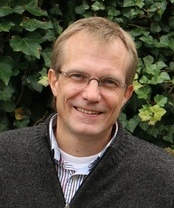
Dr. Yulia Sandamirskaya is the Head of Research Center "Cognitive Computing in Life Sciences" at Zurich University of Applied Sciences (ZHAW), focusing on neuromorphic computing applications for embodied artificial intelligence. Her work bridges computational neuroscience and robotics, emphasizing neural-dynamic architectures for real-time decision-making, learning, and sensorimotor integration in autonomous agents. Key Research Areas: Neuromorphic hardware, dynamic neural fields, spiking neural networks, spatial language modeling, and autonomous sequence generation. Projects: Developed controllers for UAVs and robotic arms using event-based vision sensors, explored on-chip unsupervised learning, and designed models for spatial language interpretation in robots. Scientific Contributions: Her publications span robotics conferences and journals like Science Robotics and Frontiers in Neurorobotics , addressing topics such as path integration, obstacle avoidance, and cognitive architectures. Recent work (2024) includes visual odometry with resonator networks and hyperdimensional scene factorization on neuromorphic chips. Advising: Supervised multiple MSc theses at ETH Zurich and NSC/INI programs, mentoring students on neuromorphic navigation, spiking networks, and tactile learning. Collaborated with institutions like ETH Zurich, University of Queensland, and INI Bochum. Labs & Collaborations: Leads the "Neuromorphic Computing Applications: Embodied AI" group at ZHAW, partnering with INIvation (Zurich) and Jörg Conradt (KTH) on neuromorphic hardware implementations. Projects integrate cognitive models with robotic platforms, emphasizing energy efficiency and low-latency interaction.