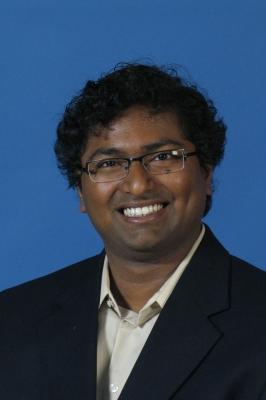
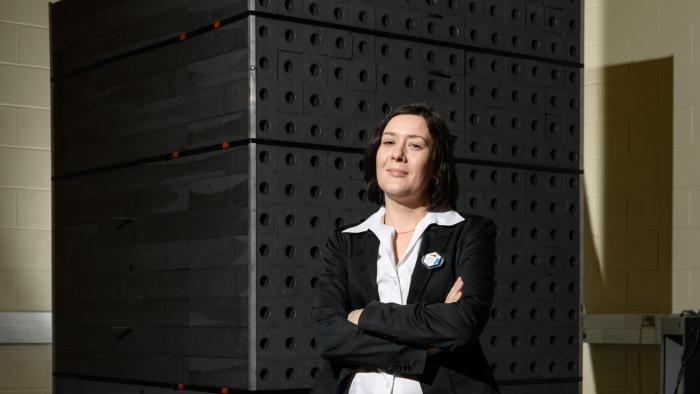
Sven Mayer is a Professor at TU Dortmund University’s Faculty of Computer Science and leads the Chair for Human-AI Interaction. He previously held a postdoctoral position at LMU Munich’s Media Informatics group and completed his PhD at Carnegie Mellon University (2014–2018). His research focuses on Human-AI/Robot Interaction , machine learning for touch systems , and sensor fusion . Recent work includes super-resolution capacitive touchscreens, pose estimation via smartphones, and city-scale sensing using retroreflective markers. The 15 most recent publications highlight trends in AI-driven interaction design , robot expressions , and smartphone-based sensing , with keywords spanning robotics, machine learning, and smart cities. Subdomains include contextual awareness, ergonomic constraints, and novel touch input paradigms. Scientific contributions recognized with Honorable Mention for 'Flyables' (2022) Honorable Mention for ISS piano learning paper (2022) . He has supervised projects in augmented reality and human-robot interaction courses , and frequently contributes to conferences like CHI, UIST, and MobileHCI as both author and organizational leader (e.g., Publications Chair at CHI 2022).
Prosper Dovonon is Full Professor of Economics at Concordia University, Montréal, Canada, where he holds the Tier 1 Concordia University Research Chair in Econometrics of Large Datasets . He is concurrently Adjunct Professor at the University of Adelaide, Australia, and has previously served as Associate and Assistant Professor at Concordia, Visiting Professor at HEC Montréal, and Assistant Vice-President at Barclays Wealth in London. Education Ph.D. in Economics, Université de Montréal (2007) M.Sc. in Statistics and Economics, ENSEA, Abidjan, Côte d’Ivoire (2000) M.Sc. in Mathematics, Université Nationale du Bénin, Abomey-Calavi, Benin (1996) Research Interests Professor Dovonon’s research lies at the intersection of theoretical econometrics and financial data applications . He focuses on developing robust inferential procedures for moment-condition models, bootstrap techniques for high-frequency data, identification issues in GMM, and volatility modeling with factor structures that accommodate skewness and leverage effects. His work on large-dimensional datasets emphasizes scalable methods for estimation and testing in big-data environments. Scientific Awards & Recognition Concordia University Research Chair, Tier 1, in Econometrics of Large Datasets (2022–present) Collaborations & Affiliations Beyond Concordia and the University of Adelaide, he is affiliated with the Centre Interuniversitaire de Recherche en Économie Quantitative (CIREQ) in Montréal and has collaborated with leading scholars across North America, Europe, and Australia. His research is frequently cited in top econometrics and statistics journals, attesting to its broad impact.
Jessica Conroy is a Professor in the School of Integrative Biology at the University of Illinois at Urbana-Champaign, with additional appointments in Earth Science and Environmental Change and Plant Biology. Her research program investigates climate variability across timescales using stable isotope geochemistry, paleolimnology, and climate modeling approaches. Education: Ph.D. (2011) and M.S. (2006) from the University of Arizona, B.A. (2003) from the College of Wooster. Research Focus: Conroy's lab specializes in reconstructing past climate dynamics through stable isotope analysis of geological archives. Key interests include: paleoclimate variability (interannual to millennial scales), isotope hydrology, atmospheric circulation patterns, ocean-atmosphere interactions in the tropical Pacific, loess-paleosol records, and climate responses to external forcings. Current projects examine isotopic signatures in precipitation, seawater, and vapor; paleowind reconstructions; and modern wind trend analysis. Publication Trends: Her recent articles (2022-2025) demonstrate a strong focus on isotopic proxies for climate reconstruction, with emphasis on tropical Pacific dynamics, Laurentide Ice Sheet influences, loess chronology, and methodological innovations including machine learning applications. Studies frequently utilize multi-proxy approaches across diverse archives like lacustrine sediments, marine carbonates, and aeolian deposits. Awards and Honors: NSF CAREER Award (2019) Kavli Frontiers of Science Fellow, National Academy of Sciences (2017) List of Teachers Ranked as Excellent (2015, 2017, 2018) Arnold O. Beckman Award, UIUC Campus Research Board (2013) DISCCRS VIII Participant (2013) Lab Leadership: Conroy directs an active research group (Conroy Lab) investigating past, present, and future climate variability using proxy records, observational data, and model simulations. The lab maintains field programs in the Galápagos, Palau, and midcontinental North America.
Dr. Kevin Mwenda is an Associate Professor of Population Studies (Research) at Brown University's Population Studies and Training Center (PSTC) and serves as Director of the Spatial Structures in the Social Sciences (S4). He maintains faculty affiliate positions at the Data Science Institute (DSI), Institute at Brown for Environment and Society (IBES), and the Sociology Department, demonstrating his interdisciplinary approach bridging geography, demography, and public health through spatial analysis methodologies. Dr. Mwenda's educational background includes: PhD in Geography (Geographic Information Science & Cartography), University of California, Santa Barbara (2018) MA in Geography, University of California, Santa Barbara (2014) BA, Dartmouth College (2010) His research program investigates spatial disparities in health outcomes among vulnerable populations globally, with particular attention to environmental, climatic, and socioeconomic determinants. Dr. Mwenda develops innovative mixed methods for exploring, analyzing, and visualizing spatial data patterns to better understand human-environment dynamics at various scales. His methodological expertise in GIS and spatial statistics enables sophisticated analysis of complex health-environment relationships across diverse geographic contexts. Dr. Mwenda's publication trajectory reveals a consistent focus on applying spatial methodologies to pressing global health challenges, with significant contributions in environmental health impacts across Africa, healthcare accessibility in conflict zones like Syria, pandemic mobility patterns, and frameworks for monitoring land degradation. His work demonstrates methodological rigor while addressing real-world problems affecting vulnerable populations in diverse settings including Africa, China, and the United States. His scholarly contributions have been recognized with several prestigious honors: Dean's Award for Excellence in Teaching (2023, Brown University) OVPR Research Seed Award (2023, Brown University) Excellence in Teaching Award (2017, Department of Geography, UCSB) Appointment as Associate Editor of Populations Journal (2025) As Director of S4, Dr. Mwenda leads a thriving research initiative that advances spatial methodologies across social science disciplines at Brown. His teaching portfolio includes undergraduate and graduate courses in GIS and spatial analysis within the Sociology Department, for which he received Brown's highest teaching honor in 2023. Dr. Mwenda maintains extensive collaborative networks spanning Epidemiology, Health Services, Environmental Science, and Data Science departments, reflecting the interdisciplinary nature of his work and institutional impact.
Dr. Saibal Mukhopadhyay is a Professor in the Department of Electrical and Computer Engineering at the Georgia Institute of Technology, where he joined in 2007. He holds the Joseph M. Pettit Professorship and is recognized as an IEEE Fellow for his contributions to low-power and reliable VLSI systems. Education: BEng (Jadavpur University, India), Ph.D. (Purdue University) Labs: Gigascale Reliable Energy Efficient Nanosystem (GREEN) Lab His research focuses on VLSI Systems , Nanotechnology , and Low-Power Electronics , with emphasis on technology-circuit co-design for energy-efficient computing. Recent work explores Compute-in-Memory (CIM) architectures and Spiking Neural Networks for edge AI. Key article themes include Transformer Model Acceleration , Quantum Computing Calibration , 3D Object Detection , and Device Aging Analysis , reflecting his interdisciplinary approach bridging hardware design and machine learning. Scientific Awards IEEE Fellow (2018) ONR Young Investigator (2012) NSF CAREER Award (2011) IBM Faculty Awards (2009, 2010) Best Paper Awards (IEEE-Nano 2003, ICCD 2004)
Anna Erickson serves as Woodruff Professor and Associate Chair for Research at Georgia Institute of Technology's George W. Woodruff School of Mechanical Engineering, where she bridges reactor engineering and nuclear nonproliferation through integrated theoretical and experimental approaches. Director of the $25M DOE NNSA-funded Consortium for Enabling Technologies and Innovation (12 universities, 12 national labs), she has authored over 100 publications including the seminal text Active Interrogation in Nuclear Security (Springer, 2018) and advises federal agencies on nuclear security policy. Education: Ph.D. in Nuclear Science and Engineering, Massachusetts Institute of Technology (2011) M.S. in Nuclear Science and Engineering, Massachusetts Institute of Technology (2008) B.S., Oregon State University (2006) Research Focus: Dr. Erickson pioneers nonproliferation-by-design methodologies through two integrated thrusts: advanced reactor analysis for proliferation-resistant nuclear energy systems and radiation detection for border security applications. Her work uniquely combines machine learning with nuclear engineering to develop safeguards for next-generation reactors, with significant contributions to antineutrino detection systems and medical physics applications like proton radiography. Current projects emphasize small modular reactor safety and spectral imaging techniques. Publication Trends: Analysis of her 15 most recent publications (2018-2020) reveals dominant themes in antineutrino-based reactor monitoring (60% of works), advanced radiation detection systems (30%), and small modular reactor design (10%). Key innovations include lithium-loaded scintillators for neutron detection, spectral X-ray correction algorithms, and high-temperature reactor concepts with inherent proliferation resistance, demonstrating consistent DOE funding focus on nuclear security infrastructure. Awards: Woodruff Professorship (2019) Lockheed Dean's Excellence in Teaching Award (2016) US Frontiers of Engineering Symposium (National Academy of Engineering, 2015) American Nuclear Society Graduate Scholarships (2006, 2009) Stewardship Science Graduate Fellowship (DOE, 2008-2011) Leadership & Funding: As director of the $25M Consortium for Enabling Technologies and Innovation, she manages cross-institutional R&D in machine learning, advanced manufacturing, and nuclear detection. Her Laboratory for Advanced Nuclear Nonproliferation and Safety (LANNS) coordinates with Aerospace Engineering, Chemistry, and International Affairs departments on nonproliferation projects, while her ELATES leadership program participation (2022) enhances STEM management capabilities. Recent media engagements with CBS News (nuclear fusion breakthrough) and CNN (radiation safety) demonstrate policy impact. Research Infrastructure: The multidisciplinary LANNS lab develops experimental detection systems alongside reactor modeling tools, supporting the Consortium's mission to create deployable nuclear security technologies. Collaborations with 12 national laboratories enable access to unique facilities for radiation source characterization and reactor simulation, with current efforts focused on AI-enhanced safeguards for commercial reactor fleets.
Professor Fiona Sampson is a leading academic in Health Services Research at the School of Medicine and Population Health, University of Sheffield. She serves as Director of the Centre for Urgent and Emergency Care Research (CURE) and School Director for Equality, Diversity and Inclusion. Working part-time since 2008, she specializes in mixed methods research and observational/ethnographic approaches within emergency care systems. Research Focus: Emergency and urgent care systems, patient perspectives, observational methods, implementation science Leadership: Director of CURE, Equality Director at School level Grants: Multiple NIHR-funded projects including prehospital pre-alerts, pain management, and thromboprophylaxis Her work spans both qualitative and quantitative methodologies, with recent publications examining prehospital care systems, pain management challenges, and thromboprophylaxis in maternal health. She supervises PhD students Naif Harthi and Melanie Watson in prehospital care research. Key recent projects include: NIHR HS&DR study on long lie after falls NIHR HTA-funded TIME trial for take-home naloxone Thromboprophylaxis economic evaluation during pregnancy NHS 111 Online evaluation Scientific awards include: NIHR Doctoral Research Fellowship (2011) Multiple NIHR project grants She founded a ScHARR observational methods research group and has extensive teaching experience in research methodologies and evidence-based healthcare through MSc programs.
Yafang Cheng is Director of the Aerosol Chemistry Department at the Max Planck Institute for Chemistry since 2024, with concurrent appointments as Guest Professor at Peking University (2023-) and Distinguished Guest Professor at University of Science and Technology of China (2021-). Her research integrates experimental methods , multi-scale modeling , and machine learning to advance understanding of aerosol particle dynamics and their impacts on air quality , public health , and climate change . Ph.D. in Environmental Sciences (Peking University, 2007) B.Sc. in Environmental Sciences (Wuhan University, 2001) Her work focuses on reactive nitrogen chemistry , aerosol acidity , black carbon effects , and planetary boundary layer interactions . She has developed novel instrumentation for aerosol analysis and pioneered machine learning applications in atmospheric science. Recent publications emphasize black carbon mitigation strategies (One Earth 2023), aerosol microdroplet pH (Chem 2023), and SARS-CoV-2 transmission modeling (Science 2021). These studies demonstrate interdisciplinary approaches spanning environmental chemistry , climate physics , and public health policy . Fellow: AAAS (2023), AGU (2022) Joanne Simpson Medal (AGU, 2022) Science Breakthroughs of the Year (Falling Walls, 2021) Highly Cited Researcher (Web of Science, 2021-2022) Minerva Outstanding Female Scientist Award (2014) She has mentored 38 early-career researchers (21 postdocs, 17 PhD students) who have achieved professorships , tenured positions , and international awards . Her institutional leadership includes initiating academic exchange programs between European and Chinese institutions.
Heiner Giefers is a Professor for Cloud Computing at the Department of Computer Science and Natural Sciences at Southwestphalia University of Applied Sciences since 2018. Prior to this position, he worked as a Research Staff Member at IBM Research - Zürich (2013-2018), focusing on hardware acceleration in cloud environments, implementation of big data algorithms on FPGAs, and development of hardware platforms for approximate and in-memory computing. Dr. Giefers received his doctorate (Dr. rer. nat.) from Universität Paderborn in 2012 with a dissertation titled "Design and Programming of Reconfigurable Mesh based Many-Cores." His academic journey at Universität Paderborn includes serving as an Academic Council Member (Akademischer Rat a.Z.) from 2008-2013 and as a Scientific Staff Member from 2006-2012, where he taught digital technology and computer architecture. Professor Giefers' research focuses on energy-efficient computing, particularly through hardware acceleration using FPGAs for cloud and AI workloads. His work spans cloud computing infrastructure, hardware-software co-design, approximate computing, in-memory computing, and energy-efficient implementations of machine learning algorithms. He has made significant contributions to the field of reconfigurable hardware for high-performance computing applications. His recent publications show a strong trend toward applying hardware acceleration techniques to artificial intelligence and machine learning workloads, with a particular focus on energy efficiency. His work bridges the gap between theoretical computer science and practical hardware implementation, often resulting in patented technologies that address real-world computing challenges in cloud environments. Best Paper Award for "Stochastic Matrix-Function Estimators: Scalable Big-Data Kernels with High Performance" (2016) Best Paper Award Nomination for "Energy-Efficient Stochastic Matrix Function Estimator for Graph Analytics on FPGA" (2016) Best Paper Award Nomination for "Analyzing the energy-efficiency of dense linear algebra kernels by power-profiling a hybrid CPU/FPGA system" (2014) Best Paper Award Nomination for "A Triple Hybrid Interconnect for Many-Cores: Reconfigurable Mesh, NoC and Barrier" (2010) Professor Giefers actively supervises numerous Bachelor's and Master's students, with over 50 completed theses covering topics from machine learning and cloud computing to IoT systems and hardware acceleration. He leads the "Energy-efficient AI" project (eki), which aims to increase the energy efficiency of AI systems through approximation techniques for FPGA implementation. Additionally, he collaborates with Prof. Dr. Christian Plessl on the "Digital teaching materials with Jupyter Notebooks" project, creating interactive learning materials that integrate teaching content, program code, and results into a single document. His work extends to practical applications through multiple patents related to FPGA implementations, neural networks, and memory systems, demonstrating his commitment to translating research into real-world solutions.
Dr. Hilal Ezgi Toraman is an Assistant Professor in Penn State's College of Earth and Mineral Sciences, with joint appointments in the John and Willie Leone Family Department of Energy and Mineral Engineering and the Department of Chemical Engineering. She leads an interdisciplinary research program focused on sustainable reaction engineering and catalysis for valorizing non-traditional carbon feedstocks like plastic waste, biomass, and shale gas. Her lab integrates advanced pyrolysis, GC×GC analytics, kinetic modeling, and data science to develop scalable chemical recycling technologies. Education includes: Ph.D. in Chemical Engineering, Ghent University (2016) M.Sc. in Chemical Engineering, Middle East Technical University (2012) B.Sc. in Chemical Engineering, Middle East Technical University (2010) Research focuses on: Developing intrinsic kinetic models for plastic pyrolysis Designing catalysts for mixed-feedstock upgrading Advancing GC×GC analytical methods for complex product characterization Building data infrastructure for process optimization Her work consistently addresses industrial challenges in plastic circularity and sustainable energy. Toraman's publications demonstrate strong emphasis on pyrolysis reaction engineering, catalytic mechanisms, and analytical innovation. Recent work explores metal-modified zeolites for polypropylene conversion, machine learning for co-pyrolysis optimization, and novel reactor designs for efficient thermochemical synthesis. Major awards: C&EN Talented 12 (2023) AIChE Pioneers in Catalysis & Reaction Engineering (2023) ACS Energy & Fuels Rising Star (2023) Wilson Faculty Fellowship (2023-2026) She leads the Toraman Lab, advising 8+ graduate students on projects funded by $5M+ grants from REMADE Institute, Dow Chemicals, and others. Current initiatives include catalytic pyrolysis of mixed plastics and development of open-source data platforms for recycling technologies.
Prof. Dr. Andreas Herkersdorf is a Full Professor and Chair of Integrated Systems at the Technical University of Munich (TUM) School of Computation, Information and Technology. His research focuses on application-specific multicore processors (MPSoC), FPGA-based prototyping, fault-tolerant systems, and energy-efficient architectures, with applications in IP packet processing, automotive systems, and visual computing. He has received multiple IBM innovation awards and serves on editorial boards including the DFG Review Board for computer architecture. Education: Dipl.-Ing. Electrical Engineering (TUM, 1987), Dr. techn. Electrical Engineering (ETH Zurich, 1991) Research: MPSoC architectures, autonomic computing, NoC resilience, FPGA acceleration, and self-optimizing systems. Awards: IBM Master Inventor (1998), IBM Outstanding Technical Achievement Award (2001), multiple IBM Innovation Achievement Awards (1996-2003) His recent publications emphasize hardware/software co-design, machine learning integration for runtime optimization, and network-on-chip innovations. He collaborates on projects involving 6G systems, smartNICs, and automotive communication protocols.
Dr. Steve Witt is a Professor and Head of the International and Area Studies Library at the University of Illinois at Urbana-Champaign, where he also serves as Director of the Center for Global Studies. As a subject specialist for Global Studies and Japanese, he bridges library science with international academic collaboration. University of Illinois at Urbana-Champaign International and Area Studies Library Center for Global Studies European Union Center Center for East Asian and Pacific Studies His research examines global information networks through historical lenses, focusing on the Carnegie Endowment for International Peace's role in shaping internationalist thought through library collections. Current projects include analyzing Imperial Japan's contributions to early 20th-century internationalism and developing digital humanities methodologies to study the CEIP's curated book corpus. Publications highlight his expertise in privacy evolution within library associations, resource sharing for area studies, and sustainable library practices. He serves as editor for IFLA Journal , promoting translational research between theory and practice.
Jorge Camba is an Associate Professor at the School of Engineering Technology and holds a courtesy appointment in the Department of Computer Graphics Technology at Purdue University . He also serves as a Senior Research Scientist (by courtesy) in the Department of Industrial Engineering at the University of Naples Federico II , Italy. PhD in Systems and Engineering Management (Universidad Politécnica de Valencia, Spain) MSc in Digital Media (East Tennessee State University) MSc in Computer Science (Universidad de Vigo, Spain) His research explores intelligent CAD systems , digital manufacturing , and mixed reality environments , focusing on model quality assurance , design intent communication , and collaborative design tools . Recent work investigates spatial cognition in CAD education , geometric variability analysis , and annotation-driven knowledge management . Key trends in his publications include parametric modeling strategies , 3D annotation systems , and XR applications in design evaluation. Awards include the Purdue Faculty Scholar (2021) and I3B Fellow (2021). He has presented at conferences on topics like Industry 4.0 , space habitat design , and digital product quality .
Hazar Dib is an Associate Professor at the School of Construction Management Technology, Purdue Polytechnic Institute, Purdue University. His work bridges Building Information Modeling (BIM) , knowledge management , and interactive learning technologies to advance construction education and process efficiency. Ph.D. in Building Construction (2007, University of Florida) MSc. in Civil Engineering (2002, University of Balamand) BSc. in Civil Engineering (2000, University of Balamand) Research Interests focus on: BIM lifecycle integration AI/knowledge-based systems for construction Digital tools for surveying and steel connection education Collaborative communication frameworks Sustainability metrics in building practices Human factors in technology adoption Scientific Awards include multiple Charles B. Murphy Awards for undergraduate teaching and the Society of Leaders in Construction induction. His NSF-funded projects like VELS (Virtual Environment for Learning Surveying) and Steel Connection Teaching Tool highlight his innovation in STEM education . Articles span serious games , visual learning , and BIM maturity assessments , reflecting his interdisciplinary approach.
Angelo Elmi is an Associate Professor at the Milken Institute School of Public Health , The George Washington University , affiliated with the Department of Biostatistics and Bioinformatics . His work bridges biostatistical methodology with applications in women's and child health sciences. Education: Ph.D. in Biostatistics, University of Pennsylvania (2009) Research Focus: Dr. Elmi specializes in Mixed Effects Models , Joint Modeling , and Longitudinal Data analysis, with emphasis on addressing complex statistical challenges in biomedical research. Publication Trends: His recent work explores advanced statistical frameworks for analyzing longitudinal and event-time data, applying nonlinear mixed-effects models and spline-based techniques. Notably, he has contributed to joint modeling methodologies for paired outcomes in public health contexts. Contact: Email: Angelo.Elmi@gwu.edu | Office Phone: 202-994-8416 | Location: Science & Engineering Hall, 800 22nd Street NW, Washington DC 20052.