
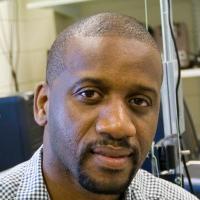
Mohamed A. Diagne serves as Oakes Ames Professor of Physics and Muslim Community Program Director at Connecticut College, where he returned in 2009 after completing his M.S.E.E. and Ph.D. at Brown University. A 1997 Connecticut College alumnus, he teaches General Physics labs, Concepts in Contemporary Physics, Classical Mechanics, and Formalism of the Quantum Theory. His research spans four primary domains: Free-space optical communication systems Semiconductor device physics with emphasis on lasers and detectors Plasmonic structures for gas and liquid sensing Bio-imagers for optogenetic applications As director of the department's photonics laboratory, he oversees a fully-automated semiconductor device characterization setup and high-speed optoelectronic systems for generating optical pulses. His publication record includes work on antimonide-based single-photon counting devices, reflecting his expertise in semiconductor optoelectronics. His research trends demonstrate consistent focus on photonic device development with applications spanning communications, sensing, and biomedical imaging. Diagne secured a 2009-2012 National Science Foundation grant for collaborative research on 'Active Plasmonics for Mid-Infrared Sensing' and has presented his work at venues including MIT Lincoln Laboratory. He maintains active professional engagement through multiple scholarly societies: MRS (Materials Research Society), 2005-Present LEOS (Lasers and Electro-Optics Society), 2001-Present IEEE (Institute of Electrical Electronics Engineers), 1999-Present OSA (Optical Society of America), 1998-Present Sigma Pi Sigma (National Physics Honor Society), 1997-Present SPIE, 1997-Present His academic service includes organizing department lectures with researchers from Yale and MIT, reviewing articles for the American Physical Society, evaluating NSF proposals, and chairing the Society of Physics Students chapter. The photonics research laboratory he directs forms part of Connecticut College's state-of-the-art research facilities housed in the F.W. Olin Science Center.