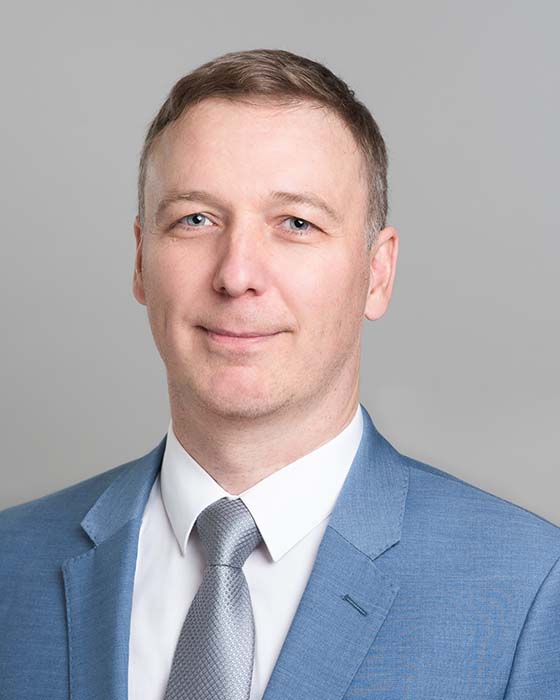
Roman Genov is a Professor in the Edward S. Rogers Sr. Department of Electrical & Computer Engineering at the University of Toronto, Faculty of Applied Science and Engineering, where he has been since 2002. His research focuses on analog and digital VLSI circuits, energy-efficient signal processing, and biomedical electronics with applications to biosensor arrays, neural interfaces, and implantable/wearable devices. B.S. in Electrical Engineering, Rochester Institute of Technology (1996) M.S.E. and Ph.D. in Electrical and Computer Engineering, Johns Hopkins University (1998, 2003) His work spans hardware-software co-design for adaptive computing, photonic sensory information acquisition, and parallel signal processing systems. Awards include IEEE Transactions associate editorships and multiple best paper/prize recognitions. Senior Member of IEEE Member of IEEE Circuits and Systems, Solid-State Circuits, and Engineering in Medicine and Biology societies Best Paper Award at IEEE Biomedical Circuits and Systems Conference (2011) DALSA Corporation Award for Microsystems Innovation (2006, 2009) He has mentored award-winning students and contributed to advancements in neural interfaces and low-power sensor arrays.
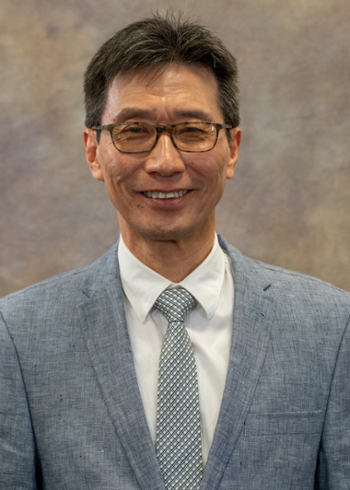
Dr. Young Ho Park is a Nakayama Professor in the Department of Mechanical & Aerospace Engineering at New Mexico State University . His research focuses on Solid Mechanics & Materials , with expertise in computational mechanics, fiber-reinforced composites, structural damage diagnosis, and multiscale modeling of nanosystems. He leads the Mechanical Design and Advanced Materials & Structures Lab . Education: PhD in Mechanical Engineering, University of Iowa (1994) Dr. Park's work spans advanced materials, renewable energy systems, and structural reliability. His recent projects include Solar Desalination with Fresnel Lenses and Flexoelectric Energy Harvesters , funded by NASA, USDA, and the Water Resources Research Institute. Publications emphasize thermal optimization , flexoelectricity , and composite pressure vessels . Key themes include energy recovery, multiscale modeling, and sustainable engineering solutions. Scientific Awards: Certificate of Recognition, ASME Pressure Vessel and Piping Division (2019, 2014) Synergy Teaching-Research-Serve Award (2017) Outstanding Conference Paper Award (2010) Mechanical Engineering Innovative Teaching Award (2003) Active grants include USDA Alpha-IOT Smart Agriculture and NASA EPSCoR Autonomous Structural Composites . His lab explores material behavior from nanoscale to industrial applications, integrating teaching and research through projects like the I-Discover STEAM initiative .
Henk-Willem Veltkamp serves as a Project leader at the MESA+ Institute for Nanotechnology, University of Twente. Holding an MSc degree (ing.) in Engineering, he specializes in microfluidic systems and silicon-based sensor fabrication within the institute's interdisciplinary research environment. His research focuses on Microfluidics, Sensor Engineering, and Silicon Fabrication, with significant contributions to MEMS, Nanotechnology, and Microfabrication. Key work includes developing microfluidic relative permittivity sensors using silicon sidewall electrodes, innovative anemometer designs, and advanced wet/dry etching techniques for microchannel fabrication. Recent publications (2024-2025) demonstrate expertise in silicon micromachining for fluid measurement systems, particularly in circular cross-section microchannels and real-time permittivity sensing. His work bridges semiconductor process engineering with microfluidic applications. Scientific recognition includes: 2nd prize poster presentation at INASCON 2013 (London) 2nd prize poster presentation at INASCON 2017 (Bristol) Long service medal from the Dutch Red Cross Veltkamp actively organizes academic conferences including INASCON 2016 and MicroFluidic Handling Systems 2017. His research at the MESA+ Institute drives innovation in microsystem fabrication and fluidic sensor design, with strong industry-relevant applications in semiconductor processing and microfluidic device manufacturing.
Carlo Alberto Paggi is a researcher at the University of Twente, specializing in Developmental BioEngineering . His work focuses on creating advanced microphysiological systems such as cartilage-on-chip and joint-on-chip platforms to study tissue regeneration and disease mechanisms. Key Research Areas: Cartilage biology, biomechanical stimulation, hydrogel-based microsystems, and synovial joint modeling. Recent Publications: Paggi has contributed to significant advancements in tissue engineering, including methods for high-density capillary network formation and dynamic mechanical stimulation of chondrocytes. Collaborations: He collaborates with experts in biomedical engineering and rheumatology, including Prof. Ali Mobasheri, Prof. Jeroen Leijten, and Prof. Marcel Karperien. Activities: Paggi has presented his work at various international conferences and symposia, emphasizing the integration of mechanical cues in tissue regeneration. The articles listed below highlight his innovative approaches to biomedical engineering , particularly in modeling complex joint systems and vascularized tissues using organ-on-chip technologies.
Stéphane Le Calvé is a CNRS Research Director (DR1) at the Institute of Chemistry and Processes for Energy, Environment and Health (ICPEES), affiliated with the University of Strasbourg. He leads the Analytical Chemistry and Materials for the Environment and Health research team and serves as head of the Molecular Chemistry and Analytics department. With extensive involvement in 37 research projects—including 6 European ones—he has coordinated 21 projects and served as principal investigator in 16. His research focuses on developing innovative analytical methods, particularly using microfluidic devices, for real-time monitoring of air pollutants. His work spans atmospheric chemistry, environmental health, and chemical instrumentation, with strong applications in public health and environmental protection. Research Interests: His primary research axis (60% effort) is the development of real-time analytical methods using microfluidic devices for air pollutant quantification. A secondary focus (10%) involves atmospheric emissions, metrology, and reactivity of pollutants. Since 2019, 30% of his time has been dedicated to studying VOC sorption on various materials, contributing to indoor air quality and material safety assessments. The 15 most recent articles reflect a consistent focus on microfluidics, environmental sensing, and analytical chemistry, with strong interdisciplinary connections to material science, instrumentation, and public health. Key trends include miniaturized, portable, and field-deployable sensors for real-time environmental monitoring, with increasing emphasis on indoor air quality and human exposure assessment. Scientific Awards & Recognition: Winner, CNRS Doctoral and Research Supervision Bonus (2019–2022) – awarded for excellence in scientific work Member, Editorial Board of Chemosensors Le Calvé has supervised 25 doctoral students (4 currently in progress), demonstrating a strong commitment to training the next generation of scientists. He has secured significant grant funding, evidenced by his leadership in 37 research projects. His work has led to 115 co-authored publications and 6 patents (3 licensed), highlighting both academic and technological impact. He leads a dedicated research team and department within ICPEES, fostering collaboration across disciplines. His laboratory focuses on microfluidic sensor development, atmospheric analysis, and material interactions with pollutants, positioning it at the forefront of environmental analytical chemistry.
Axel Scherer is the Bernard Neches Professor of Electrical Engineering, Applied Physics and Physics and Merkin Institute Professor at the California Institute of Technology (Caltech). He has been a faculty member at Caltech since 1993, progressing from Associate Professor to full Professor in 1995, and was appointed to the Bernard Neches Professorship in 2000 and the Merkin Institute Professorship in 2021. He previously served as Director (2006-08) and Co-Director (2008-11) of the Kavli Nanoscience Institute at Caltech. Professor Scherer received his B.S. (1981), M.S. (1982), and Ph.D. (1985) from the New Mexico Institute of Mining and Technology. His academic career has been centered at Caltech where he has made significant contributions to nanotechnology and photonics. Professor Scherer's research focuses on the application of microfabrication to integrated microsystems, with recent specialization on developing sensors and diagnostic tools for low-cost point-of-care disease detection and precision health monitoring. His group has pioneered microcavity lasers and filters, and currently works on integrating microfluidic chips with electronic, photonic, and magnetic sensors. They have also developed silicon nanophotonics, surface plasmon enhanced light emitting diodes, and perfected the fabrication of ultra-small structures below 10nm. Key research areas include silicon photonics for optical communications, point-of-care diagnostic tools, implantable wireless health monitors, nanostructure fabrication, and plasmonic sensing of biomolecules. Analysis of Professor Scherer's recent publications (2019-2024) reveals a continued focus on nanofabrication techniques, particularly for sub-10nm structures, and the development of advanced optical and sensing systems. His work spans multiple disciplines including nanophotonics, microfluidics, vacuum nanoelectronics, and biomedical sensing. A notable trend is the development of compact, robust optical systems for practical applications like disease detection and environmental monitoring. Elected to National Academy of Inventors Recipients of Demetriades - Tsafka - Kokkalis Prizes Professor Scherer leads the Caltech Nanofabrication Group, which specializes in the design, fabrication, and characterization of nanoscale photonic, magnetic, and fluidic devices and systems. His research has been supported by various grants enabling the development of innovative technologies such as silicon photonics for agile optical data communications, point-of-care diagnostic tools, and implantable wireless health monitors. The group has made significant contributions to the miniaturization of vacuum tube technology and optical strain gauges. Professor Scherer has also been involved in educational initiatives at Caltech, teaching courses such as APh 119 (Nanofabrication Techniques), EE/APh 180 (Nanotechnology), and APh/EE 9 (Solid-State Electronics for Integrated Circuits). His laboratory, the Caltech Nanofabrication Group, continues to push the boundaries of nanoscale device fabrication and application.
Catharina Bening-Bach is an Adjunct Professor at the Department of Management, Technology, and Economics (D-MTEC) at ETH Zurich , specializing in sustainability and technological innovation. She has contributed to research at the intersection of environmental science and business strategy. Research Focus: Sustainable technology integration, circular economy frameworks, and corporate sustainability strategies. Key Contributions: Development of analytical tools for isotope fractionation studies, exploration of microfluidic systems in material science, and historical analysis of architectural movements. Publications Highlights: Her work spans environmental biomarker analysis, microgel thermodynamics, and cultural architecture studies, reflecting interdisciplinary collaboration between engineering, economics, and humanities.
Stefan Heiserer is a researcher at the Professorship for Sensor Technologies at Universität der Bundeswehr München, where he contributes to advancements in sensor development and microsystem applications. He is based in Building 37, Room 037/0106, and can be reached at +49 (0)89 6004-3974 or via email at stefan.heiserer@unibw.de. His research focuses on sensor technologies, encompassing areas such as microelectronics, embedded systems, and instrumentation. This work aligns with applications in engineering and applied physics, particularly in the design and integration of smart sensing solutions. The body of his recent publications indicates a strong focus on semiconductor-based sensors, signal processing, and MEMS (Micro-Electro-Mechanical Systems), although specific articles are not listed in the current data source. Scientific Awards: No awards listed in available text. There is no public information available regarding student supervision, grants, or funding activities. He does not appear to lead a lab or research team independently, but rather works within the framework of the Sensor Technologies professorship under Prof. Düsberg.
Xavier Muñoz Berbel is a tenure researcher at the Microelectronics Institute of Barcelona (IMB-CNM, CSIC) and an associated professor at the Universitat Autònoma de Barcelona (UAB). His work bridges microelectronics and biotechnology, focusing on the development of biosensors and smart biomaterials. He has collaborated with leading institutions in France, the UK, the Netherlands, Denmark, and Spain. His research interests include smart biomaterials and biosystems , with specific focus on organ-on-a-chip , bacterial sensors , and microbial fuel cells . His interdisciplinary work integrates engineering, biology, and materials science to develop innovative sensing platforms. The trends in his research, as reflected in his publications, emphasize miniaturized biological systems, energy-harvesting microbial devices, and lab-on-chip technologies, primarily within the domains of bioengineering, environmental monitoring, and biomedical diagnostics. He has participated in over 30 research projects (9 as coordinator, 12 European) and presented at over 80 conferences (19 by invitation). He is co-author of more than 80 publications with over 1700 citations and an H-index of 25, and co-inventor of 14 patents (3 licensed). He leads and collaborates with multidisciplinary research teams at IMB-CNM, CSIC, and UAB, contributing to technology transfer and innovation in biosensing and microsystems.
Dirk Warmbier serves as a Researcher (Scientific Collaborator I) in the Department of Computer Science within the Faculty of Computer Science and Communication at Westfälische Hochschule University of Applied Sciences. Based in room A4.1.16 at Neidenburger Str. 43, Gelsenkirchen, he functions as Workshop representative and operates under the supervision of Prof. Dr. Lars Christoph Gleim. His research centers on Technical Microinformatics, encompassing microcontroller systems design, embedded computing architectures, and low-level hardware-software co-development. This work bridges theoretical computer engineering with practical microelectronic applications, particularly in resource-constrained technical environments requiring real-time processing capabilities. Warmbier actively contributes to laboratory instruction and research support within the Computer Science Department, with his technical expertise applied to workshop management and experimental system development. His role integrates teaching responsibilities with hands-on research in microsystem technologies.
Marko Merdzan serves as a University Lecturer in the Department of Electrical Engineering at Eindhoven University of Technology, where he has been affiliated with the Electromechanics and Power Electronics (EPE) research group since 2017. His work focuses on advancing high-speed permanent magnet machine technology for sustainable energy applications. His academic credentials include: MSc in Electrical and Computer Engineering (2009) from the University of Novi Sad's Department of Power, Electronics and Telecommunications Engineering PhD in Electrical Engineering (2024) from Eindhoven University of Technology with thesis on electromagnetic analysis of high-speed machines Merdzan's research centers on electromagnetic modeling of high-speed permanent magnet machines, specializing in eddy current loss mitigation, harmonic analysis, and thermal management. He develops computationally efficient semi-analytical models and finite element methods to optimize machine performance, directly contributing to UN Sustainable Development Goals for clean energy. His expertise bridges theoretical electromagnetic principles with practical power electronics implementation. Analysis of his 13 publications (2012-2024) reveals consistent focus on rotor loss mechanisms in high-speed machines under PWM inverter operation. Key trends include: development of harmonic modeling techniques for loss prediction, experimental validation of switching frequency effects, and comparative studies of winding configurations - all addressing critical barriers to efficient electromechanical energy conversion. His recognition includes: Best Student Paper Award at IEEE GPECOM 2020 conference Merdzan has secured significant research funding through four major projects: AutoDrive (EPE) (2017-2020): Autonomous vehicle propulsion systems Kostprijsverlaging duurzame energie (2017-2022): Cost reduction for small-scale biogas energy Strengthening CAREESD Research (2015-2018): Electromechanical systems capability building Biogas-fired Hybrid Heat and Power (2015-2019): Combined heat/power systems using biogas As core faculty in the EPE group, he contributes to TU/e's leadership in electromechanical energy conversion research, maintaining active collaboration with industry partners on sustainable energy solutions while teaching foundational courses in electromechanics and automotive systems.
Seyed Hossein Miri Lavasani serves as an Assistant Professor in the Department of Electrical Engineering and Computer Science at Case Western Reserve University's Case School of Engineering. His office is located in Glennan 712, and he can be reached at seyedhossein.mirilavasani@case.edu or 216.368.4083. His educational background includes: PhD in Electrical and Computer Engineering from Georgia Institute of Technology (2010) MS in Electrical Engineering from Arizona State University (2003) BS in Electrical Engineering from Sharif University of Technology (2001) Miri Lavasani specializes in high-performance integrated circuits and systems with particular focus on low-power interface circuits for MEMS and sensors . His research bridges microelectronics and microsystems, emphasizing energy-efficient design for wireless and IoT applications. Recent work demonstrates expertise in CMOS RF circuits, MEMS oscillators, and ultra-low-power receiver architectures. His publication record includes 21 journal and conference papers with over 510 citations, primarily in IEEE venues like JMEMS, CICC, and CSICS. Research trends show consistent innovation in MEMS-CMOS integration, power optimization for wireless systems, and novel circuit techniques for sensor interfaces. Miri Lavasani maintains active research in microelectronics with emphasis on practical implementations for emerging technologies. His work demonstrates strong industry relevance through collaborations with semiconductor research groups and focus on manufacturable solutions in advanced process nodes.
Vijay Narayanan serves as the Robert Noll Chair Professor in the Department of Computer Science & Engineering and Electrical Engineering at Pennsylvania State University, co-directing the Microsystems Design Lab and leading multiple interdisciplinary research initiatives. His academic credentials include: B.E. in Computer Science and Engineering from University of Madras (1989-1993), achieving University First Rank Ph.D. in Computer Science and Engineering from University of South Florida (1993-1998) with dissertation on "Issues in Design of a Java Processor" Research spans embedded visual analytics systems for UAVs and visually impaired assistance, non-volatile processors for unreliable power environments, and system design using emerging devices. His work integrates power-aware computing, computer architecture, and design automation to develop self-powered systems and intelligent vision technologies. Major recognitions include: IEEE Fellow ACM Fellow He directs the Visual Cortex on Silicon center for embedded vision systems, contributes to NSF ERC ASSIST on self-powered processors, and leads the Architecture, Benchmarking and Circuits Thrust in the DARPA/SRC LEAST Center for emerging device integration.
Francesco Mocera serves as a Fixed-term tenure-track Assistant Professor in the Department of Mechanical and Aerospace Engineering (DIMEAS) at the Polytechnic University of Turin. His academic work spans multiple institutional roles, including membership in the Doctoral Colleges for Mechanical Engineering (2023-2025 cycles) and invited membership in several Course of Study Colleges including Electrical and Energy Engineering, Electronic/Telecommunications/Physics Engineering, and Mechanical/Aerospace/Automotive Engineering. Dr. Mocera's research focuses on three primary areas: electromechanical performance of lithium-ion cells, innovative hybrid electric powertrain design for agricultural and construction vehicles, and IoT integrated monitoring systems for vehicle applications. His work intersects with Sustainable Development Goals 3 (Good Health and Well-being), 9 (Industry, Innovation, and Infrastructure), and 13 (Climate Action) through engineering solutions that promote sustainable agricultural practices and reduce environmental impact. His research incorporates expertise in industrial design, mechanical manufacturing engineering, simulation modeling, and sustainable design principles. Analysis of his recent publication record reveals a strong trend toward sustainable agricultural machinery electrification, with particular emphasis on hybrid and fuel cell powertrains for agricultural vehicles. His research increasingly integrates life cycle assessment methodologies to evaluate environmental impacts, alongside detailed electromechanical modeling of battery systems. The work demonstrates a clear trajectory from fundamental battery mechanics research toward practical implementation in agricultural machinery, with growing interdisciplinary connections between mechanical engineering, environmental science, and agricultural technology. Effective member of AIAS, Italia (2016-present) Dr. Mocera actively supervises three PhD students (Mattia Scanavino, Giovanni Mantini, and Valerio Martini) working on agricultural vehicle electrification projects. His research portfolio includes significant EU-funded projects like LIFE LAERTHES (2025-2027) as Scientific Manager, along with multiple commercial research contracts focused on hybrid electric systems for agricultural machinery. Current projects examine fuel cell systems, MEMS sensor applications, and performance evaluation of electrified propulsion systems for specialized agricultural vehicles. His work is conducted within the Design and testing of railway and industrial systems and vehicles and microsystems research group at DIMEAS, where he leads efforts to develop innovative solutions for sustainable agricultural machinery through advanced modeling, simulation, and experimental validation approaches.
Artur Dybko is a Professor at the Chair of Medical Biotechnology, Faculty of Chemistry, Warsaw University of Technology. His research focuses on microfluidic systems , lab-on-a-chip technology , and nanomaterials for anticancer therapy , with particular emphasis on photodynamic therapy (PDT) and photothermal therapy (PTT) . He has developed innovative PDMS-based microdevices for 3D cell culture , drug testing , and electrochemotherapy studies . Key research areas: Microfluidics, Biotechnology, Nanomedicine Major contributions: Integrated microsystems, Surface modification techniques, Cancer therapy optimization The 2025 articles highlight his work on ITO-electrode microsystems for electroporation, Au@Fe₃O₄@PEG nanocubes in PTT, and paper-based sensor cartridges for explosive detection. Earlier studies (2019-2022) explored MXene applications , gold nanoshells , and PDMS surface modifications for biomedical use. Scientific achievements include: IMCS First Place Best Paper Award (2021) Over 213 publications and 30 patents Key collaborations with Warsaw University of Technology's Faculty of Chemistry and Zbigniew Brzózka's Lab He has supervised 23 promoted theses and contributed to 9 major research projects , including advanced 3D tumor models and microfluidic diagnostic systems .