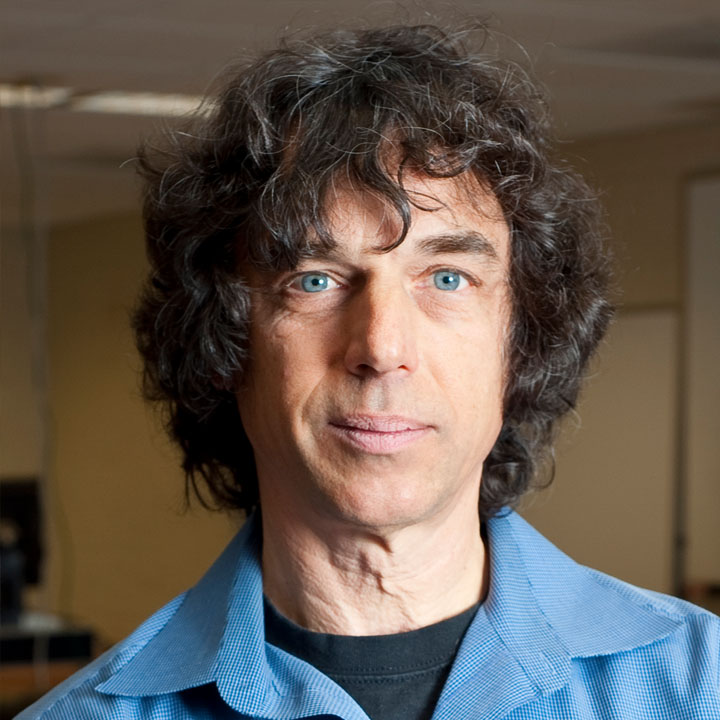
Charles C. Agosta is a Professor of Physics at Clark University and CEO/co-founder of Machflow Energy, Inc. His research focuses on superconductivity in extreme magnetic fields, renewable energy systems, and heat transfer technologies. He earned his Ph.D. from Duke University (1986) and B.A. from Wesleyan University (1980). Research interests include studying anisotropic conducting materials under extreme conditions (e.g., 51 T magnetic fields) to probe Fermi surfaces and correlated electron phenomena such as superconductivity. His group develops advanced instrumentation like pulsed magnetic field labs and the Tunnel Diode Oscillator technique. Machflow Energy’s Bernoulli heat pump, funded by Kleiner Perkins and the DOE, uses environmentally safe refrigerants for energy-efficient thermal management. Recent work includes NSF-funded studies on organic superconductors' FFLO states and DC microgrid implementations. Agosta teaches core physics courses and leads projects like the Clark NanoGrid. He holds six patents for heat transfer innovations and has over 100 publications in peer-reviewed journals.
Cornelia Helmcke is a Senior Policy Fellow at the Centre for Energy Ethics affiliated with the University of St Andrews. As a political ecologist, her research focuses on just transitions in energy systems, land-use conflicts, and the intersections between climate policy and local realities. She has conducted fieldwork in Scotland and Colombia, analyzing how global net-zero ambitions clash with community needs. Her recent projects include investigating energy grid limitations in Scottish islands and peatland restoration challenges in rural Scotland. Teaching highlights include convening undergraduate modules on political ecology and co-teaching the MSc Energy Policy and Finance program. She has advised three graduate students and collaborated with crofting communities to produce policy guidance. Key funding includes the Scottish Research Alliance for Energy, Homes and Livelihoods and University of St Andrews interdisciplinary grants. Her work bridges academic research with policy impact, producing both peer-reviewed articles and actionable reports. Current projects emphasize participatory methods to address energy poverty and carbon offsetting inequities. The Energy Data Justice Framework she developed offers innovative tools for assessing green energy projects' social and environmental impacts.
Mahshid Javidsharifi is a Postdoctoral Researcher at Aalborg University's Faculty of Engineering and Science, specializing in the Electric Power Systems and Microgrids department. Her expertise spans energy microgrids, renewable energy systems, and sustainable development. She has contributed to projects like LastWind (Ethiopian wind power integration) and Photovoltaic Energy Supply for Future Energy Neutral Base Stations , focusing on optimizing energy systems and enhancing grid reliability. Javidsharifi holds a Marie Skłodowska–Curie PhD Fellowship and has published extensively on microgrid management, battery degradation effects, and UAV-based energy solutions. Her research interests include: Multi-node microgrid operation under normal/abnormal conditions Integration of photovoltaic systems and battery storage Optimization algorithms for energy efficiency Cybersecurity in energy systems Key projects include leading PAINLESS (autonomous energy systems for infrastructure-less networks) and participating in LastWind , demonstrating her focus on sustainable energy solutions for telecommunications and developing regions. Her work aligns with UN Sustainable Development Goals, particularly clean energy access and environmental sustainability. Publications highlight her contributions to energy management strategies, stochastic optimization, and renewable integration. Awards include the prestigious Marie Skłodowska–Curie Fellowship, underscoring her academic and practical impact in energy research.
Simon Lennart Sahlin is an Associate Professor at Aalborg University's Faculty of Engineering and Science, Department of Thermal Engineering. His research focuses on advanced biofuels, hydrogen and electro-fuels, offshore drones/robotics, and sustainable energy systems. He leads and participates in major projects such as NEST (National Research Infrastructure Roadmap), FC-COGEN (Micro-CHP integration), and BlueDolphin (waste heat utilization in fuel cells). His work addresses energy transition challenges through innovations in fuel cell systems, energy storage, and renewable integration. Sahlin has authored/co-authored over 40 publications and secured significant research funding from EUDP, Innovation Fund Denmark, and others. He collaborates with industry partners and academic teams on cutting-edge technologies like high-temperature PEM fuel cells and SOE-based energy storage systems. Education : Not explicitly stated in provided texts. Research Interests : Fuel cell diagnostics, renewable energy systems, electrochemical processes, and sustainable infrastructure. Recent publications emphasize data-driven fault diagnosis in fuel cells, microgrid control systems, and high-pressure electrolysis performance. Media coverage highlights his contributions to green hydrogen solutions and energy-efficient technologies. Sahlin advises two PhD students and actively engages in interdisciplinary research initiatives.
Professor Juan C Vasquez is a faculty member at Aalborg University's Department of Energy Technology, serving as Co-Director of the Center for Research on Microgrids (CROM). Recognized as a Highly Cited Researcher (2017-2023), his work spans technical and interdisciplinary domains in energy systems, with a focus on microgrids, renewable integration, and cybersecurity. His research includes smart grid control, power electronics reliability, and AI-driven energy management systems. He also explores computational creativity in electroacoustic music, evidenced by performances at ISEA 2025 and ACMC 2024. Key subtopics involve fault diagnosis, EV infrastructure, and resilience analysis for disaster-struck communities. Scientific accolades include a First Prize at the 'Città di Barletta' competition. His publications bridge energy technology and digital arts, reflecting a unique interdisciplinary approach to sustainable energy systems and computational sound design.
Bertrand Cornélusse is an Assistant Professor at the University of Liège , affiliated with the Faculty of Applied Sciences and the Department of Electricity, Electronics and Computer Science . His work focuses on electric power systems, smart microgrids, and sustainable energy solutions, bridging engineering and computer science. He teaches courses such as Electrical Circuits , Analysis of Electric Power and Energy Systems , and Microgrids , emphasizing interdisciplinary approaches. His research aligns with ULiège’s commitment to innovation in energy transition and mathematical programming. For direct contact, his email is bertrand.cornelusse@uliege.be , and his office is located at the Montefiore Institute in Liège, Belgium.
Fatima Taousser is a Teaching Professor in the Min H. Kao Department of Electrical Engineering and Computer Science at the University of Tennessee, Knoxville. She holds a PhD in Applied Mathematics from the Polytechnic University of Hauts-de-France (2015) and has conducted postdoctoral research at CURENT and Oak Ridge National Laboratory (ORNL). Her work focuses on stability and control of switched systems, networked control systems, and machine learning applications in power systems. Education: PhD in Applied Mathematics, Polytechnic University of Hauts-de-France, 2015 MSc in Mathematics (Dynamic Systems & Control), University of Sidi Bel Abbes, Algeria, 2009 BSc in Mathematics (Probability & Statistics), University of Sidi Bel Abbes, 1999 Research interests include: Switched systems on non-uniform time domains Hybrid systems and safety verification Time scales theory applications Microgrid control and voltage restoration Multiagent systems consensus Her recent publications emphasize control design for power systems, stabilization techniques for switched systems, and consensus algorithms in multiagent networks. Collaborations include work with CURENT and ORNL on energy systems and distributed control.
John Shen is an Adjunct Professor in the Department of Electrical and Computer Engineering at Illinois Institute of Technology (IIT), part of the Armour College of Engineering. He previously held the Grainger Endowed Chair Professorship at IIT from 2013 to 2022. His career includes roles at Motorola Inc., the University of Michigan-Dearborn, and the University of Central Florida. He specializes in power electronics, power semiconductor devices, and renewable energy systems. Shen's education includes a Ph.D., M.S., and B.S. in Electrical Engineering from Rensselaer Polytechnic Institute and Tsinghua University. His research, supported by NSF, ARPA-E, and industry, focuses on high-efficiency power systems, DC/AC microgrid protection, and transportation electrification. He has authored 300+ publications and holds 18 patents. He is an IEEE Fellow and member of the U.S. National Academy of Inventors. His awards include the 2020 Sigma Xi Research Award and 2011 IEEE Fellow designation. He has held leadership roles in IEEE PELS, including Vice President of Products and editorships in journals like Power Electronics Magazine. Shen’s work bridges academia and industry, emphasizing practical applications like fault-tolerant circuit breakers and energy-efficient semiconductor devices. His contributions to power electronics have advanced grid stability and renewable energy integration.
Junbo Zhao is the Castleman Term Professor in Engineering Innovation at the University of Connecticut's Department of Electrical and Computer Engineering. He directs the DOE-funded CyberCARED Center and serves as a Research Scientist at the National Renewable Energy Laboratory. His research focuses on cyber-physical power systems, resilience, and machine learning applications in smart grids. He leads multiple IEEE PES initiatives including the Working Group on Distribution System DERs and the Task Force on Cyber-Physical Interdependency. Education: PhD from Virginia Tech's Bradley Department of Electrical and Computer Engineering (2018), advised by Prof. Lamine Mili. Prior roles include Assistant Professor at Mississippi State University and Virginia Tech, and a summer internship at Pacific Northwest National Laboratory. Research Highlights: Develops advanced methodologies for power system modeling, cybersecurity, and renewable integration. Specializes in data-driven control, uncertainty quantification, and resilient energy systems. His work bridges physics-based models with machine learning techniques for smart grid optimization. Professional Contributions: Serves as Associate Editor for leading journals like IEEE Transactions on Power Systems and IET Renewable Power Generation. Holds over 200 publications and 20+ grants from NSF, DOE, and industry partners. Recognized with the 2024 NSF CAREER Award, 2023 AAUP Research Excellence Award, and numerous Best Paper Awards. Leads $5M+ projects on grid modernization Founder of IEEE Cyber-Physical Interdependency Task Force Prominent in distribution system visibility & control Labs & Teams: Directs CyberCARED - a DOE-funded initiative developing cybersecurity solutions for advanced energy delivery systems. Collaborates with industry partners like Eversource, Dominion Energy, and Avangrid on grid resilience projects.
Dr. Hamza Abunima is an Assistant Professor at the Electrical Electronics Engineering Department of Uskudar University since 2021. He holds a PhD in Power Systems and Energy Conversion from Universiti Sains Malaysia (2020), an MSc in Electrical Engineering from Universiti Teknikal Malaysia (2015), and a BSc in Electrical Engineering from The Islamic University of Gaza (2011). His research focuses on power systems optimization, renewable energy integration, and smart grid technologies. He has published extensively on topics such as mixed-integer programming for scheduling, microgrid operations, and photovoltaic system reliability. Abunima has led or participated in projects like the establishment of a Power Systems and Electric Machines Laboratory (expiring 2024) and research on industrial energy problems (expiring 2024). His administrative roles include Erasmus Coordinator (2022–2023) and membership in the Exam Schedule Preparation Committee (2023–present). He teaches courses such as Power Systems, Fuzzy Logic and Neural Networks, and Circuit Theory II. His research interests emphasize optimizing energy systems through mathematical modeling and control strategies, with a focus on renewable energy integration challenges and grid stability. Recent work includes studies on PV system efficiency, demand-side management, and stochastic optimization for microgrids.
Dr. Augustine Egwebe is a Senior Lecturer in the School of Electronic and Electrical Engineering at Swansea University's Faculty of Science and Engineering. He specializes in electrical power systems, renewable energy integration with microgrids, energy management, modern control systems, and robotics. His work contributes significantly to Swansea University's research in sustainable energy systems and power electronics. Dr. Egwebe received his PhD and BEng degrees in Electrical and Electronic Engineering (EEE) from Swansea University. His academic career at Swansea progressed from Academic Teaching/Research Assistant (2016-2019), to Lecturer (2019-2021), and currently Senior Lecturer (2021-Present). He is a Fellow of the UK's Advance Higher Education Academy (FHEA) and a member of the Institute of Electrical Technology (IET). His research focuses on developing novel and cost-effective dynamic control and power electronics solutions for integrating renewable energy systems with microgrids. Key areas include: Electrical power systems and microgrid integration Renewable energy resource management Modern control systems and robotics applications Energy forecasting and real-time scheduling Electrical machines modeling and control Power electronics interface design His recent publications demonstrate a strong focus on power systems stability, microgrid control strategies, and renewable energy integration. The research shows increasing sophistication in control algorithms for power electronics interfaces and growing interest in machine learning applications for energy prediction, particularly in photovoltaic systems and small spacecraft power management. Professional recognition includes: Fellow of the UK's Advance Higher Education Academy (FHEA) Active membership in the Institute of Electrical Technology (IET) Regular reviewer for academic transactions in his field As an educator, Dr. Egwebe supervises multiple PhD and MSc students, with recent completions in solar energy forecasting, microgrid energy management, and power electronic control techniques. He teaches core engineering modules including EG-243 Control Systems, EG-241 Electrical Machines, and developed the EGA222 Electrical Machines Laboratory module using Arduino-based hardware-in-the-loop experiments. He champions technology-enhanced learning to inspire lifelong learning among students.
Antti Hildén is a Doctoral Researcher in the field of Electrical Engineering, focusing on advanced research in power systems and smart energy applications. His work contributes to the UN Sustainable Development Goals related to affordable and clean energy (SDG 7) and industry innovation (SDG 9). Research Interests: Hildén’s research spans power quality analysis, renewable energy integration, and smart grid technologies. He explores topics such as electric vehicle charging infrastructure, microgrid stability, and the impact of photovoltaic systems on distribution networks. His work combines data-driven approaches with machine learning to innovate solutions for modern energy challenges. Key Contributions: His publications address critical areas like automated load control detection, energy communities, and the optimization of groundwood lines for grid stabilization. Notable projects include a data collection platform for smart energy applications in modern buildings, enhancing energy efficiency and grid reliability.
Nikolaos Diaggelakis serves as an Assistant Professor in the Department of Process Development, Analysis & Design (II) at the School of Chemical Engineering, Technical University of Crete, where his work bridges theoretical optimization and industrial process applications. Education: Ph.D. in Chemical Engineering, Imperial College London, 2017 M.Sc. in Chemical Engineering, Imperial College London, 2012 Diploma in Chemical Engineering, National Technical University of Athens, 2011 Visiting Doctoral Researcher, Texas A&M Energy Institute, 2017 His research pioneers process systems engineering through mathematical optimization with moving time horizons, simultaneous design-control integration, and multi-parametric programming frameworks. Key applications span chemical process intensification, energy-efficient microgrids, and environmental systems, emphasizing worst-case and nonlinear optimization robustness. His theoretical contributions directly enable industrial implementations in energy systems and manufacturing. Publications from 2015-2022 reveal a concentrated evolution toward real-time optimization and decentralized control architectures , with increasing focus on data-driven surrogate models and robust explicit MPC strategies. The work consistently bridges fundamental algorithm development (e.g., multi-parametric quadratic programming solutions) with tangible industrial applications like air separation units and combined heat-power systems. Scientific Awards: Excellence Award for Outstanding PhD Thesis in Computer Aided Process Engineering (CAPE), Third Place, 2017 Invited Speaker, Distinguished Young Researchers Seminar Series, Northwestern University, 2016 Best Poster Award, CPSE Autumn Industrial Consortium Meeting, Imperial College London, 2014 Dr. Diaggelakis actively secures competitive funding, including U.S. Department of Energy grants (2018-2020) for smart manufacturing in chemical processing and National Science Foundation projects (2015-2016) on integrated process design-control frameworks. His leadership in the PAROC research group drives software development (POP toolbox) and industry collaborations through consortia like CPSE. Current projects emphasize uncertainty-aware scheduling for process industries and energy-efficient microgrid operation. He co-develops the industry-standard PAROC framework and POP toolbox, enabling multi-parametric optimization for complex process systems, and maintains active partnerships with Texas A&M and Imperial College London through ongoing research consortia.
Dr. Pere Colet Rafecas is a Research Professor at CSIC (Consejo Superior de Investigaciones Científicas) and Associate lecturer in the Physics Department at Universitat de les Illes Balears (UIB), specializing in Condensed Matter Physics. He earned his Physics degree from Universitat de Barcelona in 1987 and completed his PhD at UIB in 1991, followed by a Fulbright postdoctoral fellowship at Georgia Institute of Technology. Since joining CSIC in 1995, he has advanced to Senior Researcher in 2005 and Research Professor in 2007. His research program spans theoretical and interdisciplinary work in statistical and nonlinear physics, with applications ranging from optical systems to socio-technical networks. His expertise includes pattern formation, synchronization phenomena, nonlinear dynamics in optical systems, and more recently, human mobility and power grid stability. His work demonstrates remarkable breadth, connecting fundamental physics with practical applications in energy systems and social dynamics. Dr. Colet has published 111 articles in Q1 journals, with one paper exceeding 500 citations and four others surpassing 200 citations. His Google Scholar profile shows 5,634 total citations with an h-index of 35. Since 2010, he has published 26 articles in Q1 journals, including publications in Nature Communications and Physical Review Letters. Web of Science: 4,031 total citations (3,722 excluding self-citations), h-index=30 Google Scholar: 5,634 total citations, h-index=35, i-10 index=86 Dr. Colet has advised 4 completed PhD theses and currently mentors 2 additional doctoral students. He has led research projects including a Spanish government Plan Nacional project and has participated in 7 European Commission projects and 5 additional Plan Nacional projects. His current research focuses on power grid stability with high renewable penetration, human mobility patterns, and nonlinear optical systems.
Sathyajith Mathew is a Professor at the University of Agder, Norway, within the Faculty of Engineering and Science, Department of Engineering Sciences. He currently serves as Programme Manager for the Master's in Renewable Energy program and Programme Coordinator for Flexible Learning for Offshore Wind (FLOW). Previously, he held leadership positions at the University of Brunei Darussalam including Deputy Director of the Institute of Applied Data Analytics and UBD | IBM Centre, Programme Leader for Physical and Geological Sciences, and Co-Coordinator of the Energy Research Cluster. Professor, University of Agder (Current) Deputy Director, Institute of Applied Data Analytics, University of Brunei Darussalam (2017-2018) Deputy Director, UBD | IBM Centre, University of Brunei Darussalam (2013-2017) Programme Leader, Physical and Geological Sciences, University of Brunei Darussalam (2013-2014) Co-Coordinator, Energy Research Cluster, University of Brunei Darussalam (2009-2011) Dr. Mathew holds a PhD and graduated from the Indian Institute of Technology, Kharagpur, India. With over 25 years of professional experience in wind energy and data analytics, he has established himself as a leading expert in renewable energy technologies. Dr. Mathew's research focuses on wind energy systems with particular expertise in offshore wind energy, low wind speed turbines, wind power forecasting, distributed wind energy, and wind resource analysis. His work bridges theoretical research with practical applications, developing innovative solutions for improving wind energy conversion efficiency and integration into power grids. His research interests extend to solar photovoltaic systems, electric vehicle charging infrastructure, and waste-to-energy technologies, reflecting a comprehensive approach to sustainable energy systems. His extensive publication record demonstrates a consistent focus on advancing wind energy technologies while expanding into related renewable energy domains. Recent work shows an increasing integration of machine learning and artificial intelligence techniques for energy forecasting and system optimization, reflecting the evolving nature of renewable energy research. Editor, AIMS Energy journal Member of the Wind Working Group, United Nations Framework Classification for Fossil Energy and Mineral Reserves and Resources (UNFC) As an educator, Dr. Mathew teaches specialized courses including Wind Energy (MSc), Wind Power (BSc), Energy Research Project, and Masters Thesis supervision. His teaching emphasizes both theoretical foundations and practical applications of renewable energy technologies. His research group, Intelligent Mechatronics (iTron), focuses on integrating advanced computational methods with renewable energy systems to address real-world energy challenges. Dr. Mathew leads the Flexible Learning for Offshore Wind (FLOW) initiative, demonstrating his commitment to developing educational programs that address industry needs in the rapidly growing offshore wind sector. His work bridges academic research with practical industry applications, contributing to the advancement of renewable energy technologies worldwide.