Dr. Yi-Ping Fang is an Assistant Professor at the EDF Chair SSEC with a joint appointment at the Industrial Engineering Laboratory, CentraleSupélec, Université Paris-Saclay, France. His research focuses on computational methods for risk, vulnerability, and resilience analysis of critical infrastructures including smart grids, electrified transportation, and interdependent lifeline systems. Risk Analysis Resilience Engineering Optimization Under Uncertainty Game Theory Applications His work applies advanced techniques like distributionally robust optimization, POMDP modeling, and interdependency analysis to enhance infrastructure resilience against climate change, natural hazards, and intentional attacks. Publications demonstrate expertise in hybrid optimization algorithms, stochastic modeling, and network vulnerability assessment. Recent trends include: Smart grid resilience enhancement Uncertainty quantification in infrastructure systems Multi-stage decision modeling Game-theoretic approaches for interdependent networks Integration of deep learning for dynamic system prediction
Professor Antonio Griffo holds the position of Professor of Power Electronics and Electric Drives at the University of Sheffield's School of Electrical and Electronic Engineering. He leads the Electrical Machines and Drives Research Group and is involved in the High Reliability Drives Group. His academic journey includes a MSc (2003) and PhD (2007) in Electrical Engineering from the University of Naples, followed by research roles at Bristol and Sheffield Universities before becoming a Lecturer in 2013 and later a Professor. His research focuses on advanced control of electric drives, SiC-based power electronics for aerospace/renewables, fault detection in machines, and thermal management. Key projects include modeling hybrid AC/DC power systems for 'More Electric Aircraft', sensorless control techniques, and real-time simulation methodologies. He has pioneered work on SiC converter reliability, insulation monitoring, and condition-based maintenance systems. Publications (15+ in top journals like IEEE Transactions) emphasize innovative solutions for power electronics challenges, including voltage stress mitigation, thermal modeling, and fault tolerance. His work bridges theory and application, addressing critical issues in aerospace, renewable energy, and electric vehicle systems. Griffo also contributes to educational advancements through modular training platforms for power electronics education. Labs/Teams: Active in the Electrical Machines and Drives Research Group, focusing on high-reliability drive systems and sustainable energy technologies. Collaborates with industry on projects like the EPSRC Offshore Wind Prosperity Partnership.
Mesut Baran is a Professor in the Department of Electrical and Computer Engineering at North Carolina State University. He focuses on applying computer, control, and system analysis techniques to power system operation and planning, particularly in smart power distribution systems and distributed energy resource integration. His research emphasizes grid resilience, renewable energy integration, and advanced grid technologies. Education: Ph.D. in Electrical Engineering, University of California, Berkeley (1988) Master's in Electrical Engineering, Middle East Technical University, Turkey (1981) Bachelor's in Electrical Engineering, Middle East Technical University, Turkey (1979) Research interests include power electronics, smart grid technologies, distributed energy resource management, and grid resilience. His recent work addresses challenges in EV charging impacts, fault tolerance, and microgrid coordination. Baran has contributed to IEEE standards and received prestigious awards, including the IEEE Fellow designation (2010) and the William F. Lane Outstanding Teaching Award (2017). Publications highlight advancements in distribution system state estimation, fault mitigation, and microgrid management. Collaborations with industry (e.g., Strata Solar) and federal grants ($3.1M DOE award) underscore his applied research impact. He teaches foundational courses like ECE200 and advises on FREEDM Systems Center projects.
Navid Bayati is an Associate Professor at the University of Southern Denmark, affiliated with the Institute of Mechanical and Electrical Engineering and the Centre for Industrial Electronics. He leads the Control and Protection of Smart Grids (CAP-SG) group and focuses on renewable/hybrid power systems, microgrid protection, and grid code compliance. Education: Ph.D. in Power Systems & Microgrid Protection (2020, Aalborg University); M.Sc. in Power Systems (2017, Amirkabir University of Technology) His research spans renewable energy integration , transient analysis , grid interconnection , and digital twin applications . Recent work includes machine learning for carbon emission prediction, fault localization in DC microgrids, and supercapacitor resilience in hybrid systems. Collaborations include projects like IEA Wind Task 50 and RePoSys , addressing grid renovation, life cycle assessment, and digital twin resilience. His teaching portfolio covers power electronics , energy management , and microgrid control .
Chuchu Fan is the Leonardo Career Development Professor and Director of the REALM Lab (REliable Autonomous system Lab) at MIT's School of Engineering , with a primary appointment in the Department of Aeronautics and Astronautics and Laboratory for Information and Decision Systems . Her work bridges formal methods , control theory , and machine learning to ensure safety in autonomous systems. Ph.D., University of Illinois at Urbana-Champaign (2019) B.E., Tsinghua University (2013) Her research focuses on rigorous safety verification of autonomous systems through neural Lyapunov-barrier functions , control contraction metrics , and formal logic specifications . Recent work emphasizes LLM integration for symbolic planning, multi-robot collaboration , and robustness against model uncertainties . The 15 most recent articles highlight trends in safety-critical control using graph neural networks , reinforcement learning , and temporal logic . Key themes include collision avoidance , multi-agent coordination , and runtime safety filters applied to drones, self-driving cars, and microgrids. Scientific Awards & Honors : 2025 ONR YIP Award 2023 NSF CAREER & AFOSR YIP Awards 2020 ACM Doctoral Dissertation Award 2016 Rising Stars in EECS As head of the REALM Lab, she leads projects on autonomous air taxis , safety verification , and neural certificates for robotic systems. Her teaching includes courses on feedback control and formal methods for autonomous systems.
Suresh Khator is a Professor and Senior Associate Dean for Graduate Programs and Computing Facilities at the University of Houston's Cullen College of Engineering, Department of Industrial and Systems Engineering. He holds a Ph.D. in Industrial Engineering from Purdue University and has extensive experience in academia, industry, and administrative roles. His research focuses on modeling energy, healthcare, and manufacturing systems, facilities design, production planning, and project management. He has supervised 10 PhD dissertations and 37 Master's theses, and his work has been published in top-tier journals and conferences. Khator has received numerous awards, including the Fellow of IISE and multiple teaching excellence awards. His administrative roles include Director of Engineering Computing and Interim Associate Dean at the University of South Florida. He has also contributed to community initiatives, such as science fairs and outreach programs. His articles span power systems resilience, renewable energy integration, and manufacturing automation. He has led over 30 grants and contracts, including projects with the Florida Department of Transportation and utility companies.
Louis-A. Dessaint is a Professor at the Département de génie électrique at École de technologie supérieure (ÉTS). He holds B.Ing., M.Sc.A., and Ph.D. degrees from Polytechnique Montréal. His research focuses on power electronics, renewable energy integration, and smart grid technologies, with affiliations to the GREPCI research group. He has supervised numerous theses and projects, addressing topics like microgrid optimization, energy storage, and voltage stability. Education: B.Ing., M.Sc.A., Ph.D. (Polytechnique Montréal). Research interests include electric machines, power network dynamics, hybrid energy systems, and sustainable development. His recent work emphasizes real-time control of power systems, renewable energy integration, and smart building energy management. Publications highlight advancements in microgrid topology optimization, battery storage systems, and ADRC-based control strategies. Awards include IEEE Fellow (2013) and membership in the Canadian Academy of Engineering (2012). He has advised over 50 students and contributed to projects on smart grids, energy storage, and grid stability. His lab, GREPCI, focuses on power electronics and industrial control.
Sijia Geng is an Assistant Professor in the Department of Electrical and Computer Engineering (ECE) at Johns Hopkins University (JHU) and a core researcher at the Ralph O’Connor Sustainable Energy Institute (ROSEI). She directs the Power and Energy Network Systems Analysis (PENSA) Laboratory and co-leads the NSF-funded Electric Power Innovation for a Carbon-free Society (EPICS) Center as co-PI. Her research focuses on integrating control theory, mathematical analysis, and optimization to enhance renewable energy utilization and grid resiliency. Education: Ph.D. and M.S. (ECE & Mathematics) from the University of Michigan-Ann Arbor (2016–2022), B.S. in Automation from Harbin Institute of Technology (2016). Postdoctoral work at MIT (2022) and visiting scholar roles at Purdue University (2015) and Pacific Northwest National Lab (2018). Research Interests: Dynamic analysis of inverter-based power systems, nonlinear control theory, data-driven decision-making, and multi-energy systems. Her work emphasizes achieving autonomous, resilient energy systems through advanced computational tools and theoretical frameworks. Awards: Best Paper Award at MIT/Harvard Applied Energy Symposium (2022), MIT Rising Stars in EECS (2021), Barbour Scholarship (2021), Towner Prize (2018), and Gerald and Esther Forrest Fellowship (2016). She is active in IEEE and INFORMS, organizing sessions at PES General Meeting and CISS conferences. Grants & Collaborations: Funded by NSF, DOE, MIT Energy Initiative, and industry. Leads global initiatives through EPICS, collaborating with UK, Australian, and international stakeholders. Co-leads ROSEI’s Grid pillar to advance fossil-free energy systems. Labs & Teams: Directs PENSA Lab, affiliated with JHU’s Data Science and AI Institute, Applied Mathematics & Statistics, and Computer Science departments.
Associate Professor Hu Yunfei is affiliated with the School of New Materials and New Energy at Shenzhen University of Technology , where she leads the New Energy Systems and Smart Microgrids Laboratory . She is a member of the China Renewable Energy Society and Guangdong Solar Energy Association . PhD in Materials Processing Engineering (2005), South China University of Technology Bachelor of Engineering (2000), South China University of Technology Her research focuses on new energy systems , solar-storage direct-flexible systems , and high-efficiency photovoltaic devices , including perovskite solar cells , tandem solar cells , and transparent conductive oxides . Her work spans fundamental materials science and applied energy systems. The 15 most recent publications highlight her expertise in polycrystalline silicon thin films , transparent conductive oxides , perovskite solar cells , and optoelectronic materials . These works reflect trends in improving solar cell efficiency, stability, and manufacturing scalability. She has led projects such as the development of consumer solar power optimizers , optical performance testing for bifacial solar panels , and industrial collaborations on silicon ribbon substrates . Her projects are funded by institutions like the Norwegian Science Foundation and National Natural Science Foundation of China . At Shenzhen University of Technology, she oversees the New Energy Systems and Smart Microgrids Laboratory , integrating advanced materials and system design for renewable energy applications.
Ola Carlson is a Professor in Sustainable Electric Power Production at Chalmers University of Technology. He specializes in electrical systems for renewable power production and hybrid electric vehicles. Since 2022, he serves as a senior advisor to the Swedish Wind Centre, focusing on island operation with Chalmers wind turbine and battery systems. Research Interests His research spans renewable power systems, wind energy integration, grid stability, and microgrid optimization. Key projects include modeling Nordic transmission systems, analyzing wind turbine bearing currents, and developing maintenance schedules for aging components. Article Trends Recent publications emphasize wind turbine design, microgrid stochastic optimization, and dynamic state estimation for transmission protection. Topics cover machine learning applications in forecasting, fault handling, and battery degradation impacts on energy systems. Projects & Collaborations RESIST - Energy islanding for resilient systems (2026–2027) COSPACT - Nordic-Baltic co-simulation platform (2020–2023) Fossil Free Energy Districts (2016–2019) Collaborations with ABB, Swedish Energy Agency, and European Commission Labs & Teams Works with Power Grids and Components at Chalmers, leading projects like 'Detecting and eliminating bearing currents' (2018–2023) funded by the Swedish Energy Agency. Involved in Chalmers Campus as a testbed for intelligent grids.
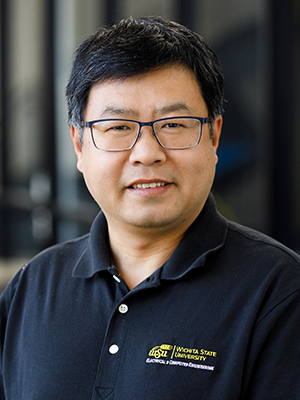
Chengzong Pang is an Associate Professor and MSECE Graduate Coordinator at the Department of Electrical and Computer Engineering, College of Engineering, Wichita State University. His work focuses on power systems, electrical engineering innovations, and renewable energy integration. He specializes in transient stability analysis, control systems, and smart grid technologies. Research Interests: Dr. Pang's expertise includes advanced control strategies for power electronics (e.g., PMSM, UPQC), machine learning applications for grid stability (LSTM/SVM), and energy storage solutions for renewable integration. His research also addresses challenges in microgrid operation, subsynchronous oscillation mitigation, and battery storage systems. Key Trends in Publications: Over 20 years of publications (2002–2022) emphasize: (1) Machine learning for power system analysis, (2) Control system design for renewable integration, (3) Grid stability enhancement via advanced algorithms, and (4) Smart grid infrastructure optimization. Recent works (2021–2022) highlight transient stability prediction and ANFIS-based power quality solutions. Labs/Teams: Active in energy systems research groups focusing on renewable integration and grid modernization, though specific lab names are not explicitly stated in the provided texts.
Professor Mohan Lal Kolhe is a distinguished academic at the University of Agder , serving as a Full Professor in Smart Grid and Renewable Energy within the Faculty of Engineering and Science and the Department of Engineering Sciences . With over three decades of international academic experience, he has held positions at prestigious institutions including University College London, University of Dundee, and Hydrogen Research Institute in Canada. His career spans technical innovation, policy development (e.g., as a member of South Australia’s Renewable Energy Board), and extensive research leadership in sustainable energy systems. Research Leadership : Focus on Smart Grid integration, Electric Vehicles, Hydrogen Energy, Solar/Wind Systems, and Techno-Economic Energy Analysis. Global Recognition : Listed in the top 2% of scientists worldwide (2020-2023) by Stanford University, with 10 publications averaging 200+ citations. Recent publications emphasize advanced optimization techniques for renewable integration, EV charging infrastructure, hydrogen production, and power system stability. His work has secured competitive funding from entities like the Norwegian Research Council and EU programs. Awards and Expert Roles : Top 2% Global Scientist (Stanford, 2020-2023) Highly Cited Researcher (Top 10 publications, 200+ avg. citations) Expert evaluator for European Commission, Royal Society London, EPSRC, and Cyprus Research Foundation He actively contributes to international conferences as keynote speaker and editorial board member, with leadership roles in research groups like Autonomous and Cyber-Physical Systems and Energy Systems .
Yanbo Wang is an Associate Professor and Vice Head of the Wind Power Research Programme at AAU Energy, part of Aalborg University's Faculty of Engineering and Science. He leads research in Electric Power Systems and Microgrids, focusing on intelligent energy systems and flexible markets. His work emphasizes stability analysis, control strategies for hybrid AC/DC systems, and renewable energy integration. He supervises multiple PhD projects on topics like multi-port energy routers and wind power converter optimization. Research interests include power electronics, microgrid stability, and energy storage systems. Key projects include the EU-funded 'S3SF: Smart Energy Solutions for Sustainable Future' and machine learning-based control strategies for multi-energy systems. He has authored over 176 publications, with recent work on DC microgrid reliability, converter design, and offshore wind energy systems. His team collaborates internationally to advance grid-friendly technologies and smart energy solutions. Notable contributions include advanced control schemes for retired batteries in DC microgrids and stability assessment methodologies for offshore wind inverters. He advises on six PhD projects and maintains a lab focused on renewable energy systems and power electronics innovation.
Kevin Schneider is a Laboratory Fellow at Pacific Northwest National Laboratory (PNNL), a Research Professor at Washington State University (WSU), and an Affiliate Associate Professor at the University of Washington. As manager of PNNL's Office of Electricity Subsector, he leads business development, client relations, and strategic investments in R&D for the grid sector, overseeing portfolios in component design, system modeling, hierarchical controls, secure communications, and energy storage. Dr. Schneider is internationally recognized for his expertise in power system analysis, planning, and operations. His research focuses on improving grid reliability and system flexibility by harnessing advanced grid concepts at the edge of power systems, including microgrids, energy storage, electric vehicles, distributed energy resources, and smart home appliances. At WSU, he is a researcher for the WSU and PNNL Advanced Grid Institute (AGI), implementing layered control architectures to enhance operational flexibility of critical power systems. His work spans multiple disciplines within electrical engineering and power systems, with strong emphasis on practical applications for grid modernization, particularly in grid resilience, microgrid operations, and integration of distributed energy resources. Dr. Schneider is a Fellow of the Institute of Electrical and Electronics Engineers (IEEE), where he has served in multiple technical leadership roles. His scientific contributions have been recognized with significant awards: Presidential Early Career Award for Scientists and Engineers (PCASE), 2019 Fellow of the Institute of Electrical and Electronics Engineers (IEEE) Dr. Schneider earned his B.S. in Physics and M.S. and Ph.D. in Electrical Engineering from the University of Washington. He is a licensed Professional Engineer in Washington State. His research has resulted in numerous patents related to power grid technologies, including several focused on voltage and frequency stability of distribution systems. His work has substantial implications for grid modernization efforts and the development of more resilient power systems in the face of climate change and other challenges.
Pooya Davari is a Professor and Head of the Section for Applied Power Electronic Systems at Aalborg University , Denmark. He leads the EMI/EMC in Power Electronics Research Group and serves as Vice Chair of the Energy Efficiency Mission. His research focuses on electromagnetic interference (EMI) and harmonic mitigation in power electronic systems, with over 200 publications and significant contributions to renewable energy integration. Education: B.Sc. and M.Sc. in Electronic Engineering (2004, 2008), Ph.D. in Power Electronics from Queensland University of Technology (2013) Prior Roles: Lecturer at QUT (2013–2014), Postdoc at AAU (2014) Research Interests: Harmonic and EMI analysis in grid-tied converters High power density converter design Signal processing for converter modeling Reliability of power electronic systems Article Trends: Recent work emphasizes EMI/EMC in renewable energy systems, wide bandgap semiconductors (SiC/GaN), and reliability modeling for EVs and hydrogen production via electrolysis. Sub-fields include converter topologies, grid integration challenges, and AI-driven diagnostics. Scientific Awards: Equinor 2022 Prize (Denmark’s oldest engineering award) IEEE EMC Society Young Professional Award (2020) World’s Top 2% Highly Cited Scientist (Stanford, 2021–2025) Multiple best paper awards (IEEE, Applied Sciences, etc.) Grants & Editorial Roles: Recipient of grants from Innovation Fund Denmark (Supra-EMC project), Horizon Europe (SOLARIS), and industry partnerships. Serves as Area Editor for IEEE Transactions on Transportation Electrification , Associate Editor for IEEE Transactions on Power Electronics , and Editor-in-Chief of Circuit World Journal (2020–2025). Labs & Standards: Coordinator of the EMC Laboratory at Aalborg University. Member of IEC standardization Working Groups 6 and 8 (TC77A), focusing on EMC strategies for power grids.