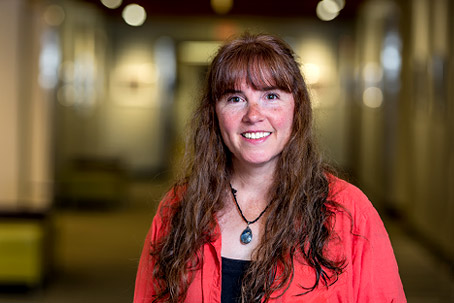
Bethanie Stadler is a Professor and Associate Dean for Academic Affairs in the College of Science and Engineering at the University of Minnesota . She holds the Erwin A. Kelen Professorship in Electrical Engineering and serves as graduate faculty in Chemical Engineering and Materials Science, Mechanical Engineering, and the Center for Micromagnetics and Information Technologies (MINT). Education : Ph.D. in Materials Science and Engineering from Massachusetts Institute of Technology (1994) B.S. in Materials Science and Engineering from Case Western Reserve University (1990) Research Interests span two major areas: Integrated optical materials for applications in optical isolators and modulators Magnetic nanowires for microelectronic and biomedical applications Scientific Honors include: Erwin A. Kelen Professor (2022–present) CSE Distinguished Professor (2021–2022) MRS Fellow (2018) Taylor Award for Distinguished Service (2017) IEEE Magnetics Society Distinguished Lecturer (2015) NSF Career Award (2001–2006) McKnight Presidential Fellowship (2006–2009) Stadler leads the Nano Magnetics and Photonics Group and has organized international conferences such as IEEE Intermag and MRS symposia. She has served on review panels for NSF and numerous journal editorial boards.
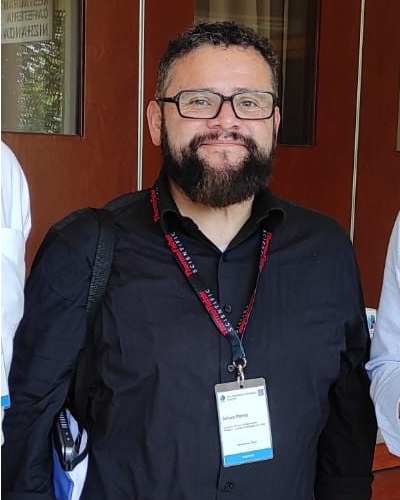
Arturo Ponce-Pedraza is a Professor and Assistant Department Chair in the Department of Physics and Astronomy at the University of Texas at San Antonio (UTSA), within the College of Sciences. He leads the Materials Physics Electron Microscopy research group and is actively engaged in advancing methodologies in transmission electron microscopy. His educational background includes a Ph.D. in Materials Science from Universidad de Cádiz and an M.Sc. in Solid State Physics from Universidad Autónoma de Puebla. His research focuses on understanding the atomic structure and behavior of functional materials such as semiconductors, dielectrics, and metallic nanostructures. Key areas include structural defects, crystal orientation mapping, and domain walls in materials like ZnO and gold nanoparticles. His lab specializes in advanced electron microscopy techniques, including aberration-corrected TEM, off-axis electron holography, 4D-STEM precession electron diffraction, and in situ TEM using specialized sample holders. While specific publications and awards are not listed in the provided text, his leadership of an active research group and technical expertise indicate ongoing scholarly contributions in materials physics and electron microscopy. Scientific Leadership: Leads the Microscopy Research Group at UTSA. Technical Expertise: Specializes in cutting-edge electron microscopy methodologies. Research Applications: Focuses on materials for microelectronics, optics, catalysis, and memory storage. He advises students in physics and materials science and is involved in research grants related to advanced microscopy and nanomaterials, though specific grant details are not provided. His lab is equipped for in situ experiments and high-resolution structural analysis, supporting both fundamental and applied research.
Dr. André Clausner is the Head of the Department of Microelectronic Materials and Nanoanalysis at the Fraunhofer Institute for Ceramic Technologies and Systems IKTS in Dresden, Germany. His research focuses on advanced materials and nanoanalytical techniques for microelectronics applications. Institution: Fraunhofer Institute for Ceramic Technologies and Systems IKTS Department: Microelectronic Materials and Nanoanalysis Fields of Interest: Materials Science, Microelectronics, Nanotechnology, Ceramic Technologies, Applied Physics, Surface Analysis
Dr. Evert Houwman is a Researcher in the Inorganic Materials Science group at the MESA+ Institute, University of Twente, specializing in functional oxide thin films for microelectronic applications. His work bridges fundamental materials science with device engineering in nanotechnology. His primary research interests include: Ferroelectric and piezoelectric thin film development Energy storage mechanisms in multilayer capacitor structures Strain engineering in perovskite materials Silicon integration of functional oxides Lead-free ferroelectric alternatives Advanced thin film deposition techniques Analysis of recent publications (2024-2025) reveals a concentrated focus on optimizing energy storage density through interface engineering and polarization manipulation in ferroelectric thin films. His work demonstrates significant advancements in piezoelectric response via thermal strain control and novel growth templates for perovskite systems, with strong emphasis on practical device integration. Dr. Houwman has supervised 4 research projects and maintains extensive international collaborations, evidenced by co-authorship networks spanning multiple countries. His research contributes to the MESA+ Institute's leadership in nanotechnology and advanced materials development.
Felice CRUPI is a Full Professor of Electronics at the University of Calabria since 2018, with prior roles as Associate Professor (2002-2018). He leads the Electrical Characterization of Semiconductor Devices section at the Nanoelectronics and Microsystems Laboratory (NML) and coordinates international collaborations with institutions like IMEC, IBM, and Purdue University. Education: PhD in Electronic Systems Engineering (University of Florence, 2001), MS in Electronic Engineering cum Laude (University of Messina, 1997) Research Interests focus on CMOS device reliability , low-frequency noise modeling , 2D material applications in electronics, and power-efficient circuits . His work spans device characterization, GaN/SiC power electronics, and hardware security through PUFs. Grant Leadership includes major European projects like GaN4AP (GaN power applications), Five2D (2D integrated electronics), and REACTION (SiC pilot lines). He has secured funding for radiation-hard memory design and international collaborations. Scientific Awards : Best paper, IEEE Ecuador Technical Chapters Meeting (2018) Best paper, IEEE International Conference on Microelectronics (2008) IEEE Senior Member (since 2014) Academic Service includes editorial roles (IEEE Transactions on Device and Materials Reliability), conference organization (INFOS 2021 General Chair), and PhD supervision of >10 students. He has taught internationally in Ecuador, China, Finland, Belgium, and Spain.
Tina Hudson is a Professor of Electrical and Computer Engineering at Rose-Hulman Institute of Technology , specializing in analog/digital systems, electronic device modeling, and engineering education. With a Ph.D. from Georgia Institute of Technology (2000), she focuses on curriculum innovation, critical thinking pedagogy, and industry collaboration. Education : Ph.D. (2000), MSEE (1995), BEE (1992) from Georgia Tech; BS in Engineering from Berry College (1992). Research Interests span test and product engineering for analog/mixed-signal circuits, behavioral analysis in analog circuit education, and integrated circuits emulating neural systems. Her work emphasizes industrial partnerships and pedagogical research. Publication Trends include engineering education methodologies (2014-2008), industry-driven curriculum design (2009), and analog/digital hybrid systems (2009-2006). Key subfields: pedagogical innovation, industrial testing, neural emulation, and hysteresis control. Scientific Awards : Dean’s Outstanding Teacher Award (2014). Teaching & Industry Engagement : Develops curricula for test engineering, conducts workshops for pedagogical research, and collaborates with Teradyne, Micron, and Texas Instruments to enhance student internships and lab resources.
Professor Tatiana Kalganova is a faculty member at Brunel University London, affiliated with the Department of Electronic and Electrical Engineering and the College of Engineering, Design and Physical Sciences. With a career spanning over two decades at Brunel, she has established expertise in Artificial Intelligence, Evolvable Hardware, and Operational Research. Education: PhD in Evolutionary Computing, Napier University MSc (distinction) in Informatics, Belarusian State University of Informatics and Radio-Electronics Research-Engineer Degree, Belarusian State University of Informatics and Radio-Electronics Her research focuses on Evolutionary Design , Swarm Optimization , and Robotics , with applications in supply chain modeling, neuromorphic computing, and intelligent systems. Recent publications emphasize Large Language Models and data-efficient machine learning techniques. Scientific Awards: 2nd place in Caterpillar's Research and Innovation in Demand Strategy Competition (2012) AFWERX Challenge Award (2019-2020) Professor Kalganova has supervised numerous PhD students on topics like 3D Autorouting Systems and Ambidextrous Robot Hands . Her funded projects include the Horizon Europe Guarantee's ReCharged initiative for climate-resilient infrastructure and collaborations with Intel, Caterpillar, and the Nuffield Foundation.
Loreto Di Donato is an Associate Professor of Electromagnetic Fields and Antennas at the Department of Electrical, Electronics and Computer Engineering, University of Catania, Italy. He joined the university in 2013 as an Assistant Professor and was promoted to Associate Professor in 2021 after demonstrating significant research contributions in electromagnetic applications. His educational background includes: B.S. Laurea degree in Biomedical Engineering from the University of Naples "Federico II" (2006) M.S. Laurea degree in Biomedical Engineering from the University of Naples "Federico II" (2008) Ph.D. in Information Engineering (Applied Electromagnetics) from University "Mediterranea" of Reggio di Calabria (2012) Professor Di Donato's research spans multiple cutting-edge areas in electromagnetics with particular emphasis on practical applications. His work in microwave imaging has significant implications for medical diagnostics, nuclear fusion research, and structural analysis of historical buildings. He has developed expertise in solving inverse scattering problems and designing specialized antennas for challenging environments including plasma diagnostics. His research in millimeter-wave bio-electromagnetic interactions addresses emerging concerns about 4G/5G technologies. His scientific contributions have been recognized through prestigious awards including international Young Scientist honors and the "Gaetano Latmiral" Prize from the Italian Society of Electromagnetism. These accolades reflect his standing in the international electromagnetics community. Professor Di Donato maintains an active research program with multiple collaborations across institutions. He regularly offers research opportunities for graduate students, particularly in microwave imaging for nuclear fusion applications through partnerships with INFN-LNS. His teaching includes advanced courses like "Transmission Lines and Antennas" for Telecommunications Engineering students. His laboratory work bridges theoretical electromagnetics with practical applications through collaborations with ST Microelectronics, multiple university departments, and national research institutions. Current projects focus on electromagnetic solutions for industrial IoT, environmental remediation, and advanced imaging techniques using novel approaches like 3D-printed cloaking devices.
Çiçek Hatice Boztuğ Yerci is an Assistant Professor and Department Head of the Department of Electrical and Electronics Engineering at TED University, with continuous teaching engagement from 2014 through the 2025 Spring semester. Her research focuses on Analog Electronics, Digital Electronics, Microelectronics, Optoelectronics, and Power Electronics, evidenced by her extensive teaching portfolio spanning circuit design, semiconductor devices, and electronic systems. She demonstrates particular expertise in analog/digital circuit integration and optoelectronic applications. Dr. Yerci actively supervises undergraduate research through Senior Projects (EE 491/EE 492) and Summer Practices (EE 399/EE 499), while teaching core curriculum courses including Microelectronic Devices, Analog Circuit Design, and Digital Electronics across multiple sections each semester.
Romeo Šajina is a Lecturer at the Faculty of Informatics in Pula, Croatia, affiliated with the University of Pula . His work focuses on computer science, machine learning, and applied informatics, with publications in areas such as neural networks, time series forecasting, and image processing. University: University of Pula School: Faculty of Informatics His research spans disciplines like Artificial Intelligence , Data Science , and Imaging Technology , emphasizing practical applications in time series modeling and computer vision. Recent publications highlight advancements in deep learning architectures and hybrid data analysis techniques. Articles demonstrate expertise in Neural Networks , Predictive Analytics , and Computer Vision , often published in IEEE and Journal of Imaging . Collaborations with researchers like Marina Ivašić-Kos and Nikola Tanković appear in multiple works. No scientific awards or student advisement details are documented in the provided materials. Further inquiries may be directed via email at romeo.sajina@unipu.hr .
Dr. Michele Caselle is a Researcher at the Karlsruhe Institute of Technology (KIT), specifically at the Institute for Process Data Processing and Electronics (IPE). He coordinates the program subtopic "Detection and Measurement" and "Beam Physics Instrumentation" within the Detector Technologies and Systems (MT-DTS) of the Helmholtz Association. He serves as Principle Investigator in the TANGERINE and ACCLAIM innovation programs, Local coordinator of the PANDA experiment at GSI, and is a member of the International Research Program RD 50 at CERN and the CMS experiment at CERN. Dr. Caselle obtained his Master's Degree in electronic engineering with a specialization in microelectronics from the Polytechnic of Bari in 1998, followed by a PhD in microelectronics from the same institution in 2006. He completed a Post-Doctoral position at the Physics Department of the University and INFN Bari (2006-2008). Prior to joining KIT in 2011, he worked at CERN's Microelectronics Group (2008-2011) and held positions at GSI including Head of Department for Experiment Electronics (2019). His research focuses on advanced silicon sensors and electronic design , high-density interconnection technologies and packaging , commissioning of complex detector systems , and high-resolution beam diagnostics . Dr. Caselle has led research groups designing and producing cutting-edge silicon detectors for large physics experiments at CERN and GSI, including the CMS pixel detector for the Phase 1 upgrade. He has also developed beam diagnostic detector systems for synchrotron and free electron laser accelerator machines, and data acquisition systems for next-generation photon science experiments. Dr. Caselle's recent publications demonstrate a strong focus on detector technologies, particularly in silicon-based detectors, data acquisition systems for particle physics experiments, and the application of machine learning techniques to accelerator physics problems. His work spans both theoretical development and practical implementation of detector systems for major international experiments. As Principle Investigator for the TANGERINE and ACCLAIM programs, Dr. Caselle leads efforts in next-generation silicon detectors and the application of artificial intelligence and machine learning to scientific challenges. His coordination of the national program subtopic within the Helmholtz Association's Detector Technologies and Systems highlights his leadership role in advancing detector technologies across Germany. Dr. Caselle has been instrumental in developing several key detector systems, including the KALYPSO line camera for MHz repetition rate applications, the ToASt ASIC for the PANDA experiment's strip detectors, and radiation-hardened silicon sensors for high-luminosity environments. His work bridges the gap between fundamental detector research and practical implementation in major physics experiments.
François Blanchard is a Professor in the Department of Electrical Engineering at École de technologie supérieure (ÉTS) in Montreal, Quebec. He leads the Canada Research Chair in Spatiotemporal Encryption of Terahertz Light Assisted by Computational Method and is affiliated with multiple research laboratories including LACIME (Communications and Microelectronic Integration Laboratory) and TeraÉTS Laboratory. His research focuses on advancing terahertz technology through innovative detection, imaging, and signal processing techniques. Dr. Blanchard's research interests span across terahertz science and technology, with emphasis on optoelectronics, THz spectroscopy and imaging, metamaterials, material characterization, laser technology, optical metrology, and quantum engineering. His work integrates theoretical modeling with experimental development to push the boundaries of terahertz applications in various fields including security, materials science, and communications. He has developed novel approaches combining active microelectronics with terahertz wave generation and detection through nonlinear effects, along with advanced signal processing techniques. His research program aims to achieve detection sensitivity down to the single THz photon level at room temperature, develop real-time THz detection systems with integrated spatiotemporal coding, advance multispectral THz imaging using frequency selective surfaces, explore nonlinear modeling of THz systems using chaos theory, and integrate artificial intelligence for enhanced system performance. A cornerstone of his approach involves lithium niobate photonic platforms enabling scalable, efficient, and room-temperature operation. Scientific Awards: Canada Research Chair in Spatiotemporal Encryption of Terahertz Light Assisted by Computational Method Dr. Blanchard actively supervises numerous graduate students across various research projects. His students work on topics including quality control of printed electronics using terahertz radiation, development of novel metrology methods for time domain THz spectroscopy systems, photonics solutions for THz systems based on ytterbium laser technologies, terahertz imaging systems, active terahertz metasurfaces, and deep learning enabled computer vision for terahertz radiation detection. He has secured significant research funding to advance quantum detection of terahertz light and develop applied research in quantum sciences. He leads several research teams operating within specialized laboratories including LACIME, which focuses on six areas of expertise from functional materials to communication protocols. His TeraÉTS Laboratory specializes in terahertz technology development, and his Canada Research Chair team combines innovative ideas in active microelectronics with terahertz wave generation and detection.
Frédéric Nabki is a Professor in the Department of Electrical Engineering at École de technologie supérieure (ÉTS) in Montreal, Canada. Holding a B.Ing. and Ph.D. from McGill University, he maintains an active research program focused on microelectromechanical systems, RF circuits, and integrated photonics. His work bridges fundamental research with practical applications in avionics, wireless communications, and sensing systems. Dr. Nabki's research interests span microelectromechanical systems (MEMS), radio frequency integrated circuits, sensor design, microfabrication techniques, and optical communications. His laboratory, LACIME (Communications and Microelectronic Integration Laboratory), focuses on three primary research axes: Sensors, Networks and Connectivity; Innovative materials and advanced manufacturing; and Quantum Engineering. His work encompasses analog and RF microelectronics, MEMS and MOEMS devices, microfabrication, system-on-chip design, integrated sensors and actuators, interface circuits for sensors, wireless and optical communication circuits, energy harvesting microsystems, silicon photonics, and embedded systems for avionics applications. Analysis of Dr. Nabki's recent publications reveals a strong focus on MEMS technology with applications spanning multiple domains. His work demonstrates expertise in piezoelectric MEMS devices, optical switching solutions using silicon nitride photonics, ultrasonic transducers for sensing applications, and RF front-ends for avionics. The research increasingly incorporates machine learning techniques for signal processing and fault detection, showing an interdisciplinary approach that combines hardware design with advanced algorithms. His work maintains strong ties to practical applications, particularly in aerospace, industrial monitoring, and biomedical imaging. Dr. Nabki has successfully supervised numerous graduate students through their master's and doctoral research. His supervision portfolio includes over 30 theses covering diverse topics from MEMS resonators and energy harvesters to optical switching systems and avionics RF front-ends. His research has been supported through significant funding that has enabled the filing of 48 patents, numerous peer-reviewed publications (116 journal articles), and multiple book chapters. The extensive patent portfolio demonstrates the translational nature of his research with practical commercial applications. Dr. Nabki leads the LACIME research laboratory, which focuses on the integration of communication systems with microelectronic technologies. The laboratory maintains strong collaborations with industry partners, particularly in the aerospace sector, and has developed specialized facilities for MEMS design, fabrication, and testing. Current research directions include quantum-based security for connected objects, advanced MEMS for avionics applications, and silicon photonics for optical switching solutions.
Prof. Dr. Caspar Demuth is affiliated with the Zurich University of Applied Sciences (ZHAW) at the School of Life Sciences and Facility Management, Institute of Chemistry and Biotechnology. His academic rank is Professor. Ph.D. in Sensor Technology, ETH Zurich (1994-1999) Diploma in Chemistry, University of Zurich (1988-1993) Research focuses on Sensor Technology , Bioprocess Analytics , and Chemical Sensors , with applications in bioreactor monitoring, pharmaceutical analytics, and industrial process optimization. His work spans Biotechnology , Applied Microbiology , and Biosensor Development . Recent publications (2016-2020) emphasize sensor innovation for bioprocessing, process analytics in academic institutions, and real-time measurement systems . Collaborative efforts include HPTLC identity testing for medicinal plants and microcarrier cultivation monitoring . Teaching areas include Analytical Chemistry , Measurement and Sensor Technology , and Biostatistics . He holds a patent (EP1889043 B1) for an electrochemical sensor and has contributed to international conferences in biotechnology and sensor technology.
José Miguel Burdío Pinilla serves as Head of the Power Electronics and Microelectronics Group (GEPM) at I3A, University of Zaragoza, where he has pioneered transformative research in applied power electronics for over three decades. His leadership spans industrial, domestic, and biomedical innovation with global impact. His research focuses on three interconnected technological pillars: power electronic devices, microelectronic systems, and electromagnetic design. Notable breakthroughs include household induction technology adoption (generating economic/social impact through world-leading appliance manufacturing) and cutting-edge biomedical applications for cancer treatment. His work bridges academic rigor with industrial transfer, emphasizing sustainable energy solutions and medical instrumentation. Beyond publications, his research trajectory reveals strong thematic cohesion in energy conversion systems, with recent emphasis on electrosurgical technologies for oncology. This evolution demonstrates strategic alignment between fundamental power electronics research and high-impact societal applications. IEEE PEIESC Career Achievement Award (Power Electronics and Industrial Electronics Spanish Chapter) As an educator and research leader, Burdío champions cohesive team dynamics that amplify R&D impact across teaching, management, and industry collaboration. His group maintains robust partnerships with manufacturing sectors while cultivating student vocations through integrated research-teaching frameworks. Current initiatives prioritize biomedical instrumentation for previously untreatable cancers, reflecting his commitment to human-centered technological advancement. The GEPM operates within I3A's interdisciplinary ecosystem, leveraging Zaragoza's engineering infrastructure for electromagnetic compatibility testing and rapid prototyping. Ongoing projects integrate AI-driven control systems with power electronics for next-generation medical devices and sustainable mobility solutions.