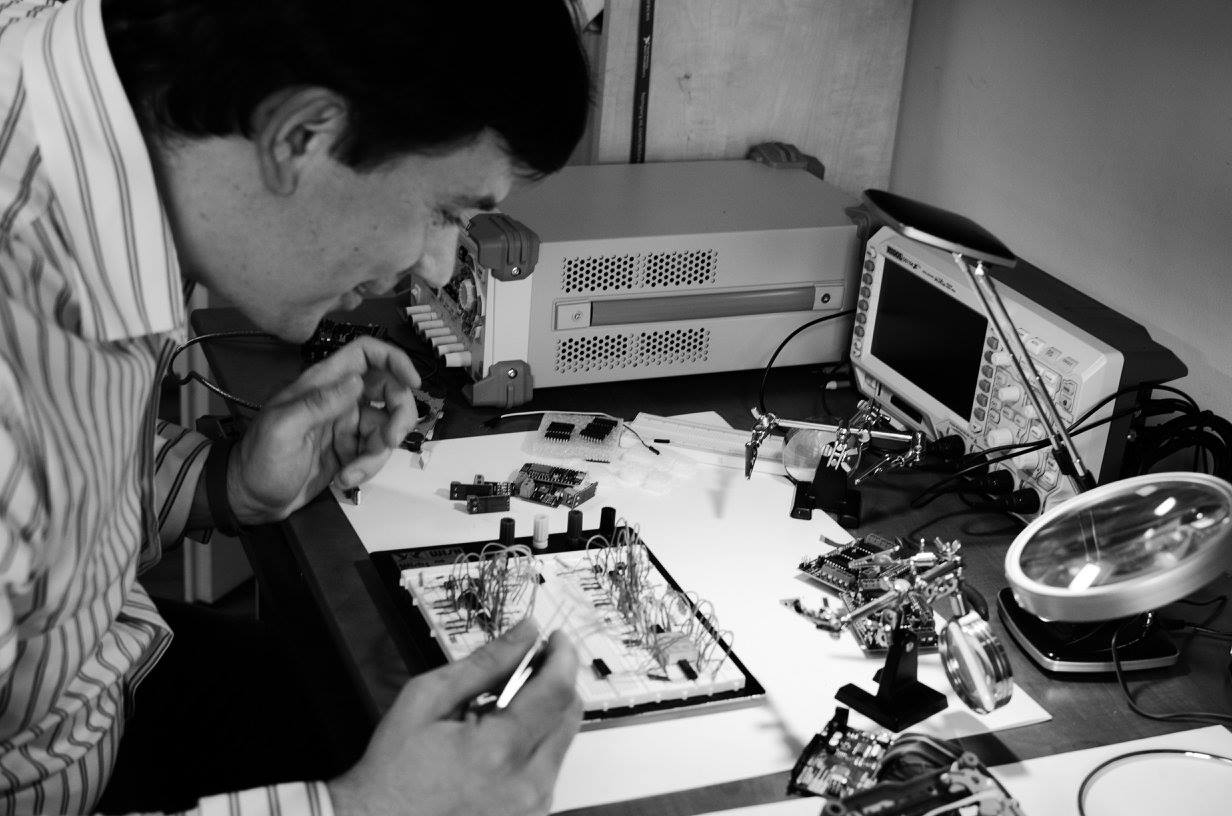
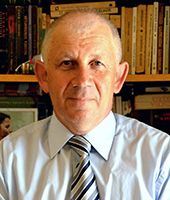
Laurentiu Dimitriu is a Professor at the Gheorghe Asachi Technical University of Iasi , affiliated with the Faculty of Electrical Engineering. His research focuses on Automotive Electronics , Real-Time Systems , and Control System Diagnostics , with significant contributions to microprocessor-based control systems and sensor technology. Teaching: Power Supplies and Circuits, Electronic Measuring and Control Devices, Automotive Electronics Contact: dimitriu@etc.tuiasi.ro Research Interests span automotive control systems, thermal engine management, and fuzzy logic applications in engine optimization. His work addresses hardware/software co-design for microprocessor control units, fuel efficiency, and cooling systems. Engineering Trends in his publications highlight real-time communication protocols, sensor diagnostics, and airflow control mechanisms. Over 84 works (including books and patents) demonstrate his expertise in integrating embedded systems with automotive engineering. Scientific Contributions include 14 invention patents for electroacupuncture devices, engine control systems, and sensor technologies. His 1995 book Sisteme electronice de control pentru automobile remains a seminal reference in automotive electronics. Collaborations extend to INMT Bucharest, Transloc R.A. Botosani, and academic-industrial partnerships for real-time engine testing systems.
Dr. Libal András is an Associate Professor at the Faculty of Mathematics and Computer Science of Babes-Bolyai University , Romania. His research spans soft condensed matter physics , active matter systems , and artificial spin ice , with a focus on computational modeling and GPU/CPU optimization. He collaborates with institutions like Los Alamos National Laboratory and has contributed seminal work on colloidal spin ice. Alma Mater: Bathory Istvan High School (Cluj), Babes-Bolyai University (BSc), University of Notre Dame (PhD) Past affiliations: Argonne National Lab, Los Alamos National Lab, Johns Hopkins University, Universiteit Antwerpen Research interests include: Computer simulation of soft condensed matter and active matter systems Topological defects in spin ice and granular materials Development of Arduino-based microcontroller applications and IoT systems GPU-accelerated simulation methods Publications focus on vortex dynamics , jamming transitions , colloidal crystals , and active matter across physics, materials science, and computational epidemiology. No scientific awards are explicitly mentioned in available sources.
Shaza Al-Wifati is a Lecturer in the Department of Biomedical Engineering at the University of Tripoli, affiliated with the College of Engineering. She has held multiple leadership roles including Founding Member of the Biomedical Engineering Department (2019-2022), Documentation Coordinator for the University Website (2023), and Program Coordinator roles (2025). Her research focuses on Optimal control of infectious diseases Medical device design and programming Artificial intelligence applications in medical engineering Digital and embedded systems for healthcare linking theoretical control systems to practical biomedical solutions. Her recent publications (2018-2025) span epidemic control modeling, medical imaging AI for skin cancer detection, and reactor control systems. These works demonstrate expertise in integrating neural networks , optimization techniques , and embedded systems into biomedical challenges.
Олена Сергіївна Назарова є доцентом в Національному університеті "Запорізька політехніка", де працює з 2005 року. Вона має науковий ступінь кандидата технічних наук та академічне звання доцента. Її професійна діяльність охоплює наукові дослідження в галузі електромеханічних систем та викладання спеціалізованих дисциплін, пов'язаних з метрологією, мікропроцесорною технікою та математичним моделюванням. Освіта: Запорізький національний технічний університет, 2007 рік, спеціальність 8.092203 "Електромеханічні системи автоматизації та електропривод", кваліфікація "Магістр з електромеханічних систем автоматизації та електроприводу"; Запорізький національний технічний університет, 2007 рік, спеціальність 7.050104 "Фінанси", кваліфікація "фінансист". У 2012 році захистила кандидатську дисертацію за спеціальністю 05.09.03 - "Електричні комплекси та системи" на тему "Синтез і дослідження систем керування електроприводами холодильних станів з використанням комплексу взаємопов'язаних моделей". Наукові інтереси Олени Сергіївни охоплюють моделювання багатомасових взаємопов'язаних електромеханічних систем, розробку інструментів автоматизації для технологічних комплексів та мехатронних систем, електромеханічні системи з мікропроцесорним керуванням, а також методи вимірювання, контролю та діагностики промислового обладнання. Вона є керівником науково-дослідної роботи № 03611 (0121U112938) "Розробка та дослідження автоматизованих електроприводів та мехатронних систем". Аналіз публікацій Олени Сергіївни демонструє її глибоку експертизу в моделюванні електромеханічних систем, зокрема систем холодної прокатки, та розробці систем керування для електроприводів. Її роботи охоплюють широкий спектр від математичного моделювання до практичної реалізації систем керування, що свідчить про її здатність поєднувати теоретичні знання з практичними застосуваннями в промисловості, включаючи останні дослідження в галузі SMART-технологій для клімат-контролю в теплицях. 2006 – Лауреат премії «Програми підтримки вчених та обдарованої молоді» розробленої АКБ «Індустріалбанк» при підтримці виконавчого комітету Запорізької міської ради «За виняткові досягнення у науковій роботі» 2011 – Грамота Міністерства освіти і науки України 2013 – Почесна грамота Районної адміністрації 2015 – Почесна грамота Міської ради до 115-річчя ЗНТУ 2017 – Подяка Міністерства освіти і науки України 2018 – Подяка Запорізької обласної ради 2019 – Подяка Управління молоді, фізичної культури та спорту Запорізької обласної державної адміністрації Олена Сергіївна активно бере участь у міжнародних науково-технічних конференціях, включаючи «Електротехнічні і комп'ютерні системи: теорія і практика (ЭЛТЕКС-2019)», «Проблеми автоматизованого електропривода» та «Modern Electrical and Energy Systems». Вона публікується в міжнародних наукових журналах та має профілі в наукометричних базах даних (ORCID, Scopus, Web of Science, Google Scholar), що свідчить про її інтеграцію в глобальний науковий простір. Наукова діяльність Олени Сергіївни тісно пов'язана з лабораторіями кафедри електроприводу та автоматизації промислових установок, де вона проводить експериментальні дослідження та тестує нові методи керування електроприводами. Її робота сприяє розвитку сучасних технологій в галузі промислової автоматизації та підготовки висококваліфікованих фахівців для української промисловості.
Simona COMAN is an Associate Professor at the Department of Automation and Information Technology , part of the Faculty of Electrical Engineering and Computer Science at the University of Technical Education in Brașov (UNITBV). Her work focuses on advancing AI applications in medical diagnostics, fractional order systems, and adaptive control mechanisms. She leads research in areas such as cardiovascular signal processing, privacy-preserving AI, and precision medicine frameworks. Her research interests include developing robust systems for non-invasive diagnostics (e.g., heart murmurs detection via AI), enhancing cybersecurity in industrial AI deployments, and creating MATLAB-based tools for anesthesia control. She actively contributes to international conferences and collaborates on projects addressing biomedical systems modeling and stability analysis. Notable achievements include pioneering AI-driven CT scan analysis for pandemic response and co-authoring frameworks for validating AI in precision medicine. Her work bridges theoretical control systems with practical healthcare applications, emphasizing both innovation and rigorous validation standards. Dr. COMAN’s publications span journals in biomedical engineering, electrical systems, and control theory, reflecting her interdisciplinary approach to solving complex technical challenges. She maintains an active role in academic and industrial partnerships, fostering advancements in automation and information technology.
Sebastian-Alexandru Arghirescu is an Assistant Professor at the Department of Electronic Technology and Reliability, Faculty of Electronics, Telecommunications and Information Technology, Politehnica University of Bucharest (UPB), Romania. He is also a doctoral candidate (since 2021) focusing on audio file quality estimation via hardware procedures, supervised by Prof. Ioan Bacivarov. PhD: Research on Audio File Quality Estimation (2021–present) MSc: Quality and Functional Safety Engineering in Electronics and Telecommunications (2019–2021) BEng: Applied Electronics (2015–2019) His research bridges audio signal processing, hardware design, and quality/reliability engineering. His 2022 publication in Sensors demonstrates expertise in optimizing sensor control modules for remote laboratories. He contributes to teaching Quality and Reliability courses and develops laboratory platforms. Professional Experience: Assistant Professor (2022–present), Research Assistant (2019–2022) at UPB's Wireless Networks and IoT Laboratory Technical Skills: Circuit design (EAGLE, LTspice), microcontroller programming (Atmel), MATLAB neural networks, C/Verilog He has participated in the MultiMonD2 research project (PN-III-P1-1.2-PCCDI-2017-0637) and designed robotics systems for competitions like RoboChallenge.
Robert Demeter is a Lecturer at the Department of Automation and Information Technology , within the Faculty of Electrical Engineering and Computer Science at the Transilvania University of Brașov , Romania. Research Interests: Embedded systems Microcontroller applications Operating systems Computer networks Digital technologies Digital simulation Dr. Demeter's research spans multiple domains within computer science and engineering, with a particular focus on the intersection of technology and society. His publications highlight several key areas: Brain-Computer Interfaces: Systematic study of applications in computer science and engineering domains Privacy-Preserving Technologies: Investigation of explainable AI and homomorphic encryption in industrial contexts Digital Transformation: Analysis of digital technologies' impact on accounting practices and engineering education Future Society: Exploration of digital simulation's role in developing competencies for Society 5.0 Contact Information: Email: rdemeter@unitbv.ro Address: Mihai Viteazu 5, Brașov, Romania Location: Building V, Room VI.1 Phone: +40 268 474017
Ioana Corina BOGDAN is a Lecturer at the Department of Electronics and Computer within the Faculty of Electrical Engineering and Computer Science at the University of Technical Education of Brasov. Her research focuses on electronic components development, dynamic modeling, control systems, artificial intelligence, and robotics applications in education, industry, and social contexts. She actively contributes to advancements in facial expression synthesis for humanoid robots, energy-efficient unmanned aerial vehicle systems, and biomedical engineering modeling. Her academic work spans theoretical and applied research, with notable contributions in robotics control systems, embedded systems optimization, and medical engineering applications. Publications highlight interdisciplinary approaches combining mathematics, computer science, and mechanical engineering. Publications emphasize trends in robotics-human interaction, energy-aware design for UAVs, and cerebral hemodynamics modeling. Research consistently bridges fundamental science with practical engineering solutions. She advises projects related to her research areas but no specific student names are listed. No scientific awards are explicitly mentioned in the provided information.
Marian ALEXANDRU is an Associate Professor in the Department of Electronic and Computers at the Faculty of Electrical Engineering and Computer Science, Transilvania University of Brașov. His research focuses on mobile communications, IoT systems, microwave technologies, and cybersecurity. He has developed remote laboratory platforms and contributed to SDR-based solutions for satellite and IoT applications. His work emphasizes practical experimentation, with notable contributions in secure access control systems and embedded multitasking frameworks. Research Interests: Mobile Communication Evolution (3G/4G/5G) IoT Gateway Architectures Software-Defined Radio (SDR) Applications Cybersecurity for Wireless Networks Remote Laboratory Systems Key Projects: Developed an SDR-based satellite gateway for IoT applications Designed an antidrone wireless personal shield Created experiment-supported mobile apps for activity monitoring using neural networks Dr. Alexandru has authored multiple textbooks including Communications, RF and Microwave Fundamentals and Mobile Communications and Mobile Computing: Evolution from 3G to 4G . His work bridges theoretical concepts with hands-on remote experimentation, emphasizing practical education in telecommunications engineering.
Niculescu Titu is an Associate Professor at the Department of Automation, Computers, Electrical and Power Engineering within the Faculty of Mechanical and Electrical Engineering at the Politehnica University of Timişoara. His research focuses on electrical systems, power quality, and control systems, with a strong emphasis on practical applications using MATLAB/Simulink and NI-USB data acquisition systems. He has contributed extensively to topics such as transient analysis in electrical circuits, power factor correction, and safety in hazardous environments. His work spans reactive power compensation, harmonic reduction techniques, and the integration of renewable energy systems. Titu has also explored explosion-proof electrical equipment for mining applications, combining theoretical analysis with experimental validation. His methodologies often involve simulation tools to model real-world phenomena, ensuring practical relevance to industrial challenges. Key areas of contribution include electro-dynamic forces in short circuits, transient analysis of inductive/capacitive circuits, and the application of programmable microcontrollers in optimizing photovoltaic systems. His research underscores the intersection of theoretical electrical engineering principles with cutting-edge instrumentation and control strategies.
Kovács Gergő is a Researcher at the National Institute for Research and Development in Isotopic and Molecular Technologies (INCDTIM) and a PhD student at the Technical University of Cluj-Napoca. He is affiliated with the Department of Materials, Energy and Advanced Technologies under the Research Group for Alternative Energies. His expertise spans FPGA design for embedded systems, microcontroller programming, PCB electronic circuit design, RF measurements, and RF analysis systems. He also specializes in CAD software applications and has contributed to R&D projects for enterprises as a project manager and coordinator. His research interests align with computational fluid dynamics, materials science, applied mathematical modeling, and technological innovation in microprocessor systems. These interests are reflected in his involvement in industrial R&D collaborations and peer-review activities for international programs. Kovács holds a BSc in Technological Physics from Babeș-Bolyai University (2022) and an MSc in Integrated Circuits and Systems from the Technical University of Cluj-Napoca (2024). He is currently pursuing a PhD in Electronics, Telecommunications, and Information Technology at the same university.
Alexandru Dinu is a Lecturer at the Department of Electronic and Computers within the Faculty of Electrical Engineering and Computer Science at the Technical University of Brasov. His research focuses on functional verification of ASICs, digital electronics, and AI integration in embedded systems. He has contributed to projects involving hardware reconfiguration, sensor peripherals, and cost-efficient verification methodologies. Research interests include: AI-driven hardware verification Microcontroller-based systems Functional coverage optimization Embedded systems programming His recent work explores automation in verification processes using genetic algorithms and reinforcement learning, with applications in FPGA-based sensors and energy management systems. Collaborations include industry-oriented laboratory redesign and educational platforms for alphabet learning. No scientific awards or grants are listed. Advising information is unavailable. Current affiliations include the Technical University of Brasov and participation in interdisciplinary projects spanning engineering education and environmental technology.
Professor Petre Lucian OGRUȚAN is an academic affiliated with the Department of Electronics and Computers at the Faculty of Electrical Engineering and Computer Science , Transilvania University of Brașov , Romania. His work bridges technical expertise in electromagnetic compatibility , microcontrollers , and IoT systems with innovative approaches to engineering education . Research Focus: Electromagnetic Compatibility, IoT Systems, and Pedagogical Strategies Contact: petre.ogrutan@unitbv.ro | Building N, Room NIII | Brașov, Romania Research Trends highlight his contributions to integrating mobile technologies and IoT-based solutions into engineering education, emphasizing student creativity and smart environment applications. Publications demonstrate interdisciplinary work in Computer Science , Electrical Engineering , and Educational Psychology , with a focus on laboratory innovation and multicultural influences on creativity.
Csaba Zoltán KERTÉSZ is a Lecturer at the Department of Electronic and Computers, Faculty of Electrical Engineering and Computer Science, Technical University of Brașov. His research focuses on embedded systems, microcontroller applications, graphical user interfaces, digital signal processing, and real-time operating systems. He has contributed to IoT/M2M communication, wireless sensor networks, and SDR platforms. He has also explored the use of GitHub in collaborative learning and automotive industry-supported curriculum design. Key research interests include: Embedded GUI development frameworks IoT gateway systems using SDR Real-time monitoring and control systems HbbTV architecture performance analysis His recent work (2021-2024) emphasizes: AI-driven programming assessment tools SIMD extension optimization Wireless sensor networks for water distribution Reconfigurable IoT infrastructure Publications span over 15 years, showing sustained contributions in embedded systems, telecommunications, and educational technology. No specific awards mentioned. Labs/Teams: Actively involved in the University's embedded systems and IoT research groups.
Marius-Catalin CARP is a Lecturer at the Department of Electronic and Computers, Faculty of Electrical Engineering and Computer Science, Technical University of Brașov. His research focuses on embedded systems, microcontroller applications, PCB design, digital signal processing, and real-time operating systems (RTOS). He has contributed to interdisciplinary projects in medical imaging, energy storage systems, and automotive electrification. His work bridges engineering and healthcare, including developing algorithms for coronary angiography analysis and hybrid energy storage solutions for transport systems. He has co-authored papers in reputable journals like the Journal of the American College of Cardiology and conferences such as IRES and OPTIM. Key research themes include: Real-time medical diagnostics using hybrid computational models Energy management systems for diesel locomotives and electric vehicles Thermal and voltage characterization of supercapacitors/batteries Wearable computing for cardiovascular patient monitoring Publications span biomedical engineering, transport electrification, and embedded systems applications. His work emphasizes practical implementations in healthcare and sustainable mobility sectors.