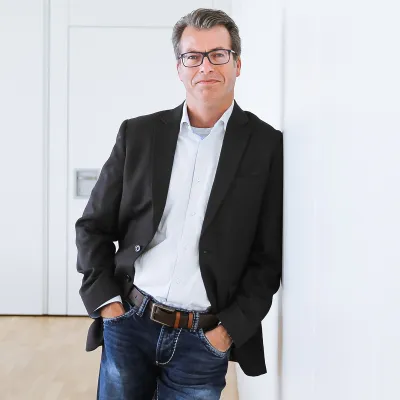
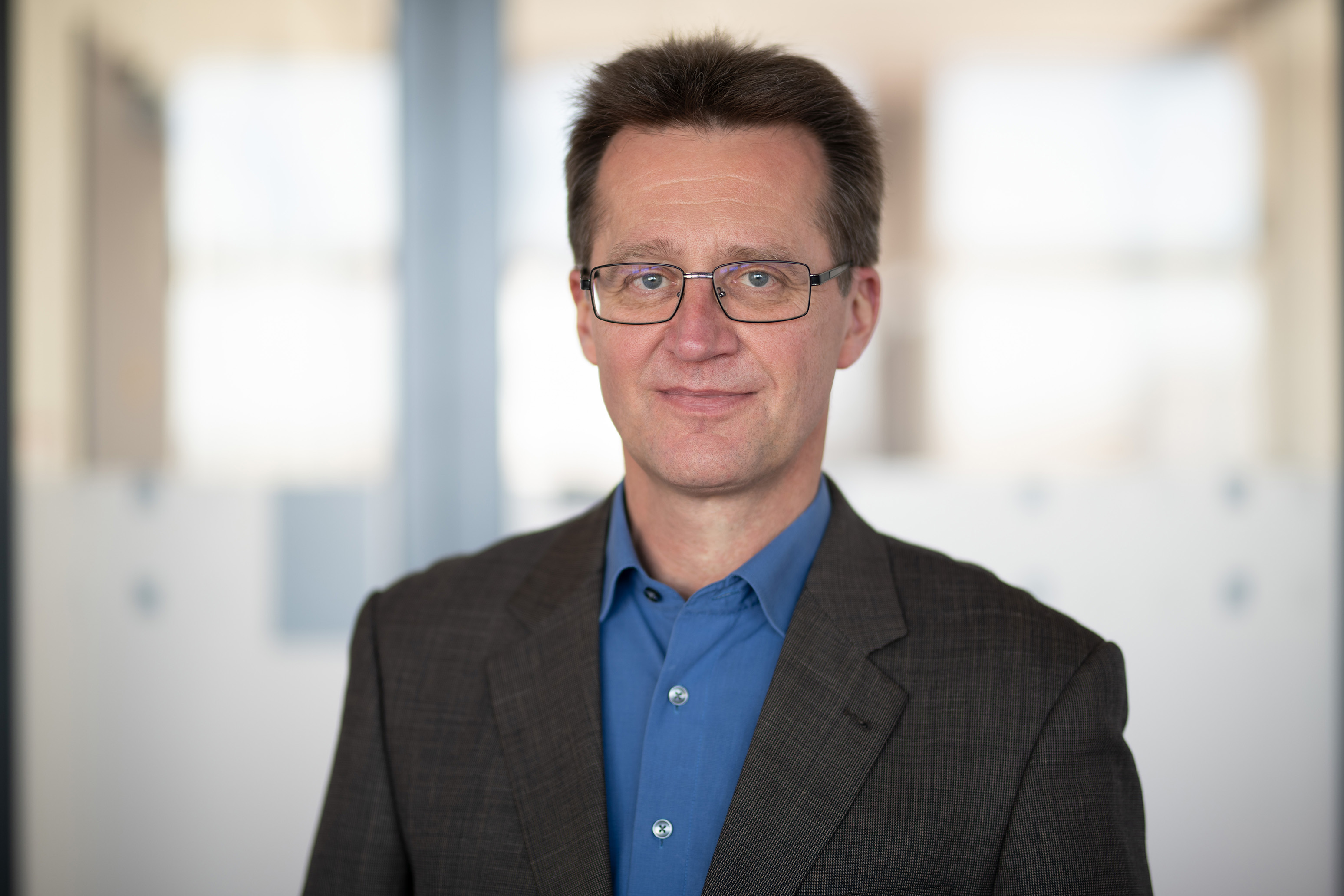
Hans-Joachim Bohr is a Lecturer at Saarland University of Applied Sciences, specializing in the Embedded Systems Laboratory (formerly Hardware Laboratory). He teaches courses in Mechatronics/Sensor Technology, Digital Technology, Microprocessor Technology, PLC Basics, and Practical Circuit Technology across both Winter and Summer Semesters. Contact: +49 (0)681 58 67 278 Email: hans-joachim.bohr@htwsaar.de Location: Room 5304, Goebenstraße 40, 66117 Saarbrücken His professional expertise includes microprocessor and microcontroller systems development (hardware/software), programmable logic controllers , and fieldbus systems . He contributes to university administration as a member of the staff council of academic staff. Consultation hours are available after classes and by arrangement . His work is associated with engineering disciplines and applied computer science, particularly through practical projects and internships.
Marc Quirin is a Lecturer at the Faculty of Engineering at Saarland University of Applied Sciences. His expertise lies in automation technology, with a focus on signal and image processing , robotics , and non-destructive materials testing . Specializes in industrial image processing, 3D imaging (stereo vision, TOF cameras), Fourier/wavelet signal analysis, and LabVIEW/Matlab/Python programming Teaches courses on machine vision, microcontroller systems, and theoretical electrical engineering Develops training materials and experimental frameworks for automated NDT and image processing
Jürgen Schäfer is a Professor at Saarland University of Applied Sciences, specializing in embedded systems and mechatronics. He leads the Embedded Systems Laboratory and contributes to curriculum development in technical disciplines. Academic Affiliation: Saarland University of Applied Sciences Research Focus: Embedded systems, microcontroller applications, and energy conversion technologies. Lecture Topics: System dynamics, control systems, FPGA design, and computer architecture across winter and summer semesters. Laboratory Leadership: Head of the Embedded Systems Laboratory. Contact: Email juergen.schaefer@htwsaar.de, Room 5311, Saarbrücken campus.
Prof. Dr.-Ing. Sven Tschirley is a Professor at the Berlin University of Technology , affiliated with Department VII Electrical Engineering, Mechatronics and Optometry . He serves as Head of the Laboratory for Electronics and Radio Frequency Technology and is actively involved in university governance as a Member of the Academic Assembly, Chairman of the Board, and other committees. Research focuses on electronics, radio frequency technology, microcontroller applications , and interdisciplinary integration of technology into creative processes . Teaching emphasizes digital signal processing, analog/digital circuit design , and embedded systems , with projects like portable digital mixing consoles and eco-mobility drivetrain systems. He has supervised over 60 theses since 2008, spanning topics from power electronics to smart home experiments . His work aligns with industry partnerships (Siemens, Rohde & Schwarz, Visiongreen Ltd.) and practical applications in audio hardware , electric vehicle drivetrains , and energy-efficient systems .
Dr. Alexander Pusch is a Senior Lecturer at the Institute for Physics Education at the University of Münster. He holds a Ph.D. in Natural Philosophy from the University of Duisburg-Essen (2014) and has been active in physics education since 2015. His academic roles include teaching courses like Introduction to Physics Didactics and supervising research projects focused on innovative teaching methods and technologies. Education: 2009–2014: Doctorate in Natural Philosophy at the University of Duisburg-Essen Research Interests: His work prioritizes accessible, low-cost experimental setups using 3D printing, microcontrollers (Arduino/ESP32), and smartphone integration. Key areas include quantum optics education, wave phenomena, inclusive teaching strategies, and diagnosing student misconceptions. He emphasizes practical, hands-on learning and the application of modern technologies in classrooms. Projects & Grants: Co-leads the QuantumMiniLabs project (2024–2027), funded by the German Federal Ministry of Research. Developed low-cost bioreactor systems for teacher training (BIOR3D, 2023–2024). Organized DPG teacher training events on topics like 3D printing and microcontrollers in physics education. Teaching: Teaches seminars on computer-based experiments, physics didactics, and laboratory demonstrations. Collaborates with schools and institutions like the Gesamtschule Waltrop and Euregio-Gymnasium Bocholt to integrate maker technologies into curricula. Awards & Recognition: While no specific awards are listed, his contributions to inclusive education and innovative didactics have been highlighted in peer-reviewed publications and funded projects. Labs & Teams: Works within the Institute for Physics Education’s collaborative environment, focusing on experimental setups for teacher training and school integration. Collaborations include the Alexianer Werkstätten for 3D-printed educational materials.
Prof. Dr. Christoph Stampfer is a full professor and director of the II. Institute of Physics (Institute 2A) at RWTH Aachen University, affiliated with the Department of Physics and the Materials Science & Engineering (MatSE) profile area. He leads the 2D Materials and Quantum Devices Group, focusing on experimental physics in graphene and 2D materials. He is also a key developer of the educational app phyphox , promoting innovative physics education. His research interests include condensed matter physics , quantum devices , spintronics , and nanoelectronics , with a focus on transport properties in graphene-boron nitride heterostructures and spin dynamics. He also pioneers smartphone-based physics experiments for education, leveraging mobile sensors for accessible, hands-on learning. His recent publications reflect a dual focus: cutting-edge research in Physical Review B and educational innovations in journals like Physics Education and European Journal of Physics . Themes include quantum phenomena in 2D materials, DIY sensor integration, and collaborative classroom experiments using mobile technology. Georg-Kerschensteiner-Preis (2023) Ars-legendi-Fakultätenpreis (2020) Falling Walls Winner (2020) RWTH Lecturer Award (2021) Lehrpreis der DPG (2019) Archimedes-Preis (2019) Lehrpreis Physik (2018) Fellowship für digitale Hochschullehre (2016) Stampfer actively supervises a large group of PhD and master’s students, including Hubert Dulisch, David Emmerich, and Katrin Hecker. His group collaborates on both fundamental research and educational outreach. He has received multiple grants supporting digital teaching and experimental physics. The phyphox project, in particular, has been widely adopted in schools and universities, supported by workshops and teacher trainings he co-organizes. The group operates advanced nanofabrication and low-temperature measurement facilities for quantum device research.
Gesche Joost is a German design researcher and Professor of Design Research at Berlin University of the Arts since 2011. She serves as President of the Goethe-Institut since 2024 and leads the Interactive Textiles research area at the German Research Center for Artificial Intelligence . Her affiliations include the Weizenbaum Institute for the Networked Society, the Einstein Center Digital Future, and supervision roles at SAP and ING-DiBa. Education: Architecture (Technical University of Braunschweig), Design (Cologne International School of Design), Rhetoric (Eberhard Karls University of Tübingen) with a 2007 doctorate Her research spans human-machine interaction , gender and diversity in communication technology , wearable computing , and social sustainability . Recent work focuses on digital sovereignty , inclusive digital society , and design research methodologies . Articles address digital education , data ethics , and participatory design across 15 entries from 2008–2018. Scientific recognitions include the iF Product Design Award (2010) , 100 Köpfe von morgen (2006) , and the Nachwuchs-Wissenschaftspreis (2008) . She was named one of Germany's 50 most influential women in tech (2021) and holds an honorary membership in the German Designer Club . Gesche Joost has advised on EU digital transformation as Germany's Internet Ambassador and contributed to policy frameworks through the German Advisory Council on Consumer Affairs . She co-founded Calliope gGmbH to distribute free Calliope mini microcontrollers for digital education in schools.
Professor Ralf Patz is a faculty member at the Kiel University of Applied Sciences , affiliated with the Institute of Communication Engineering and Embedded Systems (Room C13-2.07). His responsibilities include teaching core electrical engineering modules and supervising student research projects. Contact is available via telephone (+49 431 210-4113) or email. Research Focus: Prof. Patz specializes in interdisciplinary domains merging hardware and software systems, including: Magnetic Induction Tomography for non-invasive measurement techniques Embedded Systems design and implementation IoT architectures for Smart Home/City applications Wireless sensor networks (LoRaWAN, WLAN) Microcontroller-based measurement technology Teaching & Supervision: He coordinates multiple courses: Compulsory Electrical Engineering modules (winter/summer semesters) Microcontroller Technology courses Master's electives in Embedded Systems He actively supervises bachelor/master theses and semester projects through the 'Forschungs-Assistenz' program, focusing on Embedded Systems and IoT prototypes like LoRaWAN-based sports sensors.
Michael Hoeding is a Professor at the Brandenburg University of Technology in the Department of Economics . With expertise in network-based applications for commerce and electronic business, his work bridges databases, telecommunications, and enterprise systems. Specialization in database integration and legacy system modernization Key contributions to service-oriented architectures , XML , and SAP ERP optimization Focus on data warehousing (SAP-BI/SAP-BW) and wiki technology for knowledge management His research explores multimedia techniques in training and marketing, Oracle administration , and flash storage applications in database systems. He received the Forschungspreis (research award) from Otto-von-Guericke University Magdeburg in 1998. Notable recent work includes mobile learning applications , single-page website design , and Android development frameworks . His publications span topics from context-based querying to cooperative information systems , reflecting 25+ years of interdisciplinary research. Scientific Awards : Forschungspreis (1998) Grants : Research funding through Fraunhofer Institute participation Teaching : Courses in database systems , software engineering , and mobile applications
Ronald Blechschmidt is a Professor at the Technische Hochschule Ulm (THU) , serving as Dean of the Faculty of Mechatronics and Medical Engineering . He is also a Member of the Senate and the Study Commission for Mechatronics and Medical Engineering . His research focuses on: Sensor data fusion Smart Energy Home systems Energy-efficient building renovation Microcontroller development Image processing and analysis Technical safety He teaches foundational courses in electrical engineering and electronics, and oversees student projects involving electromechanical analogies (LT-Spice simulations) and real-world energy-efficient construction. Contact: Office hours: Wednesdays at 1:15 p.m. Phone: +49 731 96537-356 Mobile: 0160-7936094 Email: Ronald.Blechschmidt@thu.de
Professor Felix Capanni is affiliated with the Ulm University of Applied Sciences (THU) , where he holds multiple leadership roles including Dean of Studies for MMD , Head of the Biomechatronics Laboratory , and Head of the Steinbeis Institute for Implant Development, Testing and Approval . His research focuses on biomedical engineering, biomechatronics, and mechanical testing of orthopedic implants. Biomechatronics Orthotics and Prosthetics Osteosynthesis Systems Photodynamic Therapy for Glioblastoma His recent publications analyze biomechanical testing of locking plates for femoral and humeral fractures, photodynamic glioblastoma treatment, and patient-specific prosthetic design. Collaborations include Universitätsklinikum Ulm and Häussler Technische Orthopädietechnik GmbH . Scientific Awards Best Poster Award nomination, 11. Jahrestagung der Deutschen Gesellschaft für Biomechanik (DGfB), 2019 Capanni serves as 2nd Chairman of the Working Group for Angle-Stable Osteosynthesis (awiso®) and is a Juror at the Medical Engineering Student Competition. His work has been funded by the State of Baden-Württemberg under the 'Innovative Projects' program.
Prof. Dr.-Ing. Ansgar Meroth is a Full Professor at Heilbronn University within the Faculty of Technology (also known as Faculty of Mechanics and Electronics). He serves as International Representative of the Faculty, Founding Dean at the German International University in Cairo, and holds a professorship in the Automotive Systems Engineering program. His research focuses on: Human-Machine Interface systems for vehicle applications Driving simulation and vehicle dynamics Networking in vehicles, special machinery, and elevator systems Car-to-X communication technologies Autonomous water vehicles and sensor networks Prof. Meroth's recent publication activity (2023-2025) shows a strong emphasis on networked control systems under bandwidth constraints, IoT applications in agriculture, and advanced communication protocols. His work bridges theoretical control systems engineering with practical automotive applications, evolving from fundamental automotive networking toward specialized applications in precision agriculture and autonomous systems. Professional leadership roles include: Deputy Program Director for International Automotive Management International Representative for Faculty of Technology Member of uniTyLab research group Member of University Senate His industry collaborations focus on: Intelligent charging stations for electric vehicles Autonomous boats development Smart agriculture sensor networks Hardware-in-the-loop testing systems Professional affiliations: Chair of VDI Neckar Group board Member of Württemberg Engineers' Association extended board Secretary of Lions Club Heilbronn-Wartberg (since 2015) Board member of Thomas-Gessmann Foundation
Tim Nosper serves as Professor in the Department of Mechanical Engineering at Ravensburg-Weingarten University of Applied Sciences since summer semester 2003, concurrently holding the position of Director at the Steinbeis Transfer Center for Automotive Systems since winter semester 2004. He previously served as dean of studies for the mechanical engineering department from 2004 to 2014. His academic foundation includes mechanical engineering studies at Aachen University of Applied Sciences and RWTH Aachen University, followed by a doctorate in vehicle mechatronics from Ruhr University Bochum. International experience includes a research semester at RMIT University in Melbourne during winter semester 2007/2008. Professor Nosper's research specializes in electric powered small vehicles and motorhome technology, with deep expertise in mechatronics and microcontroller programming systems. His work bridges theoretical engineering principles with practical automotive applications, particularly in sustainable transportation solutions and vehicle control systems development. Professional background encompasses significant industry roles including resident engineer at Magneti Marelli's Turin development center and deputy project manager for automated manual transmissions at Daimler AG across Germany and Italy prior to his academic career.
Prof. Dr. Hartmut Paschen is a Professor of Mechatronics at Ruhr West University of Applied Sciences (HS Ruhrwest), where he has been serving since April 2013. He is the Head of the Bachelor's program in Mechatronics and is affiliated with the Institute of Measurement and Sensor Technology. His office contact information includes email at hartmut.paschen@hs-ruhrwest.de and phone number +49 208 88254-394. Prof. Paschen was born in 1966 and studied Electrical Engineering at TH Darmstadt with a focus on Electromechanical Constructions. He completed his Diplom-Ingenieur degree in 1994 and then worked as a scientific researcher at Ruhr-Universität Bochum (Faculty of Mechanical Engineering) in the field of automation technology. He completed his doctorate in 1999 with the dissertation "Vollständig verteiltes SPS-System auf der Basis einer horizontalen Kommunikation in der Sensor/Aktorebene" (Fully distributed PLC system based on horizontal communication in the sensor/actuator level). Prof. Paschen's research interests center around mechatronic systems, with particular focus on: Embedded Mechatronics and control systems Electrical drive technology and motor control Sensor technology and measurement systems Automotive electronics and control units Distributed control systems and horizontal communication in sensor/actuator levels Development of universal test stands for small electric motors His current research projects include the development of a universal test stand for small electric motors, control of brushless and brushed DC motors (including hardware, software, and sensorless methods), and embedded mechatronics applications. Well-equipped laboratories for mechatronics and drive technology are available for these research activities. Prof. Paschen's publication record shows a strong focus on motor control systems, circuit design for automotive applications, and distributed control systems. His work spans from fundamental research in control theory to practical applications in the automotive industry. The evolution of his publications demonstrates a progression from theoretical work on distributed PLC systems to applied research in automotive electronics and motor control. His recent work (2018) shows continued interest in reconfigurable distributed control systems using software agents, indicating an adaptation to modern software engineering approaches in industrial automation. Prof. Paschen's technical competencies include: Hardware and software development of automotive control units Automotive industry development processes and Automotive Spice Drive technology control Microcontroller technology / Embedded Systems Measurement technology (automotive and industrial) Before joining academia, Prof. Paschen spent 14 years in the automotive industry working on series development of control units for mechatronic systems, eventually becoming head of the "Electronics for Adjustment Systems" department. This industry experience has strongly influenced his practical approach to mechatronics education and research. At Ruhr West University of Applied Sciences, Prof. Paschen teaches courses including: Introduction to Mechatronics Embedded Systems Mechatronics Project Work Electrical Drive Technology Measurement Technology Electrical Engineering
Dirk Warmbier serves as a Researcher (Scientific Collaborator I) in the Department of Computer Science within the Faculty of Computer Science and Communication at Westfälische Hochschule University of Applied Sciences. Based in room A4.1.16 at Neidenburger Str. 43, Gelsenkirchen, he functions as Workshop representative and operates under the supervision of Prof. Dr. Lars Christoph Gleim. His research centers on Technical Microinformatics, encompassing microcontroller systems design, embedded computing architectures, and low-level hardware-software co-development. This work bridges theoretical computer engineering with practical microelectronic applications, particularly in resource-constrained technical environments requiring real-time processing capabilities. Warmbier actively contributes to laboratory instruction and research support within the Computer Science Department, with his technical expertise applied to workshop management and experimental system development. His role integrates teaching responsibilities with hands-on research in microsystem technologies.