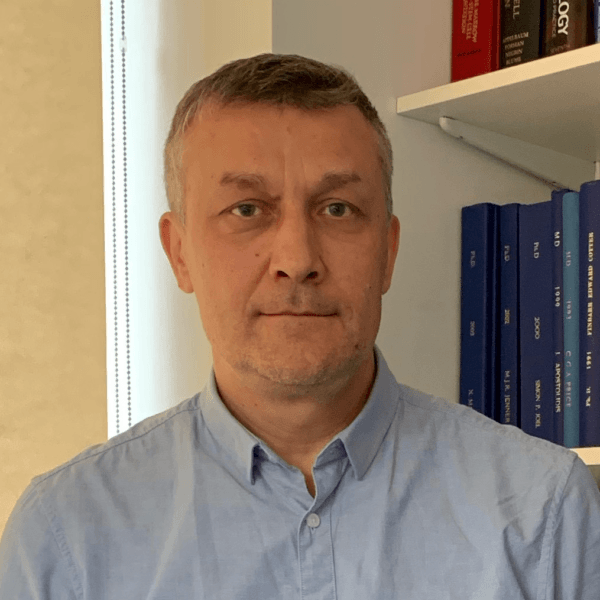
Christos Polytarchou is an Associate Professor in Health and Disease at the School of Science & Technology of Nottingham Trent University . His research focuses on the interplay between the genome, epigenome, and non-coding RNAs in inflammatory diseases and cancer . He teaches postgraduate and undergraduate courses in molecular biology, cancer signaling, and genetic technologies.
Dr. Igor Morozov is an Associate Professor (Research) at Coventry University's Centre for Health and Life Sciences, with over 20 years' experience in gene expression systems. His research examines coordinated regulation of translation, mRNA modification, and RNA decay pathways. Research themes include: RNA quality control mechanisms Microbiome-endocrine interactions Antimicrobial resistance development Fungal gene regulation models His recent publications (2021-2024) demonstrate a shift toward clinical applications, focusing on colorectal cancer microbiomes, pathogen resistance, and gut-endocrine signaling. Earlier work established in vitro protein production systems that generated six patents. Awards include: European Academia Prize in Medicine and Biology (1995) Austrian Research Council Fellowship (2006) Honorary NHS Research Appointment (2016) Dr. Morozov mentors PhD candidates and contributes to university initiatives on antimicrobial resistance.
Professor Maria Libera Ascierto serves as Professor of Translational Cancer Immunology at the School of Cancer Sciences, University of Glasgow, where she leads the Translational Pharmacology and Immunology (TPI) laboratory. Her work focuses on biomarker discovery through precision immunology, utilizing advanced proteomic approaches to decipher immune evasion mechanisms and develop novel immunotherapies for melanoma and gastrointestinal cancers. Her research centers on cancer immunology and translational pharmacology, with melanoma and GI cancers serving as primary models for studying immunotherapy response and resistance. The TPI laboratory employs cutting-edge techniques including spatial immune profiling, spectral cytometry, and ultrasensitive chemokine/cytokine measurement under GCLP standards to identify resistance patterns and pioneer new immunotherapeutic strategies. Research groups within her lab specialize in Melanoma Immunology, Breast cancer, Colorectal/Lower GI cancers (including gut microbiome), and Liver cancer. Analysis of her 2016-2025 publications reveals a consistent focus on immunotherapy resistance mechanisms, particularly to anti-PD-1 therapies across multiple cancer types. Her work increasingly integrates multi-omic approaches and spatial biology to characterize tumor microenvironment dynamics, with recent studies examining brain metastases and combination therapies involving durvalumab. No scientific awards were mentioned in the provided documentation. Professor Ascierto currently leads the grant "Unchaining spatial omics and immune monitoring in clinical practice through LUNAPHORE technology: Implications for Precision Immunotherapy" funded by NHS Greater Glasgow and Clyde Endowment Funds (2024-2027). While specific advisees aren't listed, her laboratory drives clinical trials and biospecimen research within the University of Glasgow's translational framework. The TPI laboratory functions as the central hub for translational research at the University, integrating clinical trials, biospecimen analysis, and biomedical informatics. It maintains specialized teams for spatial omics, immune monitoring, and precision immunology, with current projects focused on applying LUNAPHORE technology to clinical practice and investigating oncogenic signaling pathways in immunotherapy response.
Dr. Mark White is a Clinical Lecturer at the University of Glasgow, specializing in cancer research with a focus on colorectal cancer and the intestinal microbiome. His work bridges clinical practice and translational research within the Clinical Research Garscube group. Research Interests Colorectal cancer pathobiology Gut microbiome interactions Immune-tumor crosstalk Biomarker development Metastasis mechanisms Stromal microenvironment dynamics Recent publications highlight his work on tumor plasticity (2025), neutrophil subtypes in metastasis (2024), and immune activation strategies in colon cancer (2022). Current grants from Beat Cancer Charity and Office of the Chief Scientific Adviser focus on BRAF-mutated colorectal cancer and neutrophil blockade.
Professor Bernardo Villarreal-Ramos is a leading researcher in the Department of Life Sciences at Aberystwyth University, specializing in bovine immunology , microbiology , and metabolomics . His work addresses global health challenges through the One Health Initiative , integrating human, animal, and environmental health. With over 100 research outputs, his recent focus includes Mycobacterium bovis (bovine tuberculosis), vaccine efficacy , and metabolic profiling for disease biomarkers. Key Research Areas : Immunology, Microbiology, Metabolomics, One Health, Vaccinology, Bovine Tuberculosis Awards : Sêr Cymru II Professor His 2025 articles explore dietary interventions like green tea with rhubarb root for metabolic health and oral supplements for aging populations. Earlier work in 2022-2021 examines badger microbiomes and Mycobacterium bovis genetics. Media coverage highlights his contributions to TB eradication and metabolite research . Scientific Impact : 16+ Citations on PLoS Pathogens (2021) Collaborations with institutions in Current Microbiology and Vaccine Dataset contributions on Zenodo and Elsevier His research informs policy and practice for zoonotic disease control , emphasizing interdisciplinary approaches to achieve UN Sustainable Development Goals in health and wellbeing.
Professor Dianne Ford is the Pro Vice-Chancellor of the Faculty of Health and Life Sciences at Northumbria University, leading a faculty of ~12,000 students and 600 staff. Previously, she held leadership roles at Newcastle University, including Associate Dean for Taught Postgraduate Studies. She earned a PhD in Biochemistry from the University of Bristol (1991). Her research focuses on zinc homeostasis, dietary polyphenols, and epigenetic mechanisms in aging. She has secured £2.55M in BBSRC grants and currently collaborates internationally on NAD+ restoration projects. Dianne is a Fellow of the Royal Society of Biology and Physiological Society, with over a decade on UKRI advisory panels. Research interests include dietary interventions to extend healthspan, human intervention studies, and molecular aging pathways. Notable funding includes grants from Unilever and Nuchido Ltd. She has published widely on topics like zinc transporters, epigenetic modifications, and microbiome-drug interactions. Awards highlight her contributions to gender equality in STEM through Athena SWAN initiatives. Education: BSc (Hons) Biochemistry (University of Bristol, 1988), PhD Biochemistry (University of Bristol, 1991) Awards: Fellow of the Royal Society of Biology, Fellow of the Physiological Society Grants: £2.55M BBSRC grants (2000–2018), £95K Nuchido Ltd (2023–present) Her work aligns with UN SDG targets for good health and well-being, emphasizing translational research to combat age-related diseases. Collaborations span institutions in Italy, Australia, and beyond, reflecting her global impact in nutritional and aging sciences.
Dr. Nicholas Rattray is an Associate Professor and Reader at the University of Strathclyde’s Strathclyde Institute Of Pharmacy And Biomedical Sciences. His research focuses on metabolic changes across the human life course, particularly energy metabolism, biomarker detection, and clinical applications in pregnancy, frailty, aging, and cancer. He leads projects funded by EPSRC and NHS Lanarkshire, including the DTP 2224 PhD Studentship and frailty-focused studies. His lab specializes in metabolomics, mass spectrometry-based pipelines, and cellular models to study metabolic pathways and their role in disease. Collaborations span international institutions, with recent work addressing sex differences in cancer metabolism and biomarker validation for aging. Dr. Rattray supervises students like Mohammad Almawazini and utilizes advanced equipment such as the Genius SQ Nitrogen Generator and LCMS-2050 for high-throughput analysis. Research Interests: - Investigating metabolic dynamics in aging and disease - Development of analytical tools for biomarker discovery - Metabolomics applications in oncology and geriatrics Grants & Projects: - DTP 2224 Research Studentship (EPSRC) - Frailty (eFI JARSS NHS Monies) (NHS Lanarkshire) Key Contributions: - Over 105 publications, including peer-reviewed articles on senescence, diabetes, and cancer metabolism - Pioneering work on spatial lipidomics and protein corona analysis in nanomedicine
Prof. Aylin Hanyaloglu is a Professor in Molecular Medicine at the Department of Metabolism, Digestion and Reproduction, Faculty of Medicine, Imperial College London. She leads the G protein-coupled receptor (GPCR) Signalling Group, established in 2007. Her work focuses on understanding fundamental mechanisms of GPCR signal transduction, with applications in reproductive health, metabolic disorders, and cancer. Affiliations include the Chemical Biology CDT, Centre for Translational Nutrition and Food Research, and the Membrane Receptor Network. Education: PhD in Molecular Endocrinology (2002, University of Western Australia), Postdoctoral training at UCSF (2002–2007). Research interests span GPCR dimerization, receptor trafficking, and their roles in physiological systems like pregnancy, labor, and metabolic regulation. Major projects include studying hormone receptors in ovarian physiology, prostaglandin signaling in myometrium, and short-chain fatty acid effects on gut function. Funded by Wellcome Trust, BBSRC, MRC, and Genesis Research Trust, her work bridges basic science and clinical translation. Key research themes include spatial control of gonadotrophin receptors, GPCR oligomerization dynamics, and targeting kisspeptin receptors for reproductive health. Collaborates widely across disciplines, from chemical biology to clinical studies. No listed students or awards, though her contributions are evident in high-impact publications.
Dr. Sergey Krysov serves as Reader in Molecular Biology and Group Leader at the Barts Cancer Institute, Queen Mary University of London. He holds the position of Director of Undergraduate Studies for the institute and is an active member of the European Research Initiative on CLL (ERIC). His academic role encompasses research leadership, undergraduate program oversight, and specialized teaching in hemato-oncology. Dr. Krysov's research centers on immunogenetics of B-cell malignancies, with primary focus on chronic lymphocytic leukemia (CLL) and follicular lymphoma. He investigates B-cell receptor (BCR) signaling pathways, immunoglobulin glycosylation patterns, and tumor microenvironment interactions. His work spans cancer prevention mechanisms, targeted tumor cell therapies, and cell signaling dysregulation, with particular emphasis on how acquired N-glycosylation sites drive lymphoma evolution and how lectin binding triggers persistent BCR activation. Analysis of his 15 most recent publications (2014-2025) reveals consistent thematic focus on BCR signaling abnormalities in CLL and follicular lymphoma. Key research trajectories include CD180 expression patterns across anatomical compartments, EMT-like activation as a therapeutic target, metabolic reprogramming through glycolysis enhancement, and microbiome interactions via bacterial lectins. His work demonstrates translational potential through identification of novel biomarkers and therapeutic vulnerabilities. Scientific recognition includes: John Goldman Fellowship for Future Science (Leuka, 2016-2018) Dr. Krysov has secured substantial research funding including a Barts Charity Strategic Research Grant (2016-2020, £77,487) investigating peripheral blood composition in CLL patients, a Leuka fellowship (2016-2018, £100,000) studying the BCR-ZEB2 axis, and current Barts Charity project (2021-2024, £256,000) examining EMT-like activation in B-cell malignancies. He leads teaching modules BMD211 Human Molecular Biology and CANM935 Molecular Targeted Therapies for Blood Cancers. As Group Leader within the Centre for Haemato-Oncology Research, he directs a multidisciplinary team utilizing genomic sequencing, primary patient samples, and xenograft models to dissect molecular mechanisms of B-cell malignancies, with current emphasis on therapeutic targeting of EMT-like pathways and microbiome-BCR interactions.
Dr. Christopher Delaney serves as a Lecturer in Biomedical Sciences within the Dental School at the University of Glasgow, where he maintains an active research program focused on microbial biofilms and oral microbiology. His academic work bridges clinical dentistry with fundamental microbiological research, particularly examining fungal-bacterial interactions in polymicrobial communities. Dr. Delaney's research interests center on microbial biofilm dynamics, with specialization in Candida species pathogenesis, interkingdom interactions, and antimicrobial resistance mechanisms. His laboratory employs multi-omics approaches including transcriptomics and metabolomics to investigate host-pathogen relationships in oral and systemic infections, with particular emphasis on how biofilm heterogeneity influences disease outcomes and treatment efficacy. Current research initiatives include grants from Tenovus Scotland (2024-2026) examining the metagenomic profile of tonsil and oral flora in tonsillitis patients, and a British Endodontic Society project (2024-2027) analyzing endodontic lesions for targeted biofilm disruption strategies. These projects reflect his translational approach to developing clinical solutions for biofilm-related infections. Dr. Delaney supervises doctoral research, currently guiding Muhanna Ali M Alshehri's investigation of Candida albicans interactions with oral microorganisms. His educational contributions include implementing virtual laboratory simulations to enhance student engagement across undergraduate and postgraduate cohorts, demonstrating his commitment to innovative pedagogical approaches in microbiology education.