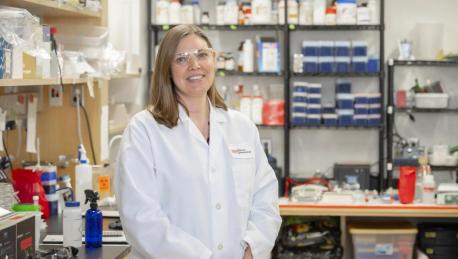
Natalie Farnyمشاهده پروفایل
دانشیار
- Synthetic Biology
- Stress Granules
- Biosensors
- +۷ مورد دیگر
Natalie Farny is an Associate Professor of Biology & Biotechnology at Worcester Polytechnic Institute (WPI), affiliated with the Bioinformatics & Computational Biology and Neuroscience departments. Her research focuses on synthetic biology applications for environmental remediation and understanding cellular stress responses. She holds a B.S. from Boston College (2000), a Ph.D. from Harvard University (2009), and completed postdoctoral work at the University of Massachusetts Medical School (2009–2013). Her lab develops biosensors and bioremediation strategies for contaminants like lead and arsenic, and investigates stress granules' roles in cellular survival under environmental stress. Dr. Farny has received significant awards, including the NSF CAREER Award ($1.2M, 2024–2029) and the EPA Early Career Award. She emphasizes active learning in education and has mentored numerous students in research projects addressing global challenges such as water/soil contamination and human health impacts of environmental toxins. Education: B.S. Biology & Philosophy, Boston College, 2000 Ph.D. Cell & Developmental Biology, Harvard University, 2009 Postdoctoral Research, UMass Chan Medical School, 2009–2013 Research Interests: Synthetic biology for environmental biosensors and bioremediation Stress granule dynamics under environmental toxin exposure Genetic engineering of soil microbes (e.g., Pseudomonas putida) Cellular stress responses to contaminants like bisphenols and heavy metals Awards & Honors: NSF CAREER Award (2024) NIH Gender Diversity Prize (2021) EPA Early Career Award (2021–2024) WPI Board of Trustees Teaching Award (2018) Grants & Funding: Funded by NIH, NSF, EPA, DARPA, and private partnerships Focus on sustainable development goals (SDGs 3, 6, 13, 15) Labs & Teams: Her lab includes 20+ students/researchers working on synthetic biology tools, microbial engineering, and stress granule modeling. Collaborations span institutions like Northeast Water Solutions, Inc., and international partners on soil microbiome studies.