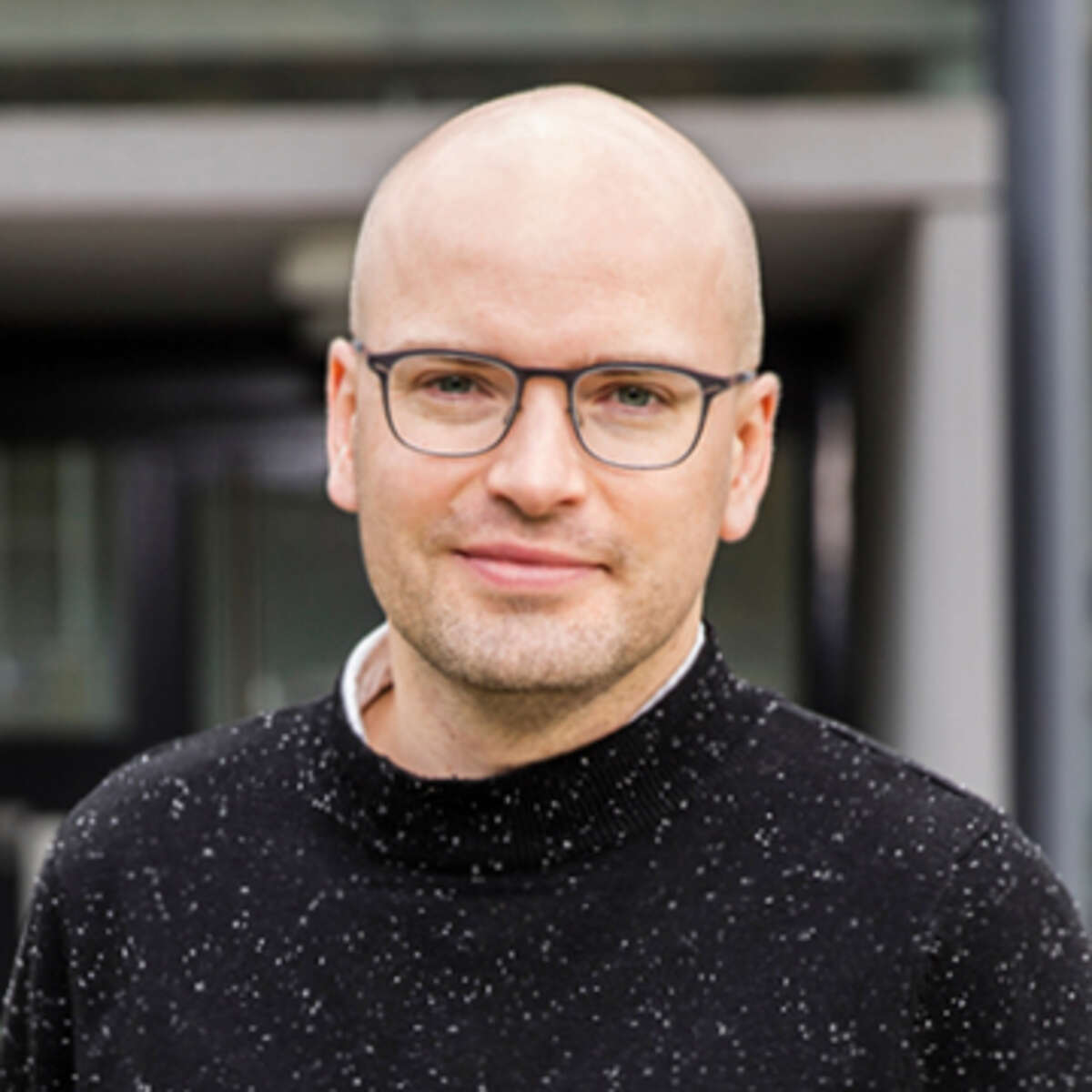
Prof. Knut Drescher is an Associate Professor at the Biozentrum, University of Basel , leading a research group focused on bacterial biofilms , swarming , and microbial multicellularity . Previously, he served as a Professor of Biophysics and Max Planck Research Group Leader at Philipps-Universität Marburg (2015-2021) and conducted postdoctoral research at Princeton University. Research Interests: Physical and biological mechanisms of biofilm formation Cell-cell interactions in microbial communities Antibiotic resistance in biofilms Hydrodynamics of bacterial swarms Evolution of cooperation in multispecies biofilms Development of bioimaging software (BiofilmQ, BacStalk) Scientific Awards: 2023: SNSF Consolidator Grant 2019: Heinz Maier-Leibnitz Prize (DFG), VAAM Research Prize, IUPAP Young Scientist Prize 2016: ERC Starting Grant Advising & Grants: Advises PhD and Master's students in microbiology, biophysics, and bioinformatics Secured major grants from ERC , HFSP , and DFG
Jorge Peña serves as an Assistant Professor at the University of Toulouse 1 Capitole and is a core member of the Institute for Advanced Study in Toulouse (IAST), where he conducts interdisciplinary research at the intersection of mathematics, biology, and social sciences. His institutional affiliation combines university faculty responsibilities with advanced research activities at IAST, an independent institute fostering innovative approaches to complex societal challenges. His research program centers on Evolutionary Game Theory, Social Evolution, and Collective Action Problems, with specific expertise in mathematical modeling of cooperation dynamics. Key investigation areas include: Stability analysis of Nash equilibria in dynamic game environments Group-size effects on collective action in public goods games Evolution of environmentally mediated social interactions Institutional evolution and cultural transmission mechanisms Cooperation dynamics in spatially structured populations Mathematical foundations of social dilemmas Analysis of his 15 most recent publications (2016-2025) reveals consistent methodological rigor in evolutionary dynamics modeling, with increasing focus on large-group cooperation (2023-2025) and interdisciplinary applications spanning biological symbiosis to institutional design. His work demonstrates sophisticated integration of graph theory, population dynamics, and game-theoretic stability concepts, particularly evident in studies of Wolbachia symbionts and voter participation games. As an active IAST researcher, Peña contributes to an environment that bridges theoretical mathematics with empirical social science, leveraging the institute's collaborative framework for cross-disciplinary innovation in evolutionary social theory.
Sebastian Bonhoeffer is a Full Professor in Theoretical Biology at ETH Zurich, where he has been serving since July 1, 2005. He is affiliated with the Department of Environmental Systems Science and serves as Head of Collegium Helveticum. His research focuses on using population biological models to understand fundamental biological processes, with particular expertise in mathematical modeling of virus infections within infected individuals, providing important insights into the pathogenesis of viral infections, especially HIV. Prof. Bonhoeffer was born in Tübingen, Germany. His academic journey began with Music studies in Basel, followed by Physics studies in Munich and Vienna. He then moved to Oxford for his PhD with Martin Nowak and Robert May at the Department of Zoology. After completing his PhD, he remained in Oxford as a Research Fellow of Wolfson College and worked as a visiting scientist with David Ho at the Rockefeller University in New York. Prior to his appointment at ETH Zurich in 2001 as an SNF Research Professor, he was a junior group leader at the Friedrich Miescher Institut in Basel. His research interests span theoretical biology, population dynamics, evolutionary ecology of infectious diseases, mathematical modeling of viral infections, and antimicrobial resistance. He has made significant contributions to understanding the population dynamics of virus infections within infected individuals, particularly HIV. His work has provided important insights into the pathogenesis of viral infections and the evolutionary dynamics of pathogens. Prof. Bonhoeffer's recent publications demonstrate a diverse research portfolio spanning microbial ecology, epidemiology, evolutionary biology, and antimicrobial resistance. His work shows a strong focus on applying mathematical and computational approaches to understand complex biological systems, from viral dynamics to microbial communities and pandemic responses. His research often involves interdisciplinary collaborations addressing pressing public health challenges. Prof. Bonhoeffer has supervised numerous students and mentored early-career researchers in theoretical biology and mathematical modeling. His work has been supported by various research grants, though specific details are not provided in the available information. He is actively involved in teaching, offering courses such as "Seminar in Evolutionary Ecology of Infectious Diseases" and "Ecology and Evolution: Term Paper" at ETH Zurich.
Dr. Sebastien Wielgoss is a Lecturer at the Department of Environmental Systems Science within ETH Zürich , Switzerland. His research focuses on the evolutionary and population genomics of social bacteria, particularly Myxococcus xanthus , and mutation rate dynamics in microbial systems. Education : PhD in Biology (Universität Konstanz, 2004-2009), Master's in Agrobiology (Universität Hohenheim, 2000-2004), Undergraduate in Agricultural Sciences (TU München, 1999-2000) Research Interests Phylogenomics with social myxobacteria : Investigating genetic diversity and phylogenetic relationships in Myxococcus xanthus across spatial scales, linking genomics to social phenotypic diversity. Mutation rate dynamics : Using experimental evolution to study spontaneous mutation rates and their evolutionary trajectories in bacteria like Escherichia coli and Myxococcus xanthus . Publication Trends His work spans phylogenomics, social evolution, phage-host interactions, and mutation rate analysis, with recent publications in high-impact journals like Science , Nature Communications , and PLoS Biology . Scientific Awards Marie Curie Postdoctoral Fellowship (EU-FP7, 2013-2015) PhD Fellowship (Universität Konstanz, 2009) PhD Fellowship (Landesgraduiertenförderung Baden-Württemberg, 2007-2008) Master Student Fellowship (DAAD, 2003) Grants & Institutional Roles He has received multiple fellowships and grants, including the Marie Curie Postdoctoral Fellowship. He serves as a study advisor for Environmental Biology (Bachelor) and study coordinator for Ecology & Evolution (Master) at ETH Zürich. Additionally, he is a member of the Teaching Commission and the Institute's Council.
Gregory Velicer is a Full Professor at ETH Zurich's Department of Environmental Systems Science and Deputy Head of the Institute of Integrative Biology. His research investigates microbial social evolution, focusing on complex behaviors like predation and multicellular development in myxobacteria using ecological, molecular, and evolutionary approaches. Research explores: Genetic controls of bacterial cooperation Predator-prey dynamics in microbial communities Evolution of cheating resistance Ecological drivers of social exploitation Molecular regulation of developmental processes Recent publications emphasize bacterial social evolution in changing environments, with themes spanning molecular genetics, ecological adaptation, and applied biocontrol. Laboratory work integrates experimental evolution with genomic and transcriptomic analysis.
Dr. Yuen-Tsu Nicco Yu is a Lecturer in the Department of Environmental Systems Science at ETH Zürich. He is affiliated with the Institut für Integrative Biologie (Institute of Integrative Biology), where his research focuses on molecular mechanisms of evolutionary adaptations in bacteria, particularly Myxococcus xanthus. His work investigates how specific mutations influence social traits like fruiting body formation and cooperative swarming. Education includes a PhD in Microbiology from Michigan State University (USA, 1993) and a BS in Zoology from National Taiwan University (Taiwan, 1986). Professional experience spans over three decades, including roles as Senior Scientist (ETH Zurich, 2018–present), Oberassistentin (ETH Zurich, 2012–2018), and Associate Scientist (Indiana University, 2007–2012). He has also held postdoctoral positions at institutions like the Max-Planck Institute (Germany, 2000–2006) and Michigan State University (USA, 1997–2000). Research interests emphasize understanding sRNA regulation, bacterial development pathways, and evolutionary dynamics through experimental evolution and genetic analysis. His studies often explore kin discrimination mechanisms, outer membrane exchange in bacteria, and the genetic basis of cooperative behaviors. Recent work has expanded into agricultural applications, including bovine genetics and livestock disease resistance. Teaching responsibilities include co-leading the Experimental Evolution course (Spring Semester) and serving as the main responsible lecturer for Integrated Practical: Antibiotic-Resistance in Soil Microbial Communities . His academic contributions bridge microbiology, systems biology, and evolutionary theory, with a focus on applying molecular insights to ecological and agricultural challenges. Yu collaborates extensively with researchers like Gregory J. Velicer, contributing to studies on myxobacterial social adaptations and their evolutionary implications. His work highlights the interplay between genetic mutations and phenotypic changes in microbial populations, informing both fundamental biology and applied fields like livestock health.
Prof. Dr. Jean Pieters is a Professor of Biochemistry at the Biozentrum, University of Basel, Switzerland. He leads a research group focused on the molecular mechanisms of immune cell homeostasis and host-pathogen interactions, particularly involving coronin proteins and their role in T cell regulation and mycobacterial survival. His educational background includes a Ph.D. in Biochemistry from the University of Maastricht (1985–1989) and undergraduate studies in Biochemistry and Microbiology at the University of Leuven, Belgium. He has held prestigious positions at the Basel Institute for Immunology and the Netherlands Cancer Institute before joining the University of Basel in 2002. His research interests center on coronin-mediated cell population size control , signal transduction in immune cells , and host-pathogen interactions , especially in the context of tuberculosis. His lab investigates how coronin 1 regulates T cell survival, macrophage function, and pathogen evasion mechanisms using models ranging from Dictyostelium discoideum to mammalian systems. The most recent publications reflect a strong trend in understanding the evolutionarily conserved role of coronin in immune regulation, T cell homeostasis, and microbial pathogenesis. His work integrates proteomics, cell biology, and immunology to dissect signaling pathways involving coronin 1, calcineurin, and PI3Kδ. Elected Member of the Royal Netherlands Academy of Arts and Sciences (2011) Friedrich Miescher Award (2002) Pfizer Award (2001) Eppendorf Young Investigator Award (1999) EMBO long term fellowship (1989) Sanofi Young Investigators Prize (1989) Prof. Pieters has supervised numerous PhD and postdoctoral researchers and teaches courses in Cell Biology, Membrane Traffic, and Microbial Pathogenesis. His lab is actively involved in training and mentoring, with a team comprising postdocs, PhD students, and research associates. He has contributed to major discoveries in antigen processing, phagosome biology, and the survival mechanisms of intracellular pathogens, particularly Mycobacterium tuberculosis .
Dr. Thibault Verdenal is a Lecturer at ETH Zurich's Department of Environmental Systems Science, with additional affiliation at Agroscope research institute. His work explores molecular mechanisms underlying bacterial developmental processes, particularly in multicellular organisms. His recent research investigates regulatory roles of small RNAs in bacterial development systems, using Myxococcus xanthus as a model organism to understand genetic pathways controlling complex cellular behaviors.
Dr. Marco La Fortezza is a Lecturer at the Department of Environmental Systems Science at ETH Zürich. His research investigates the effects of selective pressures on social traits in developmental evolution, primarily using Myxococcus xanthus as a model organism. Techniques range from microscopy to sequencing to analyze phenotypic and molecular mechanisms. Education: PhD in Developmental and Cellular Biology, LMU München (2011-2017) MSc in Genetics and Molecular Biology, Sapienza University of Rome (2009-2011) BSc in Biology, Sapienza University of Rome (2006-2009) Research Focus: Evolutionary developmental biology in microbial systems, including social selection in bacterial multicellularity, phenotypic plasticity, and latent evolutionary adaptations. Current work examines how ecological factors influence developmental evolution without direct selection pressure. Publication Trends: Recent work (2021-present) focuses on evolutionary mechanisms in bacterial multicellular development, while earlier publications (2015-2018) emphasize Drosophila genetics, epigenetics, and stress response pathways. Professional Experience: Postdoctoral fellow at ETH Zürich (2017-present) Short-term postdoc at LMU München (2017)