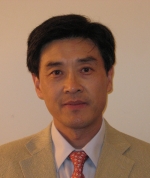
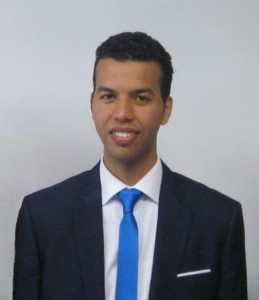
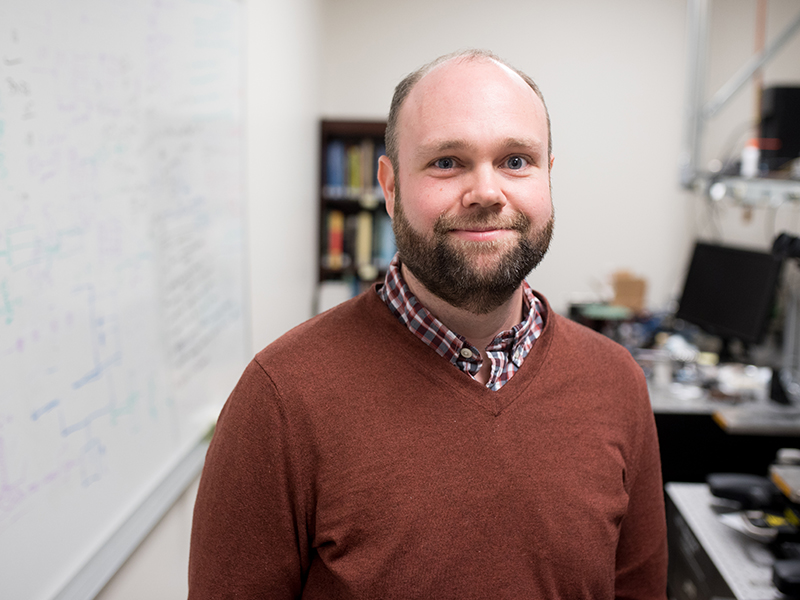
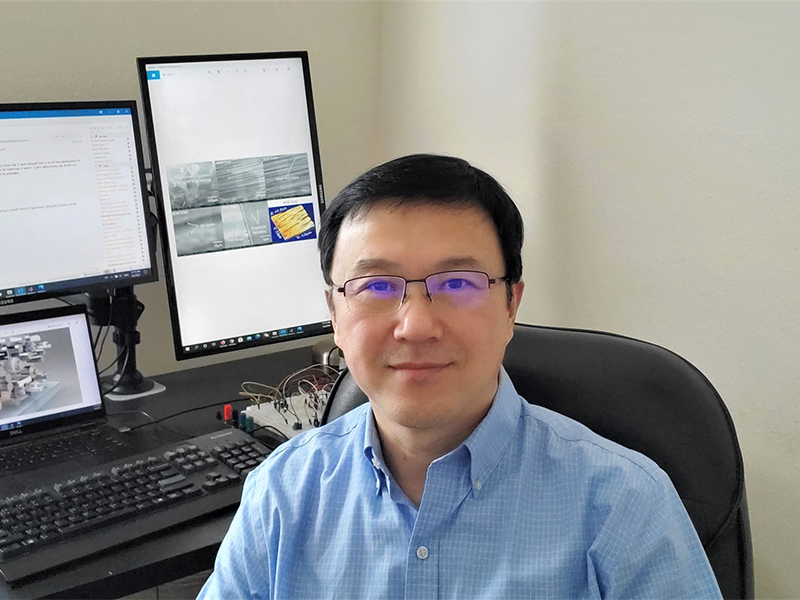
Shyam Aravamudhan is a Professor of Nanoengineering at North Carolina A&T State University and Director of the Joint School of Nanoscience and Nanoengineering (JSNN) Core Facilities. His research bridges micro/nanotechnology with life sciences, focusing on nanobioelectronic systems for diagnostics, regenerative engineering, and environmental health impacts of nanomaterials. He leads efforts in 2D materials for flexible electronics and functional additive manufacturing. Director of JSNN Core Facilities Ph.D. in Engineering (implied from title) Research interests include: Nanobioelectronic systems for disease diagnostics Toxicity of engineered nanomaterials Hexagonal boron nitride in microelectronics Regenerative engineering using nanotechnology Funding Sources: NSF, NIH, Semiconductor Research Corporation, and North Carolina Biotechnology Center. His work spans 15+ years with over 80 publications, emphasizing nanomaterials synthesis, defect engineering, and bioelectronic applications. Current students investigate topics like 3D printing of MoS₂ structures, EHS of CMP slurries, and mechanical stimuli on cell function. Outreach includes SENIC programs promoting STEM education and nanotechnology awareness.
Associate Professor Lifeng Kang is a pharmaceutical scientist at the University of Sydney School of Pharmacy , Faculty of Medicine and Health. He leads the Kang Lab which develops micro-scale and 3-D-printing technologies for drug delivery and regenerative medicine, and teaches undergraduate and postgraduate pharmacy courses. Education & career: BSc & MSc – China Pharmaceutical University (Nanjing, China) PhD – National University of Singapore (2006, drug delivery) Post-doctoral fellow – Massachusetts Institute of Technology (2007-2009, NUS-OPF Fellowship) Lecturer & Programme Director – National University of Singapore (2009-2017) Lecturer → Senior Lecturer → Associate Professor – University of Sydney (2017-present) Visiting Scholar – Stanford University (2019) Research focus: Microfabricated drug-delivery systems, 3-D printing of personalised medicines, dissolvable and hydrogel-forming microneedles, transdermal vaccination and cosmeceuticals, silk-fibroin and peptide biomaterials, organoid models for toxicology, and machine-learning-guided formulation design. Publications & impact: 86 peer-reviewed articles (65 first/corresponding), >4,600 citations, H-index 40, listed in Stanford/Elsevier global top-2 % scientists 2022-2024. Recent work appears in Nature Nanotechnology , Advanced Drug Delivery Reviews , Journal of Controlled Release , Analytical Chemistry and Biomaterials Advances . Innovation & translation: 10 patent families (5 granted, 3 licensed to industry); doctoral students have spun out two start-ups in 3-D-printed pharmaceuticals and microneedle devices. Current grants target osteoarthritis pain, skin depigmentation, paediatric IV stability and needle-free vaccination. Leadership & service: Vice-Chair (ANZ) Dissolution Research Presentation International 2023; 2nd-Year BPharm Coordinator; editorial boards of Advanced Drug Delivery Reviews , Frontiers in Pharmacology , Journal of Pharmacy and Pharmacology , Nano Convergence and others; reviewer for 40+ journals. Teaching & supervision: 14 years’ experience, primary supervisor of 15 PhD/MPhil students and >50 honours/project students; teaches drug delivery, formulation science and pharmaceutical analysis; research interest in mastery learning and formative assessment.
Yue Wu is the Kenan Distinguished Professor in the Department of Physics and Astronomy at the University of North Carolina at Chapel Hill. His research focuses on nanoscale fluid physics , glass transition phenomena , and NMR-based materials characterization . Member of APS, MRS, and AAAS Elected Fellow of the American Physical Society Research interests include: Nanoconfined liquids and gases: anomalous properties in micropores Protein interactions with nanomaterial surfaces Thermodynamics of supercooled metallic liquids His group develops innovative NMR techniques for high-pressure, high-temperature, and electrochemical studies. Publications emphasize applications in hydrogen storage , supercapacitors , and anesthetic mechanisms . Recent work explores metal-organic frameworks , dielectric contrast agents , and electrochemical nanopore dynamics .
Valeria Nicolosi serves as Chair of Nanomaterials and Advanced Microscopy at Trinity College Dublin's School of Chemistry, a position she has held since 2016. She is the first woman to achieve a Chair position in the School of Chemistry since Trinity College Dublin's founding in 1592. Her academic journey includes ERC Research Professorship at TCD (2012-2014), Departmental Lectureship at Oxford Materials (2010-2011), and multiple fellowships at the University of Oxford. Her educational background features a BSc in Chemistry from the University of Catania (2001) and a PhD in Physics from Trinity College Dublin (2006), completed under Prof. J.N. Coleman focusing on liquid phase processing of 2D nanomaterials. Nicolosi's research centers on 2D materials and nanomaterials for energy applications, with particular expertise in MXenes , battery electrodes , supercapacitors , and advanced electron microscopy . Her work bridges fundamental nanomaterial synthesis with practical energy storage solutions, emphasizing scalable production methods like liquid-phase exfoliation. Analysis of her recent publications reveals a strong focus on MXene-based energy storage systems , with significant contributions to micro-supercapacitor fabrication, silicon anode development, and transparent conductive electrodes. Her work consistently addresses industrial scalability challenges while maintaining high electrochemical performance. Trinity College Dublin ERC Researcher of the Year (2017) Science Foundation Ireland Young Scientist of the Year (2016) President of Ireland Young Researcher Award (2014) World Economic Forum Young Scientist (2013) RDS/Intel Prize for Nanoscience (2012) Women Business Forum Women of the Decade in Science & Innovation (2018) Nicolosi has secured substantial research funding through ERC grants and Science Foundation Ireland awards, enabling her leadership in nanomaterials research. She previously held a Junior Kurti Fellowship at Brasenose College, Oxford (2009-2012), and served as a Visiting Scientist at Oxford's Department of Materials (2012-2017). Her collaborative work spans international institutions including the CRANN nanoscience institute at TCD. Her laboratory focuses on advanced microscopy techniques for nanomaterial characterization, with strong industry partnerships for energy storage applications. Current research emphasizes translating lab-scale nanomaterial discoveries into commercially viable energy storage solutions through scalable processing methods.
Rebecca Gallivan is an Assistant Professor of Engineering at Dartmouth College's Thayer School of Engineering. Her research focuses on nanoscale material phenomena and additive manufacturing techniques, with an emphasis on sustainability. She holds a BS from MIT and a PhD from Caltech, followed by postdoctoral work at ETH Zurich. Education: BS in Materials Science and Engineering, MIT (2017) PhD in Materials Science, Caltech (2023) Postdoctoral Researcher, ETH Zurich (2023–2024) Research Interests: Her work explores nanostructuring, additive manufacturing at micro-/nano-scales, and sustainable nanotechnology. Key areas include: Design of functional nanostructured materials Nanomechanical characterization Integration of machine learning for material analysis Development of scalable nanotechnologies Selected Awards: Demetriades–Tsafka–Kokkalis Prize (2023) Amazon AI4Science Fellowship (2022) Kavli Nanoscience Institute Catalyst Award (2022) Grants & Advising: Active in research mentorship programs for underrepresented students. Leads the Gallivan Group, which collaborates on projects involving multi-mechanism interactions in materials and nanoscale additive manufacturing advancements. Teaches courses on additive manufacturing fundamentals and material science. Labs & Teams: Directs the Gallivan Group at Thayer School, focusing on experimental and computational approaches to nanomaterials. Collaborates with industry and academic partners on scalable nanotechnology solutions.
Dr Ahmed Ismail is a Lecturer in Fluid Dynamics at the School of Engineering and Materials Science, Queen Mary University of London (QMUL). He is affiliated with the Centre for Sustainable Engineering and the Centre for Intelligent Transport, where he serves as Research Seminars Coordinator. He holds leadership roles including Chair of the PGT Examination Board and leads a research group focused on microfluidics and electrohydrodynamics. He received his BSc in Mechanical Engineering from the University of Helwan, Cairo (2009), followed by an MSc (2014) and PhD (2016) in Fluid Mechanics from the University of Seville, Spain, under the FPI scholarship. After a postdoctoral year at Seville, he joined QMUL as a PDRA in 2017 and was appointed Academic Fellow and Lecturer in 2019. He is a Fellow of the Higher Education Academy (FHEA). His research centers on multiphase flows at micro-scale , including capillary jets, microdroplets, electrohydrodynamics, and micro-encapsulation . He employs high-speed imaging, dimensionless analysis, scaling laws, and numerical simulations to address industrial challenges in 2D/3D printing, additive manufacturing, and drug delivery . Keywords include Electrospray, Direct Printing, Microfluidics, Drops & Bubbles, and Capillary Jet. His recent publications reveal a strong trend in controlled droplet and jet dynamics , with applications in high-resolution printing, bio-fabrication, and microencapsulation . He develops scaling laws to predict jet breakup and droplet formation, enabling optimization of printing processes. His work bridges experimental observation with theoretical modeling, particularly in electrified jets, cavity collapse, and liquid-liquid electrospraying . Dr Ismail has secured significant research funding, including a KTP project with Innovate UK (£276,771, 2025–2027) and an EPSRC grant (£296,834, 2022–2024) on Electro-Collapse Jetting for next-generation printing technologies. KTP Archipelago 10144476 (Innovate UK, £276,771, 2025–2027) Electro-Collapse Jetting: Towards the Next Generation of Printing Technologies (EPSRC, £296,834, 2022–2024) He advises multiple PhD students working on hydrodynamic printing, droplet disintegration, droplet impact control, and electric propulsion . His lab focuses on translating fundamental fluid dynamics into sustainable engineering solutions, particularly in intelligent transport and digital manufacturing. He teaches EMS503U Applied Fluid Mechanics and mentors students in experimental and theoretical aspects of fluid dynamics.
Kevin Hemker is the Alonzo G. Decker Professor of Mechanical Engineering at Johns Hopkins University, affiliated with the Whiting School of Engineering and holding joint appointments in the Department of Materials Science and Engineering and the Department of Earth and Planetary Sciences. He earned his BS in metallurgy from the University of Cincinnati in 1985 and MS and PhD in materials science and engineering from Stanford University (1987, 1990), followed by a postdoctoral fellowship in physics at the Ecole Polytechnique Federale de Lausanne. Since joining Johns Hopkins in 1993, he has pioneered research on materials behavior across multiple scales, from atomic-level mechanics to macro-scale architected materials. Education: BS (1985, University of Cincinnati), MS (1987, Stanford), PhD (1990, Stanford) His research focuses on materials science and engineering , particularly nanocrystalline materials , metallic micro-lattices , thermal barrier coatings , and additive manufacturing . He leads projects on topological optimization of 3D lattice materials, deformation behavior of nanocrystalline thin films, and vapor phase alloying for high-temperature applications. His group has also explored 3D textile manufacturing, fused filament fabrication (FFF) of polymers, and mechanical damping in metallic lattices. Recent projects include collaborations with Georgetown University via a $1.6 million NSF DMREF grant to study FFF-printed polymers and the development of nanotwinned-NiMoW alloys for advanced MEMS sensors. His work spans multidisciplinary applications , from satellite thermal protection systems to armor ceramics and NASA’s DART mission (via alumni like Betsy Cogdon). Scientific Awards: TMS Oleg D. Sherby Award (2025) ASM International Silver Medal Fellowships: AAAS, ASME, ASM International, TMS Leadership and Service : Hemker served as TMS President (2018), edited Scripta Materialia (2004-2011), and held roles at DARPA (2010-2015). He founded the Johns Hopkins Center for Additive Manufacturing and Architected Materials (JAM2) and sponsors research with the U.S. Air Force, Army, Navy, NASA, and DOE.
Dr. Panos S. Shiakolas is a tenured Associate Professor in the Department of Mechanical and Aerospace Engineering at The University of Texas at Arlington . He earned a PhD in Mechanical Engineering (1992) and BS/MS at The University of Texas at Austin (1986/1988). His career spans robotics, additive manufacturing, medical diagnostics, and control systems, with a focus on micro-devices for medical applications and human-robot interaction . He has mentored numerous students in competitive design contests and developed educational testbeds for robotics and control systems. Research Emphasis : 1) Micro-scale biomedical devices for diagnostics/prognostics in confined anatomical spaces; 2) Additive manufacturing process monitoring; 3) Human-robot interaction for assistive prosthetics; 4) Engineering education pedagogy. His publications cover robotic calibration, laser micromachining, medical device design, and finite element analysis. Awards include multiple Research Excellence Awards at UTA, best paper recognitions, and industry-sponsored design competition wins. He holds memberships in ASME and the National Academy of Inventors .
Dr. Michael Cullinan is an Associate Professor in the Walker Department of Mechanical Engineering at the University of Texas at Austin, supported by the Temple Foundation Endowed Faculty Fellowship. His research focuses on nanomanufacturing systems, nanoscale phenomena applications, and the development of novel micro/nanoscale devices for energy and sensing. He holds a PhD from MIT (2011), an MS from MIT (2008), and dual degrees from Swarthmore College (B.S. Engineering and B.A. Economics). His work bridges nanotechnology and macro-scale engineering, with emphases on additive manufacturing, machine learning-driven process control, and material characterization. Research interests include nanomanufacturing processes, thin film engineering, nanoparticle sintering, and microelectronic device fabrication. Notable projects involve in-situ monitoring of additive manufacturing processes, moiré-based metrology, and development of microscale selective laser sintering (μ-SLS) systems. His publications highlight advancements in quality control, thermal energy transfer modeling, and precision manufacturing techniques. Key contributions include methodologies for metal powder emissivity measurement, data-driven predictive optimization in additive manufacturing, and advancements in roll-to-roll nanomanufacturing metrology. The Nano Design and Manufacturing Lab under his leadership explores next-generation manufacturing solutions for energy and sensing applications.
Dr. Wei Li is a Professor of Mechanical Engineering at the University of Texas at Austin, holding the John T. MacGuire Professorship. He joined the faculty in 2010 after being an Associate Professor at the University of Washington. His research focuses on advanced manufacturing, biomedical engineering, and nanotechnology. Key areas include roll-to-roll graphene transfer, 3D cell culture platforms, and electrosurgical tissue welding. Dr. Li has been funded by NSF, NIH, and industry partners like Boeing and General Motors. Education : Ph.D. from University of Michigan Affiliations : Board Director of SME's North American Manufacturing Research Institution; Chair of ASME's Biomanufacturing Technical Committee; Associate Editor of ASME's Journal of Manufacturing Science and Engineering . His research interests span nano-biomaterials processing , clean energy , and process monitoring . Notable projects include roll-to-roll dry transfer of graphene and high-throughput 3D cell culture systems for drug screening. Awards include NSF CAREER and PECASE. Current research explores polymer nanofoams, tissue models, and additive manufacturing for precision medicine. Advising : Supervises Arturo Hernandez (current graduate student). Grants : Supported by NSF, NIH, Los Alamos National Lab, and automotive/defense industries. Labs/Teams : Directs the Li Research Group, focusing on biomedical manufacturing and advanced materials fabrication .
Professor WANG Hao is a faculty member in the Department of Mechanical Engineering at the National University of Singapore (NUS), specializing in precision manufacturing and materials processing. His research laboratory focuses on ultra-precision machining techniques for challenging materials including ceramics, titanium alloys, and composites. He teaches advanced courses including ME4261 (Tool Engineering) and ME6604 (Modelling of Machining Processes). His research interests center around ultra-precision machining and polishing and hybrid machining and manufacturing techniques. Professor Wang's work particularly addresses the challenges of machining brittle materials, titanium alloys, and composite materials through innovative approaches including thermal gradient machining, graphene reinforcement strategies, and novel surface treatments. His research group investigates fundamental material behaviors during precision manufacturing processes to develop improved machining methodologies. Analysis of Professor Wang's recent publications reveals a strong focus on precision manufacturing challenges across multiple material systems. His research demonstrates expertise in thermal-assisted machining for brittle ceramics, graphene-enhanced titanium composites, and electrochemical surface finishing for additively manufactured components. A consistent theme across his work involves understanding and manipulating material deformation mechanisms at micro and nano scales to improve machining outcomes. Alexander von Humboldt Fellow Research Affiliate of The International Academy for Production Engineering (CIRP) Professor Wang's research is supported by multiple Singapore Ministry of Education Academic Research Funds (MOE-T2EP50120-0010, MOE-T2EP50220-0010, and A-8001225-00-00), as well as international collaborations including the PHC Merlion programme with France. His work involves significant computational resources from the National Supercomputing Center, Singapore, and international partnerships with institutions in China and the United States. He advises multiple PhD students and postdoctoral researchers who contribute to his publications as co-authors. Professor Wang's laboratory maintains strong connections with industrial partners in precision manufacturing and collaborates with research groups across Singapore, China, France, and the United States. His team utilizes advanced characterization techniques including micro-CT, SEM, and XAFS to investigate material behaviors during machining processes. The laboratory has developed specialized equipment for precision machining experiments and collaborates with the National Supercomputing Center for computational modeling.
Dr. Zhai Wei is an Assistant Professor at the Department of Mechanical Engineering, National University of Singapore (NUS), where he leads the Nature-inspired Advanced Materials Engineering (NAME) Laboratory. His research focuses on the Multiscale Manufacturing of Multifunctional Materials (4M), developing advanced manufacturing techniques for creating lightweight, strong materials with multifunctional properties including acoustic, electrical, and electromagnetic capabilities. Dr. Zhai received his PhD from the University of Cambridge's Department of Engineering (2011-2015) under Professor David Cardwell, following a BEng from the University of Science and Technology Beijing's School of Materials Science & Engineering (2007-2011) and a visiting period at Tsinghua University's Department of Physics (2010-2011). His research spans advanced manufacturing of porous materials, additive manufacturing, freeze casting, and powder processing for creating alloys, composites, and hierarchical ceramics. Drawing inspiration from nature materials like nacre and bamboo, his work focuses on designing materials with multi-scale structural control from nano- to macro-length scales. His group employs a multi-disciplinary approach combining engineering, materials science, chemistry, and physics principles. Analysis of Dr. Zhai's recent publications (2021-2023) reveals a strong focus on developing multiscale manufacturing techniques, particularly direct ink writing and freeze casting, to create materials with tailored microstructures. His work demonstrates significant advancements in sound-absorbing metamaterials, bio-inspired cellular structures, and multifunctional ceramics with applications in water treatment, electromagnetic wave attenuation, and bone tissue engineering. His scientific recognition includes the A*STAR Research Highlights award received during his time at the Singapore Institute of Manufacturing Technology (2015-2019). Dr. Zhai actively recruits Research Fellows (Postdocs), Master's and PhD students, as well as visiting scholars for collaborative research. He serves as Assistant Managing Editor for Materials & Design (2017-present) and Editor for Materials Today Communications (2019-present). The NAME Laboratory at NUS focuses on developing multiple types of colloidal processing technologies that enable design and control of material composition and structure across multiple length scales. Current research directions include multi-functional cellular materials, multi-functional composite materials, multi-scale freeze casting technologies, and multi-scale additive manufacturing technologies.
Aaron Johnson is a Professor in the Department of Mechanical Engineering at Carnegie Mellon University's College of Engineering, where he directs the Robomechanics Lab . He also holds courtesy appointments in the Robotics Institute and the Department of Electrical & Computer Engineering. His research focuses on enabling robots to operate robustly in complex, real-world environments through innovations in robot design, control, and interaction dynamics. Ph.D., Electrical & Systems Engineering, University of Pennsylvania (2014) B.S., Electrical & Computer Engineering, Carnegie Mellon University (2008) Johnson’s research interests lie at the intersection of legged robotics, adaptive control, bioinspired design, and physics-based planning . He investigates how robots can intelligently interact with unstructured environments—such as rocky terrain, cluttered homes, or industrial sites—by integrating mechanical design, sensor feedback, and intelligent control. His lab develops platforms like Zippy (the world’s smallest bipedal robot) and Picotaur , and works on dynamic behaviors including climbing, jumping, and navigating entanglements. The most recent publications highlight a strong trend in hybrid dynamical systems, robust state estimation, terrain-aware navigation, and ethical considerations in robotics . His group advances techniques in contact-implicit control, MPC, Kalman filtering for hybrid systems, and field deployment of autonomous robots for environmental monitoring. Themes of scalability, energy efficiency, and bioinspiration recur across the work. Johnson has received several prestigious awards: NSF CAREER Award (2020) Army Research Office Young Investigator Award (2019) Best Workshop Paper Award at ICRA 2022 (Quad-SDK) David Thuma Laboratory Project Award (2008) Honorable mention, CRA Outstanding Undergraduate Award (2008) He actively mentors students through his graduate course 24-775 Robot Design & Experimentation and lab outreach programs, including partnerships with Gwen’s Girls. He has secured grants for fielding legged robots in real-world applications, such as soil contamination sampling and hill climbing. Johnson co-organizes the CMU Locomotion Seminar and is committed to diversity, equity, and inclusion in robotics, co-authoring the Black in Robotics Reading List and advocating for ethical research practices. The Robomechanics Lab emphasizes ethical research, academic reform, equitable access, and community support. It develops full-stack frameworks like Quad-SDK and conducts field experiments in diverse environments—from deserts to power plants—pushing the boundaries of where robots can go and what they can do.
Alan McGaughey is a Professor in the Department of Mechanical Engineering at Carnegie Mellon University's College of Engineering. He leads the Nanoscale Transport Phenomena Laboratory, where his research bridges mechanical engineering, materials science, physics, and chemistry to study atomic-level transport of mass, momentum, and energy. His work emphasizes phonon, photon, electron, and fluid particle dynamics using advanced simulation techniques. Bachelor of Engineering, McMaster University (1998) Master of Applied Science, University of Toronto (2000) Ph.D., University of Michigan (2004) Post-doctoral training, University of Florida Alan McGaughey's research interests center on nanoscale thermal transport , with applications in energy technologies , materials for energy efficiency , and multiscale modeling . His lab develops molecular- and meso-scale simulation methods, including molecular dynamics, lattice dynamics, density functional theory, and Boltzmann transport equation modeling. Key research areas include thermal transport in nanostructures and interfaces, hybrid organic-inorganic materials, electrocaloric cooling, and liquid-vapor phase change. The team also applies machine learning to accelerate materials discovery and property prediction. The recent publications (2023–2025) reflect a strong focus on thermal conductivity prediction in diverse systems—from polymers and 2D materials to disordered crystals and thin films. The work integrates first-principles simulations , uncertainty quantification , and machine learning to uncover fundamental mechanisms of phonon transport and interfacial heat transfer. A recurring theme is the role of structural disorder —static, dynamic, or rotational—in modulating thermal properties. Air Force Office of Scientific Research Young Investigator Program (2009) Benjamin Richard Teare Teaching Award (2014) National Academy of Engineering’s Frontiers of Engineering Education Symposium (2015) Professor of the Year by MechE seniors (2012, 2015, 2017) 2019 & 2024 College of Engineering Faculty Awards 2021 Viskanta Fellowship, Purdue University McGaughey has advised numerous Ph.D. and Master’s students, many of whom have gone on to impactful research careers. His group has secured funding from agencies such as the Department of Defense and the Department of Energy, including Scott Institute seed grants for energy research. He collaborates extensively with experimentalists, including Jonathan Malen, Reeja Jayan, Chris Wilmer, and others, ensuring strong theory-experiment integration. He is also involved in educational innovation and was named faculty chair-elect for the College of Engineering. The Nanoscale Transport Phenomena Laboratory is a vibrant research group that combines computational modeling with interdisciplinary collaboration to advance fundamental understanding and enable next-generation thermal materials and devices.
Parthasarathi Mandal is a Professor (Reader) in Bioengineering and Structural Mechanics at the University of Manchester. He leads the Bio-engineering research theme in the School of Mechanical, Aerospace and Civil Engineering and serves as Head of Equality, Diversity, Inclusion, and Access for the School of Engineering. His expertise spans structural mechanics, biomechanics, and bio-engineering, with a focus on interdisciplinary research addressing societal challenges. Education: BE and MTech from NIT Durgapur and IIT Kanpur, followed by a PhD from the University of Cambridge. Professional roles include former Director of Civil Engineering Undergraduate Programmes (2012–2017) and co-director of Manchester Institute for Collaborative Research on Ageing (MICRA). He is an Associate Editor of Research on Biomedical Engineering and has secured ~£1.5M in research grants. Research Interests: Bio-engineering, computational mechanics, thin-walled structures, and cell/tissue engineering. Key projects include stability of large-scale structures, micro-mechanics of human cells, and novel biomechanical models for medical devices. His work contributes to UN SDGs, particularly in advancing healthcare and sustainable infrastructure. Supervised 24 PhD students and published over 80 peer-reviewed articles. Notable contributions include developing a theoretical framework for cylindrical shell buckling and advancing friction stir welding techniques. Active in teaching innovation,他曾领导战略教学工作组以提升学生学习体验.