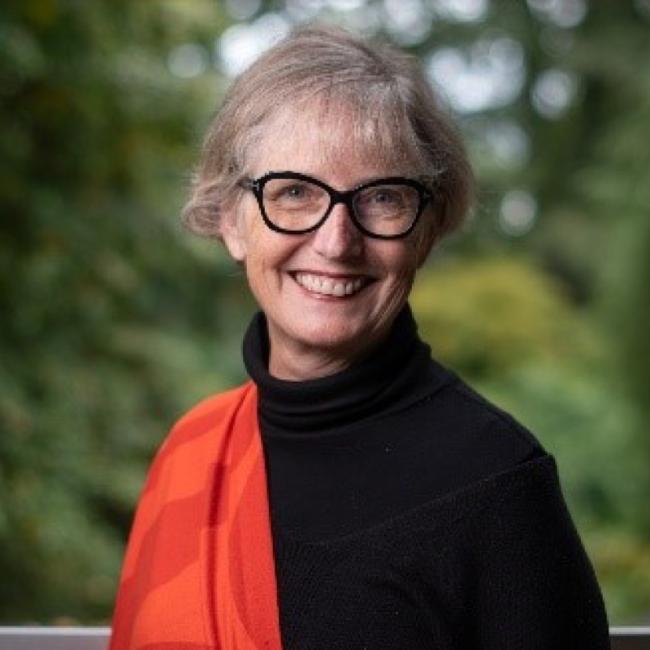
Vivian Forssman is an Adjunct Professor and Program Manager at the Resilience by Design Lab at Royal Roads University , focusing on climate adaptation capacity-building and workforce development. She collaborates with institutions like Natural Resources Canada and Environment and Climate Change Canada.
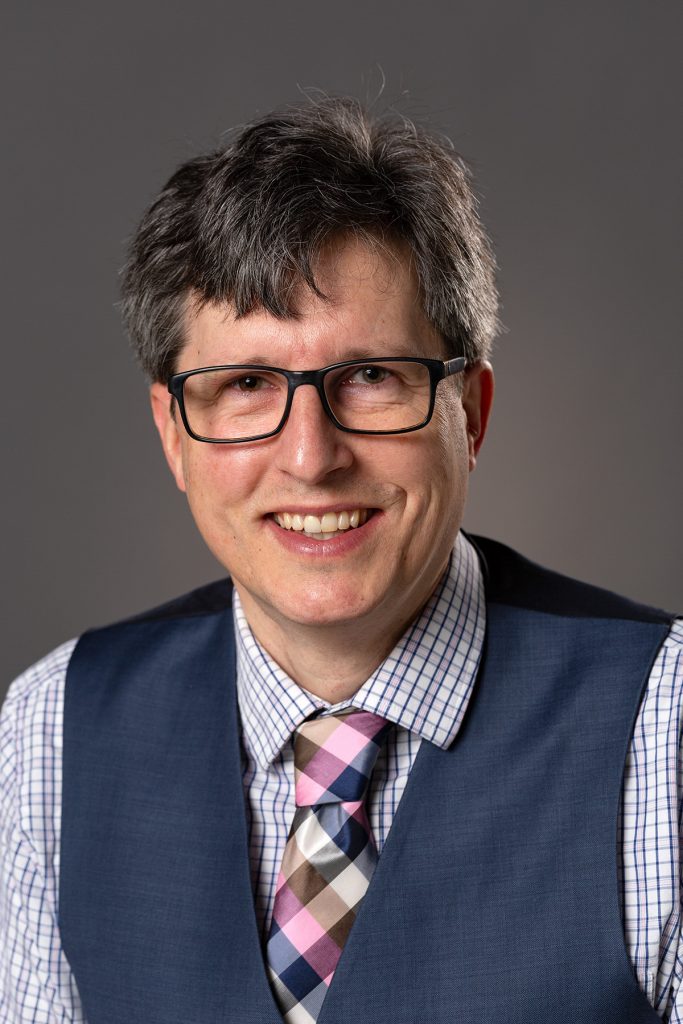
Tobias Barske serves as Assistant Dean in the School of Humanities and Global Studies and is a Professor of German Applied Linguistics at the University of Wisconsin Stevens Point, where he teaches German language, culture, pragmatics, and foreign language teacher education courses while coordinating the foreign language teacher education program. His academic credentials include: Ph.D. in German Applied Linguistics from the University of Illinois at Urbana-Champaign M.A. in Germanic Languages and Literatures from the University of Illinois at Urbana-Champaign Certificate of Advanced Study in Second Language Acquisition and Teacher Education Professor Barske's research centers on micro-analytic approaches to language interaction , specializing in conversation analysis of institutional settings with emphasis on social role construction, embodied actions, and linguistic particles. His foundational work examines how participants co-construct roles in German business meetings, while current research investigates pragmatic functions of modal particles ("ok", "so", "genau") in German discourse. He integrates these insights with second language acquisition theory, famously asserting that "the most effective way to acquire a language is if you are willing to make mistakes and learn from them". His sole documented publication applies conversation analytic methodology to German business meetings, revealing how linguistic tokens index social roles through embodied actions. This work establishes his consistent focus on interactional micro-structures within institutional contexts. His scholarly recognition includes: Academic Staff Excellence University Award (2023) University Excellence in Teaching Award (2009) As coordinator of the foreign language teacher education program, Professor Barske shapes pedagogical training while maintaining active professional engagement through board memberships in the American Association of Teachers of German and American Suzuki Foundation. His conference presentations at national venues like the National Communications Association demonstrate ongoing scholarly contribution to applied linguistics and language pedagogy.
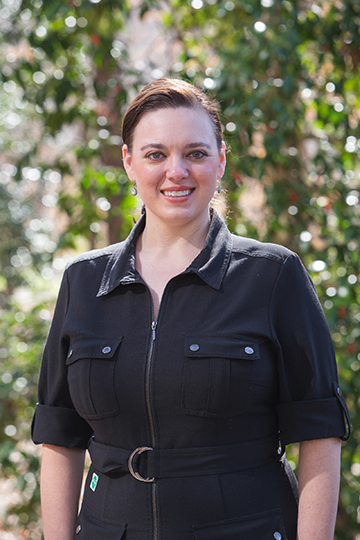
Ellie Koseda is a Professor at the University of Sunderland's Faculty of Education and Society within the Department of Education and Lifelong Learning. Her research focuses on the intersection of digital transformation and educational frameworks, particularly through the lens of Education 4.0 initiatives. She maintains active collaborations with researchers including Bryan McIntosh, Ivan K. Cohen, and Chris Reeve across multiple publications. Her research interests center on digital pedagogy innovation and systemic educational transformation . Koseda pioneers frameworks for Sustainable Development Goals integration in higher education curricula, extends critical reflection models for digital environments, and investigates knowledge transfer quality in academic settings. Her work consistently addresses how Education 4.0 principles reshape teaching methodologies, assessment practices, and internationalization strategies in contemporary universities. Koseda's recent publications (2022-2025) reveal a strong thematic progression toward technology-driven educational paradigms . Early work focused on knowledge transfer foundations (2022), evolving into comprehensive Education 4.0 applications across healthcare (2025), curriculum design (2024), and global policy contexts (2024). Her research demonstrates increasing emphasis on practical implementation frameworks rather than theoretical constructs. Her scholarly contributions include significant book chapters in international handbooks and articles in leading journals such as Policy Futures in Education and Educational Practice and Theory . Koseda's work has been featured in Springer Nature publications and InTechOpen collections, indicating recognition within global educational research communities. As a research leader, Koseda directs investigations into digital disruption impacts on academic structures, with particular attention to employability integration and SDG alignment. Her methodological approach combines comparative analysis with action learning frameworks, producing actionable insights for institutional transformation.
Kim Sanders-Davey is an Associate Professor in the Department of Public Health at Samford University's School of Public Health, where she also serves as director of the undergraduate public health program. With a multidisciplinary academic background and extensive teaching experience, she contributes significantly to public health education across undergraduate and graduate levels. Her educational credentials include a PhD in Health Services Administration (University of Alabama at Birmingham), an MBA and BS in Business Administration, a BA in Spanish (all from Samford University), and an MA in Diplomacy and International Relations (Seton Hall University). She holds Quality Matters certifications in online teaching and peer review, underscoring her commitment to pedagogical excellence. Dr. Sanders-Davey's research and teaching focus on public health policy, leadership, healthcare management, strategy, marketing, economics, and finance. She emphasizes real-world application through high-impact practices such as guest speakers, collaborative projects, experiential learning, and integration of community partners. Her innovative approaches include leading May Term courses in London and incorporating events like the Alabama Health Policy Summit into student learning. The recent publications and presentations reflect a strong trend toward educational innovation in public health, particularly in course-based undergraduate research experiences (CUREs), micro-credentialing, curriculum design, and interprofessional teaching methods. Her scholarly work bridges public health, management, and pedagogy, with a consistent focus on workforce readiness and student engagement. Quality Matters (QM) Online Teaching Certificate Quality Matters (QM) Higher Education Peer Reviewer Certificate She actively mentors students in capstone and research projects involving health policy analysis, systematic reviews, strategic evaluations, and data-driven public health inquiries. Her service includes leadership roles such as chairing the School of Public Health’s Academic Affairs and Curriculum Committee and participation in university-wide curriculum governance. Nationally, she serves as a program reviewer for AUPHA and councilor for the Council on Undergraduate Research. Her professional memberships span APHA, AUPHA, ACHE, AcademyHealth, Academy of Management, and several marketing and education associations. Dr. Sanders-Davey is also a contributing author or co-author of major textbooks including the 10th and forthcoming 11th editions of Sultz & Young’s Health Care USA , Essentials of Managing Public Health Organizations , and chapters in Public Health Administration and Comparative Health Systems . These contributions highlight her national impact on public health and health administration education.
Prof. Dr. Ayla Oğuş Binatlı serves as a faculty member and Department Chair at the Department of Economics, Izmir University of Economics, Turkey since 2009. She joined the institution in 2002 after two years as an assistant professor in the USA following her doctoral completion. Her academic credentials include: Undergraduate: Boğaziçi University, Department of Economics Graduate Studies: University of Alberta and Boston College PhD: Boston College (1999) Her research specializes in international economics and applied econometrics, with significant contributions to Turkish economic analysis. She has published extensively on current account sustainability, foreign direct investment determinants, environmental economics (particularly climate policy and CO2 emissions), and cultural economics applications. Her methodological focus consistently employs advanced econometric techniques to address real-world economic challenges within the Turkish context. Publication trends show evolving research concentrations: early work (2006-2012) examined current account dynamics and cultural economics; mid-career (2014-2019) expanded into banking stability and FDI; recent studies (2020-2022) address macroprudential policy effectiveness, environmental policy, and financial market behavior. All publications demonstrate rigorous empirical analysis of Turkish economic data across micro and macro domains.
Reşit ÇETİNKAYA is a full-time Lecturer in the Accounting and Tax Department at Tosya Vocational School, Kastamonu University, Turkey, serving since 2010 and concurrently holding the Department Head position since 2016. His academic credentials include: PhD in Business Administration, Kastamonu University, Institute of Social Sciences (2024) Master's in Business Administration, Çankırı Karatekin University, Institute of Social Sciences (2018) BA in Business Administration, Karadeniz Technical University, Faculty of Economics and Administrative Sciences (2004) Specializing in Financial Accounting and Financial Statement Analysis, ÇETİNKAYA bridges theoretical frameworks with practical corporate applications. His research examines accounting principles in automotive industry contexts and conducts cross-national comparisons of higher education financing systems, demonstrating expertise in both micro-level financial management and macro-level policy analysis. Publication trends reveal an evolution from corporate finance studies (2019 automotive liquidity analysis) to contemporary education policy research (2024 OECD financing comparisons), highlighting interdisciplinary competence across economics, public finance, and educational administration. The 2024 works particularly emphasize Türkiye's integration into global higher education funding models. With no thesis supervision records and no documented research grants, his scholarly impact is reflected through two 2024 policy analyses and a cited 2019 industry study. Collaborative work includes partnerships with Ertuğrul Çavdar (2024) and Faruk Dayı (2019), though no formal research teams or laboratory affiliations are indicated.
Muireann Ní Raghallaigh is Associate Professor at the University College Dublin within the School of Social Policy, Social Work and Social Justice. Her work bridges academic research and community practice through 17 years at UCD and prior roles at Trinity College Dublin. Focuses on refugee children's experiences Specializes in anti-racism frameworks Developed Ireland's first micro-credential for refugee support workers Research spans: Unaccompanied minors' coping mechanisms Policy impact studies Cultural diversity in social services Academic leadership includes: Head of Social Work Subject (2021-2024) Chair of UCD University of Sanctuary Committee Coordinated Masters year groups (2010-2018)
Mehmet Çağatay Akbolat serves as Assistant Professor at Gaziantep University's Faculty of Aeronautics and Astronautics, Department of Aeronautics and Astronautics Engineering, specializing in composite structural integrity for aerospace applications with focus on failure mechanisms in carbon/epoxy systems. His academic credentials include: Doctorate (2018-2022) from The University of Manchester, England Master's degree (2017-2018) from Brunel University, England Bachelor's in Mechanical Engineering (2008-2012) from Karadeniz Technical University, Turkey Research centers on interlaminar fracture behavior, impact response, and innovative toughening methodologies for aerospace composites. Key investigations examine hybrid approaches combining core-shell rubber nanoparticles with thermoplastic veils to enhance damage tolerance, alongside studies on hygrothermal aging effects and binder influences on fracture mechanics. This work directly addresses critical challenges in lightweight aircraft and spacecraft structural design requiring improved crashworthiness and fatigue resistance. Publication trends (2021-2025) reveal consistent advancement in understanding R-curve behavior and interlaminar crack propagation through systematic experimental analysis. His seven high-impact journal articles demonstrate methodical progression from fundamental fracture characterization (2021) to complex hybrid toughening mechanisms (2025), primarily published in Q1 composite science journals like Composites Part A/B. Recurring themes include comparative analysis of veil materials (carbon vs PPS), multimode fracture evaluation, and environmental degradation effects. No information exists regarding supervised students or secured research funding. International collaboration patterns indicate strong ties with UK institutions, particularly The University of Manchester and Brunel University, suggesting participation in shared experimental facilities for advanced composite testing including in-situ SEM and impact characterization rigs.
Dr. Gao Lihao serves as a Lecturer in the Department of Aeronautics and Astronautics within the College of Engineering at Southern University of Science and Technology (SUSTech), transitioning to this role after completing a postdoctoral fellowship in the Department of Mechanics and Aerospace Engineering at SUSTech from August 2022 to July 2023. His academic credentials include: Bachelor's and Master's degrees in Aircraft Propulsion Engineering and Aircraft Design from Northwestern Polytechnical University Ph.D. in Fluid Mechanics from the Department of Mechanical Engineering, Hong Kong Polytechnic University (awarded August 2022) Research spans fixed-wing aircraft aerodynamics, structural design, and laser targeting of micro-droplets, with strong emphasis on practical UAV development. His work has yielded competition-winning unmanned aerial vehicles demonstrating integration of fluid mechanics theory with real-world aerospace engineering challenges. Teaching responsibilities include core undergraduate courses "Strength of Aerostructures" and "Practice of Aircraft Design Teams" for fall 2023. No formal scientific awards (medals/fellowships) are documented, though his UAV teams secured numerous first and second place finishes in domestic and international competitions. Dr. Gao actively mentors SUSTech's model aircraft club and aviation competition team, recently achieving regional qualifying victories. Previously at Northwestern Polytechnical University, he managed the model aircraft team and Aviation Science and Technology Innovation Base, accumulating dozens of competition awards through hands-on student guidance.
Dr. Dong Liu is a Professor in the Department of Mechanical & Aerospace Engineering at the University of Houston, where he has held faculty positions since 2007 (Assistant Professor: 2007–2013; Associate Professor: 2013–2020; Professor: 2020–present). He directs the Microscale Thermal Transport Laboratory and serves as Associate Editor for the ASME Journal of Thermal Science and Engineering Applications (2023–present). His academic credentials include a Ph.D. in Mechanical Engineering from Purdue University (2006), and M.S./B.S. degrees in Thermal Engineering from Tsinghua University. Liu's research focuses on interdisciplinary thermal-fluid sciences, including: Phase change heat transfer (boiling, Leidenfrost phenomena) Micro/nanofluidic systems for energy conversion Electrowetting-enabled thermal management Optofluidic and photothermal technologies Multiphase flow dynamics in advanced materials Applications span electronics cooling, renewable energy, and biomedical devices. His recent publications (2017–2023) demonstrate consistent innovation in heat transfer enhancement, with themes including electrowetting-modulated boiling, laser-driven microfluidics, plasmonic thermal control, and nanoscale thermometry. Over 60% of articles involve experimental validation of novel concepts for industrial thermal management. Awards & Leadership: ASME Fellow (2024) Director of Graduate Studies (2020–present) Chair of multiple faculty search committees (Thermal Science, 2014–2023) As Director of Graduate Studies, Liu oversees academic programs and advises students in thermal sciences. He holds patents for microfluidic pumping systems and neural scaffold alignment technologies. His laboratory collaborates with national institutes and industry partners on next-generation thermal management solutions.
Lori Sussman is an Assistant Professor in the Department of Technology within the College of Science, Technology, and Health at the University of Southern Maine. Previously, she served as adjunct faculty in the Business Department. Her educational background includes: EdD in Transformative Leadership from the University of New England MS in National Security Studies (Distinguished Graduate) from the National War College, National Defense University MMAS from the School of Advanced Military Studies, Command and General Staff College MS in Artificial Intelligence and Human Factors Engineering (Honors) from The George Washington University BS from the United States Military Academy at West Point Dr. Sussman's research focuses on cybersecurity education and awareness, particularly through the Cybersecurity Ambassador Program (CAP). Her work explores practical intelligence expansion and the efficacy of cybersecurity awareness models for vulnerable populations in Maine, including older adults, veterans, K-12 students, and non-profits. Additionally, she investigates the role of micro-credentials in cybersecurity student retention and semi-permeable network access methodologies. Her expertise spans STEM education, women in technology, project management, leadership in STEM/technology, strategy, operations, and planning, facilitation, teambuilding, entrepreneurship, and technology innovation. Scientific awards: CRN 2015 Women of the Channel Power 50 Solution Provider Dr. Sussman has extensive experience in both the public and private sectors. After retiring from the US Army in 2007, she worked with companies such as Cisco, Hewlett Packard, and eGroup. Her military career included over 24 years of leadership roles, including service at the White House as a Presidential Communications Lead for Presidents Bush and Clinton, and at the Pentagon in various high-level positions.
Dr. Margarita Yavorskaya serves as Assistant Professor in the Department of Evolutionary Biology of Invertebrates at the Institute of Evolution and Ecology, Faculty of Science, University of Tübingen since 2020, following a Postdoctoral position at Ludwig Maximillian University Munich (2018-2020). Her academic credentials include: Ph.D. in Zoology, Friedrich Schiller University Jena (2014-2018): "Evolution of head structures in Coleoptera with special emphasis on the feeding apparatus and miniaturized forms" Diploma in Zoology, Biological Faculty of Lomonosov State University (2009-2014): "Mouthparts of hooded beetles (Coleoptera: Corylophidae) with regards to miniaturization" Her research centers on evolutionary morphology of arthropods , with particular focus on size-shape evolution and miniaturization effects in invertebrates. Key investigations encompass cephalic structure evolution in Coleoptera, feeding preference adaptations in beetle larvae/adults, and anatomical studies of minute crustaceans (Chydoridae). She integrates advanced methodologies including confocal laser scanning microscopy (CLSM), scanning/transmission electron microscopy (SEM/TEM), and 3D reconstruction from histological sections and MicroCT datasets to analyze morphological adaptations at microscopic scales. Publication analysis (2017-2023) reveals consistent specialization in beetle morphology, particularly examining head anatomy evolution across diverse families (Ptiliidae, Micromalthidae, Staphylinidae) and miniaturization constraints. Her work bridges paleontological assessments of early beetles (e.g., Coleopsis archaica) with contemporary studies of commensal adaptations (Platypsyllus castoris) and structural diversity in leaf-litter predators, demonstrating methodological innovation through Reflectance Transformation Imaging and 3D reconstruction techniques. No scientific awards were documented in the source material. Dr. Yavorskaya teaches Zoology (Bio122), Microscopic Imaging and 3D Reconstruction (Bio-3187), and Micro- & Macroevolution courses, though specific student advisement or grant details remain unreported. Her research contributes to the "Competence network Biomimetics" and "Colourful Meadow" Initiative through morphological analyses with potential biomimetic applications. She operates within the Department of Evolutionary Biology of Invertebrates utilizing specialized microscopy facilities for investigations into arthropod miniaturization, collaborating on projects examining structural adaptations across evolutionary timescales from fossil lineages to contemporary micro-crustaceans.
Mario Muñoz Organero serves as a Full Professor in the Telematics Engineering Department at University Carlos III of Madrid, concurrently directing the University Master's Degree in Connected Industry. His academic profile centers on leveraging computational intelligence to address complex challenges across healthcare, urban systems, and educational frameworks through rigorous interdisciplinary collaboration. His research spans Artificial Intelligence, Machine Learning, and Smart Environments with significant applications in Healthcare Informatics (pancreatic cancer registries, diabetes management), Transportation Systems (traffic flow optimization, commuter stress analysis), and Educational Technology (generative AI for learning, micro-credentials). He pioneers context-integrated neural network architectures for sensor data interpretation in real-world environments, emphasizing practical deployment in smart cities and clinical settings. Analysis of his 2023-2025 publications reveals a distinctive interdisciplinary trajectory where machine learning methodologies bridge traditionally separate domains. Recurrent and graph neural networks form the technical backbone for projects ranging from pandemic-influenced traffic modeling to blockchain-enabled agricultural trading in Colombia, while explainable AI frameworks increasingly inform educational applications. This cross-pollination of techniques demonstrates exceptional adaptability in addressing domain-specific constraints across medical, transportation, and pedagogical contexts.
Pedro Manuel Moreno Marcos serves as an Associate Professor in the Department of Telematics Engineering at Charles III University of Madrid, where he maintains an active research profile in educational technology. His academic work bridges telecommunications engineering with data-driven educational innovation, focusing on the practical implementation of analytics in real-world learning environments across Spanish and European higher education institutions. His research centers on learning analytics and artificial intelligence applications in education, with particular expertise in student behavior modeling, dropout prediction, and AI-enhanced learning environments. Key contributions include developing predictive models using multi-source data, creating tools like Statoodle for cheating prevention in LMS platforms, and pioneering human-centered generative AI applications through projects like GENIE Learn. His methodological approach combines machine learning algorithm evaluation with institutional ethnography to address adoption challenges in learning analytics. Analysis of his 15 most recent publications reveals an accelerating focus on generative AI's educational potential since 2023, with increasing attention to ethical implementation frameworks and micro-credentialing systems. His work consistently addresses practical barriers in learning analytics adoption while maintaining strong connections to Spanish higher education contexts through projects like PALABRIA-CM-UC3M. No scientific awards were documented in the provided materials. While specific student supervision details aren't disclosed, his research methodology frequently involves multi-institutional collaborations across European higher education settings. Current projects indicate active grant funding for initiatives including SHEILA (Support Higher Education to Integrate Learning Analytics) and PALABRIA-CM-UC3M, though specific grant amounts and durations aren't specified in the source text. Dr. Moreno Marcos leads research within the university's learning analytics ecosystem, contributing to frameworks like SHEILA that inform institutional policy. His work with telepresence classrooms and IoT-enabled educational scenarios demonstrates engagement with emerging technology infrastructure, while his focus on multi-source data integration suggests leadership in developing comprehensive analytics platforms for complex educational environments.
Kristine Principe serves as Associate Professor of Economics and Associate Dean of Curriculum and Program Development at Niagara University's Holzschuh College of Business Administration, having joined the faculty in fall 2008. Her academic credentials include a Ph.D. in Economics from Emory University and a BBA in Finance from the University of Notre Dame, preceded by professional experience as an auditor at General Electric Capital Corporation. Research focuses on the intersection of faith and market economics, business ethics, health economics, and legal-economic systems, with notable recognition through the Patrick Primeaux Best Paper Award for transformative frameworks in Vincentian business education. She actively shapes academic discourse through publications examining ethical economic systems and Catholic social teaching's relationship with capitalism, emphasizing humanitarian evaluation criteria. Scientific honors include: Patrick Primeaux Best Paper Award at the 28th International Vincentian Business Ethics Conference (2022) As faculty advisor for Omicron Delta Epsilon (international economics honor society) and member of University Mission and Promotion & Tenure Committees, she guides academic development while coordinating NUSTEP's dual-enrollment economics programs and contributing to Vincentian Mission Institute initiatives. Her teaching portfolio spans undergraduate Principles of Micro/Macroeconomics, Health Economics, Law and Economics, and MBA healthcare management courses.