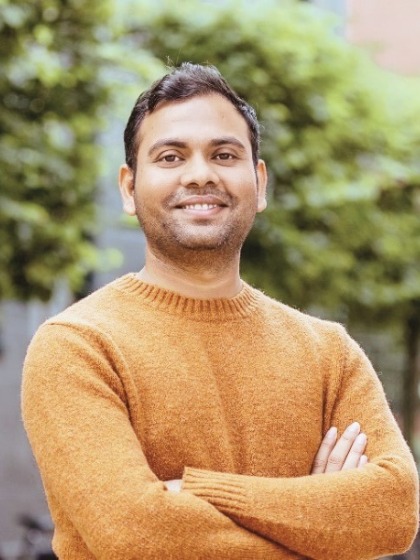
Ajay Kottapalli is an Associate Professor and Chair of the Department of Bioinspired MEMS and Biomedical Devices at the University of Groningen's Faculty of Science and Engineering. He holds a PhD from Nanyang Technological University (NTU) and MIT through the Singapore-MIT Alliance. His research focuses on developing nature-inspired micro/nano sensors, biomimetic materials, and wearable biomedical devices. Education: PhD in Mechanical Engineering (NTU/MIT, 2013), M.Tech in Solid State Technology (IIT Madras, 2009), M.Sc in Physics (Sri Sathya Sai University, 2007), B.Sc in Physics (Sri Sathya Sai Institute, 2005). Research interests include MEMS/NEMS sensors, nanofabrication, flexible electronics, and 3D printed sensors. His work emphasizes biomimicry of biological sensory systems (e.g., seal whiskers, fish lateral lines) to create ultra-sensitive healthcare sensors. He has pioneered bioinspired sensors for IV infusion monitoring and underwater robotics. He leads the ERC Starting Grant project 'SEAL SENSE' and serves as Associate Editor for IEEE Sensors Journal and PLOS One. Awards include MIT Technology Review's Innovators Under 35 (2017). Collaborations span MIT, SMART (Singapore), and industry partners like Sencilia B.V. Teaching includes courses on MEMS/NEMS, nanoscience, and biomedical sensors at the BSc and MSc levels. His lab develops wearable sensors for applications in health monitoring and robotics.
Abdul Munnaf is an Assistant Professor in Agricultural Biosystems Engineering at Wageningen University & Research, affiliated with the Plant Research International (PE&RC) institute. His work focuses on integrating advanced sensor technologies, machine learning, and geospatial analysis to improve precision agriculture practices. Key research areas include proximal sensors, soil fertility management, and crop growth modeling. He has developed novel sensing systems for real-time soil property measurement and mapping, with applications in nitrogen fertilization optimization and site-specific seeding strategies. Munnaf’s projects emphasize sustainability, such as improving bio-based fertilizer efficacy and reducing environmental impacts through data-driven approaches. His research outputs (29 articles) span topics like visible-near-infrared spectroscopy for soil analysis, robotic systems for agricultural automation, and machine learning models to predict soil organic carbon. He co-supervises PhD candidates in sensor technology and biofertilizer characterization. Collaboration networks include Belgium and China, reflecting his global research impact. Munnaf’s work bridges engineering and agronomy, addressing challenges in soil variability, crop productivity, and digital agriculture. Ongoing projects include developing biodegradable sensing technologies and evaluating spectral fusion techniques for soil attribute estimation.
Dannis M. Brouwer is a Full Professor in Precision Engineering at the University of Twente, Faculty of Engineering Technology. His research is centered on advanced mechanical systems, particularly in robotics and precision mechanisms. Position: Full Professor Institution: University of Twente School: Faculty of Engineering Technology Department: Precision Engineering His research interests span flexure-based mechanisms, compliant robotics, micro robotics, mechanical design optimization, and dynamic balance in precision systems . He actively contributes to the design of high-precision mechanical components with applications in robotics and instrumentation. The recent publications highlight a strong focus on flexure hinges, underactuated grippers, dynamic balancing, and cryogenic actuators , indicating interdisciplinary work bridging mechanical design, materials, and control. The keywords across articles reflect deep engagement in precision engineering and robotics. He has supervised multiple students, as evidenced by co-authored theses and research outputs. Although no formal awards are listed, his h-index of 16 and 1036 citations reflect significant scholarly impact. Supervised students: K. Dwarshuis, J. de Jong, W. E. Kamphof, M. Nijenhuis, P. Piening Brouwer is involved in collaborative research and data sharing, with datasets related to flexure-based linear guides. He participates in technical conferences and tutorials, contributing to the education and dissemination of precision mechanism design principles.
Prof. dr. Willem Kegel is a Full Professor in the Department of Physical and Colloid Chemistry at Utrecht University's Faculty of Science, where he holds the chair in Self-organizing Systems. He is affiliated with the Debye Institute for Nanomaterials Science and has held leadership roles including Director of Education (2018–2021) and Head of the Chemistry Department (2011–2013). Kegel earned his MSc in Chemical Thermodynamics (1989) and PhD in Physical Chemistry (1993) from Utrecht University. He conducted postdoctoral research at UCLA (1994–1996) and was a KNAW Fellow (1996–1999). Sabbaticals include Caltech (2014) and New York University (2005–2006). His research explores soft-matter physics and biophysics, focusing on colloidal self-assembly, protein organization, transcription regulation, and statistical thermodynamics. Current projects include: Transcription regulation influenced by genome size Self-organization of building blocks with conformational switches Iron-phytochemical interactions for mineral delivery Colloidal ordering at interfaces Kegel's publications emphasize colloidal systems, genetic circuits, and functional materials, with interdisciplinary work bridging physics, chemistry, and biology. Trends include advanced characterization of self-assembly mechanisms and biologically inspired systems. Awards & Honors: NWO-VICI Grant (2004) KNAW Fellowship (1996–1999) He advises PhD/Master's students and teaches courses including Physical Chemistry, Nanomaterials Science, and thesis supervision. His lab collaborates with Caltech, UCLA, and industry partners. He is a member of the Dutch Institute of Emergent Phenomena.
Dr. M. Pena Acosta is an Assistant Professor specializing in urban climate studies, with a focus on mitigating the Urban Heat Island (UHI) effect through data-driven modeling and geospatial analysis. Their work bridges engineering, climate science, and sustainable urban planning. Education: Master and Bachelor degrees from the Korea Advanced Institute of Science and Technology (KAIST). Their research investigates microclimate dynamics in cities like Málaga and the Netherlands, emphasizing drought and heat infrastructure resilience. Key methodologies include data assimilation, comparative analysis, and generalizability assessments of UHI models. Recent publications explore street-level temperature monitoring, Mediterranean climate adaptation, and novel tools for integrating UHI mitigation into urban planning. Their work aligns with UN Sustainable Development Goals, particularly climate action and sustainable cities. Scientific Award: Best Paper Award (2022 ISARC) for contributions to automation and robotics in construction-related climate resilience. Dr. Acosta’s collaborations span institutions like Delft University of Technology and Universidad de Málaga, with datasets on thermal measurements in Málaga (2024). Media engagements include expert commentary on extreme urban heat solutions.
Dr. Ronald Poppe is an Associate Professor at Utrecht University's Faculty of Science within the Department of Social and Affective Computing. His research focuses on behavioral analysis, computer vision, human-computer interaction, and non-verbal behavior. Key themes include applied data science, dynamics of youth, game research, and human-centered AI. Recent work emphasizes automated analysis of parent-child interactions, gaze dynamics, and multimodal interaction modeling. He has received a 2023 fellowship for studying early life stress and parent-child interaction. His research also explores deception detection, egocentric vision, and gesture recognition, leveraging deep learning and transformer architectures. Poppe collaborates on projects like the 'Interactive Tag Playground' and contributes to datasets such as the Corpus of Social Touch (CoST). His work bridges computational methods with psychological and social science applications. Research Themes: Applied Data Science, Dynamics of Youth, Game Research, Human-Centered AI Expertise: Behavioral Analysis, Computer Vision, Pattern Recognition Publications span action understanding, multimodal interaction analysis, and social robotics. His work emphasizes translating computational insights into real-world applications for child development, human-robot interaction, and forensic analysis.
Loai K.E.A. Abdelmohsen is an Assistant Professor at the Department of Chemical Engineering and Chemistry, Eindhoven University of Technology (TU/e), Netherlands. He holds dual affiliations with the Bio-Organic Chemistry research group and the ICMS Core member program. His academic background includes a Master’s (2013) and PhD (Bio-Organic Chemistry group, Radboud University) focused on copolymer-based supramolecular assemblies and functional properties like motility. Since 2017, he has led a research team exploring dynamic systems mimicking biological complexity, particularly in nanomedicine and artificial cell design. Research Interests: Polymer synthesis, nanoparticle characterization, copolymer self-assembly, shape transformations, and micro/nanomotors. His work emphasizes creating supramolecular systems with autonomous motion capabilities, with applications in drug delivery and biomimetic engineering. Recent Research Trends: His 2023–2025 publications focus on polymersome engineering, photothermal nanodrugs, and biomimetic cargo systems. Notable advancements include targeted nanomotors for cancer therapy and hybrid photodynamic/photothermal therapies. Awards/Grants: No explicit awards listed, but his work aligns with UN SDGs related to affordable healthcare and responsible consumption. Active collaborations include projects on tumor biodistribution and nanomotor mobility control. Advising & Teams: Supervises PhD students and postdocs in TU/e’s Bio-Organic Chemistry group. Leads development of smart compartments for medical applications, collaborating internationally on nanomedicine and synthetic biology. Labs/Teams: Core member of ICMS (Industrial and Chemical Molecular Science) and part of TU/e’s Chemical Engineering & Chemistry faculty, contributing to courses like Experimental Soft Matter and Instrumental Analysis .
Hans Goosen is an Associate Professor in the Precision and Microsystems Engineering department at TU Delft’s Faculty of Mechanical Engineering (ME). He serves as the master’s coordinator for the High-Tech Engineering track of the ME program and leads a research group focused on system integration, miniaturization, and manufacturing interfaces. His work emphasizes interdisciplinary challenges in compact systems, blending mechanics with thermal, optical, and electromagnetic effects. He contributes to education through lectures in Integrated Mechanical Systems, Micro & Nano Fabrication, and Bio-Inspired Design. His IDEE program involvement aims to integrate psychological and cognitive aspects into student learning pathways, advocating for realistic academic expectations and 'learning-to-learn' strategies. He co-founded a master’s introduction week to enhance student community and orientation. Research interests include metamaterials, micro-robotics, and meso-scale manufacturing. He collaborates on projects like phononic crystal design for ultrasonic flowmeters and topology optimization for thermocouples. Ancillary roles include board membership with the Technical Mechanics Foundation (Stichting Technische Mechanica).
Sebastien Callens is an Assistant Professor in the Orthopaedic Biomechanics group of the Department of Biomedical Engineering at Eindhoven University of Technology (TU/e) and a core member of the Institute for Complex Molecular Systems. His research centers around mechanoregeneration of orthopaedic soft tissues, with a particular focus on articular cartilage. His primary research interests include: Mechanoregeneration of orthopaedic soft tissues Tissue self-organization under mechanical and geometrical cues Development of structured extracellular matrices Uncovering tissue function in health and disease Design of innovative mechano-driven regenerative therapies Microtissue engineering approaches Micro-architected biomaterials Dr. Callens employs a multidisciplinary approach combining microtissue engineering, biomaterials design, computational simulation, and quantitative microscopy. His research spans from fundamental studies on how curvature and geometry influence tissue growth to practical applications in regenerative medicine. His publications reveal a strong focus on geometric control of tissue organization, with particular emphasis on how curvature fields guide cell behavior and tissue formation. His scientific achievements have been recognized through several prestigious awards: 2023 ON/EORS Orthoregeneration Award Rubicon Fellowship from the Dutch Research Council (NWO) Marie Skłodowska-Curie Actions (MSCA) Fellowship from the EU 2024 Veni grant from the Dutch Research Council (NWO) Dr. Callens has established collaborations across multiple institutions and disciplines, working with researchers in bone biomechanics, stem cell biology, and biomaterials science. His work bridges fundamental geometric principles with practical tissue engineering applications, particularly in the development of novel scaffolds and regeneration strategies for orthopaedic tissues.
G.C.H.E. de Croon is a Senior Researcher in the Control & Simulation group at Delft University of Technology's Faculty of Aerospace Engineering . His work focuses on: Autonomous drone control systems Bioinspired robotics Visual-inertial navigation Neuromorphic computing for UAVs Tilt-rotor aircraft design Swarm robotics Recent publications highlight advancements in flapping-wing robots and neuromorphic attitude estimation. His research combines biological insights with aerospace engineering to solve complex autonomy challenges. Notable scientific recognitions include: NWO Vici Grant (2024) for drone autonomy research Autonomous Drone Racing Championship winner (2025) Multiple best paper awards (2015, 2021) He actively organizes academic events like the International Micro Air Vehicle Conference and has supervised 17 research projects. Media coverage spans AI drone racing breakthroughs (2025), swarming technology (2024), and maritime landing systems (2025 PhD thesis data).
Mónica Acuautla Meneses is an Associate Professor in the Discrete Technology and Production Automation department at the Faculty of Science and Engineering, University of Groningen. Her research focuses on developing engineering systems that explore the potential of piezoelectric materials, with applications in mechatronic, aerospace, and biomedical devices. She leads a multidisciplinary research group that integrates material science and engineering for the design and fabrication of sensors, actuators, and piezoelectric energy harvesters. Education PhD in Micro and Nanoelectronics from Aix Marseille University (2014) MSc in Electrical Engineering - Bioelectronics from National Polytechnic Institute - Mexico (2010) BSc in Mechatronic Engineering from Instituto Politécnico Nacional - Mexico (2007) Research Interests Prof. Acuautla Meneses specializes in processing, tailoring, and characterizing piezoelectric materials including rigid ceramics, thin films, and polymers. Her research spans multiple domains including micro-nanofabrication, MEMS/NEMS technology, flexible electronics, and biomedical applications. She has developed expertise in ferroelectric materials, piezoelectricity, thin film technology, and nanoparticle applications, with particular focus on ZnO-based systems. Her work contributes to UN Sustainable Development Goals related to clean energy and technological innovation. Research Trends Recent publications demonstrate a strong focus on flexible piezoelectric composites, particularly P(VDF-TrFE)/ZnO systems for energy harvesting applications. Her research shows increasing emphasis on biocompatible materials and wearable technology, with significant contributions to hafnium dioxide-based ferroelectrics. The work spans fundamental material science to practical applications in sensors, actuators, and energy harvesting devices, reflecting a trajectory from basic research to implementation in real-world systems. Scientific Recognition TKI Top sector HTSM grant (2022) Research Leadership and Media Impact Prof. Acuautla Meneses has secured competitive research funding including the TKI Top sector HTSM grant. Her work has received significant media attention, with 14 press mentions including features on "Mónica creates a power plant under your feet" (2020) and "Slimme robots om kleinere chips te maken" (2024). She actively collaborates with researchers across disciplines and countries, as evidenced by her extensive publication record and academic presentations. Research Environment Her research is conducted within the Discrete Technology and Production Automation group at the University of Groningen, collaborating with experts in material science, electrical engineering, and nanotechnology. The research environment supports advanced micro-nanofabrication capabilities and interdisciplinary projects that bridge fundamental material science with practical applications in energy harvesting and sensing technologies.
Dr. Tanveer Ul Islam is a Research Fellow in the Microsystems group at Eindhoven University of Technology, with a joint affiliation at EPFL Switzerland. His research develops artificial cilia systems to model biological processes and disease mechanisms, particularly ciliopathies. His core research areas include microfluidic device development, magnetic actuation systems, bioinspired sensors, and nanomaterial engineering. Dr. Islam's work bridges microengineering with biomedical applications through biomimetic approaches. Dr. Islam's research outputs focus on magnetic artificial cilia systems, with recent advances in programmable metachronal motion and curved-surface applications. His work demonstrates progression from fundamental fluid dynamics to applications in sweat sensing and organ-on-chip technologies, emphasizing manufacturability through novel fabrication techniques.
G. Krijnen is a Full Professor at the University of Twente , affiliated with the MESA+ Research Institute , Digital Society Institute , and TechMed Centre . His academic career spans transducers science, biomimetic sensors, and additive manufacturing for biomedical applications. Education : M.Sc. in Electrical Engineering with honours (University of Twente, 1988) Doctorate degree with honours (University of Twente, 1992) Research focuses on transducer science (parametric/nonlinear transduction), biomimetic MEMS , and 3D-printed sensor systems . Key contributions include cricket-inspired flow sensors (BioEARS project), conductive 3D printing for biomedical devices, and anisotropic material analysis in fused filament fabrication. Recent publications highlight work at the intersection of 3D printing , biomimetic design , and biomedical engineering , with applications in prosthetic monitoring and muscle contraction prediction via dual-attention frameworks. Scientific Awards : 1993 Veder Price from Dutch Electronics and Radio Engineering Society (NERG/KIVI) 2021 Best Paper Award at IEEE Sensors Applications Symposium (SAS) 2021 Best Student Paper Award Active in TST group (chaired 2011-2015), with ongoing leadership in MEMS design and bioinspired transducers research. Collaborates extensively in robotics, healthcare technology, and sustainable materials science.
Prof. Dr. Sarthak Misra is Full Professor at the University of Twente, leading research in medical robotics within the MESA+ Institute and TechMed Centre. His work focuses on magnetic actuation systems for minimally invasive medical interventions. Misra's laboratory develops innovative robotic systems including magnetic microswimmers, steerable catheters, and compliant manipulators for applications in endovascular surgery and targeted drug delivery. His group combines electromagnetic control with advanced imaging modalities like ultrasound and fluorescence microscopy to enable precise medical interventions. Key Research Directions Magnetically guided cardiovascular interventions Collaborative microrobotic systems Biocompatible soft robotics Advanced medical imaging integration
Dannis Michel Brouwer is a Full Professor in Precision Engineering at the University of Twente. His research focuses on robotics, mechanisms, flexure design, and optimization. He leads projects in industrial micro-robotics and precision engineering systems. Research interests include the development of compliant mechanisms, flexure-based grippers, and advanced actuator designs. His work integrates mechanical design with optimization techniques for applications in micro-robotics and precision instrumentation. Recent publications explore innovations in flexure mechanisms, actuator efficiency, and additive manufacturing for robotic systems. The research demonstrates consistent emphasis on precision, thermal management, and structural optimization.