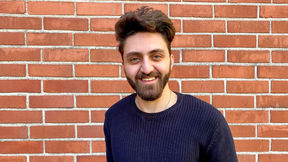
Mohammadmahdi Asgari is a Doctoral Researcher at Aalto University's Department of Electronics and Nanoengineering. His research focuses on advanced electromagnetic and photonic materials, particularly metasurfaces , metamaterials , and photonic time crystals . His work explores applications in wireless communication enhancement, inverse topology design for multifunctional surfaces, and non-reciprocal optical phenomena. Key research themes include: Wave propagation control Spontaneous magnetization effects Space-time modulated materials Passive metacrystal systems Publications reveal a concentration on both theoretical frameworks and practical implementations in electromagnetic and optical engineering. Asgari collaborates with prominent researchers including Shanhui Fan and Viktar Asadchy.
Viktar Asadchy is an Assistant Professor in the Department of Electronics and Nanoengineering at Aalto University . His research focuses on electromagnetic wave control , photonic time crystals , and metasurface engineering , with applications in nonreciprocal optics , reconfigurable intelligent surfaces , and terahertz technology . He has published extensively on dynamic metamaterials and spatiotemporal modulation. Email: viktar.asadchy@aalto.fi His recent work explores terahertz frequency conversion , inverse-designed time-varying nanostructures , and nonreciprocal metasurfaces . Trends in his publications emphasize harnessing temporal modulation and quasi-bound states to achieve extreme electromagnetic control, including perfect anomalous reflection and energy accumulation in photonic systems.
Jin Han is a Doctoral Researcher at the Department of Computer Science, Aalto University, focusing on advanced metasurface technologies and their applications in electromagnetic engineering, cryptography, and biosensing. His work bridges theoretical computer science with experimental materials engineering. Research interests span: Graphene-based and carbon nanotube metasurfaces Dynamic polarization and wavefront manipulation Terahertz/microwave device fabrication Physical-layer encryption and biosensors Article trends reveal expertise in: Multi-band electromagnetic modulation Stealth and cloaking technologies Nonlinear physics in 2D materials Programmable and tunable devices Scientific awards and honors are not publicly listed in available records. Jin Han's collaborative network includes researchers like Talal Rahwan and Petter Holme, with grants likely supporting his work in computational and materials engineering, though specific project details remain unlisted in this dataset.
Francisco Cuesta is a Postdoctoral Researcher at Aalto University's Department of Electronics and Nanoengineering. His work focuses on advanced electromagnetic systems and metasurface applications. Research Interests Metasurface design and wave manipulation Coherent illumination systems Wireless power transfer optimization Light localization in nanophotonic structures Scientific Achievements Sergei A. Schelkunoff Transactions Prize Paper Award (2019) for outstanding contributions to the IEEE Transactions on Antennas and Propagation
Jari Lietzen serves as a Postdoctoral Researcher within the Department of Information and Communications Engineering at Aalto University, Finland, actively contributing to the Communication Engineering research group. His work focuses on pioneering ultra-low-power communication solutions for next-generation wireless networks, particularly through backscatter technologies that enable battery-free device operation by harvesting ambient energy. His research spans critical domains including Backscatter Communications for Ambient IoT, Physical Layer Security mechanisms like secret key generation, Visible Light Communication integration, and Quantum-Enhanced Wireless Systems. He investigates thin-film device fabrication using additive manufacturing, polarization conversion techniques, and reconfigurable intelligent surfaces for harmonic beam steering, addressing fundamental challenges in energy efficiency and security for constrained IoT environments. Analysis of his 13 publications (2018-2024) reveals a cohesive research trajectory centered on backscatter communications evolution. Key trends include the shift from foundational quantum backscatter paradigms (2018) toward practical hardware implementations like light-controlled thin-film devices (2024) and multi-antenna integrated systems. His work consistently bridges theoretical advances in physical layer security with experimental validation, demonstrating expertise in Sub-1GHz radio systems, satellite communications security, and hybrid VLC-backscatter architectures for ambient IoT. Within Aalto University's Communication Engineering group, Lietzen collaborates extensively on experimental projects involving prototype development and link budget validation, with strong partnerships including Boxuan Xie, Kalle Ruttik, and Riku Jäntti. His research directly supports emerging 6G technologies through innovations in passive wireless infrastructure and quantum-inspired communication protocols.
Shanuka Gamaethige is a Doctoral Researcher at Aalto University's Department of Electronics and Nanoengineering. Their work focuses on THz imaging systems and diffractive optics design. Research Interests: THz and millimeter-wave technologies Holographic imaging systems Diffractive optics and metasurfaces Automatic differentiation applications Computational electromagnetics Wave propagation modeling Recent Publications (2024): Presented two papers at the IRMMW-THz Conference on holographic imaging and diffractive optics Collaborative work with Jussi Ryynänen Group on THz system optimization
Martti Kauranen is a Professor at Tampere University's Faculty of Engineering and Natural Sciences, specializing in nonlinear optics and nanophotonics. His research focuses on phenomena such as second-harmonic generation, plasmonics, and metasurface engineering. He holds a PhD from the University of Rochester (1992) and an MSc from Teknillinen korkeakoulu (1985). Key research interests include the study of nonlinear optical materials, nanoparticle interactions, and advanced optical systems. His work bridges fundamental physics and applied technologies, with contributions to areas like harmonic generation mechanisms and plasmonic resonances. Recent publications highlight innovations in metasurface design and nonlinear optical effects, with applications in photonics and materials science. Kauranen has received prestigious awards including Fellowships from SPIE and the Optical Society (OSA). He is actively involved in academic activities, including conference organization, editorial roles, and international collaborations. His research has been presented at numerous conferences and workshops, emphasizing both theoretical and experimental advancements.
Tommi Rimpiläinen is a Postdoctoral Researcher in the Department of Information and Communications Engineering at Aalto University's School of Electrical Engineering. His research focuses on electromagnetic theory, reconfigurable intelligent surfaces, and wireless communication systems with applications in sensing technologies. Education: Diplomi-insinööri (Master of Science in Technology) in Electronics and Electrical Engineering, specializing in Electrophysics, Aalto University School of Electrical Engineering (awarded September 5, 2011) Tekniikan kandidaatti (Bachelor of Science in Technology) in Electronics and Electrical Engineering, specializing in Electrophysics, Aalto University School of Electrical Engineering (awarded June 14, 2010) Dr. Rimpiläinen's research spans several specialized areas in electromagnetic engineering, with particular expertise in anisotropic materials, electromagnetic scattering problems, and coordinate systems. His recent work demonstrates strong interdisciplinary connections between telecommunications engineering and biomedical applications, especially in device-free fall detection systems using thin film reconfigurable intelligent surface technology. He has developed novel approaches for implementing radial anisotropy with self-similar structures and created advanced models for bistatic radar systems. His publication record from 2020-2024 shows a clear progression from fundamental electromagnetic theory toward practical applications of reconfigurable intelligent surfaces, with increasing focus on real-world implementations in wireless communications and health monitoring systems. The research demonstrates sophisticated modeling of electromagnetic phenomena applied to next-generation wireless technologies. Dr. Rimpiläinen has presented his work at international conferences including AT-RASC 2015 in Gran Canaria and has co-authored publications in high-impact journals such as IEEE Transactions on Antennas and Propagation, IEEE Communications Letters, and Physical Review B, demonstrating his active engagement with the global research community in his specialized field.
Tommi Eemeli Rimpiläinen serves as a Postdoctoral Researcher in the Department of Information and Communications Engineering at Aalto University, focusing on Reconfigurable Intelligent Surfaces (RIS) and metamaterials for next-generation wireless systems. His work bridges electromagnetic theory with practical communication and sensing applications. Research interests include: Reconfigurable Intelligent Surfaces for beam synthesis and wireless channel manipulation Metamaterials design involving radial anisotropy and hyperbolic permittivity Electromagnetic theory applied to scattering, polarizability, and canonical inclusion problems His contributions span theoretical modeling of anisotropic structures and applied implementations in healthcare monitoring and 5G/6G networks. Publication trends show a clear evolution from fundamental metamaterials research (2016-2020) toward RIS-driven wireless applications (2023-2024), with emphasis on beamforming optimization and device-free sensing systems. This trajectory highlights increasing industrial relevance while maintaining theoretical rigor. Scientific Awards: No awards documented in available sources Advising and Grants: No student supervision records indicated No grant funding details provided Labs and Teams: Active member of Aalto University's Communication Engineering research group, collaborating on RIS and electromagnetic theory projects with researchers including Riku Jäntti and Ari Sihvola.
Javier Cuerda serves as a Visitor Faculty member in the Department of Applied Physics within Aalto University's School of Science, specializing in Quantum Dynamics research. His work focuses on advanced photonics and nanoscale phenomena. He holds a Doctoral degree in Engineering and Technology from Universidad Autónoma de Madrid, awarded on October 19, 2017. Research interests span Nanoparticle Physics , Brillouin Zone phenomena , Lasing systems , Photonics , Metasurfaces , and Magnetic Field interactions in plasmonic structures. His fingerprint analysis reveals strong activity in Multipole Physics (45%), Antenna Physics (45%), and Metasurface Physics (45%). Recent publications demonstrate trends in quantum geometric tensor analysis, non-Hermitian systems, and silicon-integrated metasurface lasing. Key contributions include high-impact papers in Nature Photonics (41 citations) and ACS Photonics (52 citations), with significant attention from news outlets and Wikipedia references. Collaborations span international networks with prominent researchers like P. Törmä, evidenced by dataset contributions to Zenodo and substantial Mendeley readership (53+ readers).
Ville Laitinen is a Post-doctoral Researcher in the Physics Department at Lappeenranta-Lahti University of Technology (LUT), School of Engineering Sciences. His research focuses on developing magnetically shape-shifting materials, particularly magnetic shape memory alloys (MSM alloys), for applications in micropumps, robotics, and valves. He works within LUT's AMBI research platform and collaborates internationally with institutions including University of Birmingham, University of Pittsburgh, University College London, and Paul Scherrer Institute. Laitinen received his D.Sc. (Tech.) from LUT School of Engineering Science (2018-2021) following an M.Sc. (Tech.) from Lappeenranta University of Technology (2011-2015). His doctoral research centered on laser powder bed fusion for manufacturing Ni-Mn-Ga magnetic shape memory alloy actuators. Laitinen's research interests span additive manufacturing, laser processing of magnetic shape memory alloys, and 4D printing technologies. He is particularly known for pioneering work in fabricating functional magnetic shape memory structures using 4D printing techniques. His research demonstrates how these smart materials can change shape under magnetic fields, achieving up to 6% magnetic-field-induced strain. The research has significant implications for replacing complex mechanical assemblies with intelligent materials in small motion-generating devices, with potential applications in robotics and biomedical engineering. Analysis of Laitinen's recent publications reveals a strong focus on optimizing laser-based additive manufacturing processes for Ni-Mn-Ga magnetic shape memory alloys. His work spans fundamental material characterization, process development, and application-oriented research. Key trends include advancing femtosecond laser micromachining techniques, investigating solidification behavior during laser powder bed fusion, exploring elemental doping effects, and developing novel actuator designs. The research consistently addresses challenges in producing functional MSM structures with precise control over microstructure and magnetic properties. Invitation to join Young Academy Finland (2025) Laitinen has successfully secured funding from the Research Council of Finland for his research on magnetic shape memory materials. His work is conducted within a collaborative team environment that includes doctoral students like Meysam Norouzi Inallu and Professor Kari Ullakko, who pioneered magnetic shape memory alloys at MIT in the 1990s. The research group maintains strong international partnerships that provide complementary expertise and resources. Laitinen's research is conducted primarily within LUT's AMBI research platform, which focuses on advanced manufacturing technologies. His team works extensively with laser-based additive manufacturing equipment to produce and characterize magnetic shape memory structures. The laboratory environment combines materials processing capabilities with comprehensive characterization tools to analyze the relationship between manufacturing parameters, microstructure, and functional properties of these smart materials.
Mostafa Movahediqomi is a Doctoral Researcher at Aalto University's Department of Electronics and Nanoengineering. He actively contributes to advanced research in electromagnetics and antenna engineering, focusing on innovative metasurface applications. Key research areas: Electromagnetics, Antenna Engineering, and Metasurfaces Collaborates with leading experts like Sergei Tretyakov Published in top-tier journals: IEEE Transactions on Antennas and Propagation, Advanced Optical Materials His work demonstrates trends in reconfigurable intelligent surfaces , wave propagation control , and electromagnetic sensing , with applications in wireless communication and radio science.
Adel Assad is a Doctoral Candidate at Aalto University’s School of Chemical Engineering, specializing in the Nanochemistry and Nanoengineering group. His research focuses on sustainable materials, nanotechnology, and interdisciplinary applications combining materials engineering with arts and environmental science. He holds a Master's degree in Chemical, Biochemical, and Materials Engineering from Aalto University, with a minor in Fibre and Polymers Engineering. Adel’s work includes projects such as developing virtual laboratory safety training systems and part-time research on magnetic nanomaterials, electrospun fibres, and solar absorbers under Prof. Mady Elabhri. Research Interests: Adel’s research spans nanomaterial synthesis, plasmonic materials for energy applications, biomaterials for wound healing, and sustainable solar technologies. His projects often bridge fundamental science with practical solutions for environmental and energy challenges. Notable contributions include studies on polarizonic metasurfaces for camouflage and stealth, biosynthetic wound healing materials, and photochromic materials for smart surfaces. Articles and Trends: His publications highlight innovations in structural coloration, nanotheranostics for medical applications, and solar energy materials. Recent work explores ultraviolet absorbers using disordered metasurfaces and biohybrid nanofibers for therapeutic uses. These contributions underscore his focus on interdisciplinary nanotechnology for real-world impact. Awards: 2+2 Scholarship from Aalto University (2019). Grants/Support: Scholarship-funded doctoral position. Labs/Teams: Active member of the Nanochemistry and Nanoengineering group at Aalto University, collaborating on projects like colorful solar absorbers and sustainable material design.
Ali Panah Pour is a Postdoctoral Researcher specializing in advanced optical phenomena, with a focus on plasmonics, metasurfaces, and nonlinear optics. His research explores topics such as Q-factor enhancement in waveguide-coupled systems, miniaturization of plasmonic arrays, and all-optical switching mechanisms. He has contributed to studies on epsilon-near-zero microcavities and Purcell effect optimization, as well as investigations into laser-induced damage in nano-porous silica films. Key research interests include surface lattice resonances, nonlinear optical microscopy of nanocavities, and coherent control of plasmonic systems. His work bridges fundamental physics with applications in nano-optical devices and metamaterials. Recent publications highlight advancements in waveguide grating design, second-harmonic generation, and plasmon-induced refractive index modulation. Pour has collaborated with institutions on projects involving metamaterials and plasmonic nanostructures, with a focus on both theoretical modeling and experimental validation. His research demonstrates interdisciplinary approaches to solving challenges in nanophotonics and optoelectronics.
Mohamed Hesham Mohamed Mostafa is a Doctoral Researcher at Aalto University's Department of Electronics and Nanoengineering. His academic affiliation spans research in electromagnetics, metamaterials, and temporal modulation techniques. Research Interests: His work focuses on electromagnetic wave manipulation through time-varying systems, including temporal interfaces in bianisotropic media and coherently time-varying metasurfaces. Key areas include asymmetric scattering, polarization splitting, and bandwidth engineering for antennas. Publications: Recent contributions examine advanced concepts in electromagnetic theory, such as direction-dependent wave transformations in artificial moving media and spin-dependent phenomena at chiral temporal interfaces. His research bridges theoretical analysis with experimental implementations. Contact: Email: mohamed.mostafa@aalto.fi