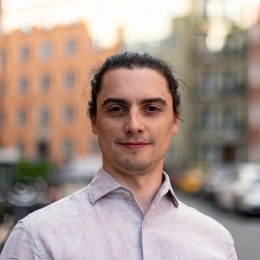
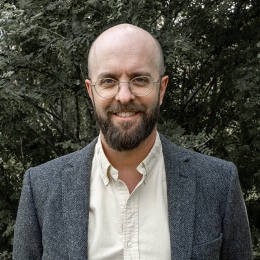
Prof. Dr. Valentin Werner is an associate professor at the University of Bamberg , holding a chair in English Linguistics . His work bridges applied linguistics, corpus studies, and pop culture analysis, with a focus on language education and sociolinguistic variation. Expertise in learner Englishes, telecinematic language, and multimodal discourse Director of multiple DFG-funded projects including 'Young German Learner English' Recipient of Taylor & Francis Outstanding Research Monograph Award (2020) His recent research explores: Pop lyrics as pedagogical tools (2023-2024 projects) Political live blogs and hybrid news discourse (2025 publications) Country music authenticity and register analysis (2024 studies) Scientific awards include: Taylor & Francis Outstanding Research Monograph Prize (2020) Habilitationspreis by German Association for the Study of English (2022)
Dr. Moritz Herrmann is a postdoc researcher and Reproducibility & Open Science Transfer Coordinator at the Munich Center for Machine Learning (MCML). He is affiliated with the Biometry in Molecular Medicine working group led by Prof. Anne-Laure Boulesteix at Ludwig-Maximilians-Universität München, and contributes to initiatives like the LMU Open Science Center , Open Science Initiative in Statistics (OSIS) , and Open Science Initiative in Medicine (OSIM) . Ph.D. in Statistics from LMU (2022), M.Sc. in Statistics (2018), and B.Sc. in Mathematics/Sports Science (2014) His research focuses on Empirical Machine Learning , Manifold Learning , and Metascience , with emphasis on epistemological foundations and reliability in ML research. He advocates for open science practices and data literacy, as outlined in his ICML 2024 position paper on rethinking empirical ML research. As a member of the Empirical Machine Learning research focus group and the Statistical Learning and Data Science Chair , Herrmann bridges statistical methodology with biomedical applications. His work spans outlier detection, cluster analysis, and reproducibility frameworks, reflected in his recent publications in journals like Biometrical Journal and Data Mining and Knowledge Discovery .
Gustav Nilsonne is a researcher affiliated with Stockholm University (Department of Psychology, Division for Psychoneuroimmunology) and holds an associate professor position at Karolinska Institutet , while also being affiliated with Stanford University . His work bridges neuroscience and metascience , focusing on sleep and diurnal rhythms , brain-immune communication, and methodological rigor in scientific research. He actively investigates reproducibility, open science practices, and analytical pitfalls in longitudinal studies. Neuroscience Research : Explores bidirectional communication between the brain and immune system, including studies on stress-related diagnostics like exhaustion disorder. Metascience Contributions : Analyzes statistical artifacts in ability tilt studies, self-esteem-depression causal links, and publication ethics, advocating for robust analytical frameworks. Recent Publications (2022–2024) span psychoneuroimmunology, reproducibility crises, and methodological interventions like discrepancy review in peer assessment. Collaborative efforts, including the Psychological Science Accelerator and global pandemic response datasets, highlight his commitment to cross-cultural and large-scale empirical validation. His work challenges assumptions in genetic/environmental interpretations and emphasizes transparency in academic publishing. Leadership & Ethics : Contributed to debates on editorial self-publication practices, psychoneuroimmunology methods, and policy recommendations for improving scientific reliability. No listed students or awards in the provided text.
Dr. Kenneth Kellner III is an Assistant Professor in the Department of Fisheries and Wildlife at Michigan State University's College of Agriculture and Natural Resources. His expertise spans Wildlife population dynamics , Quantitative ecology , and Research software development , with a focus on statistical modeling for ecological research and conservation of mammals and birds. Education: Ph.D. in Ecology, Purdue University (2015) M.S. in Ecology, Purdue University (2012) B.S. in Biology, Wheaton College (2009) Dr. Kellner's research prioritizes: Improving wildlife abundance and occurrence estimates Developing statistical software tools for ecologists Advancing reproducible research practices His recent work focuses on Bayesian hierarchical models for ecological data, including software packages like unmarked and ubms . Publications from 2021-2024 address topics in occupancy modeling, genomic diversity analysis, and distance sampling methodologies.
Linus Salö is Professor and Research Leader at Stockholm University's Department of Swedish Language and Multilingualism and the Centre for Research on Bilingualism. His work spans language policy, ideology, and practice, with a focus on language issues in academia, mother tongue instruction, and the societal impact of the humanities. Dr. Salö earned his BA in Language Consultancy Work from Umeå University (2009) and PhD in Bilingualism from Stockholm University (2016). He became Docent (Associate Professor) in 2020 and Full Professor in 2023. Prior positions include work at the Royal Institute of Technology's Division of History of Science, Technology and Environment (2017-2022), the Language Council of Sweden, and Södertörn University. His research engages with sociolinguistics, bi/multilingualism, language policy, linguistic anthropology, science studies, and sociology of knowledge and education. He examines historical aspects of linguistic minority education, language policy, and the sociolinguistics of science in internationalized academic contexts, particularly regarding publishing language, language of instruction, and workplace discourse. His work also addresses science-society interaction, research evaluation practices, knowledge impact, and the politics of humanities knowledge. Analysis of Salö's recent publications reveals a strong focus on the value and impact of humanities research, university-society relations, and language policy in academic contexts. His work spans both theoretical explorations of knowledge production and practical analyses of policy implementation, with particular attention to Swedish language in academic settings and the challenges faced by linguistic minorities. PI of "Humanities in Transition" project (Riksbankens Jubileumsfond, 2024-2027) Board Member of Graduate School "Culturally Empowering Education through Language and Literature" (Swedish Research Council, 2021-2026) Guest Researcher at Uppsala University's "Higher Education and Research as Objects of Study" Thesis Advisor for Scarlett Mannish, Klara Müller, and Matthew Glass He leads the MOB (Meta-research on bilingualism) research group, which analyzes scientific fields like bi- and multilingualism research and Swedish as a Second Language to understand patterns of recruitment and the histories of central concepts within these fields.
Professor John Towse is a distinguished academic in the Department of Psychology at Lancaster University, with expertise spanning cognitive psychology, cybercognition, and metascience. His research investigates the intricate relationships between working memory, executive functions, and real-world cognitive performance, as well as the psychological aspects of cybersecurity and software development. His research interests include: Working memory and executive functions - examining how active maintenance of transient information influences cognitive development and skills Cybercognition - studying how cognitive systems interact with online environments and digital interfaces Metascience - exploring ways to enhance research credibility and optimize research processes Psychology of computer security - investigating human factors in secure software development Professor Towse's recent publications reveal a strong focus on the intersection of cognitive psychology and cybersecurity, with particular attention to working memory mechanisms, data sharing practices in psychological research, and cognitive factors influencing susceptibility to email fraud. His work bridges theoretical cognitive science with practical applications in digital security and research methodology. Notable contributions include investigations into theoretical foundations of working memory systems, psychological predictors of vulnerability to cyber fraud, security perceptions among software developers, and ethical frameworks for digital behavioral data research. Professor Towse actively supervises postgraduate research, currently guiding PhD student Matthew Ivory in research related to protecting ordinary people from deepfakes. He has led significant research projects including 'Why Johnny doesn't write secure software? Secure Software development by the masses' (2017-2021), funded by EPSRC with £518,783.44, where he served as Co-Investigator. His professional activities include membership in the Experimental Psychology Society, editorial roles for journals including the Journal of Numerical Cognition and Psychologia, and participation in the ESRC Peer College Review. He also serves on the Expert Group on Open Science (EGOS).
Antonio García Romero, PhD, is a Full-Time Professor at IE Business School (IE University, Spain) with over 20 years of experience in interdisciplinary research. His work bridges biomedical research, healthcare innovation, and advanced analytics. Current research focuses on generative AI's disruptive potential in healthcare Contributions to metascience through studies on scientific misconduct and bibliometrics Former Head of Research and Innovation Policy for the Regional Government of Madrid His publications appear in top-tier journals including Research Policy , Scientometrics , and Health Care Management Science . He specializes in developing evaluation indicators for healthcare systems and innovation processes.
Gwenaël Kaminski is a Professor at the University of Toulouse - Jean Jaurès, affiliated with the Cognition, Languages, Ergonomics (CLLE) research laboratory within the Faculty of Arts, Letters, Languages, Human and Social Sciences. He holds the distinction of being a Junior Member of the University Institute of France, recognizing his scholarly contributions. His educational background includes a PhD from Université Paris-Nord - Paris XIII, where he completed his thesis titled 'Composante sociale des traits d'histoires de vie d'un ongulé forestier européen : cas du sanglier femelle' (Social component of life history traits of a European forest ungulate: case of the female wild boar) in 2005, demonstrating an interesting transition from zoological research to human cognitive psychology. Kaminski's research spans several interconnected domains of cognitive and evolutionary psychology. His primary focus areas include: Face recognition and processing, particularly examining how humans detect kinship through facial resemblance Evolutionary aspects of social cognition and mate preferences Tactile perception systems and accessibility technologies for visually impaired individuals Aesthetic responses to visual stimuli, particularly in art contexts The intersection of hormonal factors and social perception His work demonstrates a consistent trajectory from basic cognitive processes to applied research, particularly evident in his recent work on tactile pictograms for blind children. Kaminski frequently employs interdisciplinary approaches, combining methods from cognitive psychology, neuroscience, and human-computer interaction. Among his notable recognitions is his appointment as a Junior Member of the University Institute of France, highlighting his standing within the French academic community. His collaborative work on large-scale projects like the Psychological Science Accelerator demonstrates engagement with contemporary methodological reforms in psychological science. Kaminski maintains active research collaborations across multiple institutions, as evidenced by his co-authorship on international projects spanning numerous countries. His work on the cross-cultural applicability of social perception models represents one example of this global research perspective.
David Vaidis is a researcher at the Cognition, Languages, Ergonomics (CLLE) laboratory, a joint research unit affiliated with the University of Toulouse-Jean Jaurès. His academic career centers on cognitive dissonance theory, with significant contributions through numerous publications, books, and leadership in large-scale replication efforts. His research spans multiple dimensions of social psychology, with particular focus on attitude formation and change, inconsistency processing, expectation violation, and commitment mechanisms. Vaidis has emerged as a key figure in the movement toward methodological rigor, leading multi-lab replications of classic cognitive dissonance paradigms that address replication challenges in psychological science. His scholarly output includes two foundational books: La dissonance cognitive: Approches classiques et développements contemporains (2011) and Degré d'inconsistance, Engagement, et Information (2010). Recent publication trends reveal a strategic shift from purely theoretical explorations to methodological innovation and collaborative science. His 2024 multi-lab replication of the induced-compliance paradigm represents a landmark contribution to the field, involving researchers from numerous countries. This work exemplifies his commitment to open science principles and big team science approaches that enhance research reliability. His publications appear in premier journals including Journal of Personality and Social Psychology , Advances in Methods and Practices in Psychological Science , and European Journal of Social Psychology . Vaidis actively contributes to academic discourse through conference presentations and workshops on managing large-scale collaborative projects. His work has practical applications across environmental psychology, health communication, relationship science, and organizational behavior, demonstrating the versatility and relevance of cognitive dissonance theory to contemporary societal challenges.
Levent Neyse is a behavioral economist and researcher at the German Institute for Economic Research (DIW Berlin), where he heads the SOEP Innovation Sample. He serves as Co-Principal Investigator of the metascientific laboratory Lab² at the Wissenschaftszentrum Berlin (WZB Berlin). His affiliations extend to the Institute of Labor Economics (IZA) as an affiliated researcher and the London School of Economics and Political Science as a visiting fellow in the Department of Psychological and Behavioural Science. His research centers on behavioral economics and metascience, focusing on how individuals make economic and social decisions through survey and experimental methodologies. Key interests include cognitive reflection, risk preferences across life domains, replication studies, and improving research transparency in social sciences. His work frequently examines the intersection of psychological processes and economic behavior, particularly in labor markets and decision-making under uncertainty. Neyse's publication record demonstrates strong emphasis on replication science and methodological rigor, with recent articles analyzing cognitive reflection's relationship to economic outcomes, domain-specific risk attitudes across the life course, and biomarker validity in economic preferences. His research consistently employs large-scale representative samples and pre-registered methodologies. As Associate Editor of the Journal of Behavioral and Experimental Economics, he contributes to advancing methodological standards in the field. His leadership of the SOEP Innovation Sample and Lab² metascience laboratory reflects his commitment to developing robust research infrastructure and promoting transparent scientific practices. Neyse actively disseminates his work through international seminars including presentations at Istanbul Bilgi University, LMU München, and Foreign Trade University Hanoi, focusing on metascience topics like pre-registration and laboratory development for collaborative economic science.
Pamela Davis-Kean is Professor of Psychology in the College of Literature, Science, and the Arts at the University of Michigan, with dual Research Professor appointments at the Survey Research Center and Research Center for Group Dynamics. She serves as Center Director of the Survey Research Center and Faculty Associate at the Inter-university Consortium for Political and Social Research (ICPSR). Her research examines how parental socio-economic status—particularly educational attainment—influences child development and achievement from childhood through adulthood. Specializing in standardized child assessment and longitudinal methodologies, she emphasizes replication and large-scale data for rigorous psychological science, requiring students to master advanced statistical techniques for contextual developmental analysis. Recent publications (2022-2025) reveal expanding focus on epigenetic consequences of childhood maltreatment, global parenting dynamics in low/middle-income countries, and teacher impacts on early numeracy. Her work increasingly integrates open science practices while maintaining core investigations into socioeconomic disparities in home learning environments and developmental pathways. Dr. Davis-Kean mentors students in longitudinal statistics and contextual child development research through the Survey Research Center. She leads interdisciplinary teams across ICPSR and Group Dynamics, directing large-scale data collection initiatives and fostering collaborations on family processes and developmental outcomes.
David Peterson serves as an Assistant Professor in the Sociology Department at Purdue University. His academic journey includes a PhD from Northwestern University and postdoctoral research at UCLA. His research examines the intersection of scientific practice, emerging technologies, and expert authority. Key focus areas include: Evolution of scientific organizations facing political pressure, global competition, machine learning technologies, and regulatory bodies Science production in fields with chronic legitimacy issues (e.g., social sciences), analyzing politics-expertise-authority dynamics Specializations encompass science and technology studies, expertise, metascience, data society interactions, and qualitative methodologies.