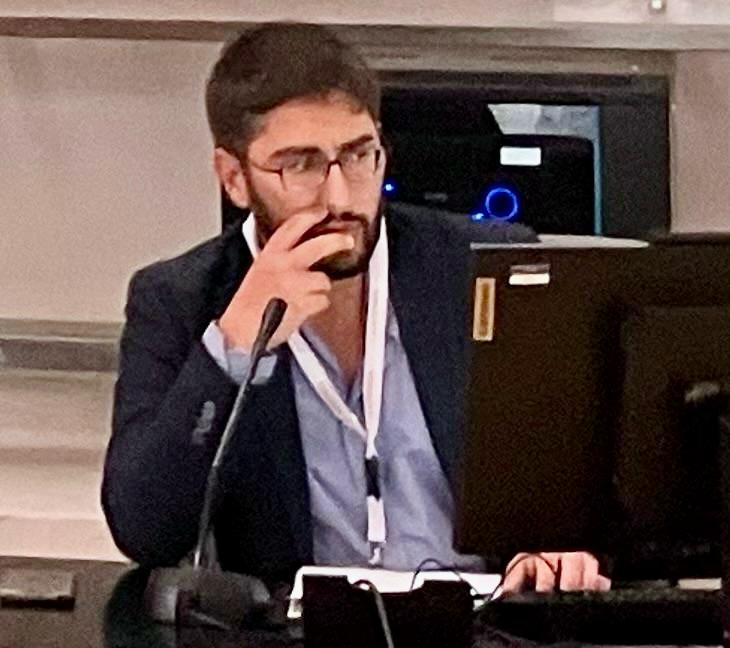
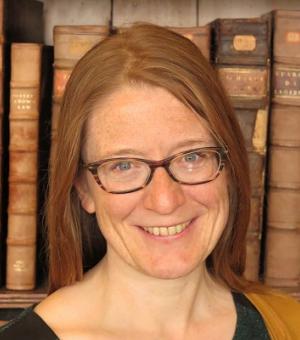
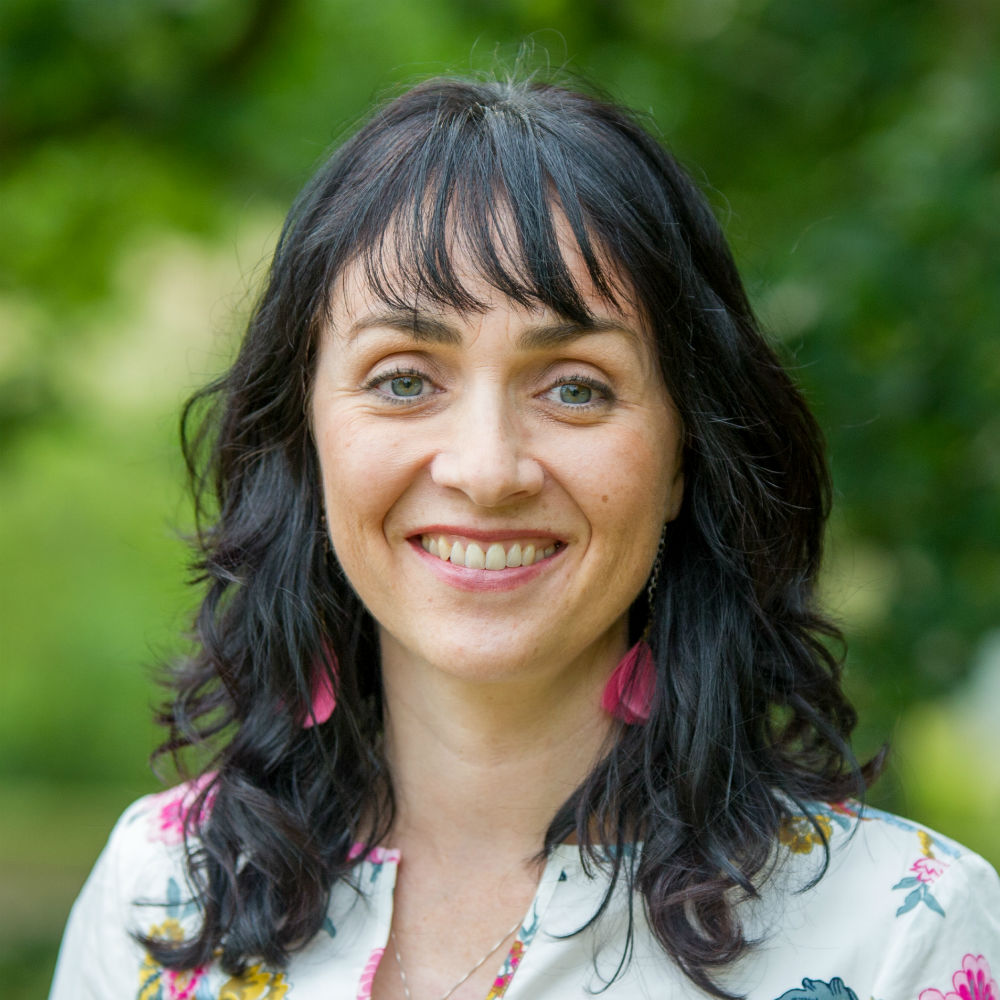
Scott MacDonald is the Norma K. Regan Professor in Christian Studies at Cornell University , with a joint appointment in the Department of Philosophy and affiliated roles in the Medieval Studies Program and Religious Studies Program within the College of Arts and Sciences . He holds advanced degrees from the University of St. Andrews (BD, 1981) and Cornell University (BA, 1978; PhD, 1986).
Alyssa Ney is a leading Professor of Philosophy at Ludwig-Maximilians University Munich (LMU), holding the Chair of Metaphysics within the Faculty of Philosophy, Philosophy of Science, and Religious Studies. Her work bridges metaphysics with the philosophy of physics and mind, focusing on the interpretation of quantum theories, fundamentality, and the unity of science. Education: PhD in Philosophy (Brown University), MS in Physics (UC Davis), BS in Physics and Philosophy (Tulane University) Previous appointments: UC Davis (2019-2024), University of Rochester (2005-2019) Ney’s research explores the metaphysical implications of quantum mechanics, particularly wave function realism and its challenges in grounding macro-objects. She investigates the relationship between quantum theory and classical conceptions of space, time, and causation, with a focus on locality and nonlocality. Her work also addresses physicalism, mental causation, and the methodology of metaphysical inquiry. Recent publications include analyses of density matrix realism (“ Is the Universe Fundamentally a Density Matrix? ”), many-worlds interpretations (“ Branching (Almost) Everywhere and All At Once ”), and the metaphysical status of spacetime in quantum gravity contexts. She was awarded the 2025 Patrick Suppes Prize for her book The World in the Wave Function and the 2024 Humboldt Foundation Bessel Award. Scientific Awards Patrick Suppes Prize (2025) Friedrich Wilhelm Bessel Research Award (2024) FQxI Essay Contest Second Prize (2018) Elsie Field Dupre Prize in Physics (1999) Ney actively mentors underrepresented scholars in philosophy of science and serves on editorial boards for Philosophy of Physics and British Journal for the Philosophy of Science . She has organized workshops connecting metaphysics with philosophy of physics and quantum interpretation.
Prof. Dr. Philipp Schwab is a Professor of Philosophy at the University of Freiburg, specializing in classical German philosophy and its reception. He holds a doctorate (2009) and habilitation (2019/20), and has led major research projects like the DFG-funded 'Schelling in Munich (1811–1841)' edition. His academic career includes positions at universities in Germany, the U.S., and Denmark. Research focuses on metaphysics, existential philosophy, and the works of figures like Schelling, Hegel, Kierkegaard, and Nietzsche. He co-edits Schelling-Studien and has supervised numerous doctoral students. Key publications include monographs on Schelling-Hegel debates and Kierkegaard's indirect communication. His awards include the Eugen Fink Prize (2009). Current projects explore Schelling's legacy, Heidegger's interpretations, and dialectics in idealist systems.
Daniele Musumeci is a Research Fellow in the history of science at the Department of Humanities, University of Catania. He teaches Models of Science Communication in the undergraduate program in Communication Sciences and Languages and co-teaches History of the Environment and Climate Change in the master's program in Languages for International Cooperation. His academic work is supervised by Scientific Director Luigi Ingaliso. He earned his PhD in Interpretation Sciences from the University of Catania in 2023 with a dissertation titled "L'interpretazione dei vulcani e della loro attività. L'evoluzione della vulcanologia internazionale dalla modernità alla contemporaneità (secoli XVII-XX)". His research primarily focuses on the historical development of volcanological studies from the 17th to 20th centuries, examining paradigmatic shifts in Earth Sciences and the historical documentation of seismic phenomena. Musumeci's scholarly work reveals a strong emphasis on the history of volcanology, particularly regarding Mount Etna and significant figures like Alfred Rittmann. His publications demonstrate interdisciplinary approaches combining historical analysis with earth sciences, often exploring how historical documentation can inform modern scientific understanding. He has made notable contributions to understanding the evolution of volcanic theories and the documentation of seismic events. His scientific achievements have been recognized through several prestigious awards: AIV/IAVCEI scholarship (2018) Best Poster Award to a young scholar from INHIGEO (2019) Premio SGI "Quintino Sella per la Storia delle Geoscienze" (2021-2022) INHIGEO Early Career Award (2023) Musumeci is actively involved in research projects related to historical seismological archives, particularly through the PNRR MEET project (Monitoring Earth's Evolution and Tectonics) under WP 11.3 IPSES - Italian Platform for Solid Earth Science. His current research focuses on analyzing historical documentation of seismic and volcanic phenomena to enhance INGV's seismological databases. His work spans multiple institutions and collaborations, particularly with the National Institute of Geophysics and Volcanology (INGV), where he contributes to historical volcanic studies and database development projects.
James Conant is the Chester D. Tripp Professor of Humanities, Professor of Philosophy, and Professor in the College at the University of Chicago. He also served as Humboldt Professor of Theoretical Philosophy at Leipzig University (2017–2022). He holds a BA (1982) and PhD (1990) from Harvard University. His academic roles include Interim Chair of the Department of Philosophy at the University of Chicago (2014–2015, 2025–2026), co-director of the Forschungskolleg Analytic German Idealism, and director of the Center for German Philosophy at Chicago. Education: Bachelor of Arts, Harvard University (1982) Doctor of Philosophy, Harvard University (1990) Research Interests: Focuses on Philosophy of Language, Philosophy of Mind, Aesthetics, German Idealism, and the History of Analytic Philosophy. He explores themes such as skepticism, Wittgenstein’s methods, rule-following paradoxes, and the interplay between German Idealism and analytic philosophy. Publications Trends: Conant’s recent work includes monographs on skepticism and film aesthetics, co-authored volumes on Wittgenstein, and edited collections of Hilary Putnam’s papers. His articles often critically engage with figures like Kant, Wittgenstein, Nietzsche, and Frege, emphasizing methodological rigor and historical context. Scientific Awards: Anneliese Meier Research Award (2012) Humboldt Prize (2017) Neubauer Collegium Award Grants and Advising: Co-recipient of Mellon Sawyer Seminar Grants (2006–2008) and Humboldt TransCoop Awards. Advised numerous postdoctoral and doctoral researchers through initiatives like the Leipzig-Chicago collaborative projects. Labs/Teams: Leads the Center for German Philosophy at Chicago and co-directs the Center for Analytic German Idealism in Leipzig. Collaborates internationally on projects bridging analytic and continental philosophy.
Manuel DeLanda is a New York-based cross-disciplinary theorist and artist. He holds the rank of Professor at The European Graduate School / EGS and serves as a lecturer at Princeton University's School of Architecture and Pratt Institute's Graduate Architecture and Urban Design program. His academic career includes past roles as a Fellow at Princeton's Institute for Advanced Study (2000/01) and teaching positions at the University of Pennsylvania and Columbia University. Education: BFA from the School of Visual Arts (New York), PhD from the European Graduate School (2010). Research interests span philosophy, complexity theory, materialism, science studies, and Deleuzean thought. His work integrates interdisciplinary approaches to topics like assemblage theory, urban capitalism, morphogenesis, and the philosophy of science. Key themes include the application of mathematical concepts (topology, chaos theory) to social and historical analysis, and rethinking materialist frameworks across disciplines. Notable contributions include books such as War in the Age of Intelligent Machines , A Thousand Years of Nonlinear History , and Assemblage Theory . His lectures (e.g., on economic agglomeration, urban capitalism, and Deleuzean philosophy) reflect his commitment to bridging abstract theory with empirical analysis. Labs/Teams: No specific lab affiliations mentioned, but his work is collaborative through academic networks and interdisciplinary projects in architecture, urbanism, and philosophy.
Professor Kathryn Murphy is an Associate Professor in the Faculty of English Language & Literature at the University of Oxford and a Fellow and Tutor at Oriel College. Her research focuses on seventeenth-century literary and intellectual culture, blending literature, philosophy, theology, and art. She explores the interplay between form (poetic, rhetorical, and artistic) and thought, with a particular interest in essays, still-life painting, and the relationship between form and idea. Her recent projects include a biography of Robert Burton (author of The Anatomy of Melancholy ) and a study of metaphysical prose in the seventeenth century. She has also edited On Essays: Montaigne to the Present and writes essays on art, including analyses of still-life painting and devotional imagery. Her work frequently bridges literary studies and medical humanities, collaborating with the Oxford Health Biomedical Research Centre and the TORCH Medical Humanities Hub. She has curated exhibitions such as Melancholy: A New Anatomy (2021) and is preparing a 2026 exhibition on natural history. Murphy is a series editor for Edinburgh Critical Studies in Renaissance Culture and serves on the editorial boards of Cambridge Quarterly and Edinburgh Critical Studies . She contributes art criticism to Apollo and reviews Czech literature for the Times Literary Supplement . Her research emphasizes interdisciplinary exploration, examining how form—from sentences to paintings—serves as an instrument of thought. Current projects include a book on still-life painting and the immanence of meaning in objects, alongside ongoing studies of attention, distraction, and decision-making in early modern texts.
Joseph Cohen is an Associate Professor in Contemporary Continental Philosophy at the School of Philosophy, University College Dublin. He holds a PhD from the University of Caen (France) and has held visiting roles at institutions including Heidelberg University, Sorbonne, and Penn State University. His research focuses on German Idealism, Phenomenology, Critical Theory, and Jewish Philosophy. Key affiliations include co-founding Les Rencontres Philosophiques de Monaco and serving as Secretary of the Irish Phenomenological Circle. He leads the 'Jewish Philosophy and Contemporary Thought' research project at UCD's Newman Centre for the Study of Religions. Cohen has authored/co-authored books like L'Adversaire privilégié and To Live and Die in History , and edited volumes on Hegel and Levinas. Research explores themes like the philosophy of history, ethics, technology's impact on humanity, and Jewish thought. Recent work critically engages Heidegger's legacy and reinterprets historical reconciliation frameworks. Over 140+ publications span journals such as Angelaki and International Journal of Philosophical Studies . Awarded 'Prix Spécial 2018' and Chevalier de l'Ordre des Palmes Académiques. Serves on editorial boards of Les Temps Modernes and Cités (2010-2016). Active in academic governance as member of UCD's Ethics Committee and Internationalisation Committee. Fluent in English, French, German, Hebrew, Italian, and Spanish.
Irene McMullin is a Professor at the University of Essex within the School of Philosophical, Historical, and Interdisciplinary Studies, affiliated with the Department of Philosophy. She joined the university in 2013 after postdoctoral work at Bergische Universität Wuppertal and six years teaching at the University of Arkansas. Her academic background includes a PhD from Rice University, an MA from the University of Toronto, and a BA Hons from St. Francis Xavier University. Her research examines questions of personhood, agency, and self-becoming, particularly emphasizing the role of others in these processes. Drawing from both Continental and Analytic traditions, McMullin explores: Existentialism and Phenomenology Virtue ethics and Kantian ethics Moral psychology and social relations Current investigations focus on the phenomenology of ideality and how encounters with 'the good' shape practical agency. Her publications demonstrate sustained engagement with themes of moral deliberation, trust, and rationality across philosophers including Heidegger, Kant, and Løgstrup. Analysis reveals consistent interdisciplinary bridges between ethics, phenomenology, and social theory, with recent work increasingly addressing normative foundations of shared human experience.
Lea Ypi is a Professor of Political Theory at the London School of Economics and Political Science (LSE) and an Honorary Professor of Philosophy at the Australian National University. She holds degrees from the University of Rome La Sapienza and a PhD from the European University Institute, followed by postdoctoral research at Nuffield College, Oxford. Her work spans political theory, the history of philosophy, Marxism, critical theory, and Kantian philosophy. Notable publications include Global Justice and Avant-Garde Political Agency , The Meaning of Partisanship (with Jonathan White), and Free: Coming of Age at the End of History . Ypi’s research has been recognized with the British Academy Prize and a Leverhulme Prize. She is a Fellow of the British Academy, Academia Europea, and the Albanian Academy of Sciences. Her research interests include revolutionary theory, Kantian philosophy, structural injustice, and global justice. Key publications address topics like Kant’s views on colonialism, the ethics of migration, and the role of partisanship in democracy. Ypi’s academic contributions bridge normative political theory with critical engagement in contemporary social and political issues. Awards include the British Academy Prize for Excellence in Political Science (2015), Leverhulme Prize (2014), and fellowships in leading academic institutions. Her interdisciplinary approach integrates historical, philosophical, and contemporary analyses to address urgent political questions.
Richard Cross is the Rev. John A. O'Brien Professor of Philosophy at the University of Notre Dame's Department of Philosophy, part of the College of Arts and Letters. He joined Notre Dame in 2007 after serving as a Fellow of Oriel College, Oxford from 1993 to 2007. His work focuses on medieval philosophy and theology, particularly Duns Scotus and the metaphysics of Christology. He holds D. Phil. and D. D. degrees from the University of Oxford. Current projects include a multi-volume history of Christological metaphysics, with recent publications exploring medieval and early modern theological debates. Education: D. Phil. and D. D., University of Oxford. Research interests span Medieval Philosophy, Theology, and the History of Philosophical Theology. His studies emphasize Christological debates, metaphysical frameworks in scholastic thought, and figures like Aquinas and Ockham. Recent works include Early Scholastic Christology 1050-1250 (2024) and Christology and Metaphysics in the Seventeenth Century (2022). Publications reflect deep engagement with theological debates, including analyses of divine action, free will, and medieval sacramental theology. His writing often bridges historical and contemporary theological discussions, highlighting continuity and transformation in metaphysical thought. No scientific awards explicitly listed. His contributions focus on scholarly publications and academic leadership. He advises students in medieval philosophy and theology, though no named advisees are mentioned. Labs/Teams: No specific lab or team affiliations noted; his work is primarily individual and collaborative through academic publishing.
Christian List is a Professor of Philosophy and Decision Theory at Ludwig Maximilian University of Munich (LMU Munich) and Co-Director of the Munich Center for Mathematical Philosophy (MCMP). He holds concurrent visiting professorships at the London School of Economics (LSE) and has held prestigious positions globally, including at Harvard Law School and Princeton University. His work bridges philosophy with social sciences, focusing on decision theory, free will, consciousness, and group agency. Education: D.Phil. in Politics (Oxford, 2001), M.Phil. and B.A. in Mathematics & Philosophy (Oxford). Key roles include Fellow of the British Academy and Member of the Bavarian Academy of Sciences. Research interests span metaphysical questions (free will, consciousness), formal methods in decision theory, and the philosophy of the social sciences. His monograph Why Free Will is Real (2019) is a landmark work. Recent articles explore AI ethics, probability aggregation, and consciousness theories. Scientific awards include the Joseph B. Gittler Award (2020) and the Social Choice and Welfare Prize (2010). He has edited major journals like Economics and Philosophy and contributed to the Stanford Encyclopedia of Philosophy . His advisory and editorial work spans multiple disciplines, reflecting his interdisciplinary approach to philosophy and social science.
Jonathan Cohen is a Professor of Philosophy at the University of California, San Diego (UCSD), and serves as an Associate Dean in the School of Arts and Humanities. Previously, he held a Killam Postdoctoral Fellowship at the University of British Columbia (2000-2001). He earned his Ph.D. in Philosophy from Rutgers University (2000), and holds a M.A. (1995) and B.A. (1993) in Philosophy and Mathematics from the University of Chicago. His research primarily focuses on the philosophy of perception and language, with a special emphasis on their intersections with cognitive science. Key areas include relationalist theories of color properties, multimodal perception, and the semantics/pragmatics of context-sensitive expressions. Recent work explores perceptual interactions across modalities, synesthesia, and the role of extrasemantic expansion in communication. Cohen’s publications span over two decades, with recent trends emphasizing perceptual architecture, phenomenal contrasts, and interdisciplinary approaches to cognitive penetration. His work often bridges analytic philosophy with empirical findings in psychology and neuroscience. While no formal grants or awards are explicitly noted, his extensive bibliography reflects sustained engagement with foundational questions in philosophy of mind and language. No lab affiliations or student advisees are listed in the provided materials.
Lara Buchak is a Professor of Philosophy at Princeton University, where she returned after 12 years at UC Berkeley. Her work bridges decision theory, ethics, epistemology, and the philosophy of religion. She holds a Ph.D. from Princeton (2009). Her research focuses on risk analysis in decision-making, ethical implications of risk attitudes (e.g., climate policy, biomedical ethics), and the rationality of faith. Notable contributions include her 2013 book *Risk and Rationality*, which argues that diverse risk preferences can be rational. Current projects explore faith as commitment despite counterevidence and the role of worst-case arguments in ethics. Her recent articles emphasize normative theories beyond expected utility, applications of decision theory to climate and biomedical ethics, and philosophical analyses of faith and tradition. She has also engaged with free will, group decision-making, and religious definitions. Buchak’s work intersects formal philosophy with practical ethics, offering frameworks to address complex societal challenges through rigorous theoretical foundations.
Stephen Darwall is the Andrew Downey Orrick Professor of Philosophy at Yale University and John Dewey Distinguished University Professor Emeritus at the University of Michigan. His research focuses on the foundations of ethics, moral psychology, and the history of moral philosophy, particularly in the 17th and 18th centuries. He has authored influential works such as Impartial Reason , The British Moralists and the Internal 'Ought' , and The Second-Person Standpoint . Darwall’s scholarship bridges historical and contemporary ethical theory, emphasizing the centrality of second-personal accountability in moral obligation. Education: Ph.D. in Philosophy from the University of California, Berkeley. He previously taught at the University of Michigan (24 years) and University of North Carolina at Chapel Hill (12 years). His edited anthologies include Moral Discourse and Practice and Contractarianism/Contractualism . His research interests include moral obligation’s psychological basis, the role of respect in ethics, and the historical development of moral concepts from Grotius to Kant. He has held prestigious fellowships and leadership roles, including NEH Fellowships (four times) and presidency of the Central Division of the American Philosophical Association. Notable contributions: Founded Philosophers’ Imprint with David Velleman, a pioneering open-access philosophy journal. His work on second-personal ethics explores how moral demands arise from interpersonal accountability rather than abstract principles. Key awards: Fellow of the American Academy of Arts and Sciences (2008), Distinguished Fellow of the APA’s Central Division.