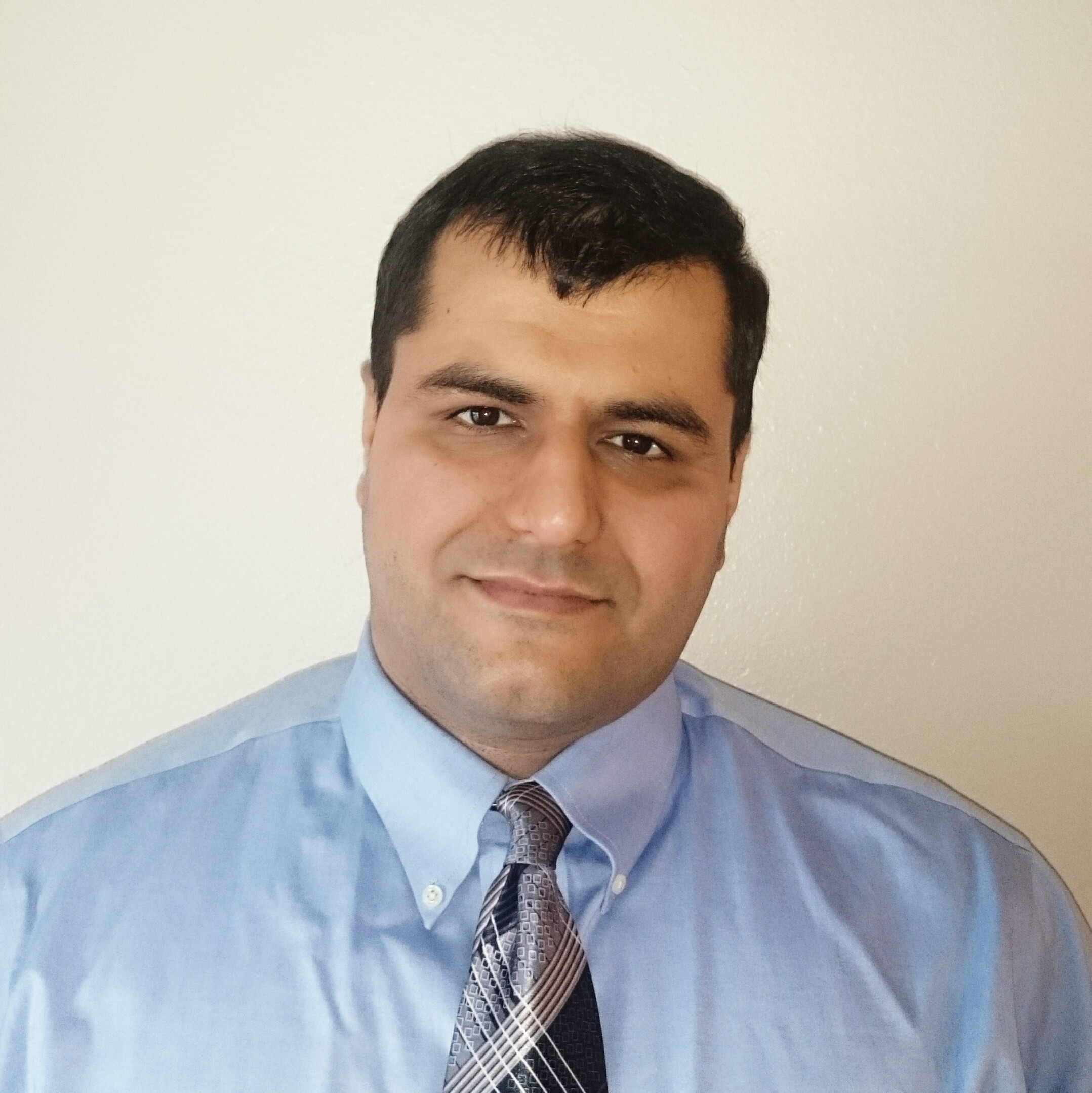
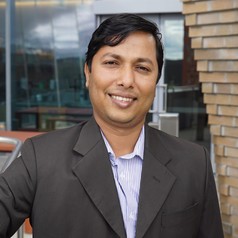
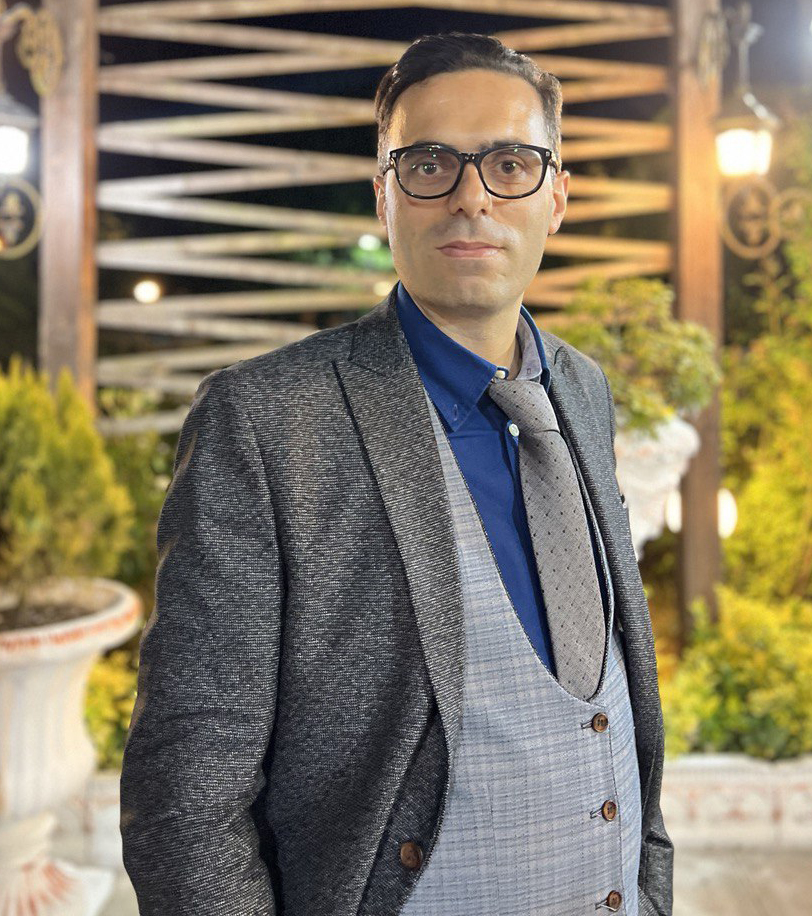
Dr. Ali Ahrari is a Lecturer at the School of Systems and Computing, University of New South Wales, Canberra. He holds a Ph.D. in Mechanical Engineering from Michigan State University (2016) and has extensive experience in research and academia, including roles as a Research Fellow and Associate at UNSW-Canberra and the University of Sydney. His research focuses on evolutionary algorithms, multimodal and multi-objective optimization, and surrogate-assisted optimization. Ahrari is a recipient of prestigious awards, including the ARC-DECRA 2023 and multiple international competition wins in optimization (e.g., CEC/GECCO competitions). He leads research groups like the Canberra Evolutionary Optimization (EvOpt) and serves on editorial boards, including Applied Soft Computing. Education: Ph.D. (2016, Michigan State University), M.Sc. and B.Sc. (University of Tehran). Awards: ARC-DECRA, ISCSO, and GECCO/CEC competition wins. Grants: ARC DECRA (2023), NCI Adapter Schemes, UNSW HPC allocations. Supervision: Currently advising 1 PhD student at SEIT, UNSW-Canberra. Engagements: Chair of IEEE Task Force on Multi-modal Optimization, organizer of optimization competitions (GECCO'2024, CEC'2022). His research emphasizes computational optimization, evolutionary computation, and swarm intelligence, with applications in engineering design and dynamic environments. He actively contributes to academic communities through editorial roles and conference organization.
Dr. Andy Nguyen is a Senior Lecturer in the School of Engineering at the University of Southern Queensland. He holds a PhD from Queensland University of Technology (QUT), an MEng from the National University of Civil Engineering (NUCE), and a BEng from NUCE. His research focuses on structural health monitoring, integrating machine learning and deep learning techniques to assess infrastructure integrity. Key areas include damage detection in bridges, pavements, and buildings, as well as sustainable construction materials like bamboo. Nguyen leads projects such as the 'Next Generation Living Laboratory for Engineering Education and Engagement,' emphasizing real-world applications of technology in civil infrastructure. His work spans crack detection algorithms, finite element model updating, and vibration-based structural analysis. He collaborates on AI-driven solutions for autonomous vehicle object detection and smart maintenance planning. Nguyen’s contributions include over 50 peer-reviewed publications and active supervision of postgraduate research in composite materials and transport infrastructure. His research outputs highlight advancements in computational mechanics, sensor technologies, and data-driven methods for infrastructure resilience. Nguyen’s expertise bridges civil engineering challenges with cutting-edge machine learning, advancing both theoretical and applied solutions for sustainable and safe structures.
Dr. Ali Kashani is a Senior Lecturer at the University of New South Wales (UNSW) within the School of Civil and Environmental Engineering. His research focuses on sustainable and low-carbon concrete materials, robot-aided construction (particularly 3D printing), and Circular Economy-aligned applications. Leadership in cementitious materials innovation Expertise in 3D printing for construction Advocate for waste valorisation and carbon capture Dr. Kashani has secured approximately $7 million in research funding and holds a patent in lightweight concrete foam. His work spans 70+ publications with 9,000+ citations, including media coverage in the Sydney Morning Herald and The Fifth Estate. He actively contributes to professional organizations such as MECLA, RILEM, and ASTM. Recent research trends include AI and optimization algorithms for sustainable concrete mix design, chloride diffusion modeling, and 3D printing performance analysis. His publications often address waste material integration, durability assessment, and eco-friendly construction practices. Scientific Awards: National and NSW Awards for 'Excellence in Concrete' (Technology and Innovation) from the Concrete Institute of Australia Churchill Fellowship for Digital Construction and 3D Printing sponsored by AVJennings Dr. Kashani serves as Co-Chair of the cement and concrete working group at MECLA and contributes to RILEM and ASTM committees. His email is ali.kashani@unsw.edu.au , and his office is located in the Civil Engineering Building (H20), Level 2, Room CE204, UNSW.
Dr. Andy Nguyen is a Senior Lecturer in Structural Engineering at the University of Southern Queensland, within the School of Engineering. He is an active researcher and educator, specializing in the Structural Health Monitoring (SHM) of critical civil infrastructure such as bridges, buildings, and transport tunnels. Bachelor of Engineering (BEng), NUCE, 1999 Master of Engineering (MEng), NUCE, 2003 Doctor of Philosophy (PhD), Queensland University of Technology (QUT), 2014 Dr. Nguyen's research is at the forefront of integrating advanced technologies into civil engineering. His primary focus is on developing and deploying sophisticated SHM systems that utilize sensors, data analytics, and machine learning to provide real-time insights into the structural integrity of ageing infrastructure. His work aims to enable proactive maintenance, extend the lifespan of structures, and enhance public safety. He has successfully implemented monitoring systems on major bridges and high-rise buildings in Queensland and New South Wales, with systems capable of even detecting distant earthquake events. His research interests span Structural Health Monitoring, Machine Learning for Engineering, Damage Detection, Finite Element Model Updating, Sustainable Building Materials like bamboo, and the application of AI for automated condition assessment of transport infrastructure. The analysis of his recent publications reveals a strong and consistent research trajectory centered on the application of data-driven and AI methods to solve practical problems in civil infrastructure. His work frequently combines signal processing techniques (like Stockwell Transform) with deep learning models for tasks such as crack detection in concrete and pavement. He also conducts significant research on model updating for complex structures like cable-stayed and arch bridges, using vibration data and optimization algorithms. The integration of machine learning for overload classification and the development of cost-effective, automated monitoring systems are key trends in his recent output. Advanced Queensland Fellow (2024-2027) Dr. Nguyen is actively involved in research supervision and collaboration. He is currently supervising several postgraduate students on projects related to AI-powered condition assessment, bamboo as a sustainable building material, and railway track design. He receives research funding from the Queensland Government through his Advanced Queensland Fellowship. His research has direct practical applications, as evidenced by his public engagement, such as writing for The Conversation on safeguarding ageing bridges, and his work with the Australian Network of Structural Health Monitoring. Dr. Nguyen's work embodies the development of a next-generation 'Living' Laboratory for engineering education, where research, teaching, and real-world infrastructure monitoring are integrated. His current projects involve creating smart, automated fault detection systems and advancing 'digital twin'-based monitoring platforms for infrastructure.
Professor Tommy Chan is Chair in Civil Engineering at Queensland University of Technology's School of Civil and Environmental Engineering. With over $10M in research funding, his work focuses on structural health monitoring of bridges and infrastructure systems. His research group develops cutting-edge methods for assessing structural integrity using vibration analysis, optical sensors, and machine learning. Professor Chan leads major projects including the ARC-funded 'Next Generation Bridge Monitoring' initiative developing real-time monitoring systems for prestressed concrete bridges. His team's innovations include GNSS-based settlement monitoring and synergic identification methods for prestress force evaluation. Current research explores vehicle-bridge interactions, damage detection algorithms, and novel materials for impact protection. He has received numerous honors including the Vice Chancellors' Leadership Award and Top Supervisor Award. Professor Chan founded the Australian Network of Structural Health Monitoring and serves on editorial boards for multiple journals in structural engineering.
Dr Zeke Ahern is a Research Fellow in Transport Engineering and Planning at Queensland University of Technology (QUT), affiliated with the School of Civil & Environmental Engineering. He holds a PhD from QUT. His research focuses on transportation safety, crash frequency modeling, and optimization of public transit systems. Dr Ahern’s work emphasizes multi-objective frameworks for analyzing crash data, improving safety infrastructure, and enhancing urban mobility through advanced statistical and computational methods. He has collaborated on projects involving raised safety platforms, parking payment behavior, and integrated bus route design. His publications reflect contributions to transportation engineering, traffic safety, and data-driven decision-making in civil infrastructure. Research Interests: Dr Ahern’s primary areas include crash frequency modeling, transportation safety infrastructure evaluation, and the application of optimization algorithms (e.g., simulated annealing, metaheuristics) to transportation problems. He develops tools like the Metacountregressor Python package to assist in analyzing count data models, bridging software engineering and transportation research. Publications highlight trends in data-driven safety analysis and infrastructure optimization. His work spans both theoretical advancements (e.g., hypothesis testing for crash models) and practical applications (e.g., raised platform effectiveness reviews). Recent efforts emphasize integrating multiple objectives into transportation planning, such as balancing safety, efficiency, and cost-effectiveness.
Hanyu Gu is a Senior Lecturer in the School of Mathematical and Physical Sciences at the University of Technology Sydney (UTS), part of the Faculty of Science. He holds a PhD in Power Engineering and Automation from Shanghai Jiao Tong University (1999) and has extensive industry experience in telecommunications, airline optimization, and mining. His research focuses on combinatorial optimization, decomposition methods, stochastic programming, and machine learning applications. Notable awards include second place in the 2020 ROADEF competition. He collaborates with institutions like the UTS Transportation Research Centre and has contributed to projects such as optimisation engines for airline management and underground mining algorithms. Current research explores hybrid algorithms, Bayesian optimisation, and scheduling under uncertainty. Education: Bachelor in Industrial Automation, Shanghai Jiao Tong University (1994) Master in Control Theory and Application, Shanghai Jiao Tong University (1997) PhD in Power Engineering and Automation, Shanghai Jiao Tong University (1999) Industry Experience: ZTE (1999–2001): Senior Wireless Communication Engineer CTI, Melbourne (2007–2011): Airline Management Optimisation Researcher NICTA (2011–2013): Underground Mining Optimisation Researcher Grants: ARC Linkage Project LP0883855 (2008–2012): Developed optimisation tools for transportation crewing, valued at $840,000. Research interests span decomposition methods for large-scale problems (e.g., airline scheduling), stochastic programming for resource sharing, and hybridisation of mathematical programming with constraint programming. Recent work includes Bayesian optimisation for knapsack problems and relax-and-solve algorithms for project scheduling. His articles frequently address optimisation in logistics, healthcare, and transportation, emphasizing practical industry applications and algorithmic innovation. Awards: Second place in the ROADEF 2020 competition for maintenance planning solutions. Advising & Grants: Supervises Masters and PhD students in operations research and optimisation. Collaborates with Ausgrid, UGL, and ANC on optimisation projects (e.g., employee training timetabling, logistics). Active in the Optimisation Group of UTS Transportation Research Centre, he bridges academic research with real-world challenges in scheduling, logistics, and resource management. Ongoing efforts include advancing metaheuristics and integrating machine learning with traditional optimisation techniques.
Dr. Aliakbar Gholampour is a Senior Lecturer in Civil and Structural Engineering at the College of Science and Engineering, Flinders University. He earned his PhD in Structural Engineering from the University of Adelaide in 2019 and served as a Postdoctoral Research Fellow at the University of Melbourne until July 2020. He currently serves as Sustainable Construction Materials and Technologies Lead at Flinders University. Dr. Gholampour's educational background includes: PhD in Structural Engineering, University of Adelaide (2019) MSc in Structural Engineering BSc in Civil Engineering (Honours) His research focuses on sustainable infrastructure development through innovative materials and technologies. Dr. Gholampour specializes in recycling waste materials, industrial by-products, and fibers to develop sustainable construction materials. His work encompasses cementitious composites containing nanomaterials, smart multifunctional construction materials, 3D printable concrete, and advanced modeling of fiber-reinforced concrete. In structural engineering, he investigates the behavior, performance, and design of civil infrastructure with emphasis on resilience, sustainability, and management of deteriorating assets. Analysis of his recent publications reveals a strong focus on sustainable construction materials, particularly in recycling waste streams (foundry sand, plastic, glass, lead slag) for concrete production. His work integrates advanced computational methods including machine learning for material property prediction. The research trends show increasing emphasis on life cycle assessment, carbon reduction technologies, and the development of high-performance sustainable concrete alternatives using industrial by-products and recycled materials. Dr. Gholampour's scientific recognition includes: World's top 2% scientist by Stanford University and Elsevier (2021-2023) Emerging Research Leader Award, Flinders University (2023) Vice-Chancellor's Award for Early Career Researchers, Flinders University (2022) Finalist, SA Climate Leaders Awards (2024) Dean's Commendation for Doctoral Thesis Excellence, University of Adelaide (2019) His research is supported by significant grants including the International Clean Innovation Researcher Networks for Decarbonising the Building Industry (2023-2027), multiple Research Investment Funds from Flinders University, and the CRC-P grant for Recycling Waste Plastics. Dr. Gholampour serves as Special Issue Editor for multiple journals including Materials, Fibers, and Frontiers in Built Environment, and as Associate Editor for Frontiers in Built Environment Journal. He is a Steering Committee Member of the International Researcher Network for Decarbonising the Building Industry and a member of the Concrete Institute of Australia.
Mina Mortazavi is a Senior Lecturer at the University of Technology Sydney's School of Civil and Environmental Engineering with over 15 years of experience specializing in structural engineering. Her academic journey includes a PhD in Structural Engineering from Western Sydney University, an MEng in Structural Engineering from Amirkabir University of Technology in Tehran, and a BSc in Civil Engineering from Shahid Beheshti University in Tehran. Her research interests focus on three interconnected fields: cold-formed steel profile assessment and section optimization, modularization in construction, and prefabrication of seismic mounting systems for building services. Mortazavi has developed expertise in applying machine learning techniques to structural engineering problems, particularly in thermal buckling analysis, seismic performance evaluation, and concrete material behavior prediction. Her publication record demonstrates consistent output in high-impact journals such as Thin-Walled Structures , Automation in Construction , and Journal of Building Engineering . Recent research shows increasing integration of artificial intelligence methods with traditional structural engineering problems, particularly in thermal analysis, seismic performance evaluation, and material behavior prediction. Research Innovation Connection grant recipient Multiple contract research projects with industry partners Active PhD and Masters student supervision Mortazavi's teaching portfolio includes courses in Steel and Composite Design, Steel and Timber Design, Mechanics of Solids, and Application of Timber in Engineering Structures. Her industry collaborations demonstrate strong practical application of research findings to real-world structural engineering challenges.
Dr. Saima Ahmad is a Senior Lecturer at RMIT University's School of Management, focusing on cultivating sustainable work environments and investigating leadership's impact on individual well-being. With a PhD in Management from Monash University, her research spans organizational behavior, workplace dynamics, and leadership ethics, addressing critical issues such as bullying, resilience, and digital disruption. She coordinates courses in the RMIT MBA program and serves on editorial boards for the European Management Journal and PLoS One . Education: PhD in Management from Monash University Her research emphasizes positive leadership styles and their influence on employee engagement and organizational sustainability. Recent work explores servant leadership in the construction industry and the role of green human resource management in fostering environmental citizenship. She has pioneered studies on workplace bullying and its mitigation through ethical leadership frameworks. Her scientific awards include the 2022 RMIT GSBL Dean’s Merit Award for HDR Leadership Excellence for her contributions as HDR Coordinator (2022-2024), where she enhanced PhD completion rates and student support systems. She actively supervises Masters and PhD research candidates, focusing on leadership and organizational behavior.
Sanjoy Paul is an Associate Professor at the University of Technology Sydney (UTS) Business School, specializing in supply chain management and operations research. He holds roles as Associate Editor of Business Strategy and the Environment and Global Journal of Flexible Systems Management . His research focuses on supply chain resilience, risk modeling, and sustainable practices, with applications to global disruptions like pandemics and IT outages. Paul has published in top-tier journals such as the European Journal of Operational Research and secured grants from government bodies including the Department of Defence. Education and Career: Prior to UTS, he worked at RMIT University and Bangladesh University of Engineering and Technology. He holds a PhD from UNSW, recognized with the Stephen Fester Prize for outstanding thesis. His career spans academic roles from Lecturer (2017) to Senior Lecturer (2019) before his current position since 2023. Research Contributions: Paul’s work bridges theoretical models and real-world applications, including recovery frameworks for supply chains during crises and strategies for sustainable practices in post-pandemic contexts. He frequently advises media on supermarket pricing, supply chain disruptions, and business strategies, appearing in outlets like The Guardian and ABC News . Awards and Recognition: His honors include the ASOR Rising Star Award, Research with Relevance Award, and inclusion in the top 2% global scientists (2020–2023). He has contributed to policy debates on supermarket competition, EV market dynamics, and Australia’s industrial strategies.
Dr. Honglei Xu is an Associate Professor of Industrial Optimization and Engineering at Curtin University, specializing in industrial system optimization for net-zero transition. He serves as Node Leader of ATN Industry Doctoral Training Centre and Mathematics Honours Coordinator. His research spans automation in mining, hybrid systems control, and optimization in construction and energy sectors. Recent publications demonstrate interdisciplinary approaches combining operations research, AI, and control theory for sustainable industrial solutions. Honors include IEEE Senior Membership and JSPS Fellowship. Current projects focus on public transport optimization, renewable energy forecasting, and intelligent control systems for mineral processing. Dr. Xu teaches courses in mathematical modeling and production planning while serving as associate editor for multiple international journals including Complexity and Energies.
Dr. Yaser Gamil is a Lecturer and researcher at the Malaysia School of Engineering, Monash University. His work focuses on cutting-edge technologies in project management and construction informatics, emphasizing sustainable practices and digital transformation. He holds a PhD in Construction Management and Informatics (2020) from Monash, alongside a Master of Engineering (2015) and Bachelor of Civil Engineering (2013). Key research areas include BIM implementation, circular economy principles, smart infrastructure automation, and digital twins. He leads projects like the 'Leveraging Digital Twins for Sustainable WEFE Nexus Management' (2024-2025) as a Partner Investigator. His recent studies address plastic waste utilization in construction materials and AI-driven progress monitoring. Dr. Gamil actively mentors PhD students in topics such as BIM socioeconomic challenges and AI applications in construction. He has contributed 18 publications since 2023, with a focus on sustainable construction technologies and material science innovations.
Dr. Hamid Alinejad-Rokny is a Scientia Senior Lecturer at UNSW Sydney and Adjunct Associate Professor at Concordia University. He leads the UNSW BioMedical Machine Learning (BML) Lab within the Graduate School of Biomedical Engineering. His research focuses on applying machine learning, bioinformatics, and statistical methods to understand genomic mechanisms underlying diseases like cancer and neurodevelopmental disorders. Dr. Rokny holds a PhD in Biostatistical Machine Learning from UNSW and has secured over $13M in grants as a principal or co-investigator. He has published 80+ papers, including 10 as first author and 45 as senior author. Education: Bachelor’s in Software Engineering (2004-2009), Master’s in Artificial Intelligence (2009-2012), PhD in BioMedical Machine Learning (UNSW, 2014-2018), Postdoc at Harry Perkins Institute (2017-2019). Research interests include medical AI, deep learning, genomic data analysis, and systems biology. He actively supervises 20+ PhD/Master’s students and collaborates with industry partners like CSIRO and 23Strands. Awards include the DECRA 2023, NHMRC MERIT, and International Autism Fellowships. He also serves as a keynote speaker at conferences like HUGO and an Honorary Lecturer at Macquarie University. Grants total $2.75M as lead investigator and $10.6M as co-investigator. Industry partnerships include PORSPA Advance ($4.7M) and Australian Digital Domains ($3.6M). His lab develops tools like MaxHiC and DeepGenePrior for genomic analysis. Labs/Teams: Director of UNSW BML Lab, Health Data Theme Leader at UNSW Data Science Hub. Active in mentoring 13 researchers globally and co-supervising international teams.
Dr. Weitong Chen is a Senior Lecturer at the School of Computer and Mathematical Sciences, University of Adelaide, and an ARC EC Industry Fellow at the Australian Institute for Machine Learning (AIML). He holds a PhD from the University of Queensland (2020), with prior roles as a Post-Doc Research Fellow and Associate Lecturer there. His research focuses on machine learning applications in medical data, particularly time-series analysis, semi-supervised learning, and IoT. He collaborates widely across academia, industry, and government, supported by multiple grants. His work emphasizes healthcare applications, adversarial robustness, federated learning, and unlearning mechanisms. Education: PhD in Machine Learning, University of Queensland (2020) Master's Degree, University of Queensland Bachelor's Degree, Griffith University Research Interests: Medical Data Analysis (e.g., EHRs, radiology) Time-Series Modeling (healthcare IoT, irregular data) Adversarial Machine Learning (backdoor attacks, robustness) Federated Learning (modality incompleteness, clustered frameworks) Data Privacy (unlearning, compliance) Grants & Collaborations: ARC EC Industry Fellowship Industry partnerships in healthcare and IoT Labs/Teams: Australian Institute for Machine Learning (AIML) Cross-disciplinary health tech collaborations