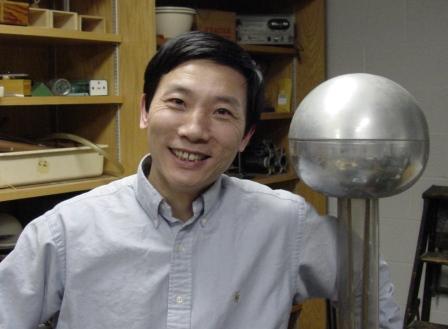
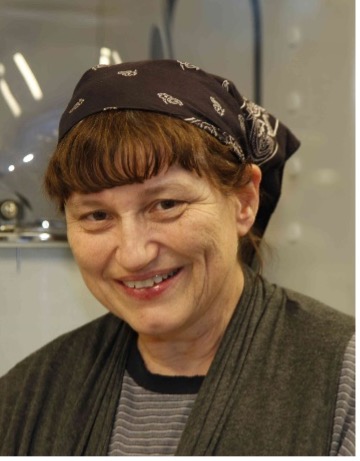
Chong-Qing Ru is a Professor in the Department of Mechanical Engineering, Faculty of Engineering at the University of Alberta, specializing in Solid and Applied Mechanics. Education PhD, Peking University (China) Research Interests Particle-laden Fluids Flow Stability Rotational/Oscillatory Flows Elasticity Solid Mechanics Applied Mechanics Soft Matter Mechanics MetaComposite Mechanics Mechanics and Materials Fluid Mechanics Teaching MEC E 380 - Advanced Strength of Materials I MEC E 682 - Nanomechanics No information is available regarding scientific awards, student advising, grants, or laboratory facilities.
Andrew Zhou is a Professor at the Madia Department of Chemistry, Biochemistry, and Physics within the Kopchick College of Natural Sciences and Mathematics at Indiana University of Pennsylvania. His research specializes in optics, photonics, condensed matter physics, nanophotonics, and nanomaterials for sensor applications. His current work focuses on developing advanced materials including diamond nanostructures, boron nitride nanosheets, and tungsten oxide nanocomposites for high-performance sensors and photodetectors. Recent publications demonstrate innovations in UV photodetection, gas sensing technologies, and nanomaterial fabrication techniques. Dr. Zhou teaches courses spanning Fundamentals of Physics, Photonics, Lasers, Fiber Optics, Quantum Mechanics, and Solid State Physics. His educational background includes a PhD in Optics from the Chinese Academy of Sciences.
Kwek-Tze Tan is an Associate Professor in the Mechanical Engineering Department at the University of Akron , specializing in composite materials and metamaterials. He joined the university in 2014 after working at the Institute of Materials Research and Engineering in Singapore. Education : B.Eng. (2004), M.Eng. (2006) from National University of Singapore; Ph.D. (2011) from Tokyo Metropolitan University; Post-Doc (2013) at Purdue University. Research Focus : Impact and fracture mechanics of composites, acoustic/elastic metamaterials, bioinspired materials, 3D printing, and Arctic temperature effects. Grants : Recipient of 2 multi-year U.S. Office of Naval Research (ONR) grants for Arctic condition composite studies. Labs : Leads research at the Metacomposites Lab (website: metacomposites.uakron.edu ). Scientific Awards include UA Faculty Research Committee Fellowship (2019), Firestone Fellowship (2018), LaunchTown Entrepreneurship Award (2016), JSPS Fellowship (2016), ICA-ASA Young Scientist Grant (2013), and Metamaterials Congress Travel Grant (2012).
Southern University of Science and Technology (SUSTech)China
Dr. Yuan Chen serves as an Assistant Professor at Southern University of Science and Technology in the School of System Design and Intelligent Manufacturing. He obtained his PhD in Aerospace Engineering from the University of Sydney in 2019 and completed postdoctoral research there before joining SUSTech in 2022. Education: PhD in Aerospace Engineering, University of Sydney (2015-2019) ME in Mechanical Engineering, Hunan University (2012-2015) Dr. Chen's research focuses on composite materials and advanced manufacturing. His work spans multiple interconnected areas including: Mechanism analysis and damage modeling for composites Additive manufacturing of continuous fiber reinforced composites Topology optimization and structural design of composites Multiscale modeling and experimental techniques Design and intelligent manufacturing of innovative metacomposites Non-destructive testing methods for composite structures His recent publications demonstrate a strong focus on 3D printing of carbon fiber composites, mechanical metamaterials, and structural optimization. The research shows progression from fundamental mechanical analysis of composite structures toward advanced manufacturing techniques and innovative material designs with specialized properties like negative Poisson's ratios and thermal-dimensional stability. Scientific Awards: Best Oral Presentation, 6th International Conference on Material Strength and Applied Mechanics (2023) Pengcheng Peacock Plan, Shenzhen Government (2022) Travel Award, Multidisciplinary Digital Publishing Institute (2022) Best Oral Presentation, 4th International Conference on Material Strength and Applied Mechanics (2021) Young Scientist Medal, International Association of Advanced Materials (2021) World's Top 2% Scientists (2024) Dr. Chen serves as Editor-in-Chief for Advanced Manufacturing: Polymer & Composites Science and is on the editorial boards of several other journals. He has been supported by multiple prestigious grants including the National Natural Science Foundation of China, National Key Research & Development Program of China, and Guangdong University Key-Area Special Program. He is actively involved in mentoring students and has established the Chen Garden research group focusing on advanced composite materials. Dr. Chen maintains strong international collaborations with researchers in Australia, the UK, Germany, and other countries, and is a member of several professional societies including the Royal Aeronautical Society and the European Materials Research Society.
Miriam Rafailovich is a Distinguished Professor at Stony Brook University in the Department of Materials Science and Chemical Engineering. She has held academic roles since 1980, including Professorships at CUNY Queens College and Stony Brook. Her research spans sustainability, environmental protection, biomedicine, and advanced materials, with over 400 publications and collaborations in nanocomposites, green energy, and tissue engineering. She leads the Garcia Center for Polymers at Engineered Interfaces. Education: PhD in Applied Nuclear Physics from Stony Brook University (1981), BS in Physics and Biology from Brooklyn College (1975). She has advised over 60 PhD/Master’s students and mentored hundreds of undergraduates. Research interests include polymer science, nanotoxicology, and integrating research with education. Notable awards include the SUNY Chancellor’s Award and Fellow of the American Physical Society. She co-directs the NSF Materials Research Science & Engineering Center. Key contributions include advancements in biodegradable polymers, flame-retardant materials, and stem cell differentiation. Her work bridges academia and industry, focusing on sustainable technologies and biomedical applications.
Dr. Mirmilad Mirsayar is an Assistant Professor of Aerospace Engineering at Florida Institute of Technology (FIT), affiliated with the Department of Aerospace, Physics, and Space Sciences. He leads the Metacomposites Integrity Research Lab (MIR-Lab), focusing on advanced composites, fracture mechanics, and additive manufacturing. Prior to FIT, he held postdoctoral and research roles at Texas A&M University. He earned his Ph.D. in Aerospace Engineering from Texas A&M in 2017. His research interests include fracture mechanics of advanced materials, computational mechanics, and additive manufacturing. He has secured major grants, including an NSF Standard Research Grant and a NASA equipment award. Notable achievements include recognition as a World's Top 2% Researcher (2021–2024) and multiple Outstanding Reviewer Awards. His lab emphasizes nature-inspired metacomposites and structural health monitoring. Equipment includes advanced testing systems (e.g., fatigue testing, DIC setup) and additive manufacturing tools. Current projects involve mixed-mode fracture mechanics in functionally graded microcellular solids. Dr. Mirsayar has advised numerous graduate students, including Victor Bautista, Behnam Shahbazian, and Niall Harris. His work bridges theory, experimentation, and innovation in aerospace and civil engineering applications.
Justin Dirrenberger is an Associate Professor (Maître de conférences HDR) at Conservatoire National des Arts et Métiers (CNAM) with a joint appointment at Arts et Métiers ParisTech (ENSAM), where he leads the CoMet research team (Comportement et microstructure des Métaux) within the PIMM laboratory. His work bridges fundamental mechanics with industrial applications in additive manufacturing, focusing on architected materials for aerospace, biomedical, and space sectors. Dirrenberger's research centers on architectured materials—including auxetics, metamaterials, and lattice structures—with expertise in computational homogenization, laser-based metal processing, and multi-material 3D printing. Key areas include instability-induced pattern generation, mechanical behavior of heterogeneous media, and sustainable manufacturing processes. His methodology integrates numerical modeling (using Zébulon code) with experimental validation through advanced laser systems and mechanical characterization. Recent publications (2023-2025) reveal strong trends toward bioinspired 4D printing, lunar construction materials (ESA project), and laser-optimized metal lattice production. His work consistently appears in high-impact journals (Materials & Design, Small, Advanced Materials Technologies), demonstrating both theoretical depth and industrial applicability in lightweight structures and energy-absorbing systems. Dirrenberger currently leads five major projects: ANR MIRACLES (2024-2027): Resilient micro-lattices inspired by crystal plasticity H2020 REDI (2022-2027): European doctoral training with RMIT University ANR REDESIGN4D (2021-2026): Machine learning-driven adaptive composites ESA MOON-COMP (2022-2025): Lunar 3D printing for energy dissipation ANR ModuFEET (2021-2026): Reliable power electronics modules He previously directed CNAM's Materials Engineering Program (2017-2024) and led ANR SCOLASTIC (2015-2020) on laser-processed steel. The CoMet team operates within PIMM's advanced experimental ecosystem, utilizing Laser Choc (shock), Héphaïstos (thermal), and MESO 3D-Panam platforms for material processing. Current work focuses on translating computational models into printable architectures—from biomedical scaffolds to lunar construction materials—through close industry collaboration with aerospace, automotive, and space sector partners.