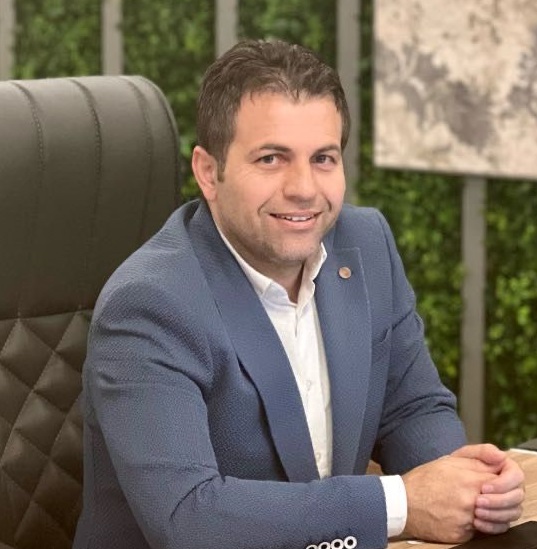
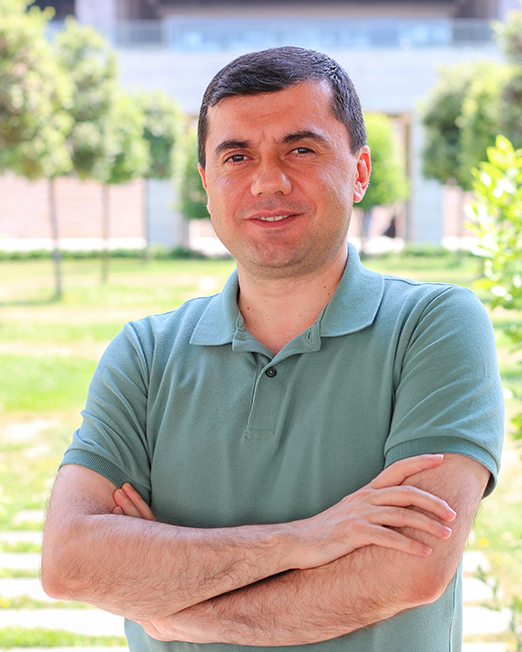
Faruk Polat is a Professor of Computer Science at the Department of Computer Engineering, College of Engineering, Middle East Technical University (METU) in Ankara, Turkey. He has been serving at METU since 1994, progressing from Assistant Professor (1994-1996) to Associate Professor (1996-2002) and then to full Professor (2002-present). He received his B.S. in Computer Engineering from METU in 1987, followed by M.S. and Ph.D. degrees from Bilkent University in 1989 and 1994 respectively, with a visiting scholar period at the University of Minnesota (1992-1993). His primary research interests include Artificial Intelligence, Reinforcement Learning, Multiagent Systems, Markov Decision Processes, and Partially Observable Markov Decision Processes. His work significantly contributes to computational biology applications, particularly in gene regulatory network modeling, and to multiagent path finding in virtual simulations and computer games. He has published extensively in top-tier journals and conferences, with recent publications extending into 2025. Professor Polat has supervised numerous graduate students who have gone on to successful careers in academia and industry, including positions at Meta, Google, Apple, Microsoft, and various universities. His research group continues to be highly active, with current PhD students working on reinforcement learning, multiagent path planning, and gene regulatory networks. His scientific contributions span multiple domains, with a clear trajectory from foundational work in multiagent systems to increasingly sophisticated applications in computational biology and autonomous systems. His recent publications indicate continued innovation in reinforcement learning techniques, particularly in handling partial observability and complex path planning problems. NATO Science Scholar at University of Minnesota (1992-1993) Member and Team Leader/Deputy Team Leader of National Informatics Olympiad Group (1995-2011) Professor Polat has advised numerous PhD and Master's students who have secured positions at leading technology companies and academic institutions worldwide. His research has been supported by grants including Tubitak 1001 Project (Grant No. 115G086). His work bridges theoretical advances in artificial intelligence with practical applications in computational biology and autonomous systems.