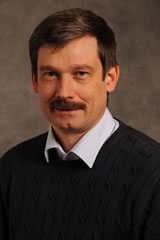
Farah Alkhatib is a Lecturer and Research Officer in Mechanical Engineering at the University of Western Australia. She specializes in computational biomechanics and finite element analysis of vascular systems. Her research develops patient-specific modeling approaches for abdominal aortic aneurysms, focusing on rupture risk assessment and surgical planning. She won the Graduate Research School Dean's List award for her PhD thesis and has contributed to open datasets for biomechanical research. Dr. Alkhatib's publications demonstrate expertise in mesh generation techniques, uncertainty quantification in medical image segmentation, and nonlinear biomechanical analysis. She develops computational methods to improve the accuracy of vascular stress predictions and translate biomechanical research into clinical applications.
Dr. Jörg Kuhnert serves as Deputy Head of the Department »Transport Operations« at the Fraunhofer Institute for Industrial Mathematics ITWM in Kaiserslautern. His research focuses on grid-free numerical methods in fluid and structural mechanics, mathematical modeling of foams, and parallelization of algorithms. He has contributed to high-impact publications in computational mechanics and geotechnical engineering. Research Interests: Development and application of mesh-free techniques (e.g., Finite Pointset Method) Mathematical modeling of complex materials like foams High-performance computing for engineering simulations Publications: His work spans theoretical advancements and practical applications in soil mechanics, fluid-structure interaction, and numerical methods. Recent contributions emphasize mesh-free approaches for multiphysics problems. No scientific awards or grants are explicitly listed in the provided text. He leads teams within the Transport Operations department at Fraunhofer ITWM.
Min Hyung Cho is an Associate Professor in the Department of Mathematical Sciences at the University of Massachusetts Lowell (UMass Lowell). He specializes in computational mathematics, applied mathematics, electromagnetics, numerical solutions of PDEs, and scientific computing. His research focuses on developing high-performance numerical algorithms for wave scattering problems in complex media, including layered media and metamaterials. He has contributed to integral equation methods, fast multipole methods (FMM), and volume integral equation techniques for solving Helmholtz and Maxwell equations in layered environments. Cho holds a Ph.D. in Applied Mathematics from the University of North Carolina at Charlotte. He has received the Teaching Excellence Award (2017) from UMass Lowell. His work has been supported by grants such as the NSF Collaborative Research grant (2020) and a Simons Foundation Collaboration Grant (2016). Cho’s recent research emphasizes spectrally-accurate numerical methods for acoustic scattering, robust fast direct solvers for quasi-periodic problems, and efficient algorithms for layered media Green’s functions. His publications span journals like Journal of Computational Physics , SIAM Journal on Scientific Computing , and Computer Physics Communications . His academic activities include organizing minisymposia at conferences like ICIAM and presenting at institutions such as Yale University and the University of Arizona. He also contributes to educational initiatives in differential equations and computational mathematics.
Hao Tian is a professor at Georgia State University's Department of Computer Science, with affiliations at institutions including Hubei University of Economics, University of Alberta, and Shanghai Key Laboratory of Trustworthy Computing. His research spans interdisciplinary domains at the intersection of computer science, applied mathematics, and engineering. Key research areas include: Machine learning architectures for image and signal processing Graph-theoretical methods for pattern recognition Federated learning and edge computing frameworks Fuzzy systems for industrial process control Numerical methods in computational mechanics Recent publications demonstrate trends in: Higher-order network representation and learning Physics-informed neural networks for financial modeling Peridynamic models for crack propagation analysis Transformer-based approaches in point cloud processing His work has been applied to municipal solid waste incineration, biomedical imaging, and smart city infrastructure, reflecting a strong engineering focus.
Prof. Qasim Zeeshan is a Professor in the Department of Mechanical Engineering at Eastern Mediterranean University, Faculty of Engineering. He holds a B.E. from NUST (Pakistan), and MS/PhD degrees in Flight Vehicle Design from Beihang University (China). With over 15 years of post-PhD experience in research and teaching, he specializes in Aerospace Vehicle Design, Multidisciplinary Design Optimization (MDO), Space Systems Engineering, and Industry 4.0. His teaching spans undergraduate and graduate courses in mechanical/aerospace engineering, including Space Systems Engineering, Manufacturing Systems, and Reliability Engineering. He is affiliated with research centers such as the Energy Research Center and Electric Vehicle Development Center. His research integrates machine learning, metaheuristic optimization, and composite materials analysis, with a focus on aerospace systems and smart manufacturing. He actively supervises graduate theses and serves as an associate editor and reviewer in academic journals. His recent work explores vibration analysis of composite structures, additive manufacturing advancements, and cloud-based manufacturing systems. He has contributed to over 50 peer-reviewed articles, emphasizing computational modeling, material characterization, and optimization algorithms. His expertise spans both theoretical and applied engineering, bridging mechanical systems, aerospace technologies, and Industry 4.0 innovations.
Michael Ortiz is the Frank and Ora Lee Marble Professor of Aeronautics and Mechanical Engineering at the California Institute of Technology (Caltech), affiliated with the Division of Engineering and Applied Science. His research focuses on solid mechanics, multiscale material modeling, and computational mechanics. He leads a group studying material behavior across length and time scales, including fracture mechanics, data-driven methods, and hydrogen embrittlement. His work bridges fundamental science and engineering applications, emphasizing real-world problem-solving through applied mathematics and computational tools. Research interests include the physics of solid materials under diverse conditions, multiscale modeling of metals and composites, and the development of advanced numerical methods. Notable projects involve ultrasonic neuromodulation, hydrogen storage in magnesium alloys, and topology optimization of lithium-ion battery anodes. He collaborates internationally on initiatives like the Data-Driven Computational Mechanics project and the M-HEAT hydrogen embrittlement study. Ortiz has advised over 40 PhD and master’s students, contributing to impactful research in fracture mechanics, materials science, and computational methods. His funded projects span NIH-supported neuromodulation studies to EU-funded hydrogen economy initiatives. He is actively involved in the Solid Mechanics group at Caltech and collaborates with institutions globally, advancing interdisciplinary research in mechanics and materials.
Juan Diego Alvarez Roman is an Associate Professor in the Department of Mathematics at Carlos III University of Madrid (UC3M), and Director of the F.Abril Martorell College. His academic role includes leadership in both education and research. Research interests focus on numerical methods and their biomedical applications, particularly inverse problems in cardiac modeling, medical imaging (e.g., optical tomography, microwave screening), and computational techniques like radial basis functions (RBF) and level-set methods. Projects include the LocMoTIC initiative for cardiac arrhythmia localization and collaboration on 3D imaging of biological tissues. Recent work emphasizes RBF-based numerical methods for differential operators and applications in cardiac ischemia localization. His articles span applied mathematics, biomedical engineering, and computational physics. Grants: Principal investigator in LocMoTIC (2010-2013), and collaborator in projects like 'Clustering Automático de Comportamientos de Invertebrados en Libertad' (2021-2025) and 'Imagen óptica 3D ultrarrápida' (2016-2020). Patents: System/method for cardiac electrical activation reconstruction (2014). Teaching: Involved in undergraduate/postgraduate programs at UC3M's Department of Mathematics. Labs/Teams: Member of the Numerical Methods and Applications research group and affiliated with the Gregorio Millán Barbany University Institute for Modelling and Simulation.
Timon Rabczuk is a Professor and Chair of Computational Mechanics at Bauhaus University Weimar, Germany. His research focuses on computational methods for moving boundary/interface problems with applications in fracture mechanics, fluid-structure interaction, inverse analysis, and topology optimization. Develops meshfree and peridynamics methods for dynamic fracture simulation Created cracking particles method (CPM) and dual-horizon peridynamics (DH-PD) Works on immersed particle methods (IPM) for fluid-structure interaction Current research includes computational materials design of piezoelectric/flexoelectric nanostructures and quantum spin Hall effect-based phononic topological insulators using isogeometric analysis and level set methods. Based at the Institute of Structural Mechanics (ISM) with expertise in thin shell formulations and topological optimization.
Jack HALE is a Research Scientist at the University of Luxembourg's Faculty of Science, Technology and Medicine (FSTM), Department of Engineering. He joined Prof. Stéphane Bordas' team in 2013, focusing on computational mechanics and numerical methods. His work integrates advanced techniques like meshfree methods, XFEM, and isogeometric analysis to address challenges in solid mechanics and high-performance computing. Education : PhD in Aeronautics, Imperial College London (2009-2013), supervised by Dr. Pedro M. Baiz Villafranca. MEng in Engineering, University of Bristol (2004-2008). Research exchange at Rice University (2006-2007) on cross-flow filtration processes. Research Interests : Implicit boundary methods for medical image-based simulations. Development of scalable meshfree/XFEM/isogeometric analysis frameworks. Mixed variational methods to resolve locking phenomena in solid mechanics. High-performance computing for distributed parallel systems. Publications & Software : His 50+ publications emphasize open-access research via ORBilu, with a focus on FEniCSx-based tools (e.g., DOLFINx, FEniCS-shells). Recent work addresses Bayesian model selection, melt instability identification, and SAR data assimilation in aquifer modeling. Collaborations : Open to academic/industrial partnerships in computational mechanics, material science, and biomedical engineering.
Miguel Martín Stickle serves as a University Professor in the Department of Mathematics and Computer Science Applied to Civil and Naval Engineering at the Polytechnic University of Madrid. He holds active memberships in the Computational Mechanics Group, Center for Research in Computational Simulation (CCS), and R&D+i Center for Smart and Sustainable Civil Infrastructure (CIVILis), while also preparing to assume the role of Deputy Director for the International Doctoral School (EID) starting June 2025. His academic foundation includes a Mathematics degree from Complutense University of Madrid and a PhD from the Polytechnic University of Madrid. Dr. Martín Stickle's research centers on Computational Geomechanics , specializing in hydro-mechanical modeling of granular porous media under large deformations. He pioneers numerical techniques including Finite Element Method (FEM), Smoothed-Particle Hydrodynamics (SPH), Material-Point Method (MPM), and Optimal Transportation Meshfree (OTM) to simulate flow-type landslides for disaster mitigation. His work bridges Civil Engineering and Applied Mathematics with direct societal impact in infrastructure safety. As Principal Investigator for the Ministry of Science-funded project "Coupled particle-based simulation models: application to rapid landslides and waves generated in reservoirs, lakes and bays" (PID2019-105630GB-I00), he has secured competitive grants under H2020, FP7, and Spain-Italy integrated actions, complemented by 20+ international conference presentations. His institutional engagement spans the Computational Mechanics Group and CCS, driving collaborative advancements in computational simulation for civil engineering challenges.
Dengpeng Huang is an Assistant Professor specializing in Artificial Intelligence and Robotics within the field of Elastomer Technology and Engineering . His work bridges computational modeling with advanced materials, focusing on applications in smart materials and mechanical systems. Research Interests: Development of AI-driven models for predicting elastomer properties Multiscale analysis of rubber composites Electromechanical coupling in dielectric elastomer actuators Meshfree methods for metal cutting and chip formation Ultra-precision polishing of optical surfaces Recent Trends: His 2024–2025 publications emphasize data-driven modeling of rubber's viscoelastic behavior, multiscale analysis of composites, and CNN-based approaches for material characterization. Earlier work (2014–2022) explores tool path optimization, beam modeling, and computational machining. Scientific Recognition: Holds an h-index of 5 according to Scopus citations, with recognition as an AI and robotics expert in the service industry. Advising & Collaboration: Collaborates with researchers like Anna Blume, Evgeny Karaseva, and Tim Bor on elastomer composites. Supervised at least one academic work, though specific students are not named in the provided data. Labs & Teams: Affiliated with simulation and robotics teams in the smart materials sector, likely within an advanced materials or mechanical engineering research group.
Professor Oleg Davydov holds a Professorship for Numerical Analysis at the Department of Mathematics, University of Giessen, Germany. His research focuses on developing advanced numerical methods with strong theoretical foundations and practical applications. He maintains an active research program with numerous recent publications and international collaborations. Position: Professor of Numerical Analysis Institution: University of Giessen, Department of Mathematics Contact: Heinrich-Buff-Ring 44, 35392 Giessen, HRZ Room 117 Email: oleg.davydov@math.uni-giessen.de Homepage: https://oleg-davydov.de/ Professor Davydov's research interests center around meshless numerical methods, approximation theory, and computational mathematics. His primary focus areas include: Meshless Finite Difference Method - Developing robust meshless techniques that avoid the need for structured grids Finite Element Method - Particularly Bernstein-Bézier finite elements and specialized approaches for complex geometries Scattered Data Fitting - Creating efficient algorithms for approximating data on irregular domains Approximation Theory - Investigating theoretical properties of splines, radial basis functions, and other approximation tools His research has resulted in several software packages including mFDlab (Meshless Finite Difference Method), BBFEM (Bernstein-Bézier Finite Elements), and TSFIT (Two-Stage Scattered Data Fitting), demonstrating the practical implementation of his theoretical work. Analysis of Professor Davydov's recent publications shows a consistent focus on improving meshless methods, particularly in stencil selection, error analysis, and applications to complex problems. His work spans both theoretical developments (like error bounds and optimal approximation orders) and practical implementations (for fluid dynamics, manifold learning, and interface problems). A notable trend is the increasing sophistication of adaptive techniques and the handling of challenging geometries. Professor Davydov has supervised several doctoral students to completion, including: Gaelle Andriamaro Fabien Rabarison Abid Saeed Wee Ping Yeo His research group appears to maintain active collaborations with institutions worldwide, as evidenced by his extensive co-authorship network. The group focuses on developing both theoretical foundations and practical implementations of numerical methods, with particular attention to problems involving irregular domains, singularities, and complex geometries. Students in his group would gain experience in both theoretical analysis and software development for numerical methods.
Eric Monteiro is a Lecturer at École Nationale Supérieure d'Arts et Métiers (ENSAM) and Academic Director of the Master 1 Factory of the Future program. He is affiliated with the Laboratory for Processes and Engineering in Mechanics and Materials (PIMM), specifically within the DISCO research team focusing on Laser Processes. His research spans several key areas in mechanical engineering and materials science: Structural Health Monitoring : Developing advanced Lamb wave-based techniques for damage detection using signal processing and machine learning approaches Topology Optimization : Creating constrained natural element methods for stress and fatigue-constrained design optimization Polymer Processing : Modeling viscohyperelastic behavior in manufacturing processes like stretch blow molding Computational Mechanics : Developing novel numerical methods including hybrid twin approaches and meshfree techniques Laser Processes : Researching applications in materials processing and manufacturing His recent publications demonstrate a strong focus on computational methods development, with applications spanning structural optimization, wave propagation analysis, manufacturing process simulation, and material behavior modeling. This work consistently combines theoretical frameworks with experimental validation. As Academic Director, he oversees the Master 1 Factory of the Future program while maintaining an active research portfolio through PIMM laboratory, which provides access to experimental platforms for materials characterization and advanced manufacturing processes.
Cung Nguyen is a Lecturer in Civil Engineering at the University of Salford, within the School of Science, Engineering & Environment. His research focuses on Wind Engineering and Structural Dynamics, with particular emphasis on modeling and simulations of typhoon wind fields, wind loading, wind-induced structural vibrations, and infrastructure resilience to wind hazards. His research interests include: Wind Engineering Structural Dynamics Infrastructure resilience to extreme events Climate change Dr. Nguyen's research employs analytical, numerical and probabilistic modeling, wind tunnel testing, and Computational Fluid Dynamics (CFD) simulations. His work has been funded by prestigious organizations including the Royal Society, the Engineering and Physical Sciences Research Council (EPSRC), Newton Fund, and UK Turbulence Consortium. His recent publications (2019-2024) show a strong focus on vortex shedding, wake dynamics, building clusters, and structural responses to wind loading, reflecting his expertise in wind engineering applications. Dr. Nguyen contributes to the UN Sustainable Development Goals related to resilient infrastructure, sustainable cities, and climate action. He teaches several modules including: Mathematics for Civil Engineering (Level 4-5) Highway Design and Analysis (Level 5) Case studies in Environment Engineering (Level 6) Finite Element Methods with Applications in Seismic Engineering (Level 7) Tall buildings (Level 7)