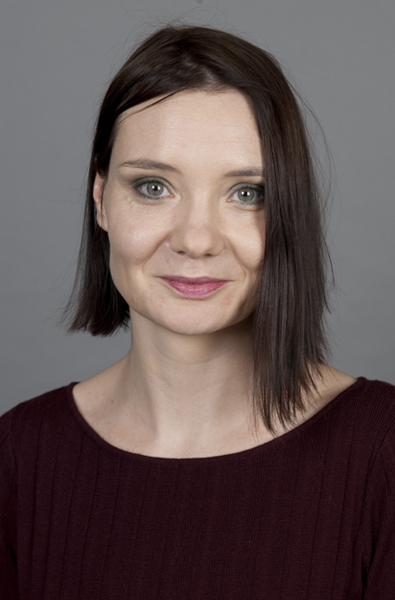
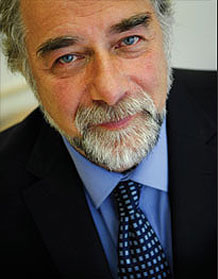
Christoph Koch is a Full Professor in the School of Computer and Communication Sciences at EPFL (Ecole Polytechnique Federale de Lausanne) , Switzerland. He has held academic positions at Cornell University (2007-2010, 2006), Saarland University (2005-2007), and TU Vienna (2001-2005). His research focuses on database systems, logic, programming languages, and data management.
Andreas Eckert is Professor and Chair of African History at Humboldt University Berlin, where he also serves as Director of the International Research Centre "Work and Human Life Cycle in Global History" since 2009. Previously, he was Head of Department at the Institute of Asian and African Studies (2008-2009) and Dean of the Faculty of History and Philosophy at the University of Hamburg (2004-2006). His academic career includes visiting professorships at Harvard University, Maison des Sciences de l'Homme in Paris, and Indiana University. Professor Eckert's research focuses on African history in the 19th and 20th century , with particular emphasis on the history of the state, urbanization, and historiography. His scholarly work extends to comparative history of colonialism , history of work/labour history , and global history . His approach combines deep regional expertise in African contexts with transnational and comparative perspectives that challenge traditional historical narratives. Eckert's publication record demonstrates a consistent engagement with themes of state formation, labor relations, urban development, and historical methodology in African contexts. His work spans from detailed case studies of specific regions like Douala and Tanzania to broader conceptual explorations of how Africa fits into world historical narratives. A notable trend in his scholarship is the examination of entangled histories that connect local African experiences with global processes of colonialism, decolonization, and postcolonial state formation. His notable achievements include: 2012 Guest Fellowship at Freiburg Institute of Advanced Study Election as chairperson of "Forum Transregionale Studien" (2011) Major Grant from the German Ministry for Research and Education for the Institute "Work and Human Life Cycle in Global History" (2009) Election as chairperson of "Arbeitskreis für Moderne Sozialgeschichte" (2007) Managing Editor of the Journal of African History (2004-2011) Fellowship in the Royal Historical Society (2000) As Director of the International Research Centre "Work and Human Life Cycle in Global History," Eckert has secured significant funding including a major grant from the German Ministry for Research and Education (2009-2015). He has also served on the Board of the International African Institute in London and has been actively involved in scholarly organizations including the "Forum Transregionale Studien" and "Arbeitskreis für Moderne Sozialgeschichte." Under Eckert's leadership, the International Research Centre "Work and Human Life Cycle in Global History" brings together scholars from multiple disciplines and countries to examine the historical dimensions of work and human life cycles from a global perspective. The center serves as a hub for innovative research that transcends traditional geographic and disciplinary boundaries.
Peter Druschel is a Professor and founding Director of the Max Planck Institute for Software Systems (MPI-SWS) in Saarbrücken, Germany. He holds adjunct professorships at Saarland University and the University of Maryland. His research focuses on distributed systems, operating systems, and privacy-preserving technologies. He earned his Ph.D. from the University of Arizona in 1994 and has held roles at Rice University since 1994, including Professor of Computer Science (2002–2005). Education: Ph.D. in Computer Science, University of Arizona (1994) Research Interests: Distributed systems, operating systems, network security, accountable computing, and privacy technologies. Current projects include privacy compliance in data systems (Thoth), secure communication (EbN), and privacy-aware image capture (I-Pic). Awards: SIGOPS Mark Weiser Award (2008) NSF CAREER Award (1995) Member of Academia Europaea and German Academy of Sciences Leopoldina Grants & Leadership: Leads the ERC Synergy Project imPACT, chairs the Max Planck Society’s Chemistry, Physics, and Technology Section, and collaborates with institutions like Cornell and Google. Advises on policy issues related to technology and privacy. Labs/Teams: Distributed Systems Group at MPI-SWS, collaborations with Microsoft Research and MIT. Current team includes students and postdocs working on privacy, security, and distributed systems.
Oliver Grau is a Chair Professor for Image Science and a leading figure in Media Art research, affiliated with Hong Kong Baptist University (Academy of Visual Arts, Distinguished Fellow since 2023) and Danube University Krems (Chair Professor for Image Science from 2005–2022). He founded the Archive for Digital Art (ADA) and the international MediaArtHistories Conference Series , with key roles at institutions across Germany, Austria, and Australia. His work bridges art, science, and technology, focusing on immersive images, digital heritage, and emotion research. Key Positions: Director of ADA (since 2000), Founding Director of MediaArtHistories Conference Series (since 2005), PI for high-resolution digitization of the Goettweig Graphic Print Collection (2005–2017). Research Grants: Funded by DFG, Austrian Science Fund, Australian Research Council, VW Foundation (total 8.3 Mio EUR), and Erasmus+ Joint Master program (5.4 Mio EUR). Research Interests: Grau’s scholarship spans the history of media art, telepresence, artificial life, emotion research, and digital humanities. His work emphasizes the evolution of immersive visual experiences from historical art forms to digital media, integrating theoretical and practical approaches. Article Trends: His recent publications focus on digital art’s sociopolitical dimensions, archiving challenges in the digital era, and cross-disciplinary methodologies. Themes include media art conservation, web-based tools for digital humanities, and the intersection of artistic expression with contemporary global issues like climate change and surveillance. Scientific Awards: Distinguished Fellow at Hong Kong Baptist University (2023) Science Award of Lower Austria (2019) Honorary Doctorate from University of Oradea (2014) Invitations to G-20 summit, Olympic Games, and international symposia Labs & Teams: He leads the Archive for Digital Art, managing a global team of 28 staff, and co-founded the Erasmus+ Joint Master in Media Arts Cultures. His projects emphasize collaborative archiving tools (e.g., Web 2.0/3.0 archives) and large-scale digitization initiatives.
Yavuz Köse is a University Professor of Turkology at the Department of Near Eastern Studies, Faculty of Philology and Cultural Studies, University of Vienna. He currently serves as Head of the Institute of Oriental Studies (since June 2024) and previously as Deputy Head (October 2022-June 2024). Before joining the University of Vienna in 2019, he was W3 Acting Professor for Turkology at the Asia-Africa Institute of the University of Hamburg (2010-2018). His educational background includes a Master of Arts in History and Culture of the Near East as well as Turkology, Psychology and Economics from Ludwig Maximilian University of Munich (2001). Professor Köse's research focuses on social, economic and consumer history of the Ottoman Empire and Turkey, environmental and tourism history, history of science, and migration and workers' history. His work examines Ottoman social structures, economic transformations, cultural heritage, and identity formation, with particular attention to urban contexts and cross-cultural interactions. His recent publications show a strong emphasis on Ottoman social history, with particular attention to conversion narratives, cultural exchanges, and urban economic structures. The 2025 edited volume Becoming Ottoman represents a significant contribution to understanding identity formation in the Ottoman Empire. Among his notable recognitions is the Emerald Literati Award (2020) Professor Köse has supervised numerous doctoral students at both the University of Vienna and University of Hamburg, with research topics spanning cultural heritage in Turkey, migration histories, women's work and property, and Ottoman economic history. He has secured significant research funding including projects funded by FWF, DFG, and VolkswagenStiftung, such as the current 'Lebensmittelhändler von Istanbul' project examining Istanbul grocers as urban actors in supply chains. He is actively involved in academic leadership, serving as Head of the Institute of Oriental Studies and Deputy Spokesperson of the Doctoral School for Philological and Cultural Studies. He co-founded and serves as Editor-in-Chief of the Diyâr. Journal for Ottoman, Turkish and Middle Eastern Studies and is a member of numerous scholarly organizations including the Society for Armenian Studies and the Society for Turkology, Ottoman Studies and Turkey Research.
Atakan Aral serves as an Associate Professor at the Faculty of Computer Science, University of Vienna, where he leads research in edge computing, distributed systems, and environmental monitoring applications. His work focuses on developing efficient and resilient computing systems for environmental applications, with particular emphasis on neuromorphic edge AI and the cloud-edge continuum. He maintains an active teaching schedule offering courses in Distributed Systems Engineering, Cloud Computing, and Practical Software Courses with Bachelor's Thesis work across multiple semesters through 2025. Dr. Aral's research interests span several critical areas in modern computing including edge computing architectures, federated learning approaches, neuromorphic computing for environmental monitoring, and resilient systems design. His work addresses fundamental challenges in resource-constrained environments, particularly focusing on latency-sensitive applications and energy-efficient computation. The interdisciplinary nature of his research bridges theoretical computer science with practical environmental applications, developing systems that can operate effectively in remote or resource-limited settings. Analysis of his recent publication trajectory reveals a clear evolution from foundational cloud computing research toward increasingly specialized edge intelligence systems. Early work focused on resource allocation and scheduling in cloud environments, while his current research emphasizes neuromorphic approaches for sustainable environmental monitoring. His publications demonstrate growing interdisciplinary collaboration, particularly with environmental scientists, and increasing focus on practical implementations of theoretical concepts in real-world monitoring systems. Dr. Aral leads significant research projects including TROCI (Towards Resilient Operation of Critical Infrastructure), an ongoing initiative, and SWAIN (Sustainable Watershed Management Through IoT-Driven AI), which ran from February 2021 to February 2024. His work spans multiple dimensions of computing systems, from hardware-aware algorithms to application-level implementations, with consistent contributions to major conferences and journals in distributed systems and edge computing. He is an active member of the Scientific Computing research group at the University of Vienna, working from Room 6.49 at Währinger Straße 29. His research environment includes collaboration with the Environment and Climate Research Hub, reflecting the interdisciplinary nature of his work that bridges computer science with environmental applications. His publications indicate strong international collaboration across European institutions and research groups.
Emanuel Sallinger is a Full Professor at TU Wien's Databases and Artificial Intelligence Group and Vice Dean of Academic Affairs for Business Informatics and Data Science. He leads the Knowledge Graph Lab, focusing on scalable knowledge-based systems, reasoning in knowledge graphs, and AI integration. His research spans computational logic, database theory, and blockchain applications. Education: PhD in Computer Science (awarded 'sub auspiciis praesidentis rei publicae'), Master's degrees in Computational Intelligence and Informatics Management, and a Bachelor's in Software and Information Engineering. Research Interests: Knowledge graphs (construction, reasoning, scalability), logic-based systems, AI/ML integration with databases, enterprise architecture modeling, and financial knowledge systems. His work emphasizes practical applications like enterprise modeling, sustainable waste management, and regulatory compliance. Grants & Projects: Lead Vienna Science and Technology Fund (WWTF)-funded Knowledge Graph Lab. Involved in projects like 'Knowledge Graph-driven Tour Management' (sustainability), 'SustainGraph' (waste processing), and 'Enterprise Architecture Knowledge Graphs'. Teaching: Offers courses on Knowledge Graphs, Generative AI, Database Systems, and research methodology. Supervises doctoral and master's students in AI, databases, and knowledge representation. Labs/Teams: Knowledge Graph Lab at TU Wien, collaborating with industry on blockchain-based systems, financial AI, and enterprise architecture frameworks.
Viktor Prasanna is the Charles Lee Powell Chair in Engineering and Professor of Electrical and Computer Engineering and Computer Science at the University of Southern California. He holds courtesy appointments in Computer Science and leads the Center for Energy Informatics, focusing on interdisciplinary research linking energy technologies, computer science, and engineering. Education: BE in Electronics (Bangalore University), ME (Indian Institute of Science), PhD in Computer Science (Pennsylvania State University) His research spans reconfigurable computing, FPGA accelerators, parallel and distributed systems, and big data applications. He has pioneered high-performance architectures and algorithms using FPGAs, impacting domains like networking, security, HPC, and machine learning. Prasanna has published over 600 papers, received 22 best paper awards, and secured >$50M in grants. His work emphasizes energy-efficient computing, with recent grants totaling $12.9M (2016–2021). His h-index is 73, with 23,454 total citations. Scientific Awards: IEEE Fellow, ACM Fellow, AAAS Fellow, W. Wallace McDowell Award, multiple Distinguished Alumnus Awards He has advised over 70 doctoral students and led major centers including CiSoft (Big Data in oilfield tech) and CAST. His editorial roles include Editor-in-Chief of IEEE Transactions on Computers and Journal of Parallel and Distributed Computing.
Marie Claire Villeval is a Research Professor (Directeur de Recherche de Classe Exceptionnelle) at the CNRS and the University of Lyon, affiliated with the GATE research institute. She holds leadership roles including Head of the GATE-Lab experimental platform (2015–present) and President of the Economic Science Association (2021–2023). Her academic career spans over three decades, with positions at CNRS since 1982. Villeval specializes in experimental and behavioral economics, focusing on topics like dishonesty, social preferences, and labor market dynamics. Education: HDR (Habilitation) in Economics (1996), PhD (1983), and M.S. from University Paris X – Nanterre. Awards: Chevalier de la Légion d'Honneur (2017), Silver Medal of CNRS (2017), and membership in Academia Europaea (2015). Editorial Roles: Department Editor at Management Science, Co-Editor of Experimental Economics (2017–2021), and multiple journal roles. Research Interests: Experimental economics explores human behavior in controlled settings, with emphasis on dishonesty, social norms, and public policy implications. Recent work examines collective-risk dilemmas and AI ethics. Her 15 most recent articles (2020–2023) reflect interdisciplinary approaches, blending economics with psychology and neuroscience to address societal challenges like fraud deterrence and pandemic behavior adjustments. Key themes include cognitive effects of feedback, unethical memory suppression, and testosterone’s role in prosocial choices. Grants and advising are integral to her work, though specific details aren’t listed. She leads international collaborations, including visiting professorships at Shandong University (China), New York University (Abu Dhabi), and Queensland University of Technology (Australia). Her labs and teams focus on experimental methodologies to inform public policy and organizational design.
Manolis G.H. Katevenis is a Professor at the Department of Computer Science, University of Crete, and Deputy Director and Head of the Computer Architecture and VLSI Systems (CARV) Laboratory at the Institute of Computer Science (ICS), Foundation for Research & Technology - Hellas (FORTH). He co-founded the European Research Center on Computer Architecture (EuReCCA) and is a founding partner of the European Network of Excellence on High-Performance and Embedded Architecture and Compilation (HiPEAC). PhD in Computer Science from University of California, Berkeley (1983) Co-founder of EuReCCA (2011) Contributed to RISC architecture (1980-1983), interconnection networks (1985-2011), and parallel computing (1993-2010) His research spans Scalable Multicore Systems , Interconnection Network Architecture , Packet Switch Design , Computer Architecture , and VLSI Systems . He has made foundational contributions to per-flow queueing, backpressure mechanisms, and wormhole IP over ATM, with applications in internet routers, data centers, and supercomputers. His publications focus on high-radix crossbar switches, flow control algorithms, and explicit interprocessor communication. Notable scientific awards include: ACM Doctoral Dissertation Award (1984) David J. Sakrison Memorial Prize (1983) IBM PhD Fellowship (1981-1983) Greek State Fellowship (1973-1978) He has supervised 40 graduate theses and participated in 22 R&D projects totaling €9M, including HiPEAC (coordinator of interconnection networks), SARC (FPGA prototype design), and ENCORE (cache-optimized remote DMA). His work has received over 2000 citations, with an h-index of 23.
Jean-Michel Ganteau is a Full Professor of Contemporary British Literature at the University of Montpellier 3, France. He has held leadership roles including Chair of the Department of Anglophone Studies (2006–2010), Director of the MA Programme in Modern Languages (since 2011), and Head of Doctoral School 58 (since 2010). He is Editor of Études britanniques contemporaines and co-editor of the 'Present Perfect' series. His research focuses on ethics in literature, aesthetics (baroque, kitsch, camp), trauma studies, and contemporary British fiction. Notable awards include the Exceptional Class Professorship (2013) and Scientific Excellence Prize (2011). His editorial roles include membership in the management board of University Presses of Montpellier and scientific board of Presses Universitaires de la Méditerranée. He has coordinated research teams like CERVEC (2004–2010) and authored monographs on vulnerability in literature and Peter Ackroyd’s work. His publications span 80+ articles and co-edited volumes on ethical components in experimental fiction and trauma narratives. His work bridges interdisciplinary studies of literature, ethics, and cultural identity. Awards: Chevalier des Palmes Académiques (2015), Exceptional Class Professorship (2013), Scientific Excellence Prize (2011, 2015). Grants: Competitive National Book Centre Award (2007) for his monograph on Peter Ackroyd. He leads initiatives in postgraduate programs and doctoral supervision, emphasizing interdisciplinary approaches to literary studies.
Nadine Akkerman is an Associate Professor at Leiden University's LUCAS (Leiden University Centre for the Arts in Society), specializing in Early Modern English Literature. She is Principal Investigator of the ERC Consolidator Grant project FEATHERS, which investigates collaborative authorship in early modern legal and literary texts. Her academic career spans roles at VU Amsterdam, Radboud University Nijmegen, and visiting fellowships at Queen Mary London, All Souls College Oxford, and NIAS. PhD in English Literature (cum laude) from VU Amsterdam (2008) Junior Lecturer at VU Amsterdam (0.8 FTE, 2002-2006) Junior Lecturer at Radboud University (0.3 FTE, 2006-2007) Her research focuses on epistolary culture, women's history, and intelligence studies. She pioneered the study of female spies in 17th-century Britain through her monograph Invisible Agents , and authored the authoritative biography Elizabeth Stuart, Queen of Hearts . Her work integrates manuscript studies, diplomatic history, and digital humanities, including a groundbreaking Nature Communications paper on virtual document unfolding. Recent publications include the projected The Correspondence of Elizabeth Stuart (3 vols, Oxford University Press) and co-authoring a Yale University Press trade book on early modern spycraft (2024). Her research has transformed understanding of women's roles in espionage and court politics, with methodological innovations in archival science. ERC Consolidator Grant (€2M, 2020) Ammodo Science Award (€300,000, 2019) World Cultural Council Special Recognition Award (2017) Aspasia NWO Premium (2016) Akkerman actively communicates her research to the public through TV/radio appearances and curated exhibitions. She leads the FEATHERS project (2020-2025), funded by the ERC, which examines authorship mediation in early modern texts. Her work combines rigorous archival analysis with interdisciplinary approaches, bridging history, literature, and digital methodologies.
Ulrike Krippner is a researcher at the Institute of Landscape Architecture , University of Natural Resources and Life Sciences Vienna. With a doctorate in 2015 and roles as Visiting Scientist at Leibniz University Hannover (2014), she focuses on historical landscape architecture, design in historical contexts, and heritage science. Education: Diplom in Landscape Planning (1996), Doctorate (2015) Key Affiliations: BOKU Wien, Leibniz University Hannover, Dumbarton Oaks (2010) Her research spans the history of landscape architecture in Austria, with emphasis on 20th-century design, cultural heritage preservation, and urban green spaces. She co-founded the Archive of Austrian Landscape Architecture (LArchiv) and contributed to projects like the Vienna Danube Island and WIG 64 garden exhibitions. Recent publications analyze historical gardens (e.g., Villa Beer, Donaupark) and their conservation. She has served on editorial boards and committees for heritage organizations, including ICOMOS Austria and ECLAS conferences. Scientific Awards: Theodor Körner Förderpreis (2006) Krippner supervised multiple master's theses and collaborated on interdisciplinary research, particularly in documenting Jewish women landscape architects and postwar urban landscapes.
Dr. Alexander Plopski is an Assistant Professor at the Institute of Visual Computing, Technische Universität Graz. His research focuses on advancing augmented reality (AR) technologies, human-computer interaction (HCI), and optical display systems. He holds a PhD, M.Sc., and BSc in relevant fields. His work emphasizes perceptual optimization in AR displays, eye tracking integration, and accessibility solutions for color vision deficiencies. Key research areas include gaze-contingent AR interfaces, light field manipulation for extended reality, and multimodal interaction techniques. Notable contributions include the development of the 'guitARhero' interactive AR guitar tutorial system and studies on focal distance effects in optical see-through displays. His publications span topics from AR display calibration to gesture recognition using radar sensing. He has explored applications in industrial training, medical AR, and robotic telemanipulation. His work often bridges theoretical perceptual studies with practical system implementations, aiming to enhance user experience and accessibility in AR/VR environments.
Bruce Brown is Pro-Vice-Chancellor for Research at the University of Brighton , overseeing research across life, physical, social sciences, and arts and humanities. He previously served as Dean of the Faculty of Arts and Architecture (1989–2006) and Head of the Department of Design (1984–1989). Administrative Leadership : REF2014/RAE2008 Chair, International Governor at Shenkar College, and advisor to academic bodies in Hong Kong, Portugal, and Italy. Research Interests : Visual memory, arts education, and research leadership, with publications spanning design history, spatial design, and cultural policy. Scientific Awards : 2007 WHO’s WHO (A&C Black) 2005 Honorary Fellow (University for the Creative Arts) 2004 Honorary Fellow (Royal College of Art) 1985 Elected Member (Designers and Art Directors Association) 1978 Sanderson and Herbert Read Awards (Royal College of Art) 1970 Elected Fellow (Royal Society of Arts) Articles focus on visual communication, design policy, and cultural memory, reflecting his expertise in design research and higher education leadership . He is currently an Editor of Design Issues: Research Journal (MIT Press).