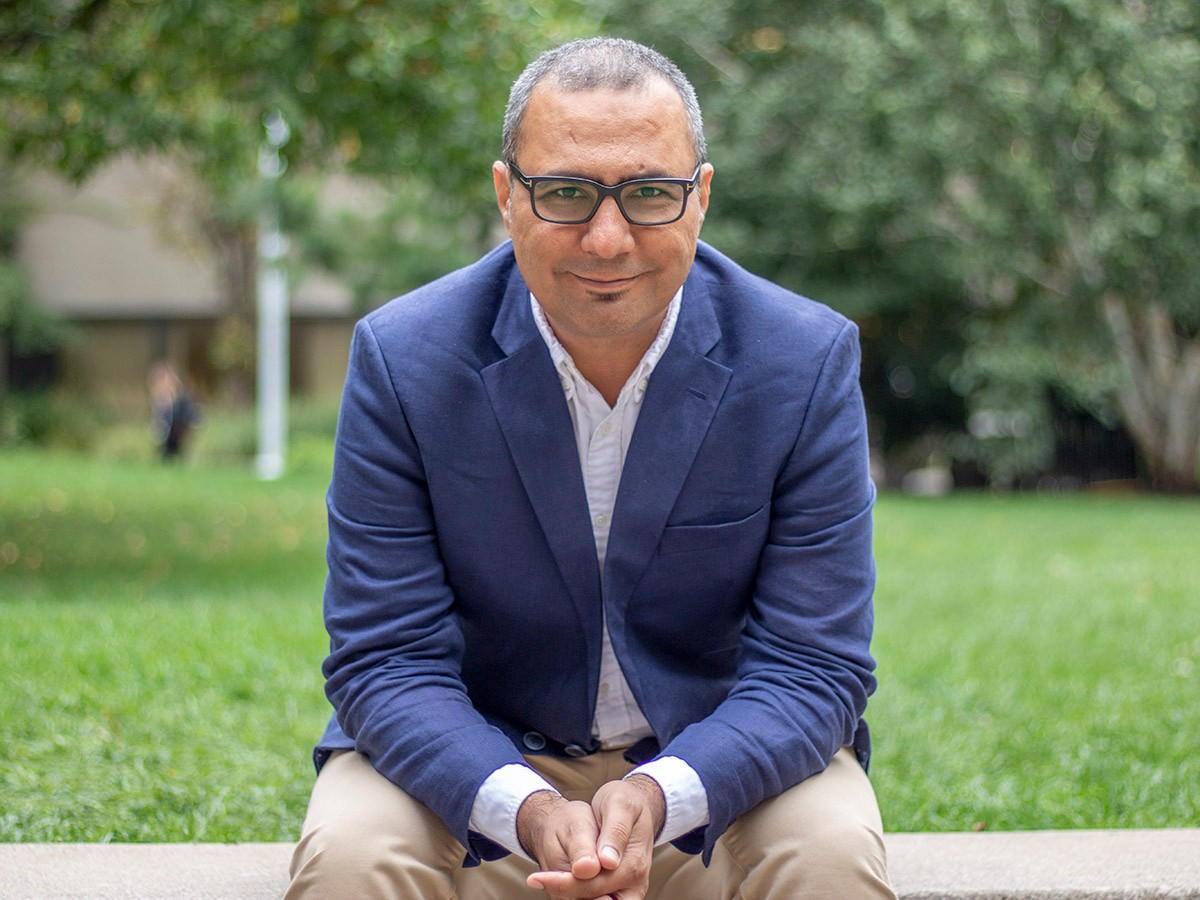
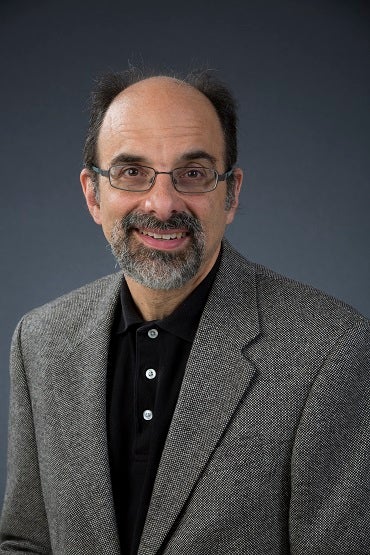
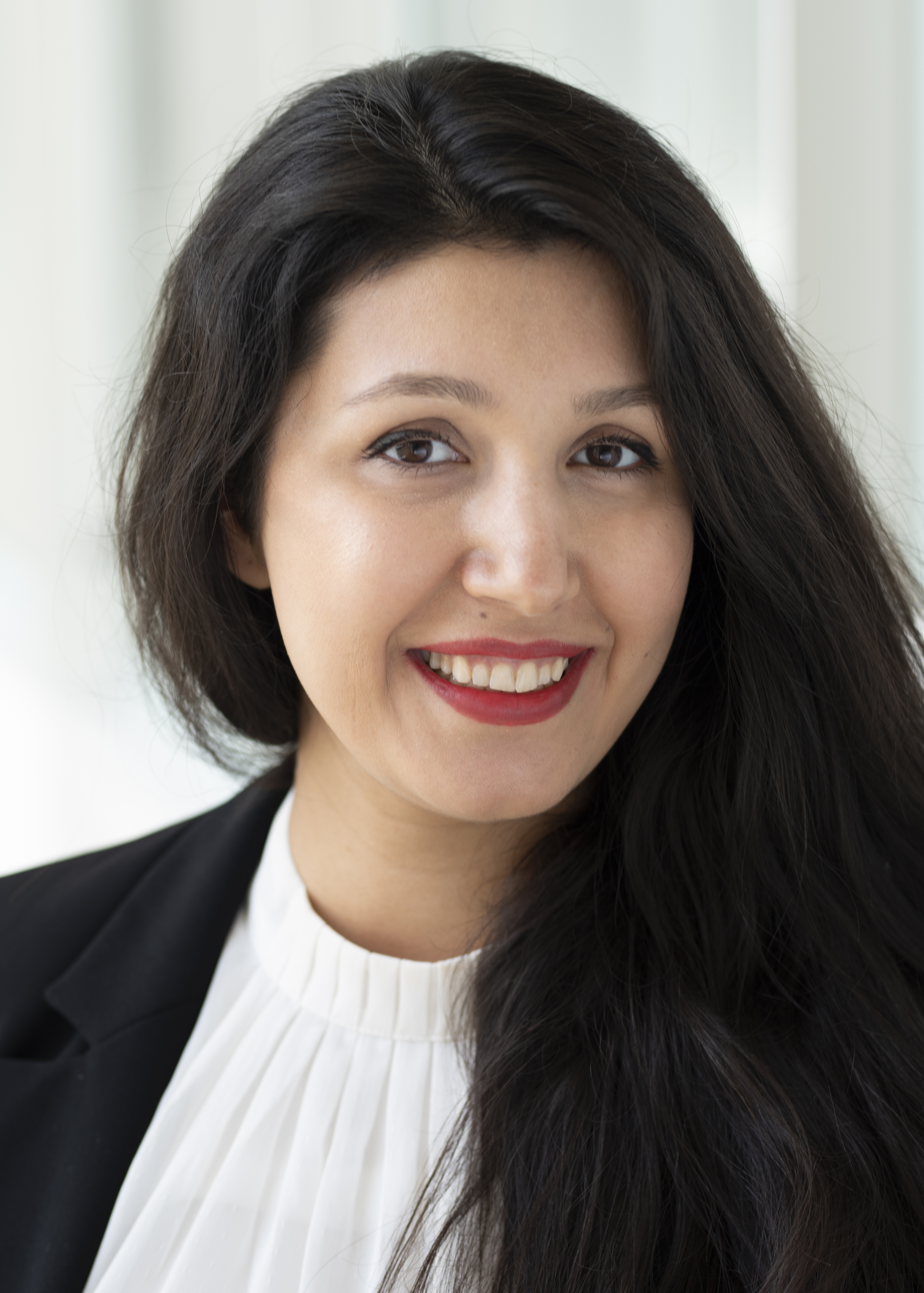
Henri Darmon is a Distinguished James McGill Professor in the Department of Mathematics and Statistics at McGill University, affiliated with the Centre Interuniversitaire en Calcul Mathématique Algébrique (CICMA) and the Centre de Recherches Mathématiques (CRM). He holds citizenships of Canada, France, and Switzerland. His research focuses on algebraic number theory, particularly elliptic curves, modular forms, and L-functions, with contributions to the Birch and Swinnerton-Dyer conjecture and Stark conjectures. Education: B.Sc. Mathematics & Computer Science, McGill University (1987) Ph.D. Mathematics, Harvard University (1991) Key Positions: Director of CICMA (1998–2024) Editorial roles at journals like Commentarii Mathematici Helvetici and Transactions of the AMS Organizer of major conferences including CNTA, ICM satellite events, and thematic programs at MSRI and CRM Research Interests: Stark-Heegner points and Euler systems p-adic L-functions and Iwasawa theory Arithmetic of modular curves and Shimura varieties His work bridges analytic and algebraic approaches to number theory, emphasizing computational and geometric methods.
Bilal Farooq is an Associate Professor and Program Director for the Master of Engineering in Interdisciplinary Engineering (MEIE) at Toronto Metropolitan University, holding the Canada Research Chair in Disruptive Transportation Technologies and Services within the Department of Civil Engineering. His educational background includes a PhD from the University of Toronto (2011), MASc from Lahore University of Management Sciences (2004), and BSc from the University of Engineering and Technology (2001). Dr. Farooq's research pioneers disruptive transportation solutions through cyber-physical systems, AI/machine learning applications, behavioral modeling, and optimization techniques. His work specifically targets on-demand multimodal systems, sustainable urban transportation, urban air mobility, automated vehicles, and extended reality applications, addressing critical urban mobility challenges with human-centered approaches. Analysis of his recent publications reveals a strong trend toward quantum-enhanced computational methods, privacy-preserving federated learning frameworks, and sustainability-focused decarbonization strategies across transportation domains, with increasing emphasis on human factors and real-world implementation. Notable scientific awards include: Ontario Early Researcher Award (2018) Canada Research Chair (2017) MassMotion Academic Pedestrian Modelling Project of the Year (2016) Québec Early Researcher Award (2014) Dr. Farooq actively supervises graduate students and secures significant research funding through his Canada Research Chair position and Early Researcher Awards. He directs the Laboratory of Innovations in Transportation (LiTrans), which develops interdisciplinary solutions integrating mathematics, engineering, computer science, and economics to address emerging transportation challenges. LiTrans focuses on disruptive transportation technologies, complete streets design, cyber-physical systems, pedestrian dynamics, resilience, and climate change impacts, collaborating with industry and government partners to translate research into practical urban mobility innovations for smart cities worldwide.
Stephen A. Vavasis is a Professor in the Department of Combinatorics and Optimization at the University of Waterloo, part of the Faculty of Mathematics. He holds a PhD in Computer Science from Stanford University (1989) and has held academic positions at Cornell University (1989–2006) before joining Waterloo. His research focuses on continuous optimization, data science, first-order methods, scientific computing, and computational mechanics. Current teaching includes courses on convex optimization and portfolio optimization methods. He has served as Associate Dean of Computing (2017–2020) and Interim Director of Data Science graduate programs. His work is supported by NSERC grants. Notable awards include the Hertz Fellowship, Churchill Scholarship, and Guggenheim Fellowship. Vavasis's research emphasizes applications of optimization to clustering, machine learning, and fracture mechanics. His publications span convex optimization frameworks, algorithmic analysis of gradient methods, and numerical methods in mechanics. Recent work explores unifying analyses of first-order optimization algorithms and robust optimization techniques for high-dimensional data problems.
Golnoosh Farnadi is an Assistant Professor at McGill University's School of Computer Science and an Adjunct Professor at the University of Montréal. She serves as a Visiting Faculty Researcher at Google, a Core Academic Member at MILA (Quebec Institute for Learning Algorithms), and holds a prestigious Canada CIFAR AI Chair. Farnadi co-directs McGill's Collaborative for AI & Society (McCAIS) and founded the EQUAL Lab (EQuity & EQuality Using AI and Learning algorithms), which focuses on advancing algorithmic fairness and responsible AI. Her educational background includes a Ph.D. in Computer Science from KU Leuven and Ghent University (2017), with postdoctoral research at the University of Montreal/MILA (2018-2020) and the University of California, Santa Cruz (2017-2018). During her doctoral studies, she was a visiting scholar at UCLA, University of Washington, Tsinghua University, and Microsoft Research. Dr. Farnadi's research centers on developing mathematical tools and algorithms for fairness-aware machine learning systems. Her work addresses bias and discrimination in AI decision-making across critical domains including healthcare, criminal justice, financial services, and social media. She has pioneered approaches to ensure fairness in deep learning models, particularly in sequential decision-making under uncertainty. Her research bridges theoretical foundations with practical applications, examining how AI systems can be designed to promote equity while maintaining performance. Analysis of her recent publications reveals a strong focus on practical implementations of fairness mechanisms across diverse AI applications. Her work spans technical domains from generative models and large language models to recommender systems and healthcare optimization. A unifying theme is the development of mathematically rigorous frameworks that balance performance with fairness considerations, with increasing attention to cultural diversity in multilingual AI systems and privacy-preserving fairness approaches. Google Scholar Award (2021) Facebook Research Award (2021) Rising Stars in AI Ethics (2021) Google Award for Inclusion Research (2023) WAI Responsible AI Leader of the Year Finalist (2023) 100 Brilliant Women in AI Ethics (2023) Canada CIFAR AI Chair Dr. Farnadi advises numerous doctoral and master's students across McGill University, University of Montréal, and MILA, with research focusing on fairness, privacy, and responsible AI. Her EQUAL Lab brings together researchers from computer science, social sciences, and policy domains to address systemic challenges in AI ethics. She has secured significant research funding from Google and other major organizations to support her work on fairness-aware AI systems, with applications spanning healthcare, social media safety, and public policy. The EQUAL Lab serves as a hub for interdisciplinary research on algorithmic fairness, bringing together computer scientists, social scientists, and policy experts. The lab's work spans theoretical foundations of fairness metrics, practical implementations in real-world systems, and policy recommendations for responsible AI deployment. Current projects include developing frameworks for fair kidney exchange programs, mitigating cultural stereotypes in multilingual language models, and creating privacy-preserving approaches for detecting online harms while protecting user data.
Dr. Limin Jao is an Associate Professor in the Department of Integrated Studies in Education (DISE) at McGill University’s Faculty of Education. Her research focuses on exemplary teaching practices in mathematics and STE(A)M education, emphasizing interdisciplinary approaches, project-based learning, and student engagement. She holds leadership roles including Vice-President of the Canadian Mathematics Education Study Group and Editorial Board member of the Canadian Journal of Science, Mathematics, and Technology Education. Her expertise spans teacher education, pedagogy, and research-practice partnerships. Education: Ph.D., Curriculum Studies and Teacher Development, Ontario Institute for Studies in Education, University of Toronto M.A., Curriculum Studies and Teacher Development, OISE, University of Toronto B.Ed., Secondary Biology and Mathematics Education, Queen's University B.Sc.H., Biology and Mathematics, Queen's University Research Interests: Limin explores how interdisciplinary and inquiry-based methods foster student engagement and teacher development. Her work bridges theory and practice, advocating for inclusive classrooms and educator collaboration. She has pioneered projects linking community artifacts to STEM learning and co-edited volumes on transdisciplinary education and teacher training borders. Publications Trends: Recent work examines gender perspectives in mathematics, pre-service teacher experiences, and professional learning communities in STEM. Her research emphasizes equity, pedagogical innovation, and the intersection of cultural contexts with educational practices. Awards: 2023 Award for Distinguished Teaching, McGill University Faculty of Education Advising & Grants: Limin supervises graduate students in mathematics education and collaborates on research-practice initiatives. She leads the Jao Research Team and contributes to the Chandaria Research Centre’s advisory board at Branksome Hall. Labs/Teams: The Jao Research Team focuses on innovative teaching strategies and STE(A)M education, with projects addressing student agency and interdisciplinary curriculum design.
Patrick Allen is an Associate Professor in the Department of Mathematics and Statistics at McGill University, where he contributes to research in number theory and related fields. He is affiliated with the Montreal Number Theory Group and the Centre Interuniversitaire en Calcul Mathématique Algébrique (CICMA), focusing on areas such as Galois representations, automorphic forms, and algebraic number theory. His work bridges algebraic geometry and arithmetic, with a particular emphasis on modularity lifting theorems and deformation theory. Allen's research interests include the study of CM fields, modular forms, and elliptic curves, alongside investigations into the Langlands program and p-adic methods. He has published extensively on topics such as potential automorphy, monodromy, and adjoint Selmer groups. His contributions address questions in arithmetic algebraic geometry and cohomological automorphic forms, often intersecting with representation theory. While his articles span over 20 years, recent work (2020–2023) emphasizes the modularity of Galois representations over CM fields and the application of automorphic techniques to solve problems in number theory. Allen’s research often involves collaboration with international experts in algebraic number theory and arithmetic geometry. Scientific Awards: None explicitly listed in the provided materials. Advising & Grants: No formal advisees or grant details are listed in the text. His affiliations with CICMA suggest participation in collaborative research initiatives, though specific grants are not mentioned. Labs/Teams: Active member of the Montreal Number Theory Group and CICMA, contributing to inter-university collaborative projects in algebraic number theory.
Jason Foster is an Assistant Professor at the Faculty of Engineering, University of Toronto, specializing in Engineering Education and Philosophy of Engineering . His work bridges rigorous academic inquiry with practical applications in engineering pedagogy. His research focuses on Research Through Design , aiming to redefine how design and education intersect. Key projects include analyzing the utility of design tools in small enterprises, developing coherent engineering requirements models, and creating open-source lab equipment for budget-constrained institutions. Recent publications highlight trends in engineering education, such as integrating multidisciplinary design, flexible project planning, and addressing intersubjective grading dynamics. His work emphasizes interdisciplinary collaboration, sustainable development, and systems thinking in curricula. He supervises graduate students through a junior colleague/collaborator model, prioritizing adaptability and critical engagement. No awards or formal honors are mentioned in the provided texts.
Samia Khan is a Professor in the Department of Curriculum & Pedagogy at the University of British Columbia's Faculty of Education, where she also serves as Associate Dean of Research. Her academic work bridges educational technology, science education, and teacher preparation across K-16 contexts. Dr. Khan earned her PhD from the University of Massachusetts. Her educational background informs her interdisciplinary approach to learning sciences and technology integration. Her research centers on how digital technologies transform science learning , with emphases on model-based teaching , visualization tools , and equitable participation in STEM . She investigates simulation technologies, future-state modeling, and strategies to broaden science engagement through interpretive and mixed-methods research. Her work particularly examines teacher epistemologies, scientific reasoning development, and socio-cultural factors in technology-mediated learning environments. Analysis of her recent publications reveals three dominant trends: (1) International comparative studies of science curricula across Southeast Asia, (2) Efficacy of digital tools (PhET, GeoGebra, Symbolab) in conceptual understanding, and (3) Pre-service teacher development in model-based science instruction. Her research spans diverse contexts from Canadian classrooms to Rwandan and Vietnamese educational settings. Dr. Khan's contributions have been recognized through: New Scholar Award from the Canadian Society for Study in Education Prime Minister’s Award of Canada for Teaching Excellence in Science, Technology, and Mathematics As former MET Director (2021-2022) and author of foundational courses ETEC 530/533, she has significantly shaped UBC's educational technology programs. Her Faculty Associate role at the Institute of Resources, Environment, and Sustainability demonstrates cross-disciplinary engagement with sustainability education. Her research appears in leading journals including Journal of Technology and Teacher Education, Computers and Education, and Educational Technology Research and Development, with consistent citation as field-shaping work in educational technology.
Pourang Irani is a Professor and Principal’s Research Chair in Ubiquitous Analytics at the University of British Columbia (Okanagan campus), within the Irving K. Barber Faculty of Science’s Department of Computer Science, Mathematics, Physics and Statistics. Previously, he served at the University of Manitoba for 19 years as a faculty member and Acting Associate Dean of Science. His research focuses on Human-Computer Interaction (HCI), Wearable Computing, and Information Visualization, with an emphasis on designing interactive systems for 'anytime, anywhere' sensemaking using emerging technologies like mixed reality and smart devices. He leads interdisciplinary projects such as the NSERC CREATE grant on Visual and Automated Disease Analytics, training data scientists in health analytics. Education: PhD in Computer Science (University of New Brunswick, 2002), supervised by Dr. Colin Ware. Research Interests: Wearable interfaces (smartwatches, smartrings, and AR/VR) Data visualization for health and pervasive systems Persuasive health technologies and data storytelling Mid-air and hands-free interaction techniques Embodied interaction through social robots Recent Work Trends: Articles emphasize innovations in smartwatch interaction (e.g., bezel-to-bezel gestures), tactile visualizations via skin-dragging, and voice assistant-driven health data queries. Projects like Databiting explore transient personal data exploration, while Data Videos focus on narrative-driven health communication. Grants & Leadership: Principal Investigator of NSERC CREATE Visual and Automated Disease Analytics program. Co-leads UBCO’s Digital Transparency cluster. Active in interdisciplinary teams addressing health informatics and HCI challenges. Labs & Teams: Leads a lab developing prototypes in wearable computing, spatial analytics, and immersive technologies. Collaborates with researchers in medicine, engineering, and data science to translate HCI innovations into practical solutions.
Gautam Kamath is an Assistant Professor at the University of Waterloo's Cheriton School of Computer Science, a Faculty Member at the Vector Institute, and a Canada CIFAR AI Chair. He leads The Salon, a research group focused on statistics, algorithms, machine learning, and optimization. His work bridges theoretical foundations with practical applications in data privacy and robustness, contributing to both academic research and real-world deployments that impact millions of users. Dr. Kamath earned his PhD and SM degrees in Electrical Engineering and Computer Science at MIT, where he was advised by Costis Daskalakis. Prior to MIT, he graduated from Cornell University in May 2012 with a degree in Computer Science and Electrical and Computer Engineering, where he worked with Bobby Kleinberg. His academic journey reflects a strong foundation in both theoretical computer science and practical applications. His research focuses on developing solutions for trustworthy and reliable machine learning and statistics, with particular emphasis on data privacy and robustness. He addresses fundamental problems in these areas, revitalizing statistical toolkits for the modern data era where privacy preservation is paramount. His work spans theoretical foundations of differential privacy to practical applications that have been deployed at scale, including contributions to systems that protect the sensitive information of hundreds of millions of individuals. Analysis of his recent publications reveals a strong trend toward addressing the interplay between privacy, robustness, and machine learning performance. His work increasingly examines practical deployment challenges while maintaining theoretical rigor, with growing emphasis on diffusion models, generative AI, and the legal implications of AI systems. There's a clear trajectory from foundational privacy theory toward addressing real-world implementation challenges across diverse application domains. Canada CIFAR AI Chair Ontario Early Researcher Award 2024 Caspar Bowden Award for Outstanding Research in Privacy Enhancing Technologies STOC Best Student Presentation Award ICML 2024 Best Paper Award Microsoft Research Fellow at the Simons Institute for the Theory of Computing Dr. Kamath actively mentors students, with notable successes including Valentio Iverson winning the Germain-Erdős Undergraduate Award and Chris Trevisan receiving the CRA Outstanding Undergraduate Researcher Award. His service to the research community is extensive, serving as Editor-in-Chief of TMLR, on the Executive Committee of the Learning Theory Alliance, and on steering committees for major conferences including ICML, COLT, and ALT. He has organized numerous workshops focused on privacy-preserving machine learning and differential privacy. Through The Salon research group, Dr. Kamath fosters a collaborative environment where postdoctoral fellows, graduate students, and undergraduates work together on cutting-edge problems at the intersection of statistics, algorithms, machine learning, and optimization. The group maintains strong connections with industry partners and participates in major research initiatives, including the Vector Institute's privacy and security research efforts. Looking forward, Dr. Kamath will be moving to the Computer Science department at NYU's Courant Institute of Mathematical Sciences in September 2026, where he plans to expand his research program.
Yuri Levin is a Professor at the Smith School of Business, Queen’s University, where he holds the Stephen J.R. Smith Chair of Analytics and serves as Founding Executive Director of the Smith School of Business Analytics and AI. He also leads the Scotiabank Centre for Customer Analytics. His research focuses on Analytics & AI, with expertise in revenue management, dynamic pricing, and strategic consumer behavior. Levin holds a Ph.D. in Operations Research from Rutgers University and degrees in Economics and Applied Mathematics from Belarus State University. Levin’s academic contributions include co-winning the 2013 INFORMS Revenue Management and Pricing Practice Prize and the 2009 INFORMS COIN-OR Cup. He has advised companies like Scotiabank, Loblaws, and McDonald’s on pricing strategies and consumer analytics. As an Associate Editor of Operations Research , he shapes academic discourse in operations research and pricing strategies. Education: Ph.D. in Operations Research, RUTCOR, Rutgers University (2001) B.S. in Economics, Belarus State University (1998) M.S. (Honours) in Applied Mathematics, Belarus State University (1998) His research explores dynamic pricing models under social influence, strategic consumer behavior, and revenue management in hospitality and retail industries. He has pioneered methodologies for optimizing pricing strategies in networked markets and developed algorithms for cargo capacity management. Awards: 2010 Queen’s School of Business Award for Research Achievement 2003 New Researcher Achievement Award Levin’s teaching spans MBA, Master of Management Analytics (MMA), and executive education programs, covering analytical decision-making and pricing optimization. His advisory work includes roles as a Visiting Professor at the Skolkovo Moscow School of Management and the University of Cambridge’s Judge School of Business.
Brian Leung is an Associate Professor at McGill University, jointly affiliated with the Department of Biology and the Bieler School of the Environment . He holds the prestigious UNESCO Chair for Dialogues on Sustainability and serves as Director of the McGill Neotropical Environment Option (NEO) , a collaborative program with the Smithsonian Tropical Research Institute. His work bridges ecological theory, computational modeling, and environmental policy. Dr. Leung earned his PhD in Biology from Carleton University and completed postdoctoral research at the University of Cambridge and the University of Notre Dame. His academic journey at McGill began in 2004 as an Assistant Professor, advancing to Associate Professor in 2010. His research centers on predictive ecology , particularly modeling biological invasions and sustainability challenges . He develops and applies mathematical, statistical, and computational models to understand invasion dynamics across terrestrial, aquatic, and marine systems. His recent work includes the Panama Research and Integrated Sustainability Model (PRISM) , a spatially explicit framework for sustainability science in the Global South. His research spans scales from local to global and integrates ecological, economic, and social factors. His recent publications show a strong focus on invasion risk assessment , species distribution modeling , economic costs of invasions , and ecological forecasting . He frequently publishes in top journals such as Nature , Ecology Letters , and Global Ecology and Biogeography , emphasizing data-driven decision-making and policy relevance. Dr. Leung has received significant recognition through invitations to contribute to major reports and has co-edited influential works on invasive species economics. While specific named awards are not listed, his leadership roles and publication record reflect high scientific esteem. He actively mentors a dynamic research group, supervising multiple Ph.D. and M.Sc. students on projects related to invasion modeling, mangrove conservation, forest pest dynamics, and urban ecology. His lab emphasizes quantitative skills and interdisciplinary collaboration. He has secured research funding to support these projects, though specific grants are not detailed in the text. He leads the Leung Lab , which focuses on predictive modeling in ecology and sustainability. The lab collaborates with institutions such as the Smithsonian Tropical Research Institute and environmental firms like Habitat. Current projects include multi-species connectivity modeling, mangrove ecosystem services, and forecasting forest pest outbreaks.
Alexander Summers is an Associate Professor at the Department of Computer Science , University of British Columbia . He joined UBC in March 2020 after serving as a Senior Researcher (Oberassistent) at ETH Zurich from 2014-2020. His research bridges Programming Languages , Formal Methods , and Software Engineering , with a focus on automated verification tools for heap-based and concurrent programs. MSc Joint Mathematics and Computer Science, Imperial College London (2004) PhD Computer Science, Imperial College London (2009) Postdoc, ETH Zurich (2009-2014) Summers leads the Prusti Project , developing deductive verification tools for Rust, and contributes to the Viper Project for intermediate verification languages. His work addresses challenges in: Memory safety and concurrency verification Ownership models and aliasing control Automated reasoning with SMT solvers Resource-oriented programming specifications Debugging verification condition quantifiers Formal validation of verification infrastructure His research has been recognized with a Amazon Research Award and ACM SIGPLAN Distinguished Paper Awards . He teaches courses like Advanced Software Engineering and Program Verifiers and Program Verification , and supervises graduate students in formal verification and Rust-related research.
Dr. Saeed Gazor is a full Professor in the Department of Electrical and Computer Engineering at Queen's University. He holds a cross-appointment in the Department of Mathematics and Statistics. His research focuses on signal processing applications in electrical energy systems, communications, and medical imaging. He has supervised postdoctoral fellows Babak Ghaffari and Yaser Esmaeili Salehani. Professional affiliations include Senior Member IEEE and membership in the Institution of Engineering and Technology. Education: PhD (1994) in Signal and Image Processing from Télécom ParisTech; M.Sc. (1989) and B.Sc. (1987) from Isfahan University of Technology with highest honors. Academic roles include former Assistant Professor at Isfahan University of Technology (1995–1998) and research associate at University of Toronto (1999). Research interests span detection theory, smart energy systems, hyperspectral imaging, and medical signal processing. Notable contributions include innovations in radar signal processing, sparse signal reconstruction, and adaptive filtering. Active in academic service, including editorial roles in IEEE journals. Awards: Professional Engineer designation from Professional Engineers Ontario. Over 200 peer-reviewed publications with recent focus on AI-driven hyperspectral analysis, robust beamforming, and energy-efficient communication systems. Labs/Teams: Leads signal processing research initiatives at Queen's, collaborating on projects involving smart energy grids, distributed radar networks, and biomedical signal analysis. Current work emphasizes integrating deep learning with traditional signal processing techniques.
Minyi Huang is a Professor in the School of Mathematics and Statistics at Carleton University. His research focuses on Mean Field Stochastic Control, Stochastic Algorithms in Multi-Agent Systems, and Wireless Networks. He holds a Ph.D. from McGill University (2003) and has held postdoctoral positions at the University of Melbourne and the Australian National University. Dr. Huang is a Fellow of IEEE and a Member of SIAM. Education: Ph.D. in Electrical and Computer Engineering, McGill University (2003) M.Sc. in Systems and Control, Chinese Academy of Sciences (Beijing) B.Sc. in Mathematics, Shandong University (Jinan, China) Research Interests: Huang's work centers on stochastic control, mean field games, and multi-agent systems. His contributions include theoretical advancements in mean field social optimization, graphon-based control frameworks, and applications in wireless networks and economic models. He has organized workshops on Mathematical Cybernetics and Stochastic Processes, fostering interdisciplinary collaboration. Scientific Awards: Fellow of the IEEE Advising & Grants: Huang has advised numerous graduate students on topics in stochastic control and mean field theory. His grants include funding for international PhD students through Carleton's initiatives. He collaborates on projects involving mean field models for production output and social dynamics. Labs/Teams: Associated with the Ottawa-Carleton Institute for Mathematics and Statistics (OCIMS), contributing to collaborative research in control theory and applied mathematics.