Oldřich Ulrych is a Lecturer in the Department of Mathematics at the Faculty of Mathematics and Physics, Charles University in Prague. He maintains his office at Karlín campus (Room K 387, 3rd floor, Sokolovská 83, Prague 8) and serves as a domain administrator for the department. His professional expertise spans information technology, computer networks, and specialized TeX systems. Ulrych teaches two specialized courses: Introduction to the Depths of TeX (NMIN267) during winter semesters and Selected Aspects of the UNIX Operating System (NMIN364) in summer semesters. His technical contributions include authoring a verbatim package for TeX in 1992 while affiliated with the Mathematical Institute of Charles University. Ulrych has maintained a consistent research and teaching focus on typesetting systems and operating environments, with particular emphasis on practical implementation of TeX macros and UNIX system administration. His work demonstrates deep technical knowledge in computer typography and network infrastructure. Consultation hours are arranged individually via email, reflecting his hands-on approach to student guidance in these specialized technical domains.
David W. Craig is an Associate Professor of Physics in the Department of Chemistry and Physics at West Texas A & M University's Paul Engler College of Agriculture and Natural Sciences. Since joining WTAMU in 2004, he teaches both introductory science courses for all majors and the most advanced physics courses offered. His academic background includes a B.S. in Physics from Rhodes College (1984), M.S. in Physics (Instrumentation Specialty) from New Mexico Institute of Mining and Technology (1988), and Ph.D. in Physics from University of Mississippi (1995), where he worked at the National Center for Physical Acoustics. Professional Interests Radio astronomy with the Undergraduate ALFALFA Team using Arecibo Observatory Optical astronomy focusing on small-scale variable stars Computational physics using Python and FORTRAN Mathematical typesetting with LaTeX Research Trends His research integrates observational astronomy with pedagogical innovation, emphasizing data compression principles in science and mathematical formalism. While specific publications aren't listed, his work gravitates toward radio astronomy data analysis and educational methodologies in physical sciences. Additional Contributions Former planetarium director at Delta State University (6 years) Created specialized teaching materials for advanced physics topics Developed computational resources for Sturm-Liouville equations and complex variable analysis Active in promoting algorithmic complexity as science education framework
Marcus Tressl is a Lecturer in Pure Mathematics at the University of Manchester , affiliated with the Department of Mathematics. His academic journey includes a PhD and habilitation from the University of Regensburg, and he has been active at Manchester since 2007. Research Interests: Mathematical Logic, Model Theory, O-Minimal Structures, Lattice Ordered Abelian Groups, Boolean Algebras, Differential Algebra, Spectral Spaces, Stone Duality, Commutative Algebra Recent Publications: Focus on distributive lattices, matrix rings, differentially large fields, and applications of model theory to algebraic structures. Teaching: Delivers Mathematical Logic (MATH33021) and supervises MSc projects (MATH61000) , emphasizing LaTeX and mathematical typesetting. Contributions: Authored a book on Spectral Spaces, co-edited proceedings on O-Minimal Structures, and developed resources for Gödel's Incompleteness Theorems, Gröbner Bases, and Neural Network Learning applications.
Dave Green is a researcher at the University of Cambridge's Department of Physics, associated with the Mullard Radio Astronomy Observatory (MRAO). His primary research focuses on supernova remnants, radio astronomy, and the interplay between active galactic nuclei and star clusters. He co-authored the book Historical Supernovae and their Remnants (2002), which explores historical records of supernovae and their modern astrophysical interpretations. Green is a leading contributor to the LeMMINGs survey, investigating nuclear activity in galaxies using multi-wavelength data. He also maintains LaTeX templates for thesis preparation, emphasizing accessibility and modern typesetting standards. His work includes cataloging over 300 Galactic supernova remnants and analyzing radio emissions from transient events like tidal disruption events (TDEs) and gamma-ray bursts (GRBs). Collaborations span international facilities such as the Arcminute Microkelvin Imager (AMI) and e-MERLIN, focusing on radio observations of cosmic phenomena. His research bridges historical astronomical records with cutting-edge observations, contributing to our understanding of stellar evolution and galactic dynamics.
Prof. Dr. Michael Kohlhase is a Professor in the Computer Science department at FAU Erlangen-Nürnberg and an Adjunct Associate Professor at Carnegie Mellon University . His work spans Computer Science and Formal Methods , focusing on Mathematical Knowledge Management (MKM), Knowledge Representation , and Natural Language Processing (NLP) in STEM domains. He leads the KWARC (Knowledge Adaptation and Reasoning for Content) research group, driving projects like OMDoc , sTeX , and MathHub . His research emphasizes modular logical foundations for mathematical knowledge and large-scale document corpora analysis, with applications in computer-supported education and semantic document systems . Collaborations include extended visits to institutions such as SRI International , University of Amsterdam , and University of Edinburgh . Key projects include developing scalable module systems for formal mathematics, theory graph models for knowledge integration, and mathematical search engines like MathWebSearch . His work bridges formal logic with practical software systems , ensuring interoperability across proof assistants , computer algebra systems , and educational tools .
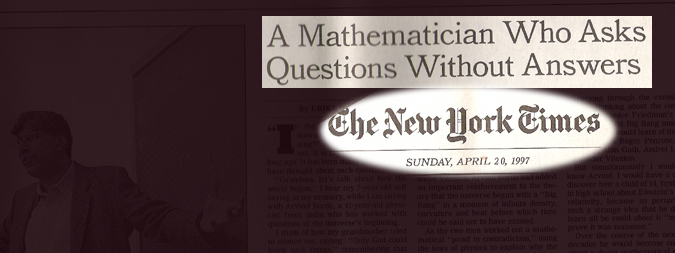
Arvind Borde is a Senior Professor of Mathematics and Physics at Long Island University, Post campus, where he also serves as Graduate Co-Director in the Department of Mathematics. He is affiliated with the College of Liberal Arts and Sciences and has made significant contributions to mathematical physics, particularly in relativity, cosmology, and topology. His work has had international recognition, including citations at Stephen Hawking's 60th birthday symposium and features in Nature . B.S., Bombay University M.A., Ph.D., Stony Brook University His research focuses on foundational questions in theoretical physics: whether the universe had a beginning, its global shape, and the nature of energy in spacetime. He is best known for the BGV theorem (with Guth and Vilenkin), which proves that inflationary models cannot be past-complete, suggesting a cosmic beginning. His work uses abstract mathematical methods pioneered by Penrose, Hawking, and Geroch to derive general results about spacetime structure. In addition to physics, Borde has deep expertise in computer science, especially in the TeX typesetting system, having authored multiple books and software tools. More recently, he has explored design and food history, co-authoring a biography of ceramic artist Eva Zeisel. The 15 most recent publications reflect a sustained engagement with cosmology, general relativity, and mathematical physics, with key themes including initial singularities, energy conditions, topology change, and baby universes. Later works also highlight his contributions to computing and digital document design, showing a unique interdisciplinary trajectory. Notable scientific awards include: Trustees Award for Scholarly Achievement (1995/96, single work) Trustees Award for Scholarly Achievement (2005, lifetime achievement) KITP Scholar, Kavli Institute for Theoretical Physics, UC Santa Barbara (2007–2009) He has advised graduate students in physics and mathematics and secured grants supporting advanced computing infrastructure, including founding the Southampton College Technology Center. He has held visiting positions at MIT, Tufts University, Brookhaven National Lab, and UC Santa Barbara. His outreach includes establishing a computer museum at LIU Post and contributing to public discourse through media features in The New York Times , Newsday , and the Boston Globe . Borde leads interdisciplinary research initiatives combining physics, computing, and design. He founded the advanced computing facility at Southampton College and maintains an active research group exploring quantum gravity, cosmology, and digital publishing technologies.
Bernd Schroeder serves as Professor and Program Chair at Louisiana Tech University, where he has been an active MERLOT member since November 5, 2000. His institutional affiliation spans contributions to 16 submitted materials, 2 authored materials, 14 comments, 1 learning exercise, and 1 bookmark collection within the MERLOT repository. His research expertise focuses on Discrete Mathematics, particularly ordered sets with emphasis on the reconstruction problem and fixed point property. He also maintains significant work in Calculus, Differential Equations, and Statistics, specializing in developing integrated engineering and science curricula for freshman/sophomore years. His educational methodology prioritizes active, cooperative, and technology-supported learning environments with specific innovations in calculus visualization techniques. As a recognized speaker, he addresses faculty development topics including mathematics-engineering-science interdisciplinary connections, curriculum design for early undergraduate years, and professional typesetting standards for academic materials.