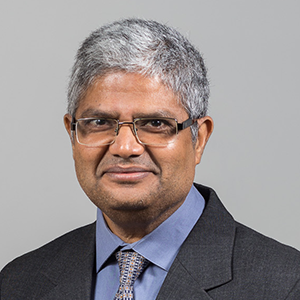
Daniel Louis Jafferis is a tenured professor of physics at Harvard University, renowned for his contributions to quantum gravity, supersymmetric quantum field theory, and string theory. His groundbreaking work includes the AdS-CFT correspondence for N=6 Chern-Simons theory and the formulation of the F-theorem in three-dimensional supersymmetric systems, as well as co-discovering traversable wormhole solutions equivalent to quantum teleportation protocols. Education: Bachelor's degree in Mathematics and Physics from Yale University (2001) PhD in Physics from Harvard University (2007), supervised by Cumrun Vafa Jafferis's research spans topological string theory, supersymmetric localization, and holography. His 2008 work with Aharony, Bergman, and Maldacena established foundational connections between M2-branes and AdS 4 ×S 7 gravity duals, while his 2016 work with Gao and Wall demonstrated wormholes without exotic matter. His 2012 New Horizons in Physics Prize recognized these insights into quantum information and gravity. Scientific Awards: Henry Primakoff Award (2012) New Horizons in Physics Prize (2019) Jafferis's recent publications focus on quantum teleportation, AdS-CFT correspondence, and supersymmetric field theories, with key themes including free energy minimization, entanglement entropy, and holographic dualities. His career includes postdoctoral research at Rutgers University (2007-2010) and temporary membership at the Institute for Advanced Study (2010-2011).
Clay Córdova is an Associate Professor at the University of Chicago, associated with the Enrico Fermi Institute, James Franck Institute, Kadanoff Center, and Kavli Institute. His research focuses on theoretical physics, particularly quantum field theory, non-invertible symmetries, and their applications in particle and condensed matter physics. Córdova’s work explores topological phases, gauge theories, and string theory, with recent contributions to non-invertible symmetry classification and their role in phase transitions. His research interests include categorical symmetries, topological defects, and anomaly matching in quantum field theories. He has pioneered studies on soliton-particle degeneracies, anyon condensation mechanisms, and anomalies in non-invertible symmetry frameworks. Córdova’s work bridges high-energy physics with condensed matter systems, often employing advanced mathematical techniques from category theory and algebraic topology. His 2023 Sloan Research Fellowship highlights recognition of his contributions. Key research trends span non-invertible symmetries across dimensions, topological field theory applications, and interdisciplinary methods combining machine learning with lattice gauge theory. Current projects include exploring duality defects, gapped phase obstructions, and symmetry-enriched phases in (3+1)D systems.
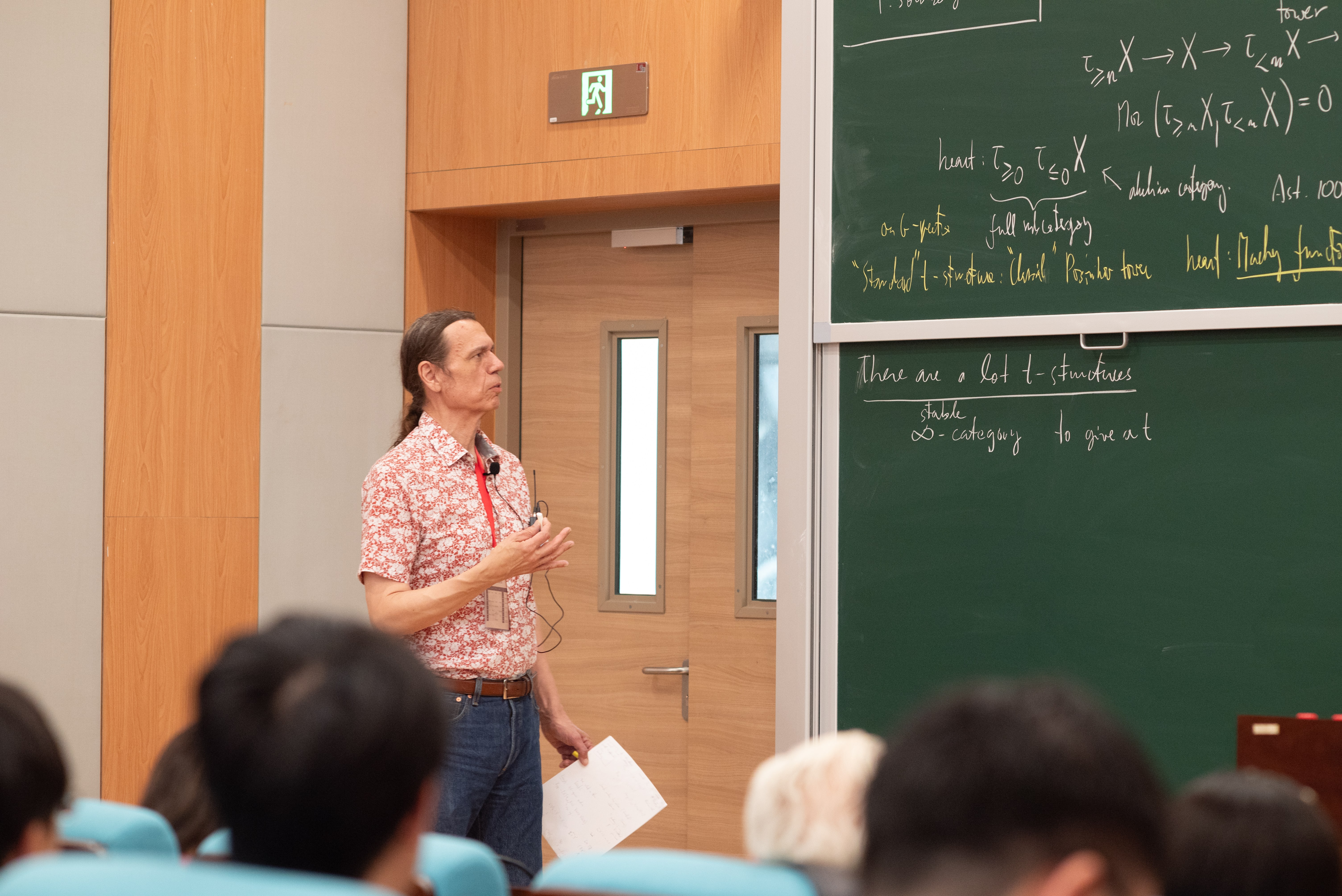
Igor Kriz is a Professor of Mathematics at the University of Michigan, specializing in algebraic topology. He is affiliated with the Department of Mathematics within the College of Literature, Science, and the Arts (LSA). His research focuses on advanced topics in algebraic topology, particularly stable homotopy theory and related areas. Kriz received his Ph.D. from Charles University in 1988. His academic journey has led him to become a prominent researcher in algebraic topology, with significant contributions to the field over several decades. Professor Kriz's primary research interests lie in algebraic topology , which studies topological spaces through algebraic invariants. He specializes in equivariant stable homotopy theory, Mackey functors, cobordism, and motivic homotopy theory . His work involves calculations of stable homotopy groups and other generalized homology theories, including Morava K-theories of classifying spaces of finite groups. He has made significant contributions to the study of operads and structures up to homotopy, with applications extending to differential geometry and physics, particularly string theory. His research often bridges multiple mathematical disciplines, creating connections between topology, algebra, and geometry. His recent publications (2022-2025) demonstrate a strong focus on equivariant topology and its connections to algebraic structures. Kriz frequently collaborates with researchers like P. Hu, P. Somberg, and others, producing work that explores the intersection of homotopy theory with representation theory and algebraic geometry. His research program shows consistent evolution from foundational work in stable homotopy to more recent applications in motivic contexts and topological Hochschild homology. Professor Kriz teaches both undergraduate and graduate courses at the University of Michigan. His teaching portfolio includes Math 425 (Introduction to Probability), Math 592 (Introduction to Algebraic Topology), and advanced graduate courses Math 695 and Math 696 (Algebraic Topology I and II). His course materials are regularly updated, reflecting his commitment to education in mathematical topology. Based in East Hall (room 3846) at the University of Michigan, Professor Kriz maintains an active research program while contributing to the academic community through teaching and mentorship. His work continues to advance our understanding of complex topological structures and their algebraic representations.
Emil Bjerrum-Bohr is an Associate Professor at the Niels Bohr Institute, University of Copenhagen, where he holds a position in the Theoretical high energy, astroparticle and gravitational physics department within the Faculty of Science. He is also affiliated with the Niels Bohr International Academy and leads the Computations of Amplitudes Group as a Lundbeck Foundation Junior Group Leader. Dr. Bjerrum-Bohr's research focuses on theoretical particle physics with particular emphasis on amplitude analysis and computations. His primary fields of research include amplitude analysis and computations, amplitudes and string theory, and quantum gravity. His current research explores relations between amplitudes from string theory and computation of amplitudes in Quantum Chromodynamics (QCD) for use at the Large Hadron Collider (LHC) at CERN. He has made significant contributions to understanding scattering equations and effective field theory in the context of gravitational physics. His recent publication record demonstrates a strong focus on gravitational scattering amplitudes, quantum gravity, and connections between string theory and particle physics. A notable trend in his research is the application of amplitude techniques to gravitational physics, particularly in the post-Minkowskian expansion framework which has implications for gravitational wave astronomy and black hole physics. His work bridges theoretical concepts with practical applications for collider physics. Scientific awards: Lundbeck Foundation Junior Group Leader As a Lundbeck Foundation Junior Group Leader, Dr. Bjerrum-Bohr oversees the Computations of Amplitudes Group, where he mentors junior researchers and collaborates with international colleagues on cutting-edge theoretical physics problems. His research has involved organizing academic meetings including the "Current Themes in High-Energy Physics and Cosmology" series (2013-2015) and Nordic Winter Schools on Cosmology and Particle Physics (2013, 2015). His work is conducted within the vibrant theoretical physics environment of the Niels Bohr Institute, which provides access to computational resources and collaborative opportunities with both experimental and theoretical physicists across multiple disciplines.
Professor Keshav Dasgupta holds the position of Professor in Physics at McGill University since March 2021. His academic journey includes a MSc from the Indian Institute of Technology, Delhi and a PhD from the Tata Institute of Fundamental Research, Mumbai. Postdoctoral research followed at the Institute for Advanced Study (Princeton, USA) and Stanford University (USA). He transitioned to faculty roles at McGill starting as an Assistant Professor (2005-2010), then Associate Professor (2010-2021), and currently as a full Professor. His research interests span Superstring Theory (focusing on flux compactifications and gauge/gravity dualities), String Cosmology (exploring de Sitter spaces and primordial phenomena), Quantum Field Theories (confinement dynamics in thermal QCD), and Mathematics (non-Kähler manifolds and Lie group applications in string theory). He also investigates Knot Theories within M-theory frameworks. Recent work emphasizes de Sitter vacua in string theory, leveraging Glauber-Sudarshan states and confronting swampland conjectures. His publications address topics like holographic QCD, quantum gravity equations, and non-perturbative string solutions. He teaches advanced courses such as PHYS 562: Electromagnetic Theory (Winter 2023).
Marco Castronovo serves as an Assistant Professor in the Mathematics Department at Columbia University, with his office located in Mathematics Hall 614. His academic work bridges continuous and discrete mathematical structures through the lens of symplectic geometry and topology. His research focuses on Symplectic Topology , particularly exploring symplectic structures as frameworks for quantization of classical invariants. Key interests include: Developing open-string versions of Schubert calculus Investigating cluster structures in positroid varieties Constructing Landau-Ginzburg models for Grassmannians Studying Lagrangian cobordisms and exotic tori Analyzing connections between Dubrovin spectra and Fukaya algebras His recent publications reveal a consistent trajectory toward unifying symplectic geometry with combinatorial algebraic structures, particularly through Grassmannian varieties and their mirror symmetric counterparts. The work demonstrates increasing sophistication in connecting Fukaya categories with cluster algebraic frameworks, while maintaining strong ties to quantum topological invariants. As an academic mentor, Castronovo supervises undergraduate researchers including B. Basson (Barnard Summer Research Institute) and S. Kesavan (Columbia Summer Research Fellowship). He actively contributes to the mathematical community through refereeing and co-organizing the Columbia SGGTC Seminar, demonstrating commitment to both research dissemination and academic service. His computational work manifests through three significant open-source projects: Posetroids for exploring Zariski closure orders in Grassmannians, DubrovinDynamics for visualizing spectral evolution in truncated Dubrovin operators, and ClusterExplorer for conducting random walks on cluster structures of Grassmannians. These tools have become valuable resources for researchers working at the intersection of symplectic geometry and combinatorics.
Alfred O. Hero, III is the John H. Holland Distinguished University Professor of Electrical Engineering and Computer Science and the R. Jamison and Betty Williams Professor of Engineering at the University of Michigan, Ann Arbor. He is currently on leave from the University of Michigan as a Program Director in the CISE Directorate at the National Science Foundation. His primary appointment is in the Department of Electrical Engineering and Computer Science (EECS), with secondary appointments in the Department of Biomedical Engineering and the Department of Statistics. He is also affiliated with the UM Center for Computational Medicine and Bioinformatics (CCMB), the UM Graduate Program in Applied and Interdisciplinary Mathematics (AIM), the UM Applied Physics Program, and the Michigan Institute for Data Science (MIDAS), which he co-founded from 2015-2018. Hero's research focuses on data science, developing theory and algorithms for multimodality data collection, fusion, analysis and visualization that use statistical machine learning and distributed optimization. His work has applications in wearable technologies for personalized health and predictive medicine, spatio-temporal networks in biology, climate, and social discourse, anomaly detection, and data analysis for international security. His recent research interests include high dimensional spatio-temporal data analysis, multimodal data integration, statistical signal processing, and machine learning, with particular emphasis on predictive mathematical models for biological and physical sciences, social networks, network security and forensics, and personalized health and disease. His recent publications demonstrate a strong focus on high-dimensional statistical methods, contrastive learning, neural network optimization, change detection in temporal graphs, and applications in microbiome analysis and epidemic modeling. The research spans theoretical foundations in information theory and statistical learning while addressing practical applications across multiple domains. Scientific Awards: IEEE Signal Processing Society Best Paper Award (1998) Best Original Paper Award from Journal of Flow Cytometry (2008) Best Magazine Paper Award from IEEE Signal Processing Society (2010) SPIE Best Student Paper Award (2011) IEEE ICASSP Best Student Paper Award (2011) IEEE Signal Processing Society Technical Achievement Award (2014) IEEE Signal Processing Society Society Award (2015) IEEE Fourier Award (2020) University of Michigan Distinguished Faculty Achievement Award (2011) Hero has advised over 60 PhD students and 30 postdocs in areas including modeling, computation, and inference for large scale time varying data in the biosciences. He has received significant research funding from the Department of Energy, Army Research Office, Air Force Office of Scientific Research, and National Science Foundation. He has held leadership positions including President of the IEEE Signal Processing Society (2006-2007), Director of Division IX (Signals and Applications) on the IEEE Board of Directors (2009-2011), and Chair of the Committee on Applied and Theoretical Statistics of the US National Academies (2018-2020).
Sergei Gukov is the John D. MacArthur Professor of Theoretical Physics and Mathematics at the California Institute of Technology (Caltech), where he has been a faculty member since 2005. He serves in the Division of Physics, Mathematics and Astronomy, with primary affiliation in the Department of Mathematics. His research bridges the fields of mathematics and theoretical physics, focusing on deep connections between geometry, topology, and quantum field theory. Gukov received his B.S. from Moscow Institute of Physics and Technology in 1997, followed by an M.S. and Ph.D. from Princeton University in 2001. He joined Caltech as an Associate Professor in 2005, was promoted to Professor in 2007, and was named the John D. MacArthur Professor in 2021. His research spans several interconnected areas at the frontier of mathematics and physics. A central theme is the exploration of quantum topology and its connections to mathematical physics. He has made significant contributions to the geometric Langlands program, gauge theory, and the categorification of knot and 3-manifold invariants. His recent work increasingly incorporates machine learning approaches to mathematical problems, reflecting his interest in the intersection of traditional mathematical research and modern computational techniques. Gukov's work often reveals deep connections between seemingly disparate areas of mathematics and physics, such as the relationship between Rozansky-Witten geometry and Coulomb branches in supersymmetric gauge theories. Gukov's publications demonstrate a consistent focus on the mathematical structures underlying quantum field theories and their topological implications. His recent work shows an increasing emphasis on computational approaches to mathematical problems, particularly through his interest in mathematics and machine learning. The recurring themes across his research include the application of physical insights to solve mathematical problems and the discovery of new mathematical structures through physical reasoning. He serves on the editorial boards of several prestigious journals including the Journal of Knot Theory and Its Ramifications, Communications in Mathematical Physics, and Letters in Mathematical Physics. Gukov is also active in the academic community, having delivered plenary talks at major conferences such as the First International Congress of Basic Science and presenting at String Math 2023 on the potential impact of AI on mathematical research. Gukov teaches Ma 146 ab, Introduction to Knot Theory and Quantum Topology, a course that reflects his research interests. He also runs a seminar on Mathematics and Machine Learning, held Tuesdays from 2-3pm in East Bridge Conference room 114, demonstrating his commitment to fostering interdisciplinary research at the intersection of mathematics and computational methods.
Thomas Lam is a professor of mathematics at the University of Michigan , specializing in algebraic combinatorics, total positivity, and connections to mathematical physics. His work bridges cluster algebras, positive geometry, and integrable systems, with applications to scattering amplitudes in quantum field theory. Lam has collaborated extensively with physicists such as Nima Arkani-Hamed and mathematicians like Pavlo Pylyavskyy and Mark Shimozono. Key research areas: Cluster algebras, total positivity, electrical networks, positroid varieties, and quantum cohomology. Notable contributions: Defining polypositroids, proving regularity theorems for totally nonnegative flag varieties, and establishing cluster structures in braid varieties. Recent work focuses on positive geometries , including the amplituhedron and moduli spaces of points on projective lines, with implications for particle physics. His articles often explore dual graded graphs, K-theoretic Schubert calculus, and the interplay between combinatorics and algebraic structures. Lam's research has been supported by NSF grants, including DMS-0748636 and DMS-1249708 .
David Eppstein is a Distinguished Professor of Computer Science at the University of California, Irvine (UCI), affiliated with the Donald Bren School of Information & Computer Sciences. He holds academic leadership roles as director of the Center for Algorithms and Theory of Computation and associate director of the Center for Algorithms, Combinatorics, and Optimization. His research focuses on graph algorithms, computational geometry, discrete mathematics, and geometric graph theory. Eppstein earned a B.S. in Mathematics from Stanford University (1984) and a Ph.D. in Computer Science from Columbia University (1989). Research Interests: Graph drawing, information visualization, dynamic graph algorithms, mesh generation, optimal triangulation, K-shortest paths, subgraph isomorphism, data depth, exponential-time algorithms for NP-hard problems. Awards: ACM Fellow (2012), AAAS Fellow (2017), Distinguished Professor (2020), Best Paper Awards (2023, 2022), and SIAM recognition. Grants: Co-PI on a $1.2M NSF grant (2022) for geometric graph research, and previous NSF grants for algorithm studies (2016). His work bridges theoretical computer science and practical applications, including contributions to graph visualization, geometric algorithms, and combinatorial optimization. Notable recent achievements include resolving open questions in graph biplanarity and authoring the book Forbidden Configurations in Discrete Geometry (2018).
Alexander Ritter is a Professor of Mathematics at the University of Oxford, affiliated with the Mathematical Institute and Wadham College. Holding a PhD from MIT (2009), he maintains active research and teaching roles, including Michaelmas 2025 Linear Algebra instruction. Education PhD, Massachusetts Institute of Technology (MIT), 2009 Research Focus Professor Ritter specializes in symplectic topology, homological mirror symmetry, Floer theory, and Gromov-Witten theory. His work bridges symplectic geometry with algebraic geometry through quantum cohomology invariants, Fukaya categories, and spectral sequence techniques. Key innovations include filtrations on quantum cohomology using C*-actions and Morse-Bott-Floer theory to analyze semiprojective toric manifolds and singularities. Publication Evolution Recent publications (2023-2025) reveal intensified collaboration with Filip Živanović on quantum cohomology filtrations, yielding eight joint papers. This work integrates Hilbert-Poincaré series, equivariant cohomology, and McKay correspondence applications, demonstrating progression from foundational symplectic cohomology (2009-2013) toward geometric topology and birational geometry implications. Honors and Recognition Junior Research Fellowship, Trinity College, Cambridge (2009-2013) Research Fellowship, MIT (2007-2008) McCormick Fellowship, University of Chicago (2004-2006) Rouse Ball Prize & Heilbronn Prize, Trinity College, Cambridge (2003) Senior/Junior Scholarships, Trinity College, Cambridge (2001-2002, 2023) Research Funding As Principal Investigator for EPSRC grant EP/Z535977/1 (2025-2028; £806K), he leads research on "Orbifold Floer cohomology and birational geometry." Previously, he served as Co-Investigator with Dominic Joyce on EPSRC grant EP/T012749/1 (2019; £653K) exploring Bridgeland stability in Fukaya categories of Calabi–Yau 2–folds. Academic Environment Based in Oxford's Geometry research group, Ritter collaborates extensively within symplectic topology networks. His 2022-2023 Visiting Associate Professorship at Stanford University underscores international recognition, while consistent teaching of advanced courses (e.g., Morse homology, Algebraic Topology) reflects commitment to graduate education.
Sanjay Jain is a Provost's Chair Professor in the Department of Computer Science at the School of Computing, National University of Singapore (NUS). His research focuses on theoretical computer science with particular emphasis on inductive inference, recursion theory, complexity theory, and computational learning theory. Education: B.Tech. in Computer Science from Indian Institute of Technology Kharagpur, India (1986) M.S. in Computer Science from University of Rochester, USA (1988) Ph.D. in Computer Science from University of Rochester, USA (1990) Professor Jain's research spans multiple areas of theoretical computer science. His primary contributions are in computational learning theory, where he has made significant advances in understanding the intrinsic complexity of language identification and the limits of inductive inference. His work on recursion theory explores fundamental questions about computability and complexity, while his research in complexity theory addresses structural aspects of computational problems. A notable achievement was his work on "Deciding Parity Games in Quasipolynomial Time," which won the prestigious STOC 2017 best paper award and later the EATCS-IPEC Nerode Prize. Professor Jain's publication record shows a consistent focus on theoretical foundations of computer science, particularly in learning theory and computational complexity. His recent work has expanded into automatic structures, semiautomatic models, and connections between computational learning and algebraic structures. There is a clear progression from foundational work on language identification to more complex models involving automatic functions, transducers, and connections to mathematical logic. Scientific Awards: STOC 2017 Best Paper Award for "Deciding Parity Games in Quasipolynomial Time" EATCS-IPEC Nerode Prize (2021) Professor Jain has served on the editorial board of Information and Computation and has been actively involved in the academic community through program committee memberships for major conferences including COLT, ALT, LATA, TAMC, and PRICAI. He has held leadership roles as program co-chair for ALT 2000 and ALT 2013, and conference chair for ALT 2005. His work has been supported by various research grants, though specific details are not provided in the available materials. Professor Jain leads research in theoretical computer science at NUS, where he has built a strong research group focused on computational learning theory and related areas. His work often involves collaborations with researchers from around the world, particularly with Frank Stephan, with whom he has co-authored numerous papers. His research group has made significant contributions to understanding the fundamental limits and possibilities of computational learning models.
Michał Pilipczuk is an Associate Professor at the Institute of Informatics, Faculty of Mathematics, Informatics and Mechanics of the University of Warsaw. His research focuses on theoretical computer science, particularly algorithms on discrete structures, parameterized algorithms, structural graph theory, and logic in computer science. He leads the ERC-funded project "BOBR: Decomposition Method for Discrete Problems" and previously led a grant on optimality in parameterized complexity funded by the Polish National Science Center. His research interests include parameterized algorithms , structural graph theory , graph algorithms , and computational complexity . He has made significant contributions to the understanding of problems such as Independent Set in restricted graph classes, graph editing problems, and structural decompositions. The recent publications highlight a strong focus on structural graph theory and exact algorithms . Key themes include quasi-polynomial time algorithms for Independent Set in claw-free graphs, diameter computation in bounded genus graphs, and kernelization in trivially perfect graphs. His work often bridges combinatorial insights with algorithmic applications, particularly in the context of parameterized complexity. Principal Investigator, ERC Grant BOBR: Decomposition Method for Discrete Problems (2021–2026) Principal Investigator, Polish National Science Center Grant on Optimality in Parameterized Complexity (2014–2017) He has advised or collaborated with several researchers, including Marcin Wrochna and Marcin Pilipczuk. His work is published in top venues such as STOC, SODA, ESA, and ICALP.
David R. Morrison is a Professor of Physics and Mathematics at the University of California Santa Barbara (UCSB). He holds offices in both the Department of Physics (Broida 6135) and the Department of Mathematics (South Hall 6708). His research focuses on interdisciplinary areas bridging mathematics and theoretical physics. Research Interests: Morrison's work spans Mathematical Physics , with emphasis on Special Holonomy in Geometry, Analysis, and Physics , Quantum Fields and Strings , and collaborations with the Simons Collaboration . He also engages with Geometry, Topology , and Algebraic Geometry through seminars and projects like the Symmetry Seminar and QFT and Geometry initiatives. His affiliations include the Kavli Institute for Theoretical Physics (KITP) and the High Energy Theory Group . Professional Involvement: Morrison serves on editorial boards, participates in conferences on string theory and algebraic geometry, and contributes to the UCSB Distinguished Lectures in the Mathematical Sciences . He mentors postdoctoral scholars through targeted visiting positions in Mathematics and High Energy Physics. Scientific Awards: Distinguished Professor (UCSB)
Mark Trodden is the Dean of the School of Arts & Sciences and Thomas S. Gates Jr. Professor of Physics and Astronomy at the University of Pennsylvania. He previously served as the Fay R. and Eugene L. Langberg Professor of Physics, Department Chair, and Co-Director of the Center for Particle Cosmology. His career includes faculty roles at Syracuse University (2000–2009) and visiting positions at Case Western Reserve University and Cornell University. Ph.D. and M.Sc. in Physics, Brown University (1992–1995) Advanced Study in Mathematics, University of Cambridge (1990–1991) M.A. in Mathematics, University of Cambridge (1987–1990) Trodden’s research focuses on the intersection of cosmology and particle physics, addressing fundamental questions such as the nature of dark energy, dark matter, the baryon asymmetry of the universe, inflation, and modified gravity theories. His work explores how cosmological data can constrain physics beyond the Standard Model and general relativity. His publications span topics like dark energy models , inflationary spacetimes , topological defects , and BPS states in supersymmetric theories , reflecting his expertise in connecting high-energy physics to cosmological observations. At Penn, Trodden has held editorial roles for journals like Physics Letters B and Journal of Cosmology and Astroparticle Physics , and has contributed to collaborative workshops advancing cosmology and particle physics.