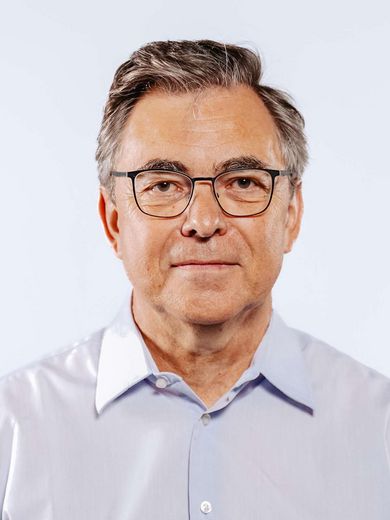
Kai Leonhard is an Adjunct Professor at the Chair of Technical Thermodynamics , RWTH Aachen University. His research focuses on computational chemistry, thermodynamics, and molecular modeling, particularly in solvent design and reactive chemical processes. Department: Chair of Technical Thermodynamics Email: kai.leonhard@ltt.rwth-aachen.de Prof. Leonhard's work integrates quantum chemistry with computer-aided molecular and process design (CAMD/CAPD), emphasizing solvation thermodynamics, reaction kinetics, and machine learning applications. His projects span biofuel combustion, microgel synthesis, and sustainable solvent development. Recent publications highlight advancements in COSMO-RS-based solvent screening, reaction network exploration via ChemTraYzer-TAD, and multi-fidelity modeling for partition coefficients. He employs machine learning to enhance predictive thermodynamic models and optimize chemical processes.
Prof. Thomas Mussenbrock is a Full Professor (W3) of Applied Electrodynamics and Plasma Technology at Ruhr University Bochum, leading the Applied Electrodynamics and Plasma Technology department within the Faculty of Electrical Engineering and Information Technology. He holds a PhD from Ruhr University Bochum (2004) and habilitation (2009), previously serving as a professor at Brandenburg University of Technology (2016-2020). His research focuses on low-temperature plasmas, nanoelectronics, and plasma modeling, with applications in material processing and energy systems. Education: Bachelor's (1995) Bielefeld University of Applied Sciences Master's (1999) Ruhr University Bochum PhD (2004) Ruhr University Bochum Habilitation (2009) Ruhr University Bochum His research interests include plasma dynamics in atmospheric pressure jets, memristive devices for neuromorphic computing, and energy-efficient plasma processes. Recent work emphasizes CO₂ conversion via plasma jets, electron dynamics in capacitive discharges, and scalable plasma modeling techniques. He collaborates on projects like the TopING doctoral program and plasma catalysis initiatives. Publications span journals and conferences, with a focus on experimental and computational plasma physics. He advises on graduate studies and chairs faculty committees at Ruhr University Bochum.
Prof. Sebastian Kaiser is a full professor at the University of Duisburg-Essen's Institute for Combustion and Gas Dynamics, where he leads research on reactive fluid dynamics since 2011. His academic background includes a Bachelor's from Dartmouth College, Diplomingenieur from RWTH Aachen, and PhD from Yale University, followed by postdoctoral work at Sandia National Laboratories. Research Focus: Kaiser specializes in optical diagnostics for reactive systems with emphases on: High-speed imaging of combustion processes Nanoparticle synthesis via spray-flame techniques Tribology and fluid-structure interactions Engine diagnostics using laser-based methods His work bridges experimental techniques and simulation development for energy and propulsion systems. Publication Trends: Recent articles (2023-2025) demonstrate consistent focus on advanced optical diagnostics applied to combustion systems, nanoparticle synthesis, and engine research. Key methodologies include laser-induced fluorescence, high-speed imaging, and machine learning for fluid dynamics analysis. Awards & Honors: Harding-Bliss Prize for Engineering Excellence (Yale, 2005) SAE Excellence in Oral Presentation Award (2008) NRW Returning Scientists Grant (2010) Professional Affiliations: Member of Society of Automotive Engineers (SAE) and The Combustion Institute, with extensive experimental facilities for reactive flow characterization.
Isnaldi R. Souza Filho is a Junior Professor (Chair of Sustainable Metallurgy) at the French National Centre for Scientific Research (CNRS) , affiliated with the Institut Jean Lamour (UMR 7198), Université de Lorraine . He also serves as Group Leader for Sustainable Synthesis of Materials at the Max Planck Institute for Sustainable Materials since 2021. Education: PhD, MSc, and BSc in Materials Engineering from the University of São Paulo (2016-2019, 2013-2015, 2008-2013). Research Interests: Focus on sustainable metallurgy , particularly hydrogen plasma-based reduction of iron ores and microstructural characterization of Mn-containing steels . His work addresses decarbonization in steel production, scrap-compatible alloy design , and waste valorization (e.g., red mud conversion to green steel). Publication Trends: Recent studies emphasize hydrogen plasma smelting reduction of iron ores, kinetic modeling of reduction processes, and microstructure engineering for enhanced mechanical properties. Collaborative work spans CO2-neutral steelmaking , elemental partitioning , and high-entropy alloy synthesis . Scientific Awards: CAPES Thesis 2020 for Best National Doctoral Thesis in Engineerings II (Brazil) Multiple undergraduate awards (CREA-SP, ABM, Engineering Institute) for top academic performance in 2013 Grants and Affiliations: Affiliated with the Dierk Raabe Lab at the Max Planck Institute and leads the Sustainable Synthesis of Materials group. Research funded by institutions supporting climate-neutral metallurgy and recycling strategies .
Lukas Arnold is a Professor and Head of the Fire Dynamics Division at Forschungszentrum Jülich GmbH, affiliated with the Institute for Advanced Simulation (IAS) and its Civil Safety Research Group (IAS-7). He holds a chair in Computational Civil Engineering at the University of Wuppertal and leads major research initiatives in fire safety science using computational methods. Research Focus: Fire Dynamics Simulation Academic Rank: Professor Key Collaborations: University of Wuppertal, DFG, BMBF His research spans fire dynamics simulation, visibility modeling in smoke environments, and flame spread prediction. He develops advanced numerical methods like CFD-based models and inverse modeling techniques for pyrolysis kinetics, smoke propagation, and material decomposition analysis. His work integrates experimental data from real-scale fires with computational tools to improve evacuation safety and risk assessment. Recent publications highlight his expertise in smoke visibility, PMMA pyrolysis, and GPU-accelerated fire simulations. He supervises PhD students in projects involving TGA experiments, multi-scale modeling, and emergency management systems. Arnold's work has been supported by third-party grants from BMBF, DFG, and State NRW, focusing on AI-driven fire modeling, high-performance computing, and disaster resilience. He organizes bi-annual summer schools on fire modeling and contributes to open-access scientific resources.
Dr. Yolita Eggeler is an Assistant Professor in the Department of Physics at the Karlsruhe Institute of Technology (KIT), leading the LEM (Laboratory for Experimental Materials) research group. Her work focuses on advanced materials science, nanotechnology, and additive manufacturing, with a particular emphasis on laser-based fabrication techniques, thermoelectric materials, and micro/nanostructural characterization. She is affiliated with the KIT Physics Department and collaborates on projects involving energy harvesting, semiconductor devices, and high-temperature alloy behavior. Research interests include: Laser microprinting of semiconductors and metals Thermoelectric generator design and optimization Nanoparticle synthesis and applications High-temperature material degradation and creep mechanisms Recent publications highlight innovations in photothermal laser printing of crystalline materials, novel thermoelectric modules, and core-shell nanocrystal engineering. Her work bridges fundamental materials science with applied technologies like flexible electronics and energy conversion systems. Key collaborations involve advanced TEM analysis for microstructural studies and correlative microscopy techniques. She is actively developing new methodologies for in-situ pyrolysis of 3D-printed materials and exploring AI-driven materials discovery through concept graph analysis. Laboratory facilities include state-of-the-art laser printing systems, electron microscopy setups, and thermal characterization equipment. Her team focuses on translating lab-scale innovations into scalable manufacturing processes for next-generation electronic and energy systems.
Prof. Dr.-Ing. Alexander Pfriem serves as Professor for Chemistry and Physics of Wood as well as Chemical Process Engineering at the University for Sustainable Development Eberswalde (HNEE). Since 2013, he has held the position of Vice President for Research and Transfer, re-elected in 2018 and 2021. He is also Head of the Department of Chemistry and Physics of Wood and previously served as Dean of the Faculty of Wood Research and Wood Technology in 2012. His research interests focus on sustainable wood technologies, including thermal and chemical modification of wood, fire protection systems for wood materials, wood recycling processes, and the development of sustainable composite materials. Pfriem's work bridges fundamental wood science with practical applications in construction, musical instruments, and transportation sectors, emphasizing ecological solutions and resource efficiency. His publication record demonstrates consistent contributions to wood science, with recent work examining carbonized wood layers for fire protection, mathematical modeling of springback in molded wood products, and sustainable alternatives to tropical woods in musical instrument manufacturing. His research shows particular emphasis on the relationship between wood modification processes and resulting material properties. Science and Research in the Field of Environmental Technology from the Friedrich and Elisabeth BOYSEN Foundation (2006) Herbert-Flemming-Price (2003) Prof. Pfriem leads multiple significant research projects including Wood Aging Visualization and Estimation (WAVE), Ecological Fire Protection in Rail Vehicles, Sustainable Functional Integration in Composite Materials (NaFuVer), and development of wood-based chicken coop components. His work often involves interdisciplinary collaboration with research institutions and industry partners to translate scientific findings into practical applications. His laboratory focuses on wood modification technologies, particularly thermal and chemical processes that enhance wood properties while maintaining ecological sustainability. Current research directions include developing sustainable sensor integration in composite materials using chitin-based alternatives to conventional piezoelectric polymers, and creating transparent fire protection coatings that preserve the decorative appearance of wood surfaces.
Prof. Rüdiger Deike is the Chair holder of the Chair of Metallurgy and Forming Technology at the University of Duisburg-Essen. His research focuses on metallurgical processes, raw material markets, recycling technologies, and sustainability in the foundry and steel industries. He leads the Institute for Metal Technologies (ITM), emphasizing innovation in material flow analysis, energy efficiency, and circular economy applications. Key research areas include analyzing global raw material market dynamics, optimizing waste-to-resource systems for foundries, and advancing metallurgical processes for non-ferrous and ferrous alloys. His work integrates numerical modeling of solidification behaviors and process optimization for industrial applications. Publications highlight trends in commodity markets, recycling strategies for valuable materials, and material recovery from industrial byproducts. His interdisciplinary approach bridges technical challenges with economic and environmental sustainability, influencing policy and industry practices. Laboratory and team activities center around the ITM, where research spans experimental and computational methods to address global metallurgical challenges. No specific grants or awards are listed, but his contributions are evident through extensive publication output and institutional leadership.
Univ.-Prof. Dr. Ruth Schwaiger is a Professor at the Research Center Jülich GmbH, affiliated with the Institute of Energy Materials and Devices (IMD-1). Her research focuses on advanced materials science, including structural and functional materials, energy-related materials, and nanotechnology. She leads projects on alloy development, solid-state electrolytes, and mechanical characterization of advanced composites. Her work integrates experimental techniques like nanoindentation, XRD, and in situ pyrolysis with computational modeling to study material behavior under extreme conditions. Recent contributions include studies on recycling solid oxide electrolyzer stacks, nano-lamellar magnet hardening, and high-temperature alloy design. Ruth Schwaiger’s research emphasizes sustainability and material performance optimization, addressing challenges in energy storage, corrosion resistance, and additive manufacturing. She collaborates on open databases (e.g., opXRD) to advance materials informatics.
Dr. Manish Kumar is a Scientist in the Department of Microbial Biotechnology at the Helmholtz Centre for Environmental Research - UFZ in Leipzig, Germany. His research focuses on the Biohybrid Solar Power Plant (BISON) project, working on electrochemical system integration and characterization for sustainable energy solutions that bridge biological and electrochemical components. Dr. Kumar received his Dr. rer. nat. (PhD) from Leibniz Universität Hannover, Hannover School for Nanotechnology, with a dissertation rated 'Very Good.' Prior to his doctoral studies, he earned a Master of Technology with Distinction in Nanotechnology from Pondicherry University and a Bachelor of Engineering in Electronics Engineering from RGPV. His primary research interests center on developing sustainable energy solutions through the intersection of electrochemistry, nanotechnology, and biotechnology. Dr. Kumar specializes in creating advanced materials for energy storage applications, particularly focusing on carbon nanofibers derived from renewable sources like lignin. His work on the Biohybrid Solar Power Plant (BISON) project aims to establish electrochemical configurations with low cost and high energy efficiency for solar energy conversion. His research bridges the gap between material science and biological systems to create innovative solutions for renewable energy challenges, with particular emphasis on microbial electrochemical technologies. Analysis of Dr. Kumar's publication record reveals a strong progression from fundamental materials synthesis to applied research on biohybrid systems. His work consistently explores the use of renewable precursors like lignin to create carbon-based nanomaterials for energy storage. Over time, his research has evolved toward more integrated approaches that combine microbial systems with electrochemical devices, reflecting the growing importance of sustainable bioprocesses in energy technology development. Dr. Kumar has received the Society for Biomaterials Award from Charlotte, NC, USA, recognizing his contributions to biomaterials research, particularly his work on protein immobilization using electrospun fibers which has important applications in biosensors and biomedical devices. As a Scientist at UFZ, Dr. Kumar contributes significantly to the Systems Biotechnology research group's mission of sustainable production of chemicals and green energy carriers. His expertise in electrochemical systems and materials science supports the group's work on manipulating redox balances and developing microbial electrochemical technologies. His current involvement in the BISON project demonstrates his role in substantial research initiatives focused on renewable energy solutions and biohybrid technology development. Dr. Kumar works within the Systems Biotechnology group at UFZ, which employs an interdisciplinary approach combining quantitative physiology, systems metabolic engineering, and microbial electrochemical technologies. The group works with photoautotrophic cyanobacteria as 'farmers' to provide redox power and organic carbon, and metabolically engineered microbes as 'laborers' for production. His research on electrochemical integration directly supports the group's four-pillar approach that includes modeling of metabolism, advanced analytics, in-depth physiology studies, and microbial electrochemical technologies.
Martin Wittmaier is a Professor and Head of the Institute for Energy and Circular Economy at Bremen University of Applied Sciences. His work focuses on the integration of renewable energy systems, circular economy strategies, and waste management technologies. Affiliation: Bremen University of Applied Sciences, Institute for Energy and Circular Economy. Research Interests: Energy transition, AI-driven waste recycling, biogas systems, and resource efficiency in rural and developing regions. Recent Research Trends: Wittmaier’s recent publications emphasize the application of AI and robotics in waste sorting, climate impact allocation in circular systems, and decentralized energy generation from organic waste. His projects address practical challenges in renewable energy implementation, phosphorus recovery, and hydrogen-based industrial solutions. Project Leadership: He leads initiatives such as Heat Transition in Rural Areas (2025–2027), Pyrolysis of Wind Turbine Rotor Blades (2023–2026), and Green Hydrogen Shunting Locomotives (2022–2024), demonstrating his commitment to scalable, sustainable technologies.
Prof. Peter Quicker is a Professor at RWTH Aachen University and holds the position of Speaker at the Research College VERBUND.NRW. His research focuses on thermal processes and emission reduction in the waste disposal and recycling industry. He specializes in waste-to-energy technologies, chemical recycling of plastics, and sustainable material recovery systems. Key research areas include gasification of biomass, CO2 conversion, and the thermal treatment of hazardous materials like carbon fiber composites. His work addresses challenges in recycling technologies, energy efficiency, and environmental impact mitigation. Recent publications highlight advancements in waste management strategies, circular economy frameworks, and innovative thermal processes for resource recovery. Notable contributions include studies on nitrogen-free co-gasification, oxygen-enriched wood chip gasification, and phosphorus recovery from sewage sludge. Prof. Quicker collaborates with industry partners to develop scalable solutions for waste valorization and has contributed to policy discussions on sustainable waste practices in Germany and Europe. His interdisciplinary approach bridges engineering, environmental science, and policy to advance sustainable resource management.
Dr. Haipeng Li is a Research Fellow at the Institute of Materials Science , Faculty of Engineering , Christian-Albrechts-Universität zu Kiel . He holds a PhD from the University of Bremen (2021) and completed postdoctoral work at the Karolinska Institutet (2020–2024) before joining Kiel University. His research focuses on applying Surface-Enhanced Raman Scattering (SERS) biosensors for food safety diagnostics , aiming to prevent foodborne illnesses through rapid pathogen detection. His expertise spans nanomaterial synthesis , plasmonic sensor technology , and optical diagnostics . Recent work emphasizes commercializing SERS biosensors via aerosol self-assembly techniques and flame-based nanoparticle fabrication. His projects integrate food safety , healthcare technology , and advanced materials engineering . Scientific awards include the KiTE Fellowship at Kiel University, supporting his postdoctoral research. His publications highlight innovations in nanoparticle synthesis , combustion dynamics , and light-based diagnostic tools , with applications in energy storage and environmental monitoring .
Dr. Corina Janzer is a Research Fellow at the Karlsruhe Institute of Technology's Institute for Chemical Technology and Polymer Chemistry. She specializes in high-temperature kinetic measurements, analytical methods (mass spectrometry), and alternative fuel development for transport/aviation/rocket applications. Her work focuses on emission control (NOX), polymer combustion safety with phosphorous flame retardants, and chemical kinetic mechanism optimization. Education Background: PhD (Dr. rer. nat.) in Chemistry, Karlsruhe Institute of Technology (2014–2017) Diploma in Chemistry, Karlsruhe Institute of Technology (2008–2014) Research Interests: Combustion Chemistry: High-temperature reaction kinetics, green propellant development (ethane/ethene-nitrous oxide mixtures as hydrazine substitutes) Emission Control: NOX/NO₂ formation mechanisms and exhaust aftertreatment optimization Material Safety: Flame retardant polymer combustion dynamics Modeling: Reduced chemical kinetic mechanisms for CFD simulations Publications Trends: Recent work emphasizes green propulsion systems, NO₂ control in lean-burn engines, and urea-water solution decomposition models. Key areas include reaction mechanism validation and alternative fuel feasibility studies. Scientific Awards: None explicitly mentioned in provided texts. Advising & Grants: Senior Scientist roles at KIT (2021–present), DLR (2018–2021), and IPC (2014–2021) Contributed to interdisciplinary projects involving combustion analysis, catalysis, and aerospace propulsion Labs/Teams: Active member of the Deutschmann group, collaborating with institutions like the German Aerospace Center (DLR) on advanced combustion and propulsion research.
Dr. Patrick Lott is a Deputy of the Chair of Chemical Technology and Senior Scientist at the Karlsruhe Institute of Technology (KIT), leading the 'Catalytic Reactors' group. His research focuses on sustainable technologies for reducing pollutants, hydrogen production, and carbon capture, with expertise in catalytic reactor design and heterogeneous catalysis. He holds a PhD from KIT (2019) and has authored over 40 peer-reviewed articles. Awards include the FCTKA Award (2023) and VAA Foundation Excellence Award (2020). His academic career includes roles as Visiting Researcher at the University of Houston (2019) and Junior Scientist at KIT (2016–2019). Research interests span methane oxidation catalysts, pyrolysis processes, and emission control for natural gas and hydrogen engines. Key projects include techno-economic assessments of carbon capture via pyrolysis and spatiotemporal analysis of catalytic reactor performance. Education: PhD in Chemistry (2019), KIT M.Sc. Chemistry (2016), KIT B.Sc. Chemistry (2014), KIT Research Highlights: Development of catalysts for methane oxidation and pyrolysis Dynamic reactor operation for low-temperature emissions Automated microkinetic modeling for heterogeneous reactions Awards: FCTKA Award 2023 VAA Foundation Excellence Award 2020 Dr. Lott collaborates extensively with automotive industries and institutions on emission control systems. His lab combines experimental, numerical, and in-situ characterization methods to advance catalyst design and decarbonization technologies.