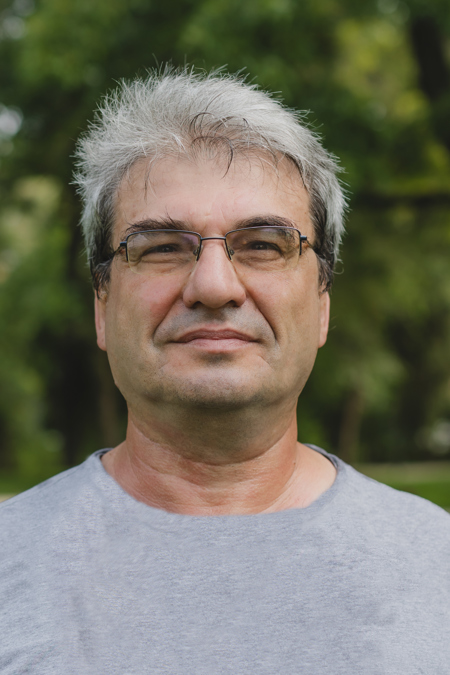
Michael Shapiro is a Professor in the Department of Mathematics at Michigan State University (MSU), located in Wells Hall. His research focuses on cluster algebras, quiver mutations, and integrable systems, particularly the classification of quivers of finite mutation type. He collaborates extensively, including with Michael Gekhtman and Alek Vainshtein, and has developed computational tools like quiver.cpp and min_inf.cpp to analyze mutation classes. He holds a M.Sci. and Ph.D., with his work appearing in top journals and arXiv preprints. His teaching includes MTH 864 (Spring 2009), and he maintains a research page detailing his contributions to cluster algebra dynamics, directed networks, and Coxeter-Toda flows. His publications explore exotic cluster structures on SL_n and generalized Bäcklund-Darboux transformations, reflecting his expertise in algebraic and geometric combinatorics.
Chris Woodward is a Distinguished Professor and Chair of the Department of Mathematics at Rutgers University (New Brunswick). He maintains an active research program in symplectic and algebraic geometry, Lie theory, gauge theory, and mathematical physics. Woodward serves as an associate editor for Selecta Mathematica and organizes the Rutgers symplectic seminar, which focuses on current developments in symplectic geometry. Woodward's research primarily centers on symplectic geometry with particular emphasis on Floer theory, mirror symmetry, and connections to mathematical physics. His work bridges geometric analysis with algebraic structures, exploring deep connections between symplectic topology and quantum field theory. He has made significant contributions to understanding the mathematical structures underlying string theory through rigorous geometric frameworks, with recent work focusing on immersed Lagrangians, tropical geometry applications, and quantum cohomology. Analysis of Woodward's recent publications reveals a cohesive research trajectory with increasing sophistication in handling complex geometric structures. His work consistently explores the connections between symplectic geometry, algebraic geometry, and mathematical physics, demonstrating how techniques from one field can solve problems in another. Recent papers show particular innovation in extending Floer theory to immersed settings and developing connections between tropical geometry and symplectic topology. Woodward has advised numerous graduate students who have secured positions at Stanford University, Pennsylvania State University, Yale University, and Columbia University His undergraduate research mentorship program has produced students who continued to top graduate programs He has mentored junior faculty members including Matt Leingang (now at NYU), Eduardo Gonzalez (now at University of Massachusetts Boston), and Yuhan Sun (now at Imperial College) Woodward leads the Rutgers symplectic geometry research group and has organized significant workshops including the Recent Developments in Lagrangian Floer theory workshop at the Simons Center for Geometry and Physics (held in March 2022 after pandemic delay) and is co-organizing a workshop at Harvard's CMSA in Fall 2026 with Denis Auroux and Jonny Evans. His research group maintains strong connections with international symplectic geometry communities.
Professor Vallipuram Muthukkumarasamy is an Associate Professor at the School of Information and Communication Technology at Griffith University, where he has pioneered Network Security teaching and research since joining in 2001. He leads the Networking & Security and Blockchain Research Group at the Institute for Integrated and Intelligent Systems. Muthu holds a Ph.D. from Cambridge University and a B.Sc. Eng. with 1st Class Honors from the University of Peradeniya, Sri Lanka. His extensive academic appointments include Group Leader of Network Security and Blockchain Research (2008-present), Program Director for the Graduate Certificate in Blockchain Technology (2022-present), HDR Convenor (2022-present), Member of the University Council (2020-2021), and Deputy Head of School for Learning and Teaching (2013-2016). Muthu's research expertise spans Cyber Security, Blockchain Technology (DLT), and Wireless Sensor Networking. He has secured national and international funding for interdisciplinary research, published over 150 articles in international journals and conferences, and supervised more than 30 research Masters and PhD students to completion. He pioneered the Network Security teaching at Griffith and successfully proposed and led the development of Queensland's first Master of Cyber Security Program, creating a truly interdisciplinary curriculum with Law, Business, and Criminology Schools. His recent publications reveal a strong research trajectory in blockchain applications, security visualization techniques, and wireless sensor networks. His work explores DeFi user behavior analysis, NFT privacy risks in the metaverse, blockchain transaction visualization, and the integration of blockchain with AI for credit scoring systems. His wireless sensor network research focuses on energy-efficient routing protocols and network lifetime modeling. Muthu has received multiple best teacher awards from students and peers, and during his tenure as Deputy Head of School, the Griffith IT program was ranked #1 in Australia for overall student satisfaction. He successfully proposed and developed Cisco-related courses at undergraduate and postgraduate levels and instrumental in creating industry-sought-after networking and security courses across all academic levels. His funded research includes significant projects such as Increasing the South East Queensland Cyber Security Workforce, Linking Digital Payments to Crime Using Big Data Machine Learning Tools, Improving Water Markets through Digital Technologies, and developing Indo-Australian partnerships for digital transformation through blockchain. He is actively involved in community and charity activities and has been instrumental in internationalization efforts for Griffith University.
Ibrahim RADWAN is an Associate Professor in Machine Learning/AI and Robotics at the University of Canberra. His research focuses on advancing AI techniques in areas such as human pose estimation, affective computing, and healthcare technology. He leads projects addressing challenges in robotics, autonomous systems, and human behavior analysis. RADWAN’s work bridges theory and application, contributing to fields like sports science, medical diagnostics, and security through innovative machine learning approaches. Research Projects: Assistive Technologies for Young People Safety on Two-Wheelers AI-Based Methods for Driver Sentiment and Mood Prediction Robotics Applications in Organic Waste Management Research Interests: RADWAN’s expertise spans human pose reconstruction , nonverbal behavior analysis , and EEG-based healthcare diagnostics . He pioneers methods for real-world applications such as: 6G Extended Reality systems using wearable sensors Multimodal deception detection via motion analysis Affective computing for mood and emotion inference Publications: His recent work emphasizes trends in spatiotemporal data analysis, few-shot learning, and synthetic data applications in healthcare and robotics. Key contributions include novel architectures like CrossFormer for 3D pose estimation and Resanet for dense prediction tasks. Advising & Grants: RADWAN supervises PhD students and has secured grants for projects integrating AI with robotics and medical technology. His team collaborates on interdisciplinary challenges, including railway safety and surgical instrument tracking. Labs/Teams: Part of the AI and Robotics research group at the University of Canberra, contributing to cutting-edge solutions in autonomous systems and human-centered AI.
Christopher Woodward is a Professor of Mathematics and Acting Department Chair at Rutgers University . His research focuses on symplectic and algebraic geometry , moduli spaces , Lie groups , and mathematical physics . He actively contributes to Floer theory , quantum cohomology , and symplectic topology , with recent work on Lagrangian surgery and tropical Lagrangians . Woodward has mentored numerous PhD students and postdocs , including Yuka Taylor , Sikimeti Mau , Reza Rezazadegan , and Yuhan Sun . He serves as an associate editor for Selecta Mathematica and organizes academic events like the Rutgers symplectic seminar and workshops on Lagrangian Floer theory at institutions such as the Simons Center and Harvard's CMSA .
Prof. Bernd Domer is an Associate Professor at the Geneva School of Landscape, Engineering and Architecture (HES-SO) specializing in Building Information Modeling (BIM) , Geographic Information Systems (GIS) , and digital transformation of civil engineering . He leads multiple ongoing research projects including CU_OFROU_PAB (CHF278,844) focused on BIM-GIS workflows for noise barriers, and SousEtoile (CHF50,000) developing subsurface prediction models for urban planning. His work addresses critical challenges in software interoperability and point cloud processing for infrastructure digital twins. BA HES-SO in Architecture (HEPIA) BSc Civil Engineering (EPFL) BSc HES-SO in Civil Engineering (HEPIA) MSc HES-SO in Engineering (HES-SO Master) His research explores digital workflows for infrastructure projects, with over 15 recent publications examining topics like: Semantic segmentation of point clouds (2024) IFC standard optimization (2023) Underground confidence level modeling (2021) Swiss BIM implementation frameworks (2020) Construction waste management platforms (2018) He serves as Head of the MIC Group and co-directs the CAS in BIM Coordination . Active in international committees like EG-ICE and Bauen digital Schweiz , his work bridges academic research with practical implementation through collaborations with HEPIA , HEIG-VD , and institutions like the Swiss Federal Roads Office (OFROU) .
Anuj Pathania serves as an Assistant Professor in the Parallel Computing Systems (PCS) group within the Informatics Institute at the University of Amsterdam's Faculty of Science. His research pioneers sustainable computing systems operating under severe power, thermal, and reliability constraints, with significant contributions to energy-efficient hardware design and embedded systems. Education: PhD in Computer Science (2018), Karlsruhe Institute of Technology MSc in Computer Science (2012), National University of Singapore B.Tech in Computer Science (2009), Maharaja Agrasen Institute of Technology Pathania's research centers on low-power design and sustainable systems for constrained environments, with particular expertise in thermal management of 3D-stacked architectures and energy-efficient machine learning inference . His work bridges electronic design automation with real-world reliability challenges, developing novel power budgeting techniques like T-TSP that incorporate transient temperature effects ignored by conventional methods. Current projects include EU-funded initiatives on energy labeling for digital services, addressing ecological impacts through technological, behavioral, and legal frameworks. His publication trajectory reveals a strategic evolution toward zero-waste computing , with recent work (2023-2025) focusing on hardware-software co-design for edge AI, energy modeling across computing continua, and parameter-efficient neural adaptation. Key themes include thermal-aware scheduling for S-NUCA many-cores, cooperative processor utilization in heterogeneous systems, and sustainability metrics for digital services. Scientific Recognition: Best Paper Award Nomination at IEEE Computer Society Annual Symposium on VLSI 2023 for 3D-TTP power budgeting technique Pathania actively mentors 4 PhD students (Ehsan Aghapour, Saeedeh Baneshi, Sudam Wasala, Yixian Shen) and has successfully supervised 5 Master's theses (including Cum Laude defenses by Joris op ten Berg and Jurre Wolff). His research is supported by major grants including Energy Labels for Ecologically Sustainable Digital Services (2023-2024) and Towards Zero-Waste Computing (2021-2025), developing simulation frameworks like HotSniper and CoMeT for thermal analysis. The PCS group maintains strong industry collaborations with ARM and NVIDIA, particularly through tools like ARM-CO-UP for heterogeneous processor utilization.
Denis Auroux is the Herchel Smith Professor of Mathematics at Harvard University, succeeding roles at MIT and UC Berkeley. His research focuses on symplectic geometry, low-dimensional topology, and mirror symmetry. He has held significant academic positions including C.L.E. Moore Instructor at MIT, Professor at UC Berkeley, and visiting roles at institutions like the Institut Henri Poincaré and IHÉS. Auroux has supervised numerous PhD students, mentored postdoctoral researchers, and received prestigious awards such as the Alfred P. Sloan Fellowship and the Prix Peccot. Education: Baccalauréat (1991), École Normale Supérieure (1993), PhD in Mathematics from École Polytechnique (1999), and Habilitation à Diriger les Recherches (2003). Teaching experience spans over 25 years at MIT, UC Berkeley, and Harvard, covering multivariable calculus, algebraic topology, and advanced topics in symplectic geometry. Research grants include NSF funding for projects on Fukaya categories, Lagrangian submanifolds, and homological mirror symmetry. His work has been published in top journals like Inventiones Mathematicae and Annals of Mathematics. Notable contributions include foundational results on Lefschetz fibrations, mirror symmetry for Fano varieties, and Fukaya category constructions. Administrative roles include co-chairing UC Berkeley's strategic planning and serving on editorial boards such as the Journal of Symplectic Geometry and Mathematische Annalen. He organizes conferences and workshops on mirror symmetry and symplectic geometry globally, fostering collaboration in the field.
Dr. Graeme Peter Desmond Wilkin is a Lecturer in Pure Mathematics at the University of York, where he serves as Undergraduate Admissions Officer for the Department of Mathematics. He completed his undergraduate studies at the University of Melbourne and earned his PhD from Brown University in 2006. Prior to joining York, he held academic positions at Johns Hopkins University, the University of Colorado, and the National University of Singapore. His educational background includes: Undergraduate studies at the University of Melbourne PhD from Brown University (2006) Dr. Wilkin specializes in the topology and geometry of moduli spaces that arise in gauge theory, with particular focus on Higgs bundles and quiver varieties . His research employs diverse techniques from differential geometry, geometric analysis, algebraic geometry, and representation theory, with special emphasis on Morse theory and geometric flows . His work has significant connections to theoretical physics, particularly in areas related to quantum field theory and string theory. Analysis of his recent publications reveals a consistent focus on the geometric and topological properties of moduli spaces, with increasing attention to the analytical aspects of Morse theory on singular spaces. His research demonstrates strong connections between pure mathematics and theoretical physics, particularly in how geometric structures relate to physical phenomena. While maintaining a strong theoretical foundation, his recent work shows growing interest in computational aspects of these complex geometric structures. Dr. Wilkin actively supervises graduate students and has secured multiple research grants. His current project "Geometry of very stable and wobbly bundles" runs from October 2024 to September 2025. Previous projects include "Algebraic and Analytic Methods in Gauge Theory" and "Geometry and Topology of Singular Spaces." Principal Investigator on "Geometry of very stable and wobbly bundles" (2024-2025) Principal Investigator on "Algebraic and Analytic Methods in Gauge Theory" (2024) Researcher on "Geometry and Topology of Singular Spaces" (2018-2019) He is an active member of the "Geometry and Analysis" research group at the University of York and frequently participates in international conferences and collaborative research projects across multiple countries. His upcoming activities include organizing the "New Frontiers in Gauge Theory, Topology and Physics" conference scheduled for September-October 2026.
Camilo Mora is a Professor in the Department of Geography at the University of Hawaii at Manoa, where he maintains an active research laboratory and teaches courses on environmental issues, biogeography, and data analysis. His academic journey began with a BSc in Marine Biology from Universidad del Valle in Colombia (1999), followed by a PhD in Biology from the University of Windsor, Canada (2005). He completed postdoctoral fellowships at the University of Auckland (2005), Scripps Institution of Oceanography (2006-2008), and Dalhousie University (2008-2010). BSc, Marine Biology, Universidad del Valle, Colombia (1999) PhD, Biology, University of Windsor, Canada (2005) Postdoctoral Fellow, University of Auckland (2005) Postdoctoral Fellow, Scripps Institution of Oceanography (2006-2008) Postdoctoral Fellow, Dalhousie University (2008-2010) Mora's research spans interconnected lines focused on understanding biodiversity patterns and their modification by human activities, with particular emphasis on climate change impacts. His lab specializes in big data analytics applied to diverse environmental challenges including heatwaves, disease transmission, marine ecosystems, and even unconventional topics like Bitcoin's environmental footprint. The Mora Lab operates on a 'divide and conquer' approach to tackle large research questions by breaking data gathering into individual parts that can be concatenated into central databases. Mora has received the CSS Excellence in Research award (2014) for his significant contributions to environmental science. His influential publications include groundbreaking work on the global risk of deadly heat (2017), the projected timing of climate departure from historical variability (2013), and the finding that over half of known human pathogenic diseases can be aggravated by climate change (2022). CSS Excellence in Research (2014) Highly cited publications in Nature and Nature Climate Change Research featured in major international media outlets Development of innovative research methodologies for large-scale analyses Mora leads an active research group that engages students in the full scientific process from idea generation to publication. His approach to mentoring involves creating yearly classes where graduate students, professors, and international advisors collaborate to tackle significant research questions, with papers typically completed within a single semester. His Carbon Neutrality Challenge project, spearheaded by his daughter Asryelle Mora, provides a practical mechanism for individuals to offset carbon emissions through tree planting. The Mora Lab maintains a distinctive approach to environmental research, working on seemingly diverse topics from reef fishes to Bitcoin, united by their reliance on big data analytics. This interdisciplinary methodology has produced impactful research across multiple domains of environmental science and climate change impacts, establishing Mora as a significant contributor to our understanding of humanity's environmental challenges.
Dr. Alexandra Fedorova is a Professor in the Department of Electrical and Computer Engineering at the University of British Columbia (UBC), with an Associate Member role in the Computer Science department. She leads the Systopia systems research group, focusing on system software design, memory/storage management, and accelerator-centric computing. Her work emphasizes performance optimization, energy efficiency, and hardware-software co-design. She holds a PhD from Harvard University (2006), where she researched operating system scheduling under Margo Seltzer. Prior to UBC, she was an Associate Professor at Simon Fraser University (2006–2015). Fedorova is a recipient of the Alfred P. Sloan Research Fellowship and the Anita Borg Early Career Award. She consults for MongoDB's storage engine team and collaborates with industry on storage and performance challenges. Her research spans tools like Non-sequitur for program trace visualization, studies on storage-class memory (e.g., Optane), and frameworks for GPU acceleration. Recent efforts include Sunstone (spatial accelerator scheduling) and ExtMem (application-aware memory management). Her work bridges low-level systems with high-performance computing needs. Key contributions include optimizing NUMA systems, improving storage engine performance, and exploring processing-in-memory architectures. Fedorova’s projects often involve open-source collaboration, reflected in her GitHub repositories such as vividperf and perf-logging , which support performance analysis tools.
Jesus Garcia Falset is a Full Professor in the Department of Mathematical Analysis at the Faculty of Mathematics, University of Valencia, Spain. He has been an active researcher since the early 1990s, with a primary focus on nonlinear functional analysis and fixed point theory in Banach spaces. Doctorate: University of Valencia (1990), thesis on Banach spaces and fixed point properties. Position: Catedrático de Universidad (Full Professor). Department: Mathematical Analysis. Faculty: Faculty of Mathematics. Email: jesus.garcia@uv.es. Homepage: https://www.uv.es/garciaf/ . His research lies at the intersection of functional analysis, operator theory, and differential equations. Key interests include fixed point theory for nonexpansive and generalized nonexpansive mappings, geometric properties of Banach spaces (such as uniform nonsquareness and normal structure), measures of noncompactness, accretive operators, and nonlinear semigroups. He has made significant contributions to the understanding of conditions under which Banach spaces possess the fixed point property. His work often involves the application of topological and geometric methods to prove existence results for differential and integral equations in infinite-dimensional spaces. The 15 most recent articles highlight a consistent research trajectory in nonlinear functional analysis. They explore fixed point theorems for various classes of mappings (pseudocontractive, multivalued, generalized nonexpansive), the role of measures of noncompactness, and applications to differential equations in Banach spaces, including models for cell population growth. There is a strong emphasis on existence, uniqueness, and well-posedness of solutions using abstract functional-analytic frameworks. While specific scientific awards are not mentioned in the provided text, his extensive publication record (66 publications, including a book), high citation count (over 800 citations in zbMATH), and long-standing professorship indicate significant recognition within the mathematical community. Dr. Garcia Falset has supervised or collaborated with several researchers, including notable co-authors like Enrique Llorens-Fuster, David Ariza-Ruiz, Khalid Latrach, and Simeon Reich. His collaborative work spans topics in fixed point theory, differential equations, and operator theory. No specific grants or funding sources are mentioned in the provided information. He is associated with the research group in Mathematical Analysis at the University of Valencia. His work contributes to the theoretical foundations used in mathematical biology and dynamical systems, particularly through the analysis of evolution equations. His homepage and presence in zbMATH, MGP, and Wikidata reflect an active academic profile.
Prof. Allen Knutson is a Professor of Mathematics at Cornell University, affiliated with the College of Arts and Sciences. He earned his Ph.D. from the Massachusetts Institute of Technology in 1996. His research focuses on algebraic geometry, algebraic combinatorics, and geometric representation theory, with an emphasis on Schubert calculus, quiver varieties, and the combinatorial structures underlying geometric problems. Education: Ph.D. (1996) from MIT. His work often involves degenerating complex algebraic varieties into simpler combinatorial pieces, bridging geometry and discrete mathematics. Notable contributions include foundational results in Schubert calculus, honeycomb models, and the use of puzzles in cohomology computations. Research Interests: Algebraic geometry, algebraic combinatorics, Schubert calculus, quiver varieties, geometric representation theory, and applications to integrable systems. His interdisciplinary approach integrates algebraic, geometric, and combinatorial methods to solve problems in mathematics and theoretical physics. Advising: Current students include Portia Anderson, Raj Gandhi, and others. Past advisees have contributed to areas like flag manifolds, Frobenius splitting, and Bruhat atlases. He has taught advanced courses on topics such as symplectic resolutions, differentiable manifolds, and algebraic geometry. Labs/Teams: Collaborates widely, with contributions to projects like the ICM 2022 paper on Schubert calculus and quiver varieties. His work often involves visual tools like puzzles and pipe dreams to encode geometric invariants.
Prof. Dr. Jochen Heinloth is a full Professor at the Faculty of Mathematics, University of Duisburg-Essen, where he leads a research group focused on algebraic geometry, moduli spaces, and algebraic stacks. He is actively involved in teaching, research, and seminar supervision, with a strong presence in both national and international mathematical communities. His research interests include Algebraic Geometry , Moduli Spaces , Algebraic Stacks , Higgs Bundles , and the Geometric Langlands Program . His work bridges abstract category-theoretic constructions with concrete geometric problems, particularly in the context of bundles and representations on algebraic curves. The most recent publications reflect a deep engagement with moduli theory, stability conditions, and geometric representation theory. Trends include the study of the P=W conjecture, support theorems for Hitchin fibrations, and structural results on algebraic stacks. His collaborations with leading mathematicians such as J. Alper, O. García-Prada, and Ngo Bao Chau highlight his central role in modern algebraic geometry. No scientific awards are mentioned in the provided text. Prof. Heinloth advises PhD students and junior researchers, as evidenced by his long-running Seminar on Stacks , where participants present advanced topics in algebraic geometry. He has supervised talks by X. Zhang, M. Zhou, and others, indicating active mentorship. While no grants are explicitly mentioned, his sustained research output and collaborations suggest ongoing funding support. He teaches a wide range of courses, from undergraduate algebra and analysis to advanced topics like Algebraic Geometry and Stacks. He leads the Research Group Heinloth , which organizes seminars and fosters collaboration on stacks, moduli, and related fields. The group hosts regular PhD-level seminars, often in collaboration with other researchers, and maintains a focus on both foundational and cutting-edge topics in algebraic geometry.
Michael Benedikt is a Professor of Computer Science at the University of Oxford and a Governing Body Fellow of University College. He holds the role of Director of the Advanced MSc in Computer Science program. His research focuses on databases, Web data management, logical methods in computer science, and theoretical computer science. Benedikt's work intersects with artificial intelligence, machine learning, and algorithms, with contributions to query languages, data integration, and formal methods. Education: Ph.D. in Mathematics, University of Wisconsin, 1993 Prior roles: Distinguished Member of Technical Staff at Bell Laboratories (1994–2006), visiting researcher at Yahoo! Labs Research Interests: Databases and information exchange Web and Web 2.0 data management Logical methods in computer science Formal verification and query optimization Applications in AI and machine learning Key Projects: FOX : Query-driven data acquisition from web-based sources PDQ : Proof-driven query answering over web-based data TRANCE : Transforming nested collections efficiently Awards: Best Paper Award at ICALP 2017 (Track B) EPSRC Established Career Fellowship (2015–2020) Advising & Grants: Directed the MSc in Advanced Computer Science program Supervised PhD students including Chia-Hsuan Lu and past advisees such as Luying Chen and Ben Spencer Received funding for projects like the ERC DIADEM initiative Labs & Teams: Active in the Department of Computer Science’s research groups, including the Algorithms At Large and Databases teams.